Women's tennis sells itself on power, precision, and poise. The slow-motion replays catch perfect forehands and graceful serves. The still photographs, on the other hand, catch everything the slow-motion skips: faces frozen mid-grunt, bodies bent into impossible angles, and athletic effort so intense that composure leaves the building entirely. Those are the frames in this gallery.
Tennis cameras sit courtside, baseline, and overhead. They fire in continuous bursts — 15 to 20 frames per second — through every point. A three-set match produces upward of 50,000 images. Out of those thousands, a handful capture the split second where a face contorts, a body twists into a shape the sponsorship contract did not account for, or an expression lands somewhere between peak focus and mild horror. Those are the photos in this collection.
Hard courts produce the loudest shoe squeaks and the widest lunges. Grass rewards low slides that send players sprawling. Clay stains every outfit orange by the second set. Each surface creates its own category of athletic absurdity, and the cameras document all of it with equal enthusiasm. No rally is too short to produce a frame that the player would prefer never existed.
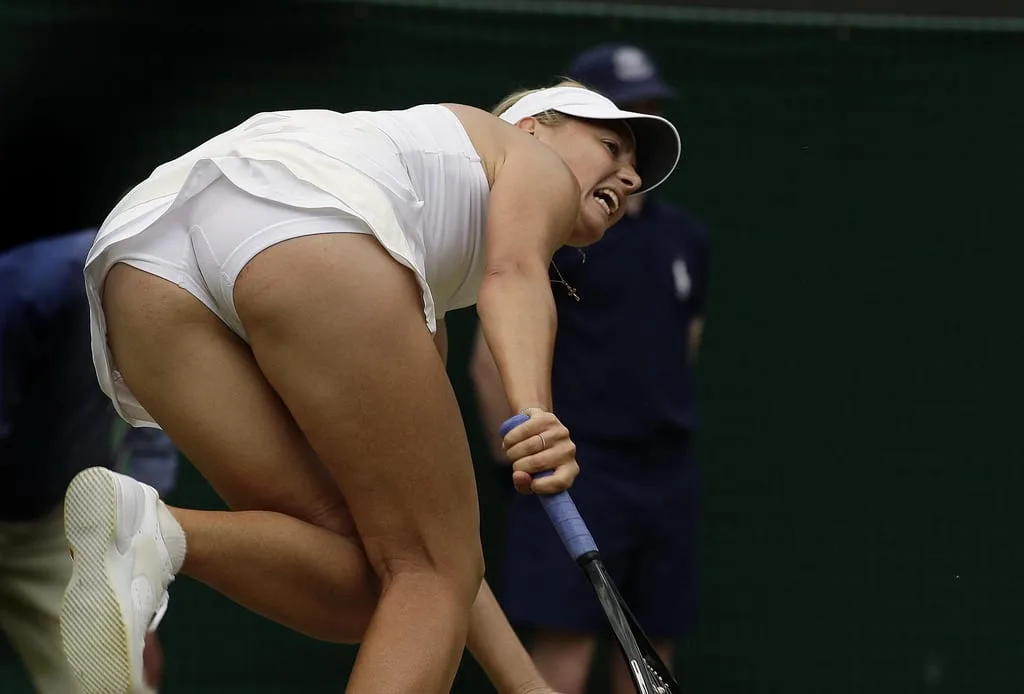
This opener catches a player mid-lunge on grass, racket trailing low, every muscle firing at full intensity. The line judge in the background watches the ball. The photographer watches the expression. The player finished the point, won the game, and found this image circulating in sports media before the post-match press conference started. Here are 30 frames that show what competitive tennis looks like between the highlights.
The serve alone accounts for half the memorable frames in women's tennis. A player tosses the ball, arches backward, and swings through a motion that engages every muscle group from calf to wrist. The whole sequence takes under two seconds. Within those two seconds, the face cycles through concentration, effort, release, and recovery — four distinct expressions compressed into a window shorter than a sneeze. Photographers set their cameras to burst mode during the service motion because the yield per toss is higher than any other shot in the sport. One toss, twenty frames, and at least three of them capture a face the player has never seen in a mirror.
Between points, the cameras keep shooting. Players argue with umpires using hand gestures that belong in traffic disputes. They celebrate aces with fist pumps that carry the force of a full-body spasm. They crouch for returns with the wide-legged stance of someone bracing for an earthquake. None of these positions are designed for still photography, and all of them produce frames that coaches would file under technique and photo editors would file under comedy. Each of the 30 images in this gallery sat in that overlap — a moment where athletic effort and visual absurdity occupied the same frame.