Behind a wall in the middle of Rome sits the smallest country on earth, 44 hectares of basilica, museum and garden that draw more than six million visitors a year. Under the floor of its great church lies the tomb of Saint Peter; above it rises the most studied ceiling ever painted. The Vatican rewards a visitor who understands how it actually works, so this guide covers what to see, the tomb tour few people know how to book, the Pope’s Swiss army, the door that opens once in 25 years, and the practical detail of dress, tickets and timing.
A Country Inside a City
Vatican City is a sovereign state, not part of Italy, created by the Lateran Treaty of 1929. At about 0.49 square kilometres it is the smallest country in the world, yet it runs like one.
- Its own everything: post office and prized stamps, a pharmacy, a supermarket, the world’s shortest national railway, and cash machines that offer Latin as a menu language.
- Diplomacy: the Holy See keeps formal ties with around 180 countries and issues its own passports and euro coins.
- Free to enter: there is no border check and no charge to walk into St Peter’s Square or the basilica. You pay only for the museums and the dome climb.
That statehood makes a souvenir in itself. You can post a card home with Vatican stamps from the yellow boxes by the post office on the square, a small ritual that stamp collectors travel for.
St Peter’s Square and Bernini’s Colonnade
The oval piazza in front of the basilica was laid out by Gian Lorenzo Bernini between 1656 and 1667, and its sweeping double colonnade is meant to feel like two arms gathering the faithful in. It holds 284 travertine columns in four rows, topped by 140 statues of saints.
Two small details reward anyone who knows them. Set into the pavement between the fountain and the obelisk are two round marble discs marked “centro del colonnato”: stand on one and the four rows of columns line up perfectly into a single row. The obelisk at the centre was brought from Egypt by the emperor Caligula and is the only ancient obelisk in Rome that has never toppled or been moved since Roman times.
St Peter’s Basilica
The largest church in the world took more than 120 years to build and gathered the talents of Bramante, Michelangelo and Bernini. Entry is free, though airport-style security can mean a long queue, so arrive early. Inside, the scale is hard to take in: the nave runs 218 metres and Michelangelo’s dome climbs 136 metres over the high altar.
- The Pieta: Michelangelo’s marble of Mary cradling Christ, carved when he was in his twenties, has stood behind bulletproof glass since a man attacked it with a hammer in 1972.
- Bernini’s baldacchino: the towering bronze canopy over the papal altar, cast partly from bronze stripped from the Pantheon.
- The dome climb: a lift takes you to the roof, then 320 steps up the curving inner shell reach the lantern and the best view in Rome.
Our detailed guide to St Peter’s Basilica covers the interior in full.
The Scavi: the Tomb of St Peter Underground
The single most extraordinary thing you can do at the Vatican is the Scavi tour, a guided walk through the Roman necropolis buried beneath the basilica, ending at what the Church holds to be the bones of Saint Peter himself.
It is also the hardest ticket to get, because it is not sold like a normal one. You must apply in advance to the Ufficio Scavi, the Excavations Office, by email, giving your language, dates and group size. Places are limited to small groups of about 12 people, children under 10 are not admitted, no photography is allowed, and the strict dress code applies underground as well. Apply weeks or months ahead, as spots are scarce.
The Vatican Museums
The Vatican Museums hold one of the greatest art collections on earth, built up by popes over five centuries, and a one-way route funnels everyone through roughly seven kilometres of galleries toward the Sistine Chapel. Allow three to four hours and do not try to see it all.
- Gallery of Maps: a 120-metre corridor lined with 16th-century painted maps of Italy under a gilded ceiling.
- Raphael Rooms: four frescoed chambers including the School of Athens.
- Pio-Clementino: classical sculpture, with the Laocoon and the Belvedere Torso.
- Cortile della Pigna: the courtyard of a giant ancient bronze pinecone, with Arnaldo Pomodoro’s slowly turning bronze Sphere Within Sphere at its centre.
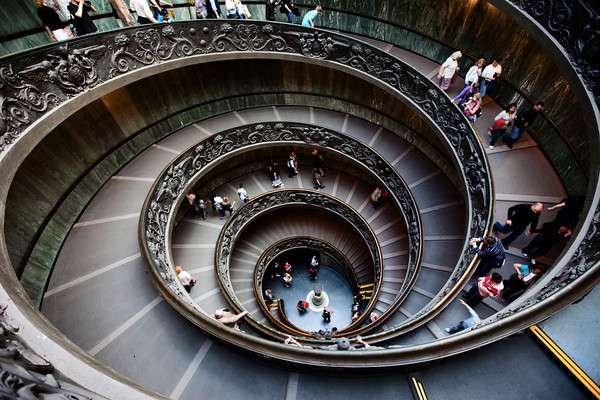
- The spiral staircase: the famous double-helix ramp at the exit was built by Giuseppe Momo in 1932, often confused with Bramante’s original of 1505.
Entry is free on the last Sunday of each month, from morning until early afternoon, which saves the ticket price but draws enormous queues. The rest of the time, book online ahead. See our guide to the Vatican Museums for the full route.
The Sistine Chapel
The route ends in the Sistine Chapel, where Michelangelo painted the ceiling between 1508 and 1512 and, decades later, the Last Judgment on the altar wall. Photography is forbidden and guards call for silenzio to keep the room reverent.
It is not only a chapel but a voting hall. When a pope dies or resigns, the cardinals lock themselves inside for the conclave, burning their ballots after each round so the smoke signals the result: black for no decision, white for a new pope. The most recent conclave met here in 2025. Our page on the Sistine Chapel looks closer at the frescoes.
The Swiss Guard
The soldiers in striped Renaissance uniform at the gates are the Pontifical Swiss Guard, the Pope’s bodyguard since 1506 and effectively the world’s smallest army. The entry rules have barely changed in centuries.
- Who can join: a recruit must be a Swiss citizen, a practising Catholic, unmarried, male, between 19 and 30, at least 1.74 metres tall, and have completed Swiss military training.
- The oath: new guards are sworn in every year on 6 May, the date in 1527 when 147 Swiss Guards died defending Pope Clement VII during the Sack of Rome.
For the full story of the corps, see our guide to the Swiss Guard.
The Holy Door and the Jubilee
On the right as you enter the basilica is the Holy Door, the Porta Santa, which stays bricked up on its inner side and is opened only for a Jubilee, the holy year the Church marks roughly every 25 years.
The most recent Jubilee opened in December 2024 and closed in early January, after which the door was sealed again with a ceremony of mortar and a metal box of coins behind the brick. The next ordinary Jubilee falls in 2050, with a possible extraordinary one in 2033, so for most visitors the door will be closed, a quiet reminder of how the Vatican measures time.
Beyond the Basilica: Gardens and Castel Sant’Angelo
Two further sights round out a visit, both needing a little planning.
- The Vatican Gardens: about half the city state is formal garden, fountains and woodland, open only on a booked guided tour or by minibus, a calm escape from the crowds.
- Castel Sant’Angelo: the round riverside fortress, built as the emperor Hadrian’s tomb, is linked to the Vatican by the Passetto di Borgo, a raised walled corridor down which popes once fled to safety, most famously in 1527.
How to Visit: Tickets, Dress Code and Timing
A little preparation makes the difference between a smooth morning and a wasted one.
- Book the museums ahead: timed online tickets for the Vatican Museums and Sistine Chapel sell out days in advance in high season.
- Dress code: shoulders and knees must be covered, for men and women alike, and it is enforced at the basilica, the museums and the necropolis. Carry a scarf in summer.
- See the Pope: the Wednesday general audience in the square and the Sunday noon blessing are both free; audience tickets come from the Prefecture of the Papal Household, not from touts.
- Time it right: go at opening or late afternoon to dodge the worst crowds, and reckon on three to four hours for the museums alone.
Getting to the Vatican
The Vatican sits on the western bank of the Tiber, about a 25-minute walk from the historic centre of Rome across the river. The nearest metro stop is Ottaviano on Line A, a few minutes from the museum entrance, and several buses and a tram serve the area.
It pairs naturally with the rest of the city, covered in our guide to things to do in Rome, and its role in the country’s faith is set out in our overview of religion in Italy.
Frequently Asked Questions
Is it free to visit the Vatican?
Partly. St Peter’s Square and St Peter’s Basilica are free to enter, as are the Wednesday papal audience and the Sunday blessing. You pay for the Vatican Museums and Sistine Chapel, the dome climb and the Scavi tour, though the museums are free on the last Sunday of each month.
How do you book the tour to St Peter’s tomb?
The Scavi tour of the necropolis is booked only through the Vatican’s Excavations Office, by email, well in advance. Groups are limited to about twelve people, children under ten are not allowed, and it sells out weeks ahead, so apply early with a range of dates.
What is the dress code at the Vatican?
Shoulders and knees must be covered for everyone. Sleeveless tops, shorts and short skirts are turned away at St Peter’s Basilica, the museums and the necropolis, so bring a scarf or a light layer, especially in summer.
Can you see the Pope?
Often, yes. The Pope usually leads a general audience in St Peter’s Square on Wednesday mornings and delivers a blessing from his window at noon on Sundays. Both are free and open to all; audience tickets are issued by the Prefecture of the Papal Household.
When are the Vatican Museums free?
On the last Sunday of every month, when entry is free from the morning until early afternoon. It saves the ticket price but brings very long queues, so arrive well before opening if you go then.
How long do you need at the Vatican?
At least half a day. The museums and Sistine Chapel take three to four hours, and St Peter’s Basilica and the square another couple. Add the dome climb or the Scavi tour and it becomes a full day.
Sources and Further Reading
- Vatican Museums – official tickets, opening hours and the free-Sunday calendar
- Fabbrica di San Pietro, the Necropolis – the Scavi tour and how to apply to the Excavations Office
- Vatican City State – official information on the state, gardens and services
- Pontifical Swiss Guard – recruitment conditions and the 6 May oath
- Jubilee 2025 – the official Holy Year site and the Holy Door
- The Holy See – the Vatican’s official portal and papal audience information