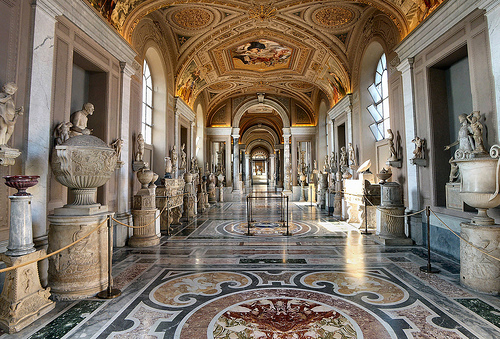
A statue dug from a Roman vineyard in 1506 founded the Vatican Museums. Pope Julius II bought the Laocoon within weeks of its discovery and set it on public view, and the collection grew around that one marble into what is now among the largest and most-visited museums on earth, drawing some six million people a year. Today a single one-way route leads through roughly seven kilometres of galleries to its climax in the Sistine Chapel. This guide covers how the museums work, the masterpieces worth slowing down for, the quieter corners most people miss, and how to get in without losing half a day to the queue, as part of a wider trip to the Vatican.
A Collection Born from One Statue
The Laocoon, a writhing ancient group of a priest and his sons crushed by sea serpents, was unearthed on the Esquiline Hill in 1506. Julius II had it carried to the Vatican within the month and displayed in the Belvedere courtyard, which became one of the first sculpture collections opened to the public.
In the 1770s and 1780s the popes Clement XIV and Pius VI organised the growing hoard of antiquities into a proper museum, the Pio-Clementino, which still carries their names. Napoleon’s armies looted the finest pieces, the Laocoon among them, in 1797, and most were returned only after his fall.
Five centuries of popes kept adding, and the Vatican now holds around 70,000 works, of which some 20,000 are on show at any time. Everyone follows the same fixed, one-way route, so the galleries can feel like a river of people; the trick is to let the crowd flow past and pause at the rooms that matter to you.
The Masterpieces Along the Route
The route strings together collection after collection. These are the stops worth planning around:
- Pio-Clementino: the classical sculpture wing, home to the Laocoon, the Apollo Belvedere and the Belvedere Torso, the battered fragment Michelangelo studied and famously refused to “restore”.
- Gallery of Maps: a dazzling 120-metre corridor of 40 frescoed maps of Italy, painted in the 1580s under a gilded ceiling.
- Gallery of Tapestries: vast woven hangings made to designs from Raphael’s workshop, one of which seems to turn and follow you as you walk past.
- Raphael Rooms: four chambers Raphael frescoed for Julius II, including the School of Athens with its crowd of ancient philosophers.
- The Round Hall: a domed room modelled on the Pantheon, holding a colossal gilded bronze of Hercules and a single porphyry basin nearly thirteen metres around, hauled from the palace of Nero.
- The Pinacoteca: the painting gallery, with Raphael’s last work the Transfiguration, Caravaggio’s Deposition and Leonardo’s unfinished Saint Jerome.
The Pinecone Court and the Spiral Staircase
Two set-pieces frame the visit. The Cortile della Pigna is named for a giant ancient bronze pinecone that once stood near the Pantheon, and at its centre slowly turns Arnaldo Pomodoro’s cracked bronze Sphere Within Sphere, a modern note among the antiquities and a favourite photo stop.
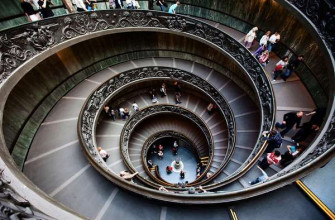
At the exit comes the museums’ most photographed feature, the double-helix spiral staircase built by Giuseppe Momo in 1932, two intertwined ramps arranged so that those going up never cross those coming down. It is often confused with Bramante’s original staircase of 1505, which survives elsewhere in the complex. Most visitors photograph it from the top looking down, where the two ramps tighten into a single shell.
Quieter Corners Worth Finding
Past the headline galleries, several collections stay calm even when the main route is heaving, and they are worth a detour.
- The Egyptian Museum: mummies, painted sarcophagi and statuary gathered by the popes, with genuine Egyptian pieces beside Roman imitations.
- The Etruscan Museum: gold jewellery, bronzes and pottery from the civilisation that ruled central Italy before Rome.
- The Borgia Apartments: a suite of rooms richly frescoed by Pinturicchio for the notorious Borgia pope Alexander VI.
- The Collection of Modern Religious Art: an unexpected set of works by Matisse, Dali, Van Gogh and Francis Bacon, slipped in just before the Sistine.
- The Carriage Pavilion: the popes’ gilded state coaches and the earliest papal cars, down a ramp many visitors walk straight past.
Tickets, Free Days and Timing
The Vatican Museums are the part of the city that needs the most planning, because the queue without a booking can swallow hours.
- Book online ahead: timed tickets sell out days in advance in high season, and a booking lets you walk past the long standby line.
- Free last Sunday: entry is free on the last Sunday of each month, from morning to early afternoon, which saves the fee but draws enormous crowds, so arrive well before opening.
- Friday evenings: in the warmer months the museums open late on selected evenings, a cooler and far calmer way to visit.
- Dress code: shoulders and knees must be covered, the same rule as the basilica, enforced at the door.
Inside, signs point a fast track to the Sistine Chapel for those short on time, but the full route past the maps, the Raphael Rooms and the Pinacoteca is the real reward. There are courtyards to rest in and a cafe halfway, so pace the marathon rather than racing it.
Allow three to four hours and accept that you cannot see everything. The route ends in the Sistine Chapel, and a side door there, usually for guided groups, leads straight into St Peter’s Basilica, saving the long walk back to the square.
When to Visit
Timing the day matters as much as the season inside these galleries.
- Time of day: large tour groups pack the route from mid-morning to early afternoon, while the first hour after opening and the last two hours before closing are noticeably calmer.
- Day of the week: the museums close on Sundays apart from the free last one, which makes the surrounding Saturdays and Mondays busy, so aim for midweek.
- Season: spring and autumn are the most comfortable, while July and August pile summer heat onto the crowds in galleries that are not all air-conditioned.
Frequently Asked Questions
How long do you need in the Vatican Museums?
Three to four hours for the main route to the Sistine Chapel at a steady pace. A focused visit hitting only the highlights can be done in about two hours, while art lovers can easily spend most of a day among the galleries.
Are the Vatican Museums free at any time?
Yes, on the last Sunday of every month, when entry is free from the morning until early afternoon. It is the busiest day to visit, with long queues, so go very early or pay for a timed ticket on another day.
Do the Vatican Museums include the Sistine Chapel?
Yes. The Sistine Chapel is the final room of the one-way museum route and is covered by the same ticket. You cannot visit the chapel on its own.
How do you skip the line at the Vatican Museums?
Book a timed ticket online in advance, which lets you enter at your slot past the long standby queue. Guided tours and early-entry tickets also bypass it, and the free last Sunday is best avoided if you dislike crowds.
Can you take photos in the Vatican Museums?
Yes, throughout the galleries, though without flash and without a tripod. The one exception is the Sistine Chapel at the very end, where all photography and video are forbidden.
What are the essential works to see?
The Laocoon and Apollo Belvedere in the Pio-Clementino, the Gallery of Maps, Raphael’s School of Athens, Leonardo’s unfinished Saint Jerome in the Pinacoteca, and, at the end, Michelangelo’s Sistine Chapel ceiling.
Are the Vatican Museums worth visiting?
For most visitors, yes, even those with no interest in the church. The antiquities, the Raphael Rooms and the Sistine Chapel are of the first rank, and the collection rivals any in Europe. The crowds are the only real drawback, and booking a timed ticket and visiting early or late largely solves that.
Where do the Vatican Museums start and end?
They begin at the entrance on Viale Vaticano, a short walk around the wall from St Peter’s Square and close to the Ottaviano metro stop. The route ends at the Sistine Chapel, from where you leave back near the square, or straight into the basilica if you are on a guided tour.
Sources and Further Reading
- Vatican Museums, official site – tickets, opening hours, free days and the gallery map
- Vatican Museums collections – the individual galleries and their masterpieces
- The Holy See – the Vatican’s official portal
- UNESCO, Vatican City – the World Heritage listing