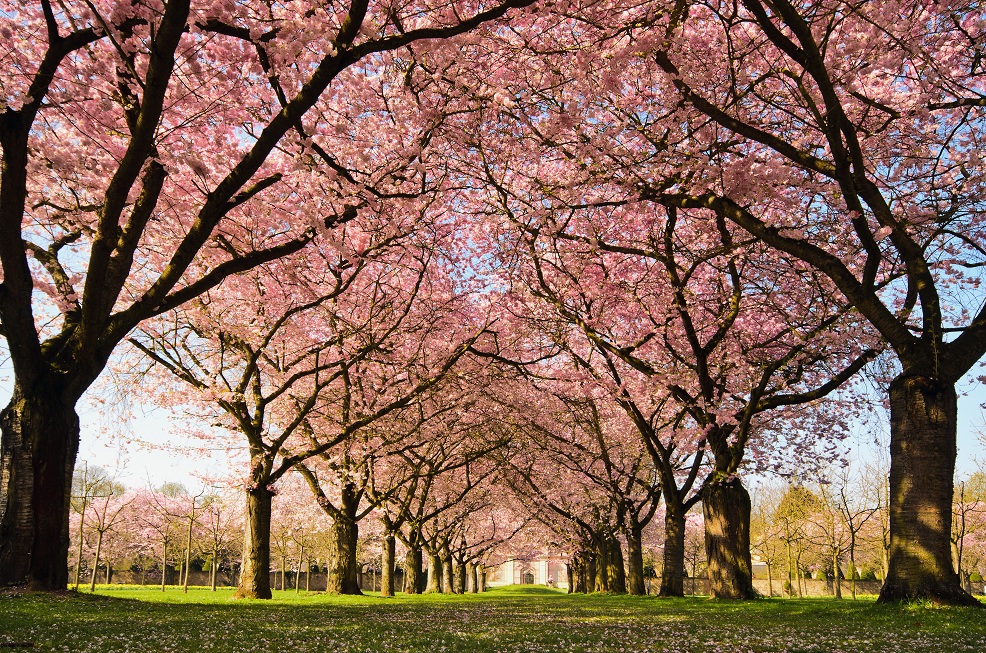
Japan has over 200 cultivated varieties of cherry blossom trees, and roughly 80% of the ones planted in parks, along riverbanks, and beside temple grounds belong to a single cultivar called Somei Yoshino. The trees bloom for 7 to 14 days each spring, triggering a nationwide tradition of outdoor picnics under the blossoms called hanami that dates back over a thousand years. The Japanese Meteorological Agency tracks the “cherry blossom front” (sakura zensen) as it moves north from Okinawa in late January to Hokkaido in mid-May, and national news broadcasts report its progress the way other countries report election results. This article covers the main sakura varieties, the cultural traditions tied to them, and how to grow cherry blossom trees outside Japan.
Sakura Varieties: From Somei Yoshino to Weeping Cherry
The Japan Cherry Blossom Association recognizes nine basic types of cherry trees in the country, with over 100 wild varieties and another 200 cultivated ones. Somei Yoshino dominates the landscape – a hybrid of Edohigan and Oshima-zakura cultivars developed roughly 200 years ago in the Somei district of Edo (present-day Tokyo). Its five-petaled blossoms open as pale pink buds and fade to white within two or three days, creating the effect of a color shift across an entire grove as the flowers age. The tree spreads through grafting rather than seed, which means every Somei Yoshino in Japan is genetically identical – a fact that explains why entire parks bloom and drop their petals within the same narrow window.
Other varieties bloom at different times and in different forms:
- Yamazakura (mountain cherry) – wild species, blooms alongside reddish-bronze new leaves, found across Japan’s mountain forests
- Shidarezakura (weeping cherry) – drooping branches that form canopies of pink and white, among the longest-lived varieties at 300+ years for some specimens
- Kanzan (double-flowered) – deep pink blossoms with 20 to 50 petals per flower, blooms two weeks after Somei Yoshino, lasts longer
- Kawazu-zakura – early bloomer that opens in February, a full month before Somei Yoshino, popular in the Izu Peninsula
- Ukon – unusual pale yellow-green blossoms, one of the few sakura varieties that does not produce pink or white flowers
- Fugenzo – late-blooming, double-petaled variety with pink flowers that deepen to dark rose before dropping
The Cherry Blossom Front and Blooming Season
Japan’s cherry blossom season runs from late January in subtropical Okinawa through mid-May in northern Hokkaido. The Japanese Meteorological Agency has tracked the sakura zensen (cherry blossom front) since 1951, issuing official forecasts that predict when each region will hit mankai (full bloom) – the point where 80% or more of the buds on a reference tree have opened. Tokyo and Kyoto typically reach full bloom in late March or early April, though warming temperatures have pushed the average date earlier by roughly one week compared to records from the 1950s.
The blooming window for any single tree lasts 7 to 14 days under normal conditions. Cool weather extends the display; warm days, wind, and rain shorten it. The Somei Yoshino variety tends toward the shorter end at 5 to 7 days of peak bloom. Double-flowered cultivars like Kanzan hold their blossoms for up to two weeks. The final stage – hanafubuki, or “petal blizzard” – scatters white and pink petals across paths, rivers, and rooftops, a visual that Japanese poetry has described for centuries.
Hanami: The Tradition of Flower Viewing
Hanami translates to “flower viewing” and refers to the practice of gathering beneath blooming cherry trees to eat, drink, and appreciate the blossoms. The tradition traces to the Nara period (710-794), when court aristocrats held formal viewing parties for plum blossoms. By the Heian period (794-1185), sakura had replaced plum as the preferred flower, and hanami expanded from the aristocracy to samurai and then to commoners during the Edo period (1603-1868).
Modern hanami ranges from casual afternoon picnics to organized corporate parties where junior employees stake out spots under the best trees hours before the group arrives. Parks like Ueno in Tokyo, Maruyama in Kyoto, and Hirosaki Castle in Aomori fill with blue tarps, bento boxes, sake, and beer during peak bloom weekends. Some spots offer yozakura (nighttime cherry blossom viewing), with lanterns and spotlights illuminating the trees after dark.
Hanami food carries its own traditions. Sakura mochi – a pink rice cake wrapped in a pickled cherry leaf – appears in shops during the season. Hanami dango – skewered rice dumplings in pink, white, and green – represent the blossoms, petals, and leaves of the sakura. Seasonal limited-edition drinks, snacks, and cosmetics branded with sakura flavoring and imagery fill Japanese convenience stores and department stores from February through April.
Hanami etiquette carries unspoken rules. Groups spread tarps but keep to their allocated space. Music stays at a volume that does not disturb neighboring parties. Trash gets packed out, and the area is left clean. Corporate hanami often assigns a junior team member to hold the spot from early morning, arriving with tarps and supplies hours before colleagues finish work. In Kyoto’s Maruyama Park, the centerpiece is a massive weeping cherry tree lit by spotlights after dark, and the pathways fill with food vendors selling yakitori, takoyaki, and candied strawberries.
Cultural Symbolism: Mono no Aware and Beyond
The Japanese aesthetic concept of mono no aware – roughly translated as “the pathos of things” or “sensitivity to impermanence” – finds its clearest expression in the sakura. The blossoms matter because they end. A tree that bloomed for months would not carry the same emotional weight as one that peaks for a single week and then scatters. The 18th-century scholar Motoori Norinaga connected mono no aware specifically to cherry blossoms, arguing that the awareness of their transience intensifies the viewer’s emotional response.
Samurai culture adopted the sakura as a symbol of the warrior’s willingness to die at the peak of life rather than fade into decline. This association persisted into the 20th century when the Japanese military used cherry blossom imagery on equipment and insignia. After 1945, the symbolism shifted away from martial associations and back toward renewal – schools and government buildings plant cherry trees to mark institutional beginnings, and the fiscal year and academic year both start in April, coinciding with sakura season.
Cherry blossom imagery saturates Japanese daily life. The 100-yen coin carries a sakura design. Sakura motifs appear in paintings, kimono patterns, lacquerware, and ceramic glazes. The word “sakura” itself serves as a given name for girls born during bloom season, and weather reports treat the first bloom announcement as a seasonal milestone comparable to the first snowfall. Ukiyo-e woodblock prints from the Edo period depict hanami scenes under weeping cherries, and modern manga and anime use falling sakura petals as a visual shorthand for emotional transitions, first meetings, and farewells.
Growing Cherry Blossom Trees Outside Japan
Cherry blossom trees grow in USDA hardiness zones 5 through 9, covering most of the continental United States, southern Canada, and much of Europe. The Yoshino variety (Prunus x yedoensis) needs full sun – a minimum of six hours of direct sunlight per day – and well-drained soil. Clay, loam, or sandy soils all work, provided water does not pool around the roots. The trees are drought-sensitive during their first two to three years and need regular watering until established.
Washington, D.C.’s Tidal Basin holds roughly 3,700 cherry trees, most of them Yoshino, donated by Japan in 1912 as a diplomatic gift. The National Cherry Blossom Festival runs for several weeks each spring and draws over 1.5 million visitors. Other major plantings outside Japan include Jinhae in South Korea (over 360,000 trees), the Botanical Garden of Hamburg, and the Cowra Japanese Garden in New South Wales, Australia.
The lifespan of an ornamental cherry tree ranges from 15 to 30 years for most cultivated varieties, with well-maintained specimens reaching 40 years. Weeping cherries and wild mountain cherries can live much longer – the Miharu Takizakura, a weeping cherry in Fukushima Prefecture estimated at over 1,000 years old, is designated a national natural monument. Pruning after bloom, avoiding overwatering, and treating fungal infections early extend the productive life of garden-planted trees.
Common pests include Japanese beetles, aphids, and borers that attack the trunk of stressed trees. Bacterial canker and brown rot are the primary fungal threats. Gardeners in humid climates should avoid overhead irrigation, since wet foliage encourages fungal growth. The best time to plant a new cherry tree is late autumn or early spring while the tree is dormant. Container-grown specimens transplant with less shock than bare-root stock, especially in regions with unpredictable spring weather. Once established, ornamental cherries require minimal fertilization – a single application of balanced slow-release fertilizer in early spring supports healthy bloom without promoting excessive vegetative growth.
Frequently Asked Questions
How long do cherry blossoms last?
Individual trees bloom for 7 to 14 days under normal conditions. The Somei Yoshino variety, which makes up 80% of Japan’s cherry trees, peaks for 5 to 7 days. Double-flowered cultivars like Kanzan hold blossoms for up to two weeks. Cool temperatures extend the display, while heat, wind, and rain shorten it.
When is cherry blossom season in Japan?
Cherry blossom season runs from late January in Okinawa to mid-May in Hokkaido. Tokyo and Kyoto typically reach full bloom in late March or early April. The Japanese Meteorological Agency issues official forecasts tracking the “cherry blossom front” as it moves northward.
What is hanami?
Hanami means “flower viewing” and refers to the Japanese tradition of picnicking beneath blooming cherry trees. The practice dates to the Nara period (710-794) and evolved from an aristocratic court ritual to a popular activity enjoyed by people across all social classes.
Can you grow cherry blossom trees outside Japan?
Cherry blossom trees grow in USDA zones 5-9, which covers most of the U.S., southern Canada, and much of Europe. They need full sun (6+ hours daily), well-drained soil, and regular watering during the first few years. The Yoshino variety is the most commonly planted ornamental cherry outside Japan.
Sources and Further Reading
- Nippon.com – Japan’s Cherry Blossom Spring: The Beauty and Traditions of Hanami (nippon.com)
- Highlighting Japan – History of Japan’s Unique Cherry Blossom Species and Flower-Loving Culture (gov-online.go.jp, April 2024)
- byFood – What is Sakura: 13 Cherry Blossom Types in Japan (byfood.com)
- Planet Natural – How to Plant, Grow, and Care for Cherry Blossom Trees (planetnatural.com)