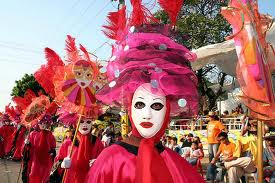
Colombia holds two UNESCO-recognized festivals – the Barranquilla Carnival and the Blacks and Whites Carnival in Pasto – alongside dozens of regional celebrations that reflect the country’s mix of Indigenous, African, and Spanish colonial heritage. The Barranquilla Carnival ranks as the second-largest carnival event in the world by attendance, drawing over 1.5 million people to four days of parades, dance, and music on the Caribbean coast. Medellin’s Flower Festival turns the city’s hillside farms into parade floats carried on the backs of silleteros. Cali’s December fair showcases salsa dancing at a level of technical skill that exists nowhere else on Earth. These festivals are not tourist productions bolted onto a calendar – they grow from community traditions that predate Colombian independence and continue to shape regional identity.
Barranquilla Carnival: Colombia’s Largest Street Celebration
The Barranquilla Carnival runs for four days before Ash Wednesday, typically in February or early March. UNESCO inscribed it as a Masterpiece of the Oral and Intangible Heritage of Humanity in 2003, recognizing the event’s role in preserving Afro-Colombian, Indigenous, and European cultural expressions through dance, music, and costume. The carnival opens on Saturday with the Batalla de Flores (Battle of the Flowers), a parade of floats decorated with tropical flowers that runs along Via 40, Barranquilla’s main processional avenue.
Sunday brings the Gran Parada de Tradicion y Folklore, featuring cumbia groups, mapalé dancers, and comparsa troupes performing choreographed routines in costumes that represent animals, mythological figures, and historical characters. Monday’s Festival de Orquestas shifts the focus to music, with salsa, vallenato, champeta, and cumbia orchestras competing through live performances across the city. Tuesday closes the carnival with the symbolic burial of Joselito Carnaval, a fictional character whose mock funeral procession mourns the end of the celebration with exaggerated weeping and theatrical grief.
The carnival draws its musical energy from cumbia, a rhythm born from the convergence of African drums, Indigenous flutes, and Spanish melody on the Caribbean coast. Cumbia bands march through the streets alongside sound system trucks blasting champeta (an electronic dance genre rooted in African and Caribbean rhythms that originated in Cartagena’s Afro-Colombian neighborhoods). Barranquilla’s working-class barrios organize their own smaller parades (comparsas de barrio) that run parallel to the official route, and participation cuts across income levels – the carnival belongs to the entire city rather than to a paying audience watching from grandstands. Hotels in Barranquilla fill months in advance, and visitors who cannot find city lodging often stay in nearby Santa Marta or Cartagena and travel to the events by bus.
Key Barranquilla Carnival elements:
- Cumbia – Colombia’s defining rhythm, danced with candles, long skirts, and synchronized footwork
- Mapale – a fast-tempo Afro-Colombian dance originating from the Caribbean coast
- Garabato – a dance drama depicting the battle between life and death, performed with scythes and red costumes
- Congo – dancers in animal masks and bright costumes representing African-descended carnival traditions
- Monocuco – hooded figures in capes who anonymously satirize local politicians and social issues
Feria de las Flores: Medellin’s Flower Festival
The Feria de las Flores runs for 10 days in early August, centered on Medellin’s identity as a flower-producing region. The festival dates to 1957, when the city organized the first Desfile de Silleteros (Silleteros Parade) – a procession in which flower farmers from the village of Santa Elena carry enormous wooden frames (silletas) loaded with floral arrangements on their backs. The silletas weigh 30 to 70 kilograms and display designs ranging from traditional symmetric patterns to portraits, landscapes, and political messages composed entirely of cut flowers.
Over 500 silleteros walk the parade route through downtown Medellin, and the event draws roughly 600,000 spectators to the streets. The festival also includes a classic car parade (Desfile de Autos Clasicos), equestrian shows (cabalgata), a Tablado concert series featuring Colombian artists across multiple stages, and the Feria de Orquideas (Orchid Fair) at the Joaquin Antonio Uribe Botanical Garden. Medellin sits in a valley at 1,500 meters elevation, and the surrounding hillsides produce roses, carnations, orchids, and chrysanthemums for both domestic and export markets – the flower industry employs over 130,000 people in the Antioquia department. Colombia ranks as the second-largest flower exporter in the world after the Netherlands, and the Feria de las Flores serves as a public celebration of an industry that generates over $1.5 billion in annual export revenue.
Feria de Cali: Salsa and the December Fair
The Feria de Cali runs from December 25 through December 30, turning Colombia’s third-largest city into an open-air salsa performance space. Cali claims the title of Salsa Capital of the World based on its concentration of salsa schools, professional dancers, and nightclubs (discotecas) that play salsa exclusively. The fair’s centerpiece is the Salsodromo – a 1.5-kilometer stretch of road where salsa schools parade with choreographed groups of up to 500 dancers each, performing routines that take months to prepare.
The Cali Fair also includes concerts (superconcierto) headlined by Colombian and international artists, a cavalcade (cabalgata) of horses and riders through the city center, bullfighting at the Plaza de Toros de Canaveralejo, and community block parties (verbenas) in neighborhoods across the city. Cali’s salsa scene operates year-round – the barrio of Juanchito, across the Cauca River from central Cali, holds dozens of salsa clubs that stay open until dawn – but the December fair concentrates the energy into six days of continuous performance, competition, and celebration.
Carnival de Negros y Blancos: Pasto’s UNESCO Festival
The Blacks and Whites Carnival in Pasto, near the Ecuadorian border, runs from January 2 through January 7 and received UNESCO Intangible Cultural Heritage status in 2009. The festival’s defining days fall on January 5 (Dia de los Negros) and January 6 (Dia de los Blancos). On the Day of the Blacks, participants paint their skin with black cosmetic grease to commemorate a day when enslaved Africans were granted temporary freedom during the colonial period. On the Day of the Whites, everyone covers each other in white talcum powder and foam, symbolizing equality across racial and social lines.
January 6 also features the Desfile Magno (Grand Parade), in which massive floats built from papier-mache, wood, and foam depict satirical, political, and mythological scenes. The float-building tradition in Pasto produces sculptures up to 10 meters tall, constructed by artisan families (artesanos del carnaval) over several months. The carnival’s origins predate the Spanish conquest – elements trace to Indigenous celebrations of the lunar calendar – and it has survived colonial-era bans, independence-era disruptions, and modern security challenges to remain the defining cultural event of the Narino department.
Pasto sits at 2,527 meters elevation in the Andes, and the January weather brings cool temperatures (10-15 degrees Celsius) and occasional rain. Visitors should dress in layers and carry waterproof bags for electronics, since the talcum powder and foam of January 6 cover everything and everyone within reach. The float-building workshops (talleres de carrozas) open to visitors in the weeks before the carnival, offering a behind-the-scenes view of the artisan process. Pasto’s location near the Ecuadorian border also makes it a gateway to the Laguna de la Cocha, Colombia’s second-largest lake, and the Santuario de Las Lajas, a Gothic Revival church built into a canyon face near Ipiales.
Vallenato Legend Festival and Other Regional Events
The Festival de la Leyenda Vallenata runs annually in late April or early May in Valledupar, capital of the Cesar department. Vallenato music – built on accordion, caja drum, and guacharaca (a ribbed percussion instrument) – is Colombia’s most popular folk genre and received its own UNESCO intangible heritage designation in 2015. The festival crowns a Rey del Vallenato (King of Vallenato) through accordion competition across four categories of traditional song form: son, merengue, paseo, and puya.
The Festival Iberoamericano de Teatro in Bogota, held every two years (even years) in March and April, is the largest theater festival in the Western Hemisphere. Over 800 performances across 40 venues bring theater companies from Latin America, Spain, and beyond. The Rock al Parque festival, also in Bogota, fills Simon Bolivar Park with three days of free rock, metal, punk, and alternative music each July, drawing over 300,000 attendees and ranking among the largest free music festivals in Latin America.
The Festival Petronio Alvarez in Cali, held every August, celebrates the music of Colombia’s Pacific coast Afro-Colombian communities – currulao, chirimia, and marimba de chonta rhythms that differ sharply from the Caribbean coast sounds of cumbia and vallenato. The festival honors Petronio Alvarez, a musician from Buenaventura, and draws performers from the remote Pacific lowlands to Cali’s urban stages. The Hay Festival in Cartagena, a literary and ideas festival linked to the Hay-on-Wye original in Wales, runs each January and brings international authors, journalists, and artists to the walled city for four days of talks, readings, and panels.
Frequently Asked Questions
What is the biggest festival in Colombia?
The Barranquilla Carnival is Colombia’s largest festival, drawing over 1.5 million participants across four days. UNESCO inscribed it as a Masterpiece of Intangible Heritage in 2003. It ranks as the second-largest carnival in the world after Rio de Janeiro.
When is the Medellin Flower Festival?
The Feria de las Flores runs for 10 days in early August. The Silleteros Parade, where flower farmers carry floral arrangements weighing 30-70 kg on their backs, is the centerpiece event and draws roughly 600,000 spectators.
What is the Blacks and Whites Carnival in Pasto?
The Carnival de Negros y Blancos runs January 2-7 in Pasto. On January 5, participants paint themselves black to honor the legacy of enslaved Africans granted temporary freedom. On January 6, everyone covers each other in white powder and foam as a symbol of equality. UNESCO recognized the festival in 2009.
Why is Cali called the Salsa Capital?
Cali earned the title through its concentration of salsa schools, professional dancers, and nightclubs dedicated to the genre. The Feria de Cali in late December features the Salsodromo, a 1.5-km parade route where salsa schools perform with groups of up to 500 dancers each.
Sources and Further Reading
- UNESCO – Carnival of Barranquilla, Masterpiece of Intangible Heritage (unesco.org)
- Impulse Travel – Top 10 Colombian Festivals in 2026 (impulsetravel.co)
- Uncover Colombia – Famous Festivals in Colombia (uncovercolombia.com)
- Visit My Colombia – Colombia’s Main Festivals (visitmycolombia.com)