Of the 28 ancient Egyptian obelisks still standing or reassembled today, only 6 remain in Egypt itself. The rest stand in Rome (13), France, the United Kingdom, the United States, Italy beyond Rome, Turkey, and Poland, moved during the Roman imperial period and the 19th-century Egyptomania that followed Napoleon’s expedition. The single tallest standing obelisk, the Lateran Obelisk in Rome, reaches 32.18 metres and weighs approximately 455 tonnes, cut from a single piece of red Aswan granite over 3,000 years ago. This guide covers the construction methods of ancient Egyptian masons, the major surviving obelisks worldwide with their dates and current locations, the three most important obelisks remaining in Egypt, the history of their transportation, and their hieroglyphic inscriptions.
Construction and Purpose in Ancient Egypt
Egyptian obelisks served religious rather than commemorative functions in most cases. The pyramidal top (pyramidion) was sometimes gilded with electrum, a gold-silver alloy, to reflect the sun and symbolise the primordial mound of creation from which the sun god Ra emerged. Pairs of obelisks flanked the entrances to major temples, aligned on east-west axes to frame the rising sun.
Quarrying took place almost exclusively at Aswan in Upper Egypt, where deposits of pink-red granite of unusual hardness and consistency suited the monumental scale. Workers extracted monoliths from the bedrock using dolerite hammer stones and wooden wedges, a process that left deep scars visible in the ancient quarries today.
The Unfinished Obelisk at Aswan, abandoned during quarrying around 1500 BCE during Hatshepsut’s reign, remains in place showing the cracked fault that ended the project. Originally planned at 42 metres and over 1,100 tonnes, it would have been the largest obelisk ever attempted. Modern experimental archaeology at the quarry has reconstructed the cutting techniques using dolerite hammers.
Transport from Aswan to temple sites downstream required Nile barges during the flood season when water levels permitted navigation close to temple landings. Inscriptions at Deir el-Bahari show the obelisks of Hatshepsut being transported on a tandem barge 91 metres long pulled by three teams of galleys.
The Three Main Obelisks Remaining in Egypt
Only 6 ancient Egyptian obelisks remain in Egypt today, and three carry particular historical importance.
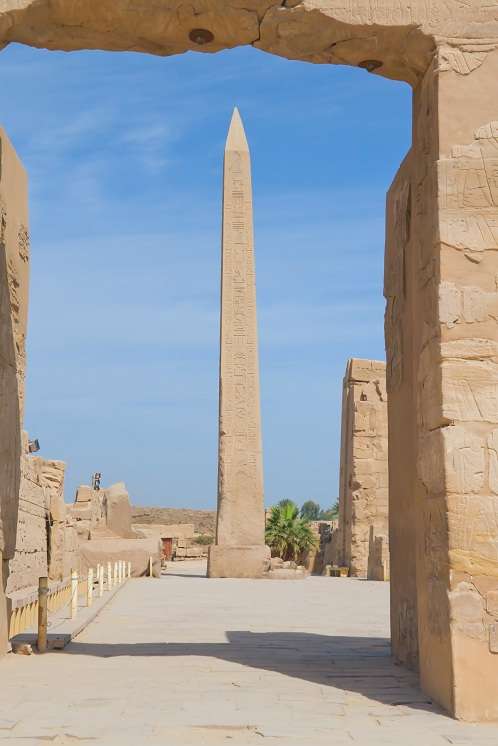
The standing obelisk at Karnak’s Temple of Amun, commissioned by Thutmose I and completed around 1500 BCE, rises 22 metres from its red granite base. A second original obelisk from Thutmose I, its pair, was dismantled after the temple closed and sections survive in pieces at the site.
The Hatshepsut Obelisk at Karnak stands 29.6 metres high, one of the two erected by the female pharaoh around 1457 BCE. Hatshepsut’s other obelisk fell and broke in antiquity, with sections displayed at Karnak’s sacred lake. The standing version remains the tallest obelisk at its original ancient Egyptian site.
The Luxor Obelisk, the eastern of the original pair at the Luxor Temple entrance, commissioned by Ramses II around 1260 BCE. The western pair stands today in Paris as the Luxor Obelisk at Place de la Concorde (see below). The Luxor obelisk is 25 metres tall, slightly shorter than its Paris twin, with both carved from the same quarry around 3,200 years ago.
Rome: Thirteen Obelisks and a Papal History
Rome holds more ancient Egyptian obelisks than anywhere else including Egypt itself. The Roman emperors beginning with Augustus transported obelisks from Egypt as tokens of provincial authority, and medieval popes repurposed several as Christian symbols.
The Lateran Obelisk, standing at San Giovanni in Laterano, is the largest standing Egyptian obelisk anywhere in the world at 32.18 metres. Originally commissioned by Thutmose III around 1450 BCE for Karnak, it was transported to Alexandria by Constantine II in 357 CE and subsequently to Rome where Pope Sixtus V re-erected it in 1588.
The Vatican Obelisk in St Peter’s Square came to Rome under Caligula in 37 CE, originally placed at his circus. Moved to its current position in 1586 under Sixtus V, the obelisk stands 25.37 metres and carries a bronze cross at its peak instead of the original pyramidion. Unlike most other Roman obelisks, it lacks hieroglyphic inscriptions.
The Flaminio Obelisk at Piazza del Popolo came to Rome under Augustus in 10 BCE, along with the Solare Obelisk now at Montecitorio. Both originally stood at Heliopolis. Sixtus V moved the Flaminio in 1589 and Pius VI relocated the Solare in 1792.
Smaller Roman obelisks include those at Piazza Navona (Pamphilj Obelisk, originally from Iseum Campense), Piazza della Minerva (carried by Bernini’s elephant sculpture), and the Trinità dei Monti above the Spanish Steps.
Paris: The Luxor Obelisk at Place de la Concorde
The Luxor Obelisk at Place de la Concorde is the western twin of the Luxor Temple pair commissioned by Ramses II. Muhammad Ali Pasha, the ruler of Egypt, gifted the obelisk to France in 1830 as part of his push to modernise relations with European powers.
Transportation took four years. French engineer Apollinaire Lebas designed a specialised barge, Le Luxor, to carry the 230-tonne monument. The voyage covered the Nile, the Mediterranean, the Strait of Gibraltar, the Atlantic coast, and the Seine, arriving in Paris in 1833. Erection at Place de la Concorde followed in October 1836 under the eye of King Louis-Philippe and a crowd estimated at 200,000 spectators.
The obelisk stands 22.83 metres on a pedestal that depicts the erection machinery used in 1836. The pyramidion was replaced with a gold-leaf reproduction in 1998 to complete the ancient appearance that had been missing since antiquity.
In 1981 French President François Mitterrand formally declared that France would never claim the eastern twin that remains at Luxor, closing any possibility of the pair being reunited in Paris. The gesture was symbolic rather than legally necessary, since Egypt’s modern cultural property laws would block export regardless.
London and New York: The Cleopatra’s Needles Pair
Two matched obelisks originally erected at Heliopolis around 1450 BCE were transported, nearly simultaneously, to London and New York in the 1870s and 1880s. Both are called Cleopatra’s Needle despite predating Cleopatra by over 1,400 years.
The London obelisk on the Victoria Embankment was gifted by Muhammad Ali to the United Kingdom in 1819 but remained in Alexandria for 58 years due to transport difficulties. Engineer John Dixon designed a cylindrical iron pontoon named Cleopatra to ship the 224-tonne monolith. The pontoon broke loose in a Bay of Biscay storm in October 1877, killing six crew before the obelisk was recovered. It finally reached London in January 1878 and was erected that September.
The New York obelisk in Central Park, gifted by Egyptian Khedive Ismail Pasha to the United States in 1879, reached New York in 1881. US Navy Lieutenant Commander Henry Gorringe supervised the transport aboard the steamer Dessoug. Erection took place on 22 January 1881, and the 220-tonne monument has stood in Central Park ever since.
Both obelisks have weathered significantly since arrival, particularly the hieroglyphics which suffered from London’s and New York’s industrial-era air pollution. Conservation treatments in the 1980s and 2010s stabilised the surfaces.
Other Obelisks Abroad
Istanbul’s Theodosius Obelisk stands in the Hippodrome at Sultanahmet, one piece of a once-taller monument erected by Thutmose III around 1450 BCE. Emperor Theodosius I moved it to Constantinople in 390 CE, where it stands 19.59 metres on a Byzantine pedestal carved with imperial scenes.
The Obelisco della Minerva in Florence, though smaller and medieval in its current mounting, carries Egyptian origins from the Roman period.
Munich’s Glyptothek museum holds smaller Egyptian obelisks indoors, not erected as landmarks but preserved as museum pieces.
Washington DC, Buenos Aires, and several other modern cities hold replica obelisks built to Egyptian templates rather than original ancient stones. The Washington Monument, at 169 metres, is a modern structure roughly five times taller than any ancient Egyptian obelisk but not itself Egyptian.
Hieroglyphic Inscriptions and Their Meaning
Obelisk inscriptions follow a consistent pattern. Each of the four sides typically carries a central column of hieroglyphs with the royal titulary of the commissioning pharaoh (the five royal names plus epithets) and statements of dedication to the temple’s principal god.
Thutmose III’s inscriptions on the Lateran Obelisk include standard formulas dedicating the monument to Amun-Ra at Heliopolis. Hatshepsut’s Karnak inscriptions note the obelisks’ gilding with electrum brought from Punt, a trade destination that her reign emphasised.
Ramses II’s Luxor inscriptions (now distributed between Paris and Egypt) recount his military victories in Syria and his devotion to Amun-Ra. The Paris obelisk’s inscriptions were partly recut by Ramses II over earlier Thutmoside work, a reuse detectable in the inconsistent depth and style of certain glyphs.
Modern Egyptology decodes these inscriptions through the Rosetta Stone framework established by Jean-François Champollion in 1822. Champollion’s initial breakthroughs used obelisk inscriptions, particularly those from the Philae Obelisk, as cross-references with the Rosetta Stone’s Greek text.
Restoration, Controversy, and Return Debates
Egyptian cultural property authorities have periodically requested the return of obelisks taken during the colonial period. Formal requests have been made to Italy and France at various points, with responses from host countries varying between cooperation on restoration and declination of return.
The Aksum Obelisk, technically Ethiopian rather than Egyptian, provides the clearest precedent for obelisk repatriation. Italy returned the Aksum Obelisk to Ethiopia in 2005 after decades of negotiation, more than 60 years after its 1937 removal by Italian forces.
Egyptian authorities have maintained a more pragmatic stance on the ancient Egyptian obelisks in Rome and elsewhere, focusing on conservation support and academic cooperation rather than repatriation demands. The practical obstacles to returning 25-metre stone monuments weigh against aggressive claims.
Restoration campaigns have extended the life of urban obelisks damaged by air pollution. Rome’s Vatican Obelisk received cleaning and consolidation in 2016, London’s Cleopatra’s Needle in 2005, and New York’s Central Park obelisk in 2014. These programmes typically involve stone consolidation, surface cleaning, and pedestal waterproofing.
Visiting the Obelisks Today
A specialised Egyptian-obelisk itinerary can connect Luxor, Rome, Paris, London, and New York across several weeks of travel. Each location offers different interpretive depth.
Luxor Temple (Egypt) provides the original setting with the obelisk in its ancient context. The Karnak Temple complex, adjacent, holds the Hatshepsut and Thutmose obelisks. A half-day at each covers the main obelisks plus the associated temple architecture.
Rome’s obelisks are walkable across two days. A morning covering the Lateran, Vatican, and Flaminio obelisks fits a first-time Rome visit. A second day for the smaller obelisks at Piazza Navona, Minerva, and Trinità dei Monti takes longer as these are scattered.
Paris, London, and New York each hold a single central obelisk, visitable in 30 minutes as part of broader sightseeing. Place de la Concorde, Victoria Embankment, and Central Park respectively form the contexts.
Museum obelisks in the British Museum, Louvre, Metropolitan Museum, and several European collections add smaller indoor examples alongside the major standing monuments.
Frequently Asked Questions
How did ancient Egyptians transport obelisks?
Nile barges during flood season, pulled by rowed galleys. The barge Hatshepsut described at Deir el-Bahari was 91 metres long and carried a tandem of two obelisks simultaneously. Modern experimental archaeology has reconstructed this transport method.
Why are there more Egyptian obelisks in Rome than in Egypt?
Roman emperors systematically removed obelisks during the imperial period as tokens of provincial authority. Over 50 obelisks were transported to Rome between Augustus’s reign and the 4th century CE. Many fell and lay buried through the medieval period, with 13 standing today after papal-era restoration work.
Are any obelisks being returned to Egypt?
No major ancient Egyptian obelisks have been returned to Egypt in modern times. The Ethiopian Aksum Obelisk, returned from Italy in 2005, provides the clearest repatriation precedent for obelisk-scale monuments.
What’s the tallest obelisk in the world?
The modern Washington Monument at 169 metres is the tallest obelisk-shaped monument. Among ancient Egyptian obelisks, the Lateran Obelisk in Rome at 32.18 metres is the tallest standing example.
Can I visit the quarry where obelisks were cut?
Yes. The Aswan granite quarries are open to tourists, with the Unfinished Obelisk being the most-visited site. A 30-minute walking tour covers the abandoned monolith and the carved channels around it.
What’s inside the pyramidion?
The pyramidion is solid granite, not hollow. The gilded finish was applied to the stone surface rather than wrapping a hollow cap. Some pyramidions bear additional hieroglyphic inscriptions naming the king and dedication.
For related Egyptian monument topics, see our guide to Egyptian mythology covering the gods that obelisks commemorated. Our Egyptian pyramids overview covers the larger monumental architecture tradition, and our ancient Egyptian sailing post explains the river transport that moved these stones.
Sources and Further Reading
- Dieter Arnold, Building in Egypt: Pharaonic Stone Masonry
- Martina D’Alton, The New York Obelisk: A History of the Central Park Egyptian Obelisk
- Labib Habachi, The Obelisks of Egypt: Skyscrapers of the Past
- Susan Sorek, The Emperors’ Needles: Egyptian Obelisks and Rome
- Egyptian Ministry of Tourism and Antiquities, Karnak and Luxor conservation reports