The sable colour in German Shepherds is the oldest coat pattern in the breed, tracing directly to the founding dog Horand von Grafrath registered in 1899 who was himself sable. The standard black-and-tan saddle pattern that dominated show rings through the 20th century is genetically newer than sable, which has survived by staying concentrated in working lines where function rather than fashion drove the selection. Black sable sits at the richer end of the sable spectrum, with pronounced black tipping over a dark underlying base. This guide covers the genetics of sable colouring, the distinction between sable subtypes, the working-line preference for this colour, how sable develops from puppy to adult, selection tips for black sable puppies, and comparisons to other shepherd coat patterns.
Genetics of the Sable Coat
Dog coat colour is controlled by several interacting genes, and sable falls under the agouti locus (ASIP gene) which determines the distribution of pigment along each hair shaft. The dominant allele at this locus, called agouti-sable or Ay, produces hairs with banded pigmentation: a lighter base with a black tip.
Sable (Ay) sits at the top of the ASIP dominance hierarchy in the breed. Black-and-tan saddle pattern (at) and pure solid black (a) both fall below sable. A dog with any copy of the Ay allele expresses sable, even if it also carries at or a on the other chromosome. This is why two black-and-tan parents cannot produce sable puppies, but two sable parents often produce a range of saddle and solid black pups alongside sable littermates.
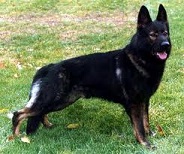
Shade variation within sable depends on secondary modifier genes that control the extent and depth of black tipping. Light or silver sables carry minimal black tipping over a cream or silver base. Medium sables show moderate tipping over a tan or red base. Dark or black sables carry extensive black tipping over a rich base, often appearing almost solid black from a distance.
Black Sable in the Working Line
Working-line shepherds, particularly the DDR (East German) and Czech working lines, preserve sable colouring at higher rates than Western show lines. The working line breeders selected for performance traits without weighting coat colour against function, which kept sable in the gene pool through the decades when saddle patterns dominated show rings.
A walk through a German SV working trial today shows sable and bi-colour dogs outnumbering classic saddle patterns. The working line breeders have long maintained that sable parents produce better-pigmented and more weather-hardy offspring, though objective performance data does not fully support that claim.
Black sable carries particular prestige in working circles because the colour combines the genetic dominance of the Ay allele with the rich pigmentation of strong modifier genes. Police and military agencies in Europe frequently select black sable dogs, partly for tactical visibility considerations and partly because the colour co-selects with working-line pedigree lines.
How Sable Develops From Puppy to Adult
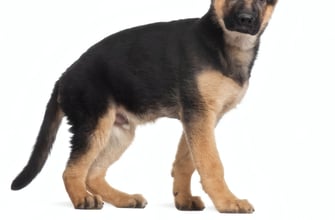
A black sable puppy at eight weeks looks almost entirely tan or red, because the black tipping on each hair shaft takes months to fully develop. Parents who produced a black sable litter often report that the puppies looked like plain sables until 16 weeks, when the dark tipping began to emerge.
The colour deepens through adolescence. By six months the black tipping is visible across the back and sides. By one year the adult colouring is roughly established, though further darkening continues through the second year. Some black sables continue darkening into their third year, eventually appearing almost solid black from a distance.
Seasonal coat changes affect the appearance. During the twice-yearly blowouts the undercoat releases in waves, and the lighter base tone temporarily shows more clearly as black guard hairs thin. The dog looks darker in winter when the coat is full and lighter in summer when the undercoat has shed out.
Distinguishing Sable from Related Patterns
Pet buyers sometimes confuse sable with bi-colour, solid black, or the darker end of saddle pattern. Four visual checks separate them.
- Sable: banded hair shafts, tan or red base visible at the roots, variable black tipping across body
- Bi-colour: predominantly black with tan points on the lower legs, under the tail, and above the eyes, like a Doberman pattern
- Solid black: no banding, uniform black from root to tip across the entire body
- Black-and-tan saddle: distinct saddle-shaped black area across the back and sides with clear tan on face, legs, and chest
To check for sable at home, part the coat and look at the hair roots. A sable shows a visibly lighter colour at the root that extends up the shaft before reaching the black tip. A bi-colour or solid black shows uniform black from root to tip.
Selecting a Black Sable Puppy
Selection protocols match standard shepherd practices, with the added consideration that colour prediction in sable puppies is less reliable than in saddle or solid black puppies. An eight-week sable puppy may darken substantially or very little by adulthood, depending on the modifier genes inherited from both parents.
Parents matter more than the individual puppy for colour prediction. Both parents being dark sables raises the odds of dark adult colour in the puppies. One dark parent and one light sable parent produces unpredictable outcomes. Asking the breeder for photos of previous litters at six months and one year gives a better indication than looking at the eight-week puppy itself.
Health testing takes priority over colour. A well-pigmented black sable from parents without proper OFA hip and elbow scoring, DNA panels, and cardiac clearance carries the same genetic risk as any undertested puppy. Reputable breeders produce health-tested litters where sable colouring is a welcome secondary outcome rather than the primary selection criterion.
Living With a Black Sable Shepherd
The coat produces some specific household effects. Dark sable hair shows less prominently on dark upholstery but shows clearly on light surfaces. The twice-yearly blowouts produce hair tufts that look dramatic because of the colour gradient from lighter base to darker tip.
Photography of black sables requires deliberate camera settings. The coat absorbs light and can under-expose in automatic settings, particularly indoors or on cloudy days. Owners who post to social media often struggle to capture the rich colour the dog shows in person.
Temperature tolerance for sable shepherds matches standard shepherd baselines. The darker coat absorbs slightly more heat in direct summer sun, but the double-coat structure regulates temperature through airflow rather than colour reflection alone. Hot-climate households should provide shade and water regardless of shepherd colour.
Coat maintenance runs on the same schedule as standard shepherds. Weekly brushing with an undercoat rake, monthly deshedding sessions during the blowout seasons, and bathing every six to eight weeks cover the routine. Black sables show mud and dust slightly less than lighter sables but show more than solid blacks, so the visible reminder to brush falls somewhere in the middle of the coat-colour spectrum.
Genetic testing has become affordable enough that buyers can now DNA test their black sable for the specific alleles at the ASIP locus and the modifier genes. A full coat colour panel from a reputable laboratory runs 75 to 150 US dollars and returns results within three weeks, which can help breeders plan future matings more precisely.
Frequently Asked Questions
Is black sable a rare colour?
Less common than black-and-tan saddle but not rare. Working lines produce sable routinely, and dedicated working-line breeders often have black sable stock as a significant portion of their programme. Show lines produce sable less often but do produce it.
Does black sable command higher prices?
In working-line circles, yes, often 10 to 20 percent above other colours from the same breeder. In show-line circles the colour commands no particular premium because saddle patterns still dominate preference. Pet buyers should not pay a premium based on colour alone.
Can a black sable be registered with the AKC?
Yes. The American Kennel Club standard accepts sable as a recognised colour for the breed, alongside black-and-tan, bi-colour, and solid black. Only the white colour remains disqualified in the AKC standard.
Why does the sable colour come from working lines?
The early working line breeders selected for performance, bite work, and temperament without filtering for coat colour. Show line breeders filtered more aggressively for the saddle pattern that judges preferred. Over several generations this produced the two populations with their visible colour differences.
Does coat colour affect trainability?
No. Coat colour correlates with pedigree line, which correlates with temperament and drive, but colour itself does not determine training outcomes. A black sable from show lines trains like a show shepherd, a black sable from working lines trains like a working shepherd.
For the breed overview and line differences, see our German Shepherd breed overview. Other coat patterns are covered in white German Shepherds and long-haired German Shepherds. For training considerations across all colour variants, read our German Shepherd training guide.
Sources and Further Reading
- Fédération Cynologique Internationale, Breed Standard 166 German Shepherd Dog
- Canine coat colour genetics research on the ASIP and MC1R genes
- Verein fur Deutsche Schaferhunde, breed colour registration data
- Working Dog Federation breed line documentation
- American Kennel Club, German Shepherd Dog breed standard