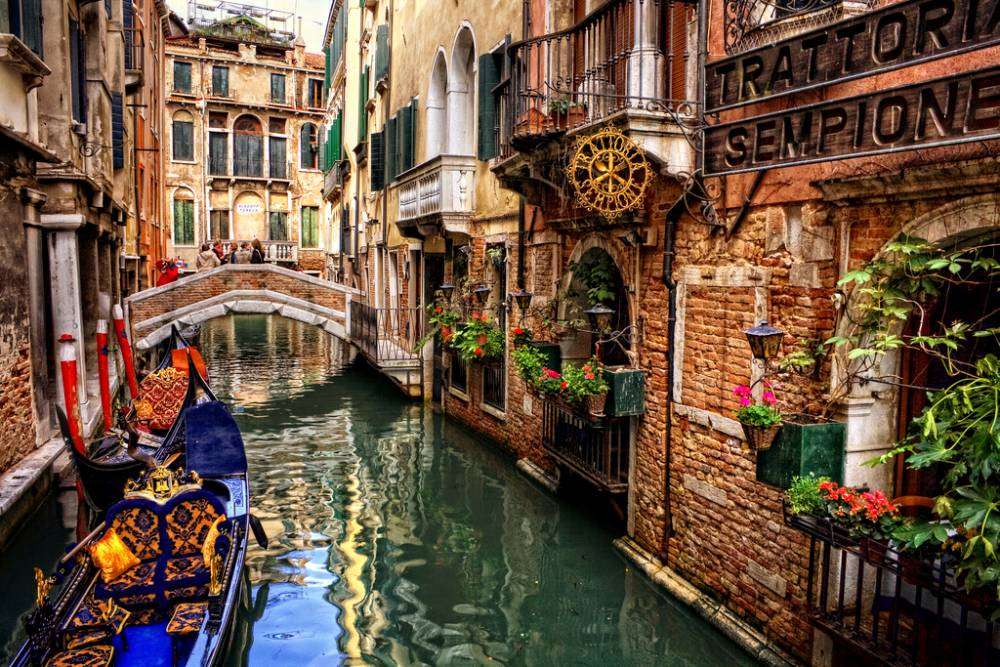
Venice stands on millions of wooden piles driven into the mud of a lagoon, a city of more than a hundred small islands laced together by canals and over 400 bridges, with no cars anywhere. The streets are water, the house numbers run past 6,000, and the whole place has been slowly sinking and flooding for centuries while somehow staying among the most beautiful cities ever built. This guide covers the great sights around St Mark’s, how to read and move through the city, the lagoon islands, the food, and the practical detail of crowds, flooding and the new visitor fee.
A City Built on Wooden Piles
Venice should not exist. Its builders sank countless trunks of alder and larch deep into the lagoon mud until they hit firm clay, then laid stone platforms on top, and the church of Santa Maria della Salute alone rests on more than a million of them. Starved of oxygen under the water, the wood petrified rather than rotted, and it still holds the city up after 400 years.
Above the piles sits a lattice of 118 islands stitched together by canals and bridges. There are no roads and no cars: the road from the mainland ends at Piazzale Roma, and from there you walk or take to the water. That single fact shapes everything about a visit.
Reading the City: Sestieri, Calli and House Numbers
Venice is divided into six districts, the sestieri: San Marco, Cannaregio, Castello, Dorsoduro, San Polo and Santa Croce. Locals navigate by these before any street name, and learning the local vocabulary on the painted wall signs, the nizioleti, saves a lot of confusion.
- Calle: a street; a salizada is a wider, paved one.
- Campo: a square; a small one is a campiello.
- Fondamenta: a walkway along a canal; a rio terà is a filled-in canal turned street.
- Sottoportego: a passage tunnelling under a building.
The house numbers are the real trap. Each sestiere is numbered as a single run from 1 up into the thousands, with Castello reaching nearly 7,000, and the numbers follow the order buildings were put up rather than the street, so two doors side by side can be hundreds apart. Navigate by landmark and sestiere, not by the civic number.
St Mark’s Square and Basilica
Everything funnels toward Piazza San Marco, the only square in Venice grand enough to be called a piazza, ringed by arcades and the historic Caffe Florian.
St Mark’s Basilica
The Basilica di San Marco glows with 8,000 square metres of golden Byzantine mosaics and holds the relics of St Mark, smuggled out of Alexandria in the 9th century. Above the entrance stand copies of the four bronze horses, the Triumphal Quadriga looted from Constantinople during the Fourth Crusade in 1204; the worn originals are inside. The jewelled altarpiece, the Pala d’Oro, is studded with thousands of gems. Our guide to St Mark’s Basilica covers it in detail.
The Doge’s Palace and the Campanile
Beside it, the pink Gothic Doge’s Palace was the seat of the Venetian Republic, linked to the old prison by the Bridge of Sighs, named for the last view of freedom condemned prisoners caught through its windows. The brick Campanile bell tower opposite gives the best view over the city; the original collapsed into a heap in 1902 and was rebuilt exactly as it had stood.
The Grand Canal, the Gondola and Getting Afloat
The Grand Canal snakes through the city in a reversed S, lined with palaces and crossed by just four bridges, the most famous the stone Rialto, beside the centuries-old fish and produce market. The real way to travel it is by water.
- The vaporetto: the public water-bus network is how Venetians actually move; a timed travel pass quickly pays off.
- The gondola: built deliberately asymmetrical, its left side longer so the single oarsman’s weight does not turn it in circles, and shaped from around 280 pieces of eight woods. The metal comb on the bow, the ferro, carries six teeth said to stand for the six sestieri, with one turned back for the Giudecca. The fare is fixed by the city, so agree it before you step in.
- The traghetto: the local secret, a plain public gondola that ferries standing passengers straight across the Grand Canal for a couple of euros, the cheapest gondola ride in Venice.
Acqua Alta and the MOSE Barriers
From autumn to spring Venice floods. When high tides, low pressure and a southerly wind line up, water pushes up through the lagoon and seeps into the lowest squares, with St Mark’s, the deepest point, going under first. Sirens warn the city, and raised walkways, the passerelle, appear across the worst spots.
After decades of work, the city now fights back with MOSE, a system of 78 hinged steel gates lying on the seabed at the three inlets to the lagoon. When a dangerous tide is forecast they fill with air, rise up and seal the lagoon off from the Adriatic. First raised in 2020, it has already saved the city from several major floods, though it cannot hold back the smaller ones.
Beyond San Marco: Art, Churches and the Ghetto
The crowds thin fast a few bridges from the square, where the city keeps some of its greatest art.
- The Frari: a vast brick Gothic church holding Titian’s glowing Assumption over the altar and the painter’s own tomb.
- Scuola Grande di San Rocco: a hall covered floor to ceiling with dark, dramatic canvases by Tintoretto.
- The Accademia: the great collection of Venetian painting, from Bellini to Veronese.
- Peggy Guggenheim Collection: modern art in the heiress’s unfinished palazzo on the Grand Canal.
- The Jewish Ghetto: in Cannaregio, the original ghetto, where the Republic confined its Jewish residents from 1516 and which gave the word to the world.
The story of how the Republic rose and fell runs through our history of Venice, and its galleries are gathered in our guide to Venice’s museums.
The Lagoon Islands
A day among the islands is the best escape from the crush around San Marco, all reached by vaporetto.
- Murano: the glass island, where furnaces have blown Venetian glass since the trade was moved here in 1291 to keep its fire and secrets away from the wooden city.
- Burano: the lace island, famous for its rows of brightly painted fishermen’s houses, covered in our guide to Burano.
- Torcello: the near-empty island where Venice began, with a cathedral of shimmering Byzantine mosaics older than St Mark’s.
- The Lido: the long sandbar with the city’s beaches and the September film festival.
Eating Venetian: Cicchetti and the Bacaro Crawl
Venetian food is best grazed standing up. The city’s wine bars, the bacari, serve cicchetti, small plates and bites of crostini, fried seafood and meatballs, washed down with a small glass of wine the locals call an ombra, the word for “shade”, from the days wine was sold in the shadow of the Campanile.
Moving from bar to bar with an ombra at each is the giro di ombre, the local crawl, and the best meal in town. Look out too for sarde in saor, sweet-and-sour sardines, black cuttlefish-ink pasta, and the spritz, which was invented in this region. The freshest produce is at the Rialto market early in the day.
Carnival and the Masks
For two weeks before Lent, Venice puts on the Carnival, a festival of masked balls and costumes that dates back to the Republic, when masks let nobles and commoners mingle unrecognised.
The traditional masks each had a use: the ghostly white bauta that disguised the voice, the small velvet moretta held in the teeth by women, and the sinister long-beaked plague-doctor mask, once packed with herbs against infection. Our guide to the Venice Carnival covers the season in full.
The Access Fee, Crowds and When to Go
Venice is loved nearly to death, and the city has started to push back. A day-visitor access fee was introduced in 2024 and raised the year after, charged to day-trippers on the busiest days and booked online in advance; overnight guests are exempt but pay a separate tourist tax through their hotel.
- Best seasons: spring and autumn for mild weather and thinner crowds; the acqua alta risk runs from October to spring.
- Avoid: high summer and any day when several cruise ships are in, when San Marco becomes a slow-moving river of people.
- Stay over: the city empties in the evening once the day-trippers leave, and an early morning in a quiet Venice is worth the hotel price.
Getting There and Around
Trains cross the causeway from the mainland straight into Santa Lucia station on the Grand Canal, the easiest arrival. Marco Polo airport sits on the lagoon edge, linked to the centre by the Alilaguna water bus or by land to Piazzale Roma.
From either, you continue on foot or by vaporetto, as there are no cars, taxis or buses inside the old city. Pack light, since you will be hauling bags over stepped bridges. Venice pairs naturally with the rest of the country in our guide to Rome and our seven-day Italy itinerary.
Frequently Asked Questions
How many days do you need in Venice?
Two full days cover St Mark’s, the Grand Canal, the Rialto and a couple of quieter churches. A third day lets you slow down and add the lagoon islands of Murano, Burano and Torcello without rushing.
Do you have to pay to enter Venice now?
Day-trippers do on certain busy days. An access fee, introduced in 2024 and since raised, is charged to visitors who come just for the day and must be booked online in advance. Those staying overnight in the city are exempt but pay a separate tourist tax at their accommodation.
How much is a gondola ride?
The fare is fixed by the city rather than the gondolier, with a set price for a standard ride of about 30 minutes and a higher rate after the evening. For a couple of euros instead, the traghetto gondola ferries you standing across the Grand Canal.
What is acqua alta?
The seasonal high water that floods the lowest parts of Venice, mainly from autumn to spring, when tides and weather combine to push the lagoon over the quaysides. Sirens warn of it, raised walkways appear, and the MOSE barriers are now used to block the worst tides.
Is Venice sinking?
Slowly, yes, and the sea is also rising, which is why flooding has worsened. The MOSE flood barriers, first raised in 2020, are the city’s main defence, while the old wooden-pile foundations still hold the buildings up.
How do you get from the airport to Venice?
From Marco Polo airport, the Alilaguna water bus runs across the lagoon to St Mark’s and other stops, while land buses and taxis reach Piazzale Roma, where the road ends. From there you walk or take a vaporetto, as no cars enter the old city.
Sources and Further Reading
- Venezia Unica – the official city service for transport passes and tickets
- Venice Access Fee – the official page on the day-visitor contribution and how to book it
- St Mark’s Basilica – official visitor information and history
- City of Venice – municipal information, including acqua alta and the MOSE system
- UNESCO, Venice and its Lagoon – the World Heritage listing
- ACTV – the official vaporetto water-bus network and timetables