Four hundred years ago Ayuthaya was one of the largest cities on the planet, the capital of a Siamese kingdom that stretched from the Malay peninsula into parts of what is now Laos and Cambodia, and a trading port where Persian, Japanese, Portuguese, Dutch, and French merchants kept separate quarters along the river. The Burmese army burned the city in April 1767 after a fourteen-month siege. The Siamese court retreated south to Thonburi and then to Bangkok, and the old capital was left to the forest. What a visitor walks through on a day trip from Bangkok in 2026 is the ruin field of that burned city: brick stupas, headless Buddha statues, the foundations of royal monasteries, and the famous sandstone Buddha head that tree roots have wrapped at Wat Mahathat. The ruin field sits on an island formed by three rivers around sixty-five kilometres north of Bangkok, was listed as a UNESCO World Heritage site in 1991, and carries more than four hundred documented temple foundations of which around a dozen repay a serious visit on foot or by rented bicycle.
Wat Mahathat, the Tree Root Buddha, and the Chronology of the Ruins
Wat Mahathat, the Temple of the Great Relic, sits near the centre of the old city and is the single temple a visitor should see if time allows only one stop. The temple was founded around 1374 under King Borommaracha the First, who chose the site for a relic of the Buddha brought from Sri Lanka, and was rebuilt and extended repeatedly through the four centuries of Ayuthaya’s royal period. The central prang, the tall corn-cob tower typical of Khmer-influenced Siamese architecture, collapsed in the early twentieth century and has been left as a ruin at the core of the site. The most photographed object on the site is a sandstone Buddha head that has been taken up by the roots of a bodhi tree at the edge of the ruin field. The head is set at ground level and visitors are asked to lower themselves below the line of the head, either by sitting or by kneeling, before taking a photograph, so as to keep the Buddha’s face higher than the visitor’s own. Temple staff enforce the rule gently and will ask a standing photographer to crouch. The rows of headless Buddha statues along the outer wall of the temple date from after the 1767 sack, when the Burmese army decapitated the stucco and sandstone Buddhas and carried the heads away as trophies along with the temple’s gold leaf and the bronze fittings.
Wat Ratchaburana and the Crypt Paintings Under the Prang
Wat Ratchaburana sits directly north of Wat Mahathat across the road and was founded in 1424 by King Borommaracha the Second to mark the site of the cremation of his two elder brothers, who had killed each other in an elephant duel over the succession to the throne. The central prang is one of the best preserved of the Ayuthaya period and can be climbed by a steep internal staircase to a narrow gallery near the top, from which the roof line of the old city opens out in every direction. The painted crypt below the prang is the rarer sight. In 1957 looters broke into the underground chamber and removed a hoard of gold leaf, gold plaques, and small gold Buddha figures that had been sealed into the shrine at its fifteenth-century consecration. The subsequent official excavation recovered a second cache of gold objects that are now displayed at the Chao Sam Phraya National Museum in the town of Ayuthaya. The crypt walls carry faded fresco paintings of Buddhist cosmology and of Chinese-influenced scenes of courtly life, and are among the oldest surviving paintings from the Ayuthaya period. The staircase down to the crypt is narrow, unlit in places, and closed when the humidity rises above the level the painted surfaces can safely hold.
Wat Phra Si Sanphet and the Royal Chapel of the Old Palace
Wat Phra Si Sanphet sits on the grounds of the former royal palace and served the Ayuthaya kings as a chapel royal without resident monks, similar to the role of Wat Phra Kaew inside the Grand Palace in present-day Bangkok. The temple was founded in 1448 under King Borommatrailokanat, and its three large bell-shaped chedis along the central axis are the signature image of Ayuthaya postcards and guidebook covers. The chedis hold the ashes of three Ayuthaya kings, their builders and immediate successors, and the row of identical white stupas lined up on a single platform is one of the cleanest pieces of classical Siamese temple planning anywhere in the country. The temple once held a standing Buddha image covered in gold and around sixteen metres tall called the Phra Si Sanphet, from which the temple took its name. The Burmese army melted the gold cladding of the statue down for bullion in 1767 and the core of the image was left in ruins. The visitor who walks the length of the chedi row at golden hour, an hour before sunset, sees the stupas cast long shadows across the brick pavement in a way that a midday visit does not show.
Wat Yai Chai Mongkhon, the Reclining Buddha, and the Ceylonese Connection
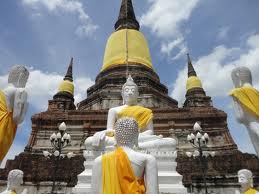
Wat Yai Chai Mongkhon lies southeast of the old city walls on the far side of the river and is reached by a short tuk-tuk ride or by bicycle across one of the bridges over the Pa Sak. The temple was founded around 1357 by King Ramathibodi the First, the founder of Ayuthaya itself, as a centre for a community of Buddhist monks who had returned from advanced study in Sri Lanka. The large bell-shaped chedi set on the central platform of the site is said to have been rebuilt and enlarged in 1593 by King Naresuan to mark his victory over the Burmese crown prince in a famous elephant duel near Suphanburi, although some historians argue the association with the duel was added to the temple’s story in later centuries. The chedi can be climbed by an external staircase to a gallery around the base of the bell, from which the viewer can look into the central shaft and see an older, smaller stupa set inside the larger one. A long rectangular hall to the north of the chedi holds a reclining Buddha image around seven metres long, set on an outdoor platform under an open sky, with coloured cloth draped across the lower body by lay visitors who come to make merit. A row of seated Buddha statues in saffron robes runs around the inner cloister of the site and is a popular photograph spot for Thai school groups on day trips.
Planning the Visit from Bangkok and Practical Notes
Ayuthaya sits around 65 to 80 kilometres north of central Bangkok depending on the route, and is reached by train from Hua Lamphong station or Bang Sue Grand Station, by minivan from the Mo Chit northern bus terminal, by day-trip coach through hotel tour desks, or by private car and driver booked through a Bangkok hotel. The train ride takes around an hour and a half to two hours on the standard-class service and is the cheapest option, with trains running through the day in both directions. The minivan is faster but cramped. A private car with a driver, arranged through a Bangkok hotel or a travel agency, costs more and gives a full day’s flexibility for a group of two to four. On arrival in the town of Ayuthaya a rented bicycle from a shop near the train station or the ferry landing is the best way to cover the ruin island, which is flat and compact enough to cycle around in a day. Electric tuk-tuks and songthaew shared taxis are available for visitors who prefer not to cycle in the heat. The main sites charge a small admission fee each, and a combined ticket covering the six or seven most visited temples is sold at the Ayuthaya Historical Park office and at the larger sites. Dress rules at working temples require covered shoulders and covered knees for all visitors regardless of gender, and shoes are removed before entering any viharn or bot building. The best months for a visit run from November to February, when the cool dry season brings daytime highs around thirty degrees and low humidity. March to May brings the hottest weather of the year, with temperatures that can make a mid-afternoon bicycle loop uncomfortable. June to October is the rainy season, with heavy afternoon downpours that flood parts of the ruin field in some years and that require a folding umbrella and a willingness to reshuffle the day’s plan.
Sources and Further Reading
- UNESCO World Heritage Centre, Historic City of Ayutthaya listing, whc.unesco.org
- Fine Arts Department of Thailand, Ayutthaya Historical Park, finearts.go.th
- Chris Baker and Pasuk Phongpaichit, A History of Ayutthaya: Siam in the Early Modern World, Cambridge University Press
- Charnvit Kasetsiri, The Rise of Ayudhya: A History of Siam in the Fourteenth and Fifteenth Centuries, Oxford University Press
- Michael Smithies, editor, Witnesses to a Revolution: Siam 1688, The Siam Society
Visitor Questions
How do I get to Ayuthaya from Bangkok?
The train from Hua Lamphong or Bang Sue Grand Station takes around an hour and a half to two hours and is the cheapest option, with several services a day in both directions. Minivans from Mo Chit are faster but cramped, and hotel day-trip coaches or a private car with driver arranged through a Bangkok hotel offer more flexibility for groups of two to four.
Which temple should I see first if I only have a few hours?
Wat Mahathat for the tree-root Buddha head and the central prang ruin, followed by Wat Phra Si Sanphet for the three royal chedis on the old palace grounds. The two sites sit within a ten-minute walk or a two-minute bicycle ride of each other and cover the core of the classical Ayuthaya temple landscape.
Can I climb any of the old stupas at Ayuthaya?
Yes, at selected sites. The central prang of Wat Ratchaburana carries a steep internal staircase to a gallery near the top, and the large chedi at Wat Yai Chai Mongkhon has an external staircase around the base of the bell with a view into the inner shaft. Other stupas are fenced off for conservation reasons.
What should I wear to visit the temples of Ayuthaya?
Covered shoulders and covered knees for all visitors regardless of gender, and shoes that can be slipped off easily for entry to any viharn or bot building. Loose cotton trousers or a long skirt with a light cotton shirt work best in the heat, and a wide-brimmed hat and sunscreen are useful for the long walks or bicycle loops between sites.