
Turkish is the official language of Turkey, spoken as a first language by roughly 80 percent of the country’s 85 million residents and recognised as a co-official language in Cyprus. Beyond Turkey itself, significant Turkish-speaking populations live in the Balkans (Bulgaria, North Macedonia, Kosovo, Greece), the Caucasus, and among European diaspora communities in Germany, the Netherlands, and France. Turkish belongs to the Turkic language family, which also includes Azerbaijani, Kazakh, Uzbek, Turkmen, Kyrgyz, and Uyghur. The modern standardised Turkish language is based on the Istanbul dialect and underwent major reforms in the 1920s and 1930s under Mustafa Kemal Atatürk to replace Arabic script with Latin alphabet and purge Persian and Arabic vocabulary in favour of Turkic roots.
This guide walks through the Turkish language within the broader Turkic family, the history of Turkish from the Anatolian conquests of the 11th century through modern Republican reforms, the 1928 alphabet change and its consequences, Turkish grammar and its distinctive agglutinative structure, the relationship between modern Turkish and neighbouring Turkic languages, Kurdish and other minority languages in Turkey, and practical notes for learners and visitors.
Turkish versus Turkic: The Language Family
A key distinction for anyone studying the Turkish language is between Turkish (the specific language spoken in Turkey) and Turkic (the family of languages to which Turkish belongs). Turkic languages are spoken across a vast geographic region from southeastern Europe through Central Asia to northwestern China.
Major Turkic languages and their countries:
- Turkish: Turkey, Cyprus, Balkans, diaspora. Around 88 million speakers total.
- Azerbaijani: Azerbaijan, northwestern Iran, Russia. Around 23 million speakers.
- Uzbek: Uzbekistan, neighbouring Central Asian states. Around 35 million speakers.
- Kazakh: Kazakhstan, China, Russia. Around 14 million speakers.
- Kyrgyz: Kyrgyzstan. Around 5 million speakers.
- Turkmen: Turkmenistan. Around 7 million speakers.
- Uyghur: Xinjiang region of China. Around 10-12 million speakers.
- Tatar, Bashkir, Chuvash: Russia. Several million combined speakers.
- Yakut (Sakha): Siberian Russia. Around 450,000 speakers.
All Turkic languages share similar grammatical structure, vowel harmony systems, and core vocabulary, which means a Turkish speaker can understand fragments of Azerbaijani or Uzbek conversation without formal study. Mutual intelligibility varies: Turkish and Azerbaijani are roughly as close as Portuguese and Spanish, while Turkish and Yakut are as distant as English and Hindi.
Historical Development of Turkish
The oldest Turkic written records are the Orkhon inscriptions from 8th-century Mongolia, carved in a runic script and preserving an early form of the language. Turkic-speaking peoples migrated westward over the following centuries, reaching Anatolia in large numbers after the 11th century. The Seljuq Turks under Alp Arslan defeated the Byzantine Empire at the Battle of Manzikert in 1071, opening Anatolia to Turkish settlement. For more on this period, see our Seljuq dynasty of Turkey guide.
Anatolian Turkish developed over the next three centuries, heavily influenced by Persian (the prestige literary language of the medieval Islamic world) and Arabic (the language of Islamic religious scholarship). By the time the Ottoman Empire consolidated its rule in the 15th century, written Turkish had become so saturated with Persian and Arabic loanwords and grammatical structures that Ottoman Turkish effectively functioned as a high-register mixed language inaccessible to ordinary Turkish speakers.
The earliest surviving Anatolian Turkish script, dating to the 13th century, shows the literary tradition from Central Asia only slightly modified after the tribes settled in Anatolia. Conquest and settlement brought Turkish speakers into contact with Greek, Armenian, Kurdish, and Persian communities, producing the linguistic complexity that characterised Anatolia under Ottoman rule.
Ottoman Turkish and the Literary Tradition
Ottoman Turkish (Lisan-ı Osmani) served as the administrative and literary language of the Ottoman Empire from the 14th through early 20th century. The language was written in a modified Arabic script called Arabic-Ottoman or Osmanli. Ottoman Turkish had three main registers:
- High register (Fasih Türkçe): court and scholarly use, heavy with Persian and Arabic vocabulary, often unintelligible to ordinary Turks
- Middle register (Orta Türkçe): administrative and educated urban use
- Folk register (Kaba Türkçe): everyday speech, closer to modern Turkish in vocabulary and structure
Parallel to the high literary Ottoman tradition, a body of mystical literature and folk poetry preserved the more purely Turkic register used by ordinary populations. Sufi poets like Yunus Emre (13th-14th century) wrote in an Anatolian Turkish that modern readers can follow with minor glosses, despite being 700 years old. This folk tradition proved crucial for the 20th-century reformers who sought to purify Turkish of excessive foreign elements.
The 1928 Alphabet Reform
Mustafa Kemal Atatürk’s 1928 Language Reform replaced the Arabic-based Ottoman script with a Latin alphabet specifically designed for Turkish phonology. The transition happened quickly: within six months of the November 1928 law, newspapers, schools, and government offices switched to the new alphabet. Adult literacy programmes across Turkey taught the Latin script to millions of people who had learned to read in the old system.
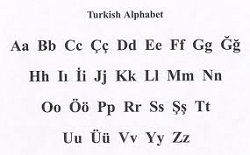
The new Turkish alphabet has 29 letters, including six letters not found in English:
- Ç (pronounced “ch”)
- Ğ (silent or lengthens the preceding vowel)
- I (distinct from dotted i, pronounced like the “i” in “sit”)
- Ö (like German “ö”, similar to “ur” in “fur”)
- Ş (pronounced “sh”)
- Ü (like German “ü”)
Turkish also lacks the letters Q, W, and X. The spelling system is almost perfectly phonetic: each letter represents a single sound, and words are pronounced exactly as written. This makes Turkish relatively easy to read aloud once the basic letter-sound correspondences are learned, which matters for travellers trying to pronounce place names or menu items.
Purification of Vocabulary
Alongside alphabet reform, Atatürk established the Turkish Language Association (Türk Dil Kurumu, founded 1932) with the goal of replacing Persian and Arabic loanwords with Turkic-root equivalents. The association scoured old Anatolian Turkish texts for indigenous roots and coined neologisms from Turkic morphemes. Newspapers were pressured to adopt new vocabulary, and within two generations the saturation of Persian and Arabic vocabulary that characterised Ottoman Turkish had been dramatically reduced.
Examples of purification:
- Mektep (Arabic, “school”) became okul (Turkic coinage from okumak “to read”)
- Muallim (Arabic, “teacher”) became öğretmen (Turkic, from öğretmek “to teach”)
- Şark (Arabic, “east”) became doğu (Turkic, from doğmak “to rise”)
- Hesap (Arabic, “calculation”) became sayı or hesap remained in use depending on context
The purification process remains ongoing and sometimes controversial. Conservative writers and religious scholars retain older Persian and Arabic vocabulary; secular and progressive publications use more purified Turkic. Some of the Turkish Language Association’s coinages became standard; others failed to replace the older forms. Modern Turkish vocabulary thus contains layered registers reflecting decades of reform activity.
Turkish Grammar: Agglutination and Vowel Harmony
Turkish grammar differs fundamentally from Indo-European languages like English, French, or Greek. Two structural features define the language:
Agglutination: Turkish builds complex meanings by attaching suffixes to root words in sequence. A single Turkish word can convey what English expresses in a full sentence. Example: “evlerinizdeymiş” (it is said to be in your houses) decomposes as ev (house) + ler (plural) + iniz (your) + de (in) + ymiş (it is said). English requires eight separate words for the same meaning.
Vowel harmony: Turkish vowels divide into two groups (front: e, i, ö, ü; back: a, ı, o, u), and suffixes change vowel to match the root word’s vowels. The plural suffix is -ler after front-vowel roots but -lar after back-vowel roots. Vowel harmony makes Turkish smoothly pronounceable and distinctively musical.
Other grammatical features:
- Word order: subject-object-verb (SOV), unlike English’s subject-verb-object
- No grammatical gender: single pronoun “o” serves for he, she, and it
- No articles: Turkish has no equivalent of “a” or “the”
- Postpositions instead of prepositions: modifiers follow the noun
- Evidential suffixes: built-in way to indicate whether information is witnessed, reported, or inferred
- Verb conjugation covers tense, aspect, person, and evidentiality in compact suffix chains
These features make Turkish grammatically challenging for English speakers at the beginning but produce a very consistent and logical system once the core patterns are learned.
Modern Turkish Pronunciation and Dialects
Standardised modern Turkish uses the Istanbul dialect as its reference. Regional varieties exist across Turkey but mutual intelligibility is high: a speaker from Istanbul can hold complex conversations with speakers from Antalya, Kayseri, Trabzon, or Erzurum. The main dialect groups:
- Istanbul Turkish: the reference dialect used in broadcasting, formal education, and written media
- Anatolian Turkish: various rural dialects across inland Anatolia, slightly more conservative in vocabulary
- Eastern Anatolian Turkish: influenced by Kurdish, Armenian, and older Azerbaijani contact
- Aegean and Mediterranean coastal Turkish: influenced historically by Greek
- Black Sea Turkish (Karadeniz): distinctive intonation and some unique vocabulary, subject of much Turkish comedy and regional cultural identity
- Cypriot Turkish: somewhat distinct from mainland Turkish, with some Greek influence and older vocabulary
Balkan Turkish varieties spoken in Bulgaria, North Macedonia, Kosovo, and northern Greece developed under different political conditions and retain some older Ottoman features. They remain mutually intelligible with mainland Turkish but can sound archaic to Istanbul speakers.
Kurdish and Other Minority Languages
Turkey is not a monolingual country, despite the official status of Turkish. The largest minority language is Kurdish, spoken by 15-20 percent of Turkey’s population, mainly in the southeastern provinces. Two main Kurdish varieties appear in Turkey:
- Kurmanji (Northern Kurdish): spoken by the majority of Turkey’s Kurds, written in Latin script
- Zaza (Zazaki): spoken in parts of eastern and southeastern Turkey, classified by some linguists as a separate language within the broader Iranian family
Kurdish was officially banned from public use in Turkey from 1983 to 1991, and restricted from education and broadcasting until reforms in the 2000s. Kurdish-language TV broadcasting in Turkey started in 2009 on state channel TRT 6; Kurdish-language private schools and courses became legal in the 2010s. Political sensitivities around Kurdish remain, with periodic restrictions on Kurdish-language political speech or activity.
Other minority languages in Turkey include:
- Arabic: spoken by around 1.5 million people, mainly in southeastern border areas and Syrian refugee communities
- Laz: spoken in the Black Sea coast by around 30,000 people
- Circassian (Adyghe, Kabardian): spoken by descendants of 19th-century refugees from the Caucasus
- Armenian: historically widespread, now spoken by a small community in Istanbul and elsewhere
- Greek: spoken by the Rum community, mainly in Istanbul
- Judeo-Spanish (Ladino): spoken by descendants of Sephardic Jews who settled in the Ottoman Empire after 1492
- Romani: spoken by the Turkish Roma community
For historical context on the religious communities connected to these language groups, see our religion in Turkey overview.
Learning Turkish for Travellers
Turkish ranks as a medium-difficulty language for English speakers, requiring around 1,100 class hours to reach professional proficiency according to US Foreign Service Institute estimates. That places Turkish between Indo-European languages (600-750 hours) and East Asian languages (2,200+ hours).
Practical tips for travellers:
- Learn basic greetings: merhaba (hello), teşekkür ederim (thank you), lütfen (please), evet (yes), hayır (no)
- Turkish pronunciation is phonetic: read words as spelled
- Numbers 1-10: bir, iki, üç, dört, beş, altı, yedi, sekiz, dokuz, on
- English is widely spoken in Istanbul, Antalya, and other tourist areas; less common in inland towns
- Most menus in tourist areas have English translations; smaller local restaurants rely on Turkish menus
- Road signs, airport signs, and public transport information usually include English
- Apps: Duolingo, Pimsleur, Memrise, and Italki teachers provide entry-level instruction
- TV and film immersion: Turkish TV dramas (dizi) have become globally popular and provide listening practice
A short Turkish study before a trip to Turkey improves the travel experience markedly, especially in smaller towns and rural areas where English proficiency declines.
Turkish in the Modern World
Turkish is the native or heritage language for tens of millions of people in diaspora communities. Germany holds the largest Turkish-speaking community outside Turkey at around 3 million, mostly the descendants of Gastarbeiter (guest workers) who arrived from the 1960s onward. Other significant diaspora populations live in France, the Netherlands, Belgium, Austria, and the United States.
Turkish cultural exports have expanded the language’s global visibility. Turkish television series (dizi) from Muhteşem Yüzyıl (Magnificent Century) to Diriliş: Ertuğrul (Resurrection: Ertugrul) have drawn audiences across the Middle East, Balkans, Central Asia, Latin America, and beyond. The Turkish music industry produces wide international export; Turkish coffee culture and gastronomy continue to spread. For broader historical and cultural context, see our Istanbul travel guide which covers the city that stands at the linguistic and cultural centre of the Turkish world.
Frequently Asked Questions
What language do they speak in Turkey?
Turkish is the official language, spoken by around 80 percent of Turkey’s 85 million residents as their native language. Kurdish is the largest minority language (15-20 percent of the population), with smaller communities speaking Arabic, Laz, Circassian, Armenian, Greek, and Judeo-Spanish.
Is Turkish similar to Arabic?
No. Turkish and Arabic belong to completely different language families. Turkish is a Turkic language; Arabic is a Semitic language. They share some vocabulary borrowings from centuries of Islamic cultural contact, but grammar and sound systems differ fundamentally. Turkish grammar has much more in common with Japanese or Korean (which share agglutinative structure) than with Arabic.
What is the Turkish alphabet?
The modern Turkish alphabet has 29 letters based on Latin script, introduced by Atatürk’s 1928 alphabet reform. It includes Ç, Ğ, I (dotless), Ö, Ş, and Ü, but does not include Q, W, or X. The spelling system is almost perfectly phonetic.
Is Turkish hard to learn?
Medium difficulty for English speakers. The US Foreign Service Institute estimates 1,100 class hours to professional proficiency, roughly twice what Spanish or French require but half of what Mandarin or Arabic require. Turkish grammar is very consistent once its agglutinative and vowel harmony rules are understood.
Can Turkish and Azerbaijani speakers understand each other?
Yes, to a substantial degree. Turkish and Azerbaijani are closely related Oghuz Turkic languages, roughly as close as Portuguese and Spanish. A Turkish speaker and an Azerbaijani speaker can hold conversations with occasional difficulty over specific vocabulary differences.
Why did Turkey change its alphabet?
Mustafa Kemal Atatürk’s 1928 alphabet reform replaced the Arabic-Ottoman script with a Latin alphabet designed specifically for Turkish phonology. The goals were modernisation, literacy expansion, cultural reorientation toward Western Europe, and better representation of Turkish sounds than the Arabic script could provide.
Is Kurdish allowed in Turkey?
Kurdish has been legal in public use since 1991 and in education and broadcasting since reforms in the 2000s. Kurdish-language TV (TRT 6) started broadcasting in 2009, and Kurdish-language private schools became legal in the 2010s. Political sensitivities remain, and restrictions on Kurdish-language political activity have varied across different Turkish government periods.
Sources and Further Reading
- Türk Dil Kurumu (Turkish Language Association), tdk.gov.tr
- Ethnologue: Languages of the World, Turkish entry, ethnologue.com
- A Reference Grammar of Modern Turkish – Aslı Göksel and Celia Kerslake, Routledge
- The Turkic Languages – Lars Johanson and Éva Csató, Routledge
- Turkish: A Comprehensive Grammar – Aslı Göksel, Routledge
- The Turkish Language Reform – Geoffrey Lewis, Oxford University Press