Cambodia’s writing system holds a Guinness World Record. With 74 distinct characters across consonants, vowels, and diacritics, the Khmer script (អក្សរខ្មែរ aksar khmae) ranks as the largest alphabet on the planet. The earliest dated Khmer inscription, catalogued as K.557/600 from Angkor Borei in Takeo Province, was carved in 611 CE, making this one of the oldest writing systems still in continuous daily use in Southeast Asia. Thai, Lao, and Burmese scripts all borrowed from Khmer centuries later.
This guide covers the origins of the Cambodian alphabet, breaks down its 33 consonants and dependent-vowel system with full charts, presents the three Khmer script styles and the seven native punctuation marks, traces script evolution through four historical periods, tells the story of Samdech Chuon Nath and the standardization of modern Khmer, examines what survived the Khmer Rouge years, and explains how the script functions in modern Cambodia.
Origins of the Khmer Script and the Angkor Borei Stele
The Khmer script descends from the Pallava script of southern India through the broader Brahmi family. Pallava arrived in Cambodia between the 5th and 6th centuries through Indian monks and traders crossing the Bay of Bengal, who carried it along with Hindu and Buddhist religious practices. The Cambodian court adopted the script to record royal decrees, religious texts, and administrative records in both Sanskrit and Old Khmer.
The earliest dated inscription written entirely in the Khmer language sits in Takeo Province at Angkor Borei. The French epigrapher George Cœdès catalogued it as inscription K.557/600 in his Inventaire des inscriptions du Champa et du Cambodge, first published in 1908, and produced the first French translation in 1942. The stone records a temple endowment dated to 611 CE. The text lists the names of donated servants, and the personal-name analysis reveals an early Cambodia of mixed ethnolinguistic origins: the names include Sanskrit, Old Khmer, Austronesian, and Austroasiatic elements. This makes K.557/600 not only the oldest dated Khmer-language inscription but also a snapshot of seventh-century Khmer society as a regional crossroads.
Earlier inscriptions exist from Cambodian temple sites, including Sambor Prei Kuk in Kampong Thom Province, but those use Sanskrit rather than Khmer. The K.557/600 stele marks the shift to writing in the Khmer language itself, when local rulers began recording land grants, temple dedications, and genealogies in their own tongue instead of relying on Sanskrit as the sole written language.
Pallava’s influence extended past Cambodia. The Thai alphabet, formalized by King Ramkhamhaeng in 1283, drew from an older Khmer model. The Lao script followed a similar path. Both writing systems share visible similarities with Khmer letterforms, a direct consequence of their shared Pallava ancestry by way of the Cambodian court.
The 33 Consonants and the Two-Series System
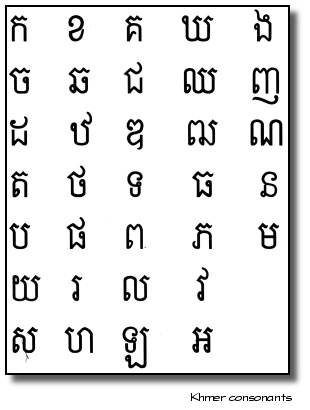
The Khmer alphabet contains 33 consonants split into two groups linguists call the first series (a-series) and the second series (o-series). First-series consonants carry an inherent /ɑː/ vowel sound; second-series consonants carry an inherent /ɔː/ sound. The series matters because it determines how attached vowel signs are pronounced. The same vowel marker produces different sounds depending on the consonant beneath it.
The consonants are organized in the traditional Brahmic order by place of articulation: velars, palatals, retroflex, dentals, labials, and a sonorant group at the end.
| Group | First Series (a /ɑː/) | Second Series (o /ɔː/) |
|---|---|---|
| Velars | ក kɑ, ខ khɑ | គ kɔ, ឃ khɔ, ង ŋɔ |
| Palatals | ច cɑ, ឆ chɑ | ជ cɔ, ឈ chɔ, ញ ɲɔ |
| Retroflex | ដ ɗɑ, ឋ thɑ, ណ nɑ | ឌ ɗɔ, ឍ thɔ |
| Dentals | ត tɑ, ថ thɑ | ទ tɔ, ធ thɔ, ន nɔ |
| Labials | ប ɓɑ, ផ phɑ | ព pɔ, ភ phɔ, ម mɔ |
| Sonorants and others | ស sɑ, ហ hɑ, ឡ lɑ, អ ʔɑ | យ jɔ, រ rɔ, ល lɔ, វ ʋɔ |
The first series holds 15 consonants; the second series holds 18. Each consonant has a subscript form, a smaller version written below the main consonant line. Scribes and typists use these subscripts to create consonant clusters, stacking two or three consonants vertically. The word “Khmer” itself, written ខ្មែរ, uses a subscript form of ម mo tucked beneath ខ kho to form the consonant cluster kh-m before the vowel ែ ae and the final រ r.
Subscript consonants create one of the script’s steepest learning curves. A single base consonant can combine with multiple subscripts and vowel markers, producing complex character stacks that read as a single glyph to untrained eyes. Cambodian children spend their first several school years mastering these combinations through repetitive handwriting drills. Learners who memorize which series a consonant belongs to can predict vowel pronunciation; learners who skip this step face constant confusion. The series concept is the gateway skill for Khmer language study.
Vowels, Diacritics, and Word Spacing
Khmer vowels fall into two categories. Dependent vowels, numbering around 24, attach to consonants as small marks positioned above, below, before, after, or wrapped around the base consonant. Independent vowels, a set of 12 to 13 characters, stand alone without needing a consonant host. Independent vowels appear less often in modern writing, mostly in loanwords from Sanskrit and Pali.
The placement system makes Khmer a true abugida, a script type where each consonant-vowel combination forms a single unit rather than separate letters. The table below shows ten of the most common dependent vowels paired with the consonant ក kɑ to illustrate placement.
| Vowel | With ក | First-series sound | Placement |
|---|---|---|---|
| ា | កា | aa | right of consonant |
| ិ | កិ | e | above |
| ី | កី | ei | above |
| ុ | កុ | o | below |
| ូ | កូ | ou | below |
| េ | កេ | ei | left of consonant |
| ែ | កែ | ae | left of consonant |
| ៃ | កៃ | ai | left of consonant |
| ោ | កោ | ao | wraps around |
| ៅ | កៅ | au | wraps around |
The vowel marker for “ae” extends to the left of its consonant even though readers pronounce it after the consonant sound. This left-write-but-read-right convention is shared with several other Brahmic scripts and is a frequent confusion point for beginners.
The 13 independent vowels are ឥ i, ឦ ī, ឧ u, ឩ ū, ឪ uw, ឫ ru, ឬ rū, ឭ lu, ឮ lū, ឯ ae, ឰ ai, ឱ ao, ឳ au. They appear mainly in Sanskrit and Pali loanwords. Modern Khmer style guides note that ឩ ū is the rarest in current use, and some sources count only 12 by treating it as obsolete.
Diacritics add another layer. The nikahit ំ adds nasal quality. The bantoc ់ shortens a vowel. The toandakhiat ៌ silences an entire consonant. Additional marks include the yukleakpintu ៎ for emphatic sentences, the kakabat ៉ that converts a second-series consonant to first-series pronunciation, the treisap ៊ that converts first-series to second-series, and the robat ៌ that marks a silent Sanskrit-origin consonant. A single syllable can carry a base consonant, one or more subscripts, a vowel marker, and a diacritic, all compressed into a tight visual cluster.
Khmer text does not use spaces between individual words. Spaces in Khmer mark clause or sentence boundaries instead. Readers parse word boundaries through context, vocabulary knowledge, and the visual rhythm of character groupings. This feature puzzles speakers of European languages, but Khmer readers process it automatically.
The Three Khmer Script Styles: Mul, Chrieng, and Khom
Modern Khmer uses three distinct script styles, each with its own historical role. The distinction goes back to the medieval period, when scribes developed specialized letterforms for ceremonial, everyday, and religious purposes. The three styles share the same 33 consonants and the same vowel inventory, but the visual treatment of every glyph differs.
អក្សរមូល Aksar Mul, “round script”. Bold, thick, ceremonial. Used for titles, banknote inscriptions, shop signs, banners, and royal names. The 100, 500, 1,000, 5,000, 10,000, 20,000, 50,000, and 100,000 riel denominations of Cambodian currency all carry their value in Aksar Mul. The script appears on the National Bank of Cambodia building, the Royal Palace gates, and the inscription panels of restored Angkor-era temples. The round letterforms photograph well at distance and remain the formal style for any public-facing official text.
អក្សរជ្រៀង Aksar Chrieng, “oblique script”. The everyday cursive form. Novels, newspapers, magazines, school textbooks, and the body text of websites use Chrieng. Handwritten Khmer almost always uses an informal version of Chrieng. The slant and the lighter strokes evolved from Aksar Mul as a way to write faster and to fit more text per palm-leaf line during the manuscript era.
អក្សរខម Aksar Khom, “Khom script”. The sacred script reserved historically for Pali and Sanskrit religious texts. The name “Khom” is the Thai word for “Khmer”, a clue to its cross-border importance: Thai Theravada Buddhists adopted Aksar Khom to write Pali sutras and continued using it in monasteries even after Thai vernacular shifted to the modern Thai script. In Cambodia, Aksar Khom remains the script of choice for sacred manuscripts, ritual yantras, and protective tattoos. The letterforms are squarer and more angular than Mul or Chrieng, preserving a closer link to the original Pallava ancestor.
The three-style system means a Cambodian reader develops three visual recognitions of the same alphabet, each tied to a specific context. A wedding invitation might combine Mul for the bride and groom’s names with Chrieng for the date and venue. A Buddhist amulet might carry a Khom-script Pali blessing alongside a Chrieng-script donor inscription. Most English-language alphabet guides treat Khmer as a single visual system, missing this stylistic depth entirely.
Khmer Punctuation: Seven Native Marks
Khmer has seven native punctuation marks that remain in active use for traditional and formal contexts. Latin punctuation (period, comma, question mark, exclamation mark) also appears in modern Khmer text, but the seven Khmer marks below carry meanings that the Latin set does not match exactly.
| Mark | Name | Use |
|---|---|---|
| ។ | Khan | Sentence end, equivalent to a Latin period |
| ៕ | Bariyoosan | Section or chapter end |
| ៖ | Camnuc Pii Kuuh | Khmer colon for lists and dialogue |
| ៗ | Lek Too | Repetition: repeat the preceding word |
| ៘ | Beyyal | “And so on”, equivalent to Latin etcetera |
| ៙ | Phnaek Muan | Decorative section opening, used in religious and poetic texts |
| ៚ | Koomuut | Decorative section closing, often called the “fish-tail” mark |
The repetition mark ៗ Lek Too is the most distinctive of the seven and the most useful for learners to recognize. A Khmer word followed by ៗ means the word repeats, similar to the Japanese 々 iteration mark. The word ខ្ញុំៗ for example reads as ខ្ញុំ ខ្ញុំ “me, me” or “we ourselves”. The mark eliminates the need to write the same word twice and appears in everyday Cambodian text from text messages to road signs.
The currency mark ៛ riel sits in the same Khmer Unicode block. The riel symbol appears in pricing across Cambodian markets alongside the US dollar sign, since the dollarized economy uses both currencies in parallel for daily transactions in Cambodian commerce.
Four Historical Periods of the Script
Scholars divide the Khmer script’s development into four periods, each with distinct visual and structural characteristics.
Pre-Angkorian Period, before 802 CE
The earliest Khmer inscriptions from the 7th century used a script close to its Pallava source. Writers carved text into stone pillars and doorframes of brick temples. Most surviving inscriptions from this era record royal donations to Buddhist and Hindu temples, land boundaries, and the names of servants and slaves donated to religious institutions. The script was angular, with sharp strokes suited to stone carving. The Angkor Borei stele belongs to this period.
Angkorian Period, 802 to 1431 CE
The Angkor Empire brought a golden age for Khmer epigraphy. Cambodian rulers from Jayavarman II through Jayavarman VII commissioned thousands of inscriptions across temple complexes, including the massive Angkor Wat and Bayon temples. The script became more rounded and ornamental during this era. Scribes developed standardized letterforms, and the language absorbed a flood of Sanskrit vocabulary related to administration, philosophy, and religion. The Cœdès Inventaire catalogues more than 1,200 Angkorian-era inscriptions, the densest concentration of Old Khmer texts anywhere in Southeast Asia.
Middle Khmer Period, 14th to 18th century
After the fall of Angkor in 1431, the script continued evolving. Palm-leaf manuscripts known as សាស្ត្រាស្លឹករឹត sastra sleuk rit replaced stone inscriptions as the primary writing surface. This shift from chisel to stylus transformed letterforms: angular carved characters softened into the curving shapes recognizable in modern Khmer. Neighboring Thai and Lao influences entered the language during this period, particularly as the Cambodian court moved through Lovek to Phnom Penh. The language changed so much across these centuries that modern Cambodians cannot read Angkorian-era texts without specialized training.
Modern Khmer, 19th century to present
French colonial administrators in the late 19th century introduced printing technology to Cambodia and pushed for orthographic standardization. The standardization effort matured under Cambodian leadership in the early 20th century, an effort detailed in the next section. The Khmer Rouge years of 1975 to 1979 nearly destroyed the script’s institutional infrastructure but failed to destroy the script itself, as the survival-and-recovery section below describes.
Chuon Nath and the Standardization of Modern Khmer
The man who fixed the modern Khmer spelling system was Samdech Sangha Raja Chuon Nath, សម្តេចព្រះសង្ឃរាជ ជួន ណាត, Supreme Patriarch of the Mohanikaya Buddhist order. His dictionary is the reason a Cambodian student today can look up a word and trust the spelling.
The standardization effort began in 1915 with a French-backed orthography commission, which deadlocked over a fundamental question: should Khmer spelling follow the etymological style, preserving Sanskrit and Pali roots even when modern pronunciation had drifted, or the phonetic style, writing words the way Cambodians actually pronounced them? The first commission could not resolve the dispute and produced no dictionary.
On July 19, 1926 a new commission was formed, and Chuon Nath joined as a leading voice. The new committee adopted the etymological style, the choice that has shaped modern Khmer spelling ever since. Chuon Nath then led the dictionary project for the next twelve years. Book One of វចនានុក្រមខ្មែរ Vacanānukrām Khmae, the Khmer Dictionary, was published by the Buddhist Institute in 1938. The complete two-volume work runs to 1,858 pages and remains the foundational reference for the language. Cambodian schools, courts, ministries, and publishers anchor their spelling to the Chuon Nath dictionary to this day.
The etymological choice carried a political weight beyond linguistics. By keeping Sanskrit and Pali spellings visible, Chuon Nath aligned modern Khmer with its classical and religious heritage at a moment when French colonial pressure was pushing Cambodia toward Romanization. The 1938 dictionary became a quiet but durable anchor of Khmer cultural autonomy. The Institute of National Language, founded in Phnom Penh on July 10, 1998 and integrated into the Royal Academy of Cambodia in December 1999, has continued the Chuon Nath orthographic line in all subsequent reference works.
The Khmer Rouge Years and the Survival of Khmer Letters
The Khmer Rouge declared Year Zero on April 17, 1975. Phnom Penh was evacuated within 72 hours. Buddhist monasteries were closed or destroyed across the country, and the regime targeted intellectuals for execution. By the time Vietnamese forces ended the regime in January 1979, an estimated 90 percent of Cambodia’s Buddhist monks had been killed or forcibly defrocked, and the institutional infrastructure that had carried the Khmer literary tradition for centuries lay in ruins.
The Buddhist Institute in Phnom Penh held the largest collection of Khmer manuscripts and reference materials anywhere in the world before 1975: over 40,000 volumes in Khmer, French, English, Thai, Burmese, Lao, and Sinhala. The Khmer Rouge years devastated the collection. By 1980, only a small portion of the library survived, mostly multiple copies of the Institute’s own publications which had been distributed before the regime took power. Across Cambodia, scholars estimate that 95 percent of palm-leaf manuscripts in temple libraries disappeared between 1975 and 1990.
The Chuon Nath dictionary survived for a specific reason: Chuon Nath had died in 1969, six years before Year Zero, and the dictionary had already been printed in enough copies and distributed widely enough that the Khmer Rouge could not destroy every one. Copies that families and monks hid through the regime years became the seed material for the post-1979 reconstruction of Khmer education.
The Khmer Rouge tried to break the connection between Cambodians and their classical literary tradition. They failed. The script survived, the dictionary survived, and the post-1979 generation rebuilt the institutions: the Buddhist Institute was re-established in 1992 with support from the Japanese Sotoshu Relief Committee and the German Heinrich Böll Foundation. The post-1979 literacy recovery saw Cambodia move from a war-shattered education system to over 87 percent adult literacy in recent measurement.
The Script in Modern Cambodia
Approximately 16 million people in Cambodia use the Khmer script daily. Ethnic Khmer communities in Thailand’s Surin and Buriram provinces and in Vietnam’s Mekong Delta region also maintain the script, adding several million more users. The Cambodian government mandates Khmer as the language of instruction in all public schools.
The Apsara typeface, developed under the Khmer Software Initiative by Cambodian designer Danh Hong and the Open Forum of Cambodia, brought Khmer script into the open-source software world. Released under the LGPL license, Apsara and the broader KhmerOS font family became the first widely-distributed Unicode-compliant Khmer fonts. Their availability meant that Linux distributions, Wikipedia, and free office software could render Khmer correctly without requiring users to install proprietary fonts. Google Fonts now hosts the Khmer family and powers Khmer rendering across millions of web pages.
Khmer typefaces present unique design challenges because a complete Khmer font requires hundreds of individual glyphs to cover all consonant-subscript-vowel-diacritic combinations. Khmer has its own Unicode block of 128 code points plus a supplementary block of 32 characters for lunar date markers and Cambodian calendar signs, enabling digital text processing in any modern operating system. Cambodian artists and designers have developed dozens of modern typefaces that balance traditional calligraphic forms with screen readability.
The script also serves minority languages within Cambodia. The Tampuan, Jarai, and Brao hill tribe communities, which historically had no writing systems, have adopted modified versions of Khmer script for their own languages, a practice that dates back centuries but has expanded under government literacy programs. Khmer also remains the working script for Pali in Theravada monasteries across the country, where novice monks still memorize sutras written in Aksar Khom or in modern Khmer with Pali phonetic conventions.
Mobile phone usage has reshaped how Cambodians interact with their script. Predictive text engines handle the complex stacking rules automatically, and younger Cambodians increasingly mix Khmer script with Latin-alphabet transliterations in informal messaging. Language advocates worry this trend could erode script literacy, but school curricula continue to prioritize traditional Khmer letterforms and handwriting drills.
Differences Between Khmer and Neighboring Scripts
Visitors to Southeast Asia often notice that Cambodian, Thai, and Lao scripts look related. All three descend from Pallava through various intermediary stages, and they share the abugida structure, the consonant-series system, and the practice of marking vowels as attachments rather than standalone letters.
The differences are substantial. Thai script simplified its consonant inventory to 44 characters arranged in a single row, while Khmer retained 33 consonants with extensive subscript stacking. Lao script reduced its alphabet even further to 27 consonants after a 1960s reform. Khmer preserved more of the original Pallava complexity than either of its neighbors, partly because Aksar Khom kept the Pali religious script alive and conservative inside Cambodian monasteries.
Writing direction is the same across all three: left to right, top to bottom. Khmer and Thai both lack word-level spacing, though modern Thai has begun introducing spaces in some contexts. Lao adopted word spacing more readily. The numeral systems share a common ancestor but diverged in their glyph shapes over the centuries. Khmer numerals (០១២៣៤៥៦៧៨៩) remain in daily use alongside Arabic numerals, particularly on currency, government documents, temple inscriptions, and traditional contexts.
Frequently Asked Questions
How many letters does the Cambodian alphabet have?
The Khmer script contains 33 consonants, around 24 dependent vowels, 12 to 13 independent vowels, and several diacritical marks. The total count of 74 characters earned it a Guinness World Record as the world’s largest alphabet. The exact number varies by source because some scholars count obsolete or archaic characters differently.
Is the Cambodian alphabet hard to learn?
The consonant-vowel combination system, subscript stacking, and lack of word spacing make Khmer one of the more challenging scripts for speakers of European languages. The US Foreign Service Institute classifies Khmer as a Category IV language, estimating 44 weeks (1,100 class hours) to reach professional proficiency. Most learners find the two-series consonant system the biggest initial obstacle. The series concept is also the highest-leverage thing to master early, since it predicts the pronunciation of every vowel marker once the consonant is identified.
What is the oldest Khmer inscription?
The oldest dated inscription in the Khmer language is the Angkor Borei stele in Takeo Province, catalogued by Cœdès as inscription K.557/600 and dated to 611 CE. Older inscriptions exist at Cambodian temple sites like Sambor Prei Kuk, but those use Sanskrit rather than the Khmer language. The Angkor Borei stele marks the earliest confirmed use of Khmer as a written language and lists donated servants with names of Sanskrit, Old Khmer, Austronesian, and Austroasiatic origin.
Who standardized the modern Khmer alphabet?
Samdech Sangha Raja Chuon Nath, Supreme Patriarch of the Mohanikaya Buddhist order, led the orthography commission from 1926 and edited the 1,858-page Khmer Dictionary published by the Buddhist Institute in 1938. The commission chose the etymological spelling style over the phonetic style, and Cambodian schools and ministries continue to anchor their orthography to the Chuon Nath dictionary today.
What are Aksar Mul, Aksar Chrieng, and Aksar Khom?
These are the three Khmer script styles. Aksar Mul is the bold round script for titles, currency, and formal signage. Aksar Chrieng is the oblique cursive used for everyday text in books, newspapers, and handwriting. Aksar Khom is the squarer sacred script reserved for Pali and Sanskrit religious texts and for ritual yantras and protective tattoos. Thai Buddhist monasteries adopted Aksar Khom centuries ago and still use it for Pali sutra study.
Did the Khmer script influence the Thai alphabet?
Yes. King Ramkhamhaeng of Sukhothai created the Thai script in 1283 using an older Khmer model as his template. The Thai consonant-series system, vowel placement patterns, and overall script structure all reflect this Khmer origin. The Lao script shares the same lineage. Thai Buddhists also retained Aksar Khom for Pali sutra texts, a parallel borrowing alongside the vernacular script.
Do Cambodians use their own numerals?
Cambodia maintains its own numeral system (០១២៣៤៥៦៧៨៩) alongside Arabic numerals. Khmer numerals appear on currency, official documents, temple inscriptions, and traditional contexts. Arabic numerals dominate in business, technology, and international communication.
Sources and Further Reading
- Cœdès, George. Inventaire des inscriptions du Champa et du Cambodge. Bulletin de l’École française d’Extrême-Orient, 1908. The foundational K-numbering catalogue of Cambodian and Cham epigraphy. BEFEO collection on Persée
- Sasagawa, Hideo. “The Establishment of the National Language in Twentieth-Century Cambodia: Debates on Orthography and Coinage”. Southeast Asian Studies, Vol.4 No.1, 2015. Detailed account of the 1915 and 1926 orthography commissions and Chuon Nath’s role. CSEAS Journal full text
- Buddhist Institute, Phnom Penh. វចនានុក្រមខ្មែរ Chuon Nath Khmer Dictionary, 1938, two volumes, 1,858 pages. Online edition: Angkor Database Chuon Nath dictionary
- Cambodianess. “The Khmer Script: History, Structure, and Phonetics”. Cambodianess article
- Unicode Consortium. “Southeast Asia I”, Unicode Standard Chapter 16, covering Khmer block U+1780 to U+17FF and Khmer Symbols U+19E0 to U+19FF. Khmer Unicode chart PDF
- Khmer Software Initiative. KhmerOS Apsara typeface and related Unicode-compliant fonts. KhmerSoftwareInitiative repository