Ephesus once opened straight onto the sea, the second city of the Roman empire and the busiest port in Asia, home to perhaps a quarter of a million people. Then its harbour silted up, the coastline crept away, and the city was left stranded six kilometres inland, slowly abandoned and, in the end, almost perfectly preserved. Walking its marble streets today is the closest thing in the eastern Mediterranean to stepping into a living Roman city. This guide covers the great monuments, the daily-life corners most tours rush past, the Christian sites around it, and the practical detail of beating the heat and the crowds.
Why Ephesus Was Left Behind
The single fact that explains the whole site is its vanished harbour. Ephesus was built around a port on the Aegean, but the Kucuk Menderes, the ancient Cayster river, kept dumping silt into the bay. Over centuries the waterfront filled in faster than engineers could dredge it.
As the sea retreated, the trade that made Ephesus rich drained away with it. Earthquakes and later Arab raids finished the job, and by the medieval period the population had drifted off to the hill where Selcuk now stands. That slow death is why the ruins are so complete: there was no thriving modern city to build over them.
The Marble Streets and the Great Theatre
You enter along grooved marble roads still rutted by cart wheels, lined with column stumps, shopfronts and the odd surviving mosaic pavement.
- Curetes Street: the grand sloping avenue past the Temple of Hadrian, the fountains and the terrace of the rich.
- The Marble Road: the processional way down to the harbour, with a worn carving in the paving, a footprint and a woman’s head, long read as an advert pointing to the brothel.
- The Great Theatre: carved into Panayir Hill and seating about 25,000, the largest in the ancient world, where Saint Paul’s preaching against the cult of Artemis triggered the silversmiths’ riot recorded in the Book of Acts.
- The Arcadian Way: the colonnaded avenue running from the theatre toward the vanished harbour, lit at night in late antiquity by around fifty lamps, one of the very few streets in the ancient world to have street lighting.
The Library of Celsus
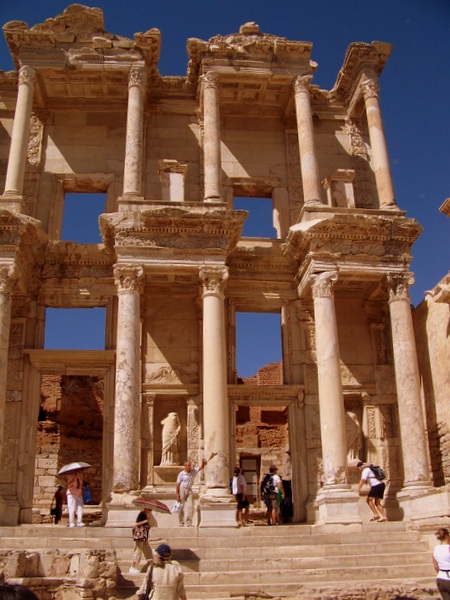
The Library of Celsus, finished around 117 AD, is the face of Ephesus, a two-storey façade of paired columns and statue niches that once held some 12,000 scrolls in double walls that buffered them against damp and heat.
It is also a tomb. The library was raised by a Roman consul’s son as a mausoleum for his father, Tiberius Julius Celsus, who is buried in a crypt directly beneath the reading room, a rare pairing of grave and library. The four female statues on the façade represent Wisdom, Knowledge, Intelligence and Virtue; these are copies, since the originals were carried off to Vienna by the early excavators.
The Terrace Houses
The one part of Ephesus that costs an extra ticket is also the one most worth it. The Terrace Houses, the Yamacevler, climb the slope opposite the Temple of Hadrian and show how the city’s wealthy actually lived from the 1st century on.
Under a modern protective roof, a walkway threads past rooms with intact wall frescoes, coloured marble cladding and floor mosaics, heated from below by a hypocaust system. These are among the best-preserved Roman domestic interiors anywhere, and the covered route is a welcome patch of shade on a hot day.
Daily Life: the Latrines, the Brothel and the Temples
The smaller monuments bring the ancient city to life better than the grand ones.
- The public latrines: a room of marble bench-seats set side by side over a drain, with no partitions, where men sat and gossiped in a row.
- The Temple of Hadrian: a small, exquisite façade on Curetes Street, its arch carved with a relief of the city’s mythical founding.
- The brothel: a ruined block near the library that guides love to point out, linked in legend to the footprint carved in the road outside.
- The Gate of Mazeus and Mithridates: the triple arch built by two freed slaves in honour of the emperor Augustus.
The Temple of Artemis and the Strange Goddess
A short way off, at the edge of Selcuk, stands what is left of the Temple of Artemis, one of the Seven Wonders of the Ancient World. The let-down is part of the story: a single re-erected column in a marshy field is all that survives of a temple once four times the size of the Parthenon, burned, rebuilt and finally quarried away.
Ephesus grew rich on its goddess. The cult statue of Artemis of Ephesus is covered from the waist up in rows of egg-shaped bulges that scholars have argued over for a century, read variously as breasts, ostrich eggs or sacrificed bull testicles, all symbols of fertility. The best examples stand in the Ephesus Museum in Selcuk, and it was the trade in her silver shrines that drove the riot against Saint Paul.
Christian Ephesus: Mary, John and the Council
Few places matter more to early Christianity, and three of its sites sit just around the ancient city.
- The House of the Virgin Mary: a small stone chapel on Bulbul Dagi where tradition holds Mary spent her last years; it is a pilgrimage site, and the popes Paul VI, John Paul II and Benedict XVI have all prayed here.
- The Basilica of St John: built by the emperor Justinian over the believed tomb of the apostle John, on the hill in Selcuk.
- The Council of Ephesus: held in the city in 431, this gathering of bishops declared Mary the Mother of God, a turning point in Christian doctrine.
- The Cave of the Seven Sleepers: on a hillside just outside the ruins, the cave where, in a legend shared by Christians and Muslims alike, a group of young men slept for centuries; the Quran retells it in its Surah of the Cave, and the necropolis around it drew pilgrims of both faiths.
For the wider picture of faith in the country, see our guide to religion in Turkey.
Selcuk, the Museum and Sirince
The ruins sit beside the easygoing town of Selcuk, worth time in its own right and the place most independent visitors base themselves.
- The Ephesus Museum: the home of the Artemis statues and the finest small finds from the site, far more rewarding after you have walked the ruins.
- The Isa Bey Mosque: a graceful Seljuk-era mosque of 1375 below the basilica, from the Seljuk period that followed Byzantine rule.
- Sirince: a former Greek hill village above Selcuk, now known for its stone houses and its homemade fruit wines.
The whole area lies in the province of Izmir, covered in our guide to Izmir.
Practical Tips: Tickets, Heat and Crowds
Ephesus is exposed, hot and hugely popular, so timing matters as much as any ticket.
- Two gates: enter at the upper Magnesia gate and walk downhill to the lower harbour gate, which saves a steep climb in the heat.
- The extra ticket: the Terrace Houses need a separate ticket on top of site entry; the Museum Pass covers the main site.
- Beat the crowds: cruise groups from the port at Kusadasi flood the site between roughly 10 and 2, so go at opening or late afternoon.
- Bring shade: there is almost no cover on the main route, so carry water, a hat and sunscreen, and check the seasonal closing time, later in summer than winter.
- Night visits: in the summer months the site now stays open into the evening and is floodlit, a cooler and far quieter way to walk the ruins.
Getting to Ephesus
The site is on the edge of Selcuk, about an hour south of Izmir and its airport, and a short drive from the cruise port at Kusadasi. Trains and buses run to Selcuk, from where it is a short taxi or a walk of around three kilometres to the gate.
Many visitors pair Ephesus with the white travertine terraces of Pamukkale a few hours inland, or fold it into a wider tour that takes in Antalya on the south coast.
Frequently Asked Questions
How long do you need at Ephesus?
Around three hours for the main site at a steady pace, or half a day with the Terrace Houses and the museum. Adding the House of the Virgin Mary and the Basilica of St John makes it a comfortable full day around Selcuk.
Are the Terrace Houses worth the extra ticket?
Yes, for most visitors. They hold the best-preserved Roman frescoes and mosaics on the site, are far less crowded than the main street, and the protective roof gives rare shade. Skip them only if you are very short on time or budget.
Why is Ephesus not on the coast?
It once was. The harbour silted up over centuries with mud carried down by the Kucuk Menderes river, the sea retreated about six kilometres, and the loss of the port slowly killed the city. That decline is why the ruins survived so intact.
Where is the Temple of Artemis?
On the edge of Selcuk, between the ancient city and the town, a short drive or walk from the main gate. Only one re-erected column remains of the Seven Wonders temple, standing in a low, often marshy field, so manage your expectations and pair it with the museum.
Can you visit the House of the Virgin Mary?
Yes. The House of the Virgin Mary on Bulbul Dagi is open to visitors of any faith and is a short drive up from the ruins. It is a quiet chapel and pilgrimage site, and three modern popes have prayed there.
When is the best time to visit?
Spring, from April to June, and autumn, in September and October, bring the most comfortable weather. Summer is intense and shadeless, and any time of year is best early in the morning or late in the day to avoid the cruise crowds.
Sources and Further Reading
- Ephesus Site, Turkish Ministry of Culture and Tourism – official tickets, hours and the Terrace Houses
- UNESCO, Ephesus – the World Heritage listing and site history
- Austrian Archaeological Institute – the team that has excavated Ephesus since 1895
- Go Turkiye – the official national tourism guide to Ephesus and Selcuk
- House of the Virgin Mary – the shrine on Bulbul Dagi and its history