Bread, ekmek, is the foundation of the Turkish table, and the country eats more of it per head than almost any other in the world. It is more than a staple. Turks call bread the staff of life, treat a fallen piece with real reverence, and bake it in a range of forms that runs from the daily white loaf to the sesame rings sold on every street corner. This is fitting, because Anatolia is one of the places where bread itself began: the oldest known fermented bread yet found comes from Çatalhöyük in central Anatolia and dates back to around 6600 BC.
This guide runs through the main Turkish breads, what each is for, the reverence that surrounds them, and a simple flatbread you can make at home. It sits within our wider guide to Turkish cuisine.
Why Bread Is Sacred in Turkey
To understand Turkish bread you have to understand how it is regarded. Bread is treated almost as a gift, and wasting it is close to a sin. It is common to see someone pick up a piece dropped on the ground, touch it to their lips and forehead, and set it somewhere high so it cannot be stepped on. People say bereket versin, may it bring abundance, when bread is shared, and a person’s livelihood is simply their ekmek parası, their bread money.
That reverence is practical as well as spiritual. Most households buy bread fresh every single day from the local fırın, the neighbourhood bakery, rather than keeping it for long. In the big cities, municipal halk ekmek kiosks sell a subsidised loaf so that good bread stays within everyone’s reach. Bread appears at every meal, and a Turk will happily eat it alongside rice or pasta, using it to scoop up sauce to the last drop.
Ekmek, the Everyday Loaf
The default bread is the somun, a soft white loaf with a thin crust, bought warm from the bakery and torn rather than always sliced. It is the bread of the breakfast table and the kebab wrap, plain and ever-present. The smell of warm bread from the fırın at first light, and again before the evening meal, is one of the constants of a Turkish neighbourhood, and a household will often send a child out for a fresh loaf minutes before sitting down to eat. Beyond it, the regions bake their own everyday loaves:
- Vakfıkebir ekmeği: the famous bread of the Black Sea, also called Trabzon bread, a large round sourdough baked in a wood oven. It is dense, deeply flavoured and keeps for days, sometimes sold in loaves weighing several kilograms.
- Mısır ekmeği: the cornbread of the Black Sea coast, dense and golden, a legacy of the region’s maize fields.
- Tandır ekmeği: bread baked against the wall of a clay tandır oven, common in the east and central plateau.
Simit, the Street Bread
The bread every visitor remembers is simit, the ring crusted thickly with sesame that is sold from red and gold glass carts at all hours. Thought to have appeared in Istanbul as far back as the sixteenth century, it is made from a leavened dough that is dipped in pekmez, grape molasses, before being rolled in sesame and baked, which gives it its colour and faint sweetness. A simit with a glass of tea is the classic cheap Turkish breakfast, and the cry of the simitçi is part of the sound of any Turkish street. Foreigners often call it the Turkish bagel, though it is lighter and crustier than that suggests. A softer, sweeter ring called kandil simidi appears on the religious nights known as kandil, a reminder that even the street bread has its festival form. Simit also turns up split and filled with cheese or chocolate spread as a quick lunch.
Pide and the Flatbreads
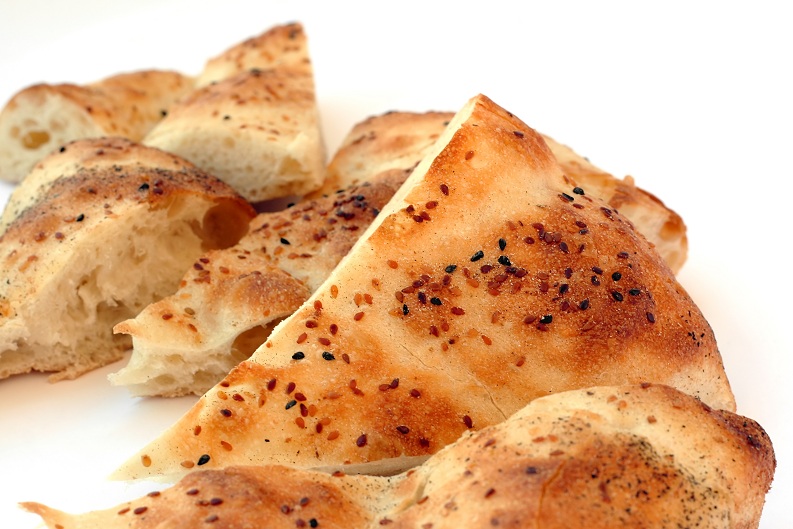
The word pide covers two things. One is the boat-shaped flatbread baked with toppings, closer to a meal. The other is a soft, round, dimpled flatbread, and its most cherished form is the Ramazan pidesi:
- Ramazan pidesi: baked only during Ramadan, a round, soft loaf scored in a lattice and scattered with sesame and nigella seeds. Bakeries sell it warm in the last hour before the fast breaks, and the queues that form for it are one of the sights of the holy month.
- Lavaş: a very thin, soft, unleavened flatbread baked in a hot oven, used to wrap kebabs and scoop meze, at its best in eastern Anatolia.
- Bazlama: a thick, round village bread cooked on a griddle rather than baked, soft and slightly chewy, common across central Anatolia.
- Gözleme: hand-rolled village flatbread folded over cheese, spinach or potato and cooked on a griddle, half bread and half savoury pancake.
- Yufka: paper-thin sheets of unleavened dough, dried for keeping, the raw material for börek pastries and for the dürüm wrap.
Each of these belongs to a different moment. Lavaş and yufka wrap and carry other food, bazlama and gözleme are made and eaten fresh in the village, and the Ramazan pidesi belongs to a single month of the year. Between them they cover almost every way a Turk meets bread across a day.
The Soft Buns
Turkish bakeries also turn out a shelf of soft, enriched buns that blur the line between bread and pastry. Açma is a soft, slightly sweet twisted roll, the gentle cousin of the simit. Poğaça is a tender bun filled with white cheese, olives or spiced potato, eaten for breakfast or with tea. Both sit in the bakery window beside the loaves and the simit, and both are everyday comfort food rather than occasion baking. Beside them you find seeded çörek rolls and small cheese pastries that fill the counter by mid-morning, the soft end of a tradition whose other end is a hard sourdough crust.
Make Turkish Flatbread at Home
Bazlama is the easiest Turkish bread to make without an oven, cooked in a dry pan on the stove. For four to six flatbreads you need:
- 3 cups (about 400 g) plain flour
- 1 cup warm water and half a cup plain yogurt
- 1 teaspoon instant yeast and 1 teaspoon sugar
- 1 teaspoon salt
Mix everything into a soft dough, knead it for a few minutes until smooth, cover it and let it rise in a warm place for about an hour until doubled. Divide it into four to six balls, roll each into a round about a centimetre thick, and cook them one at a time in a dry, hot, heavy pan, a couple of minutes a side, until they puff and colour in patches. Wrap them in a cloth as they come off the heat to keep them soft, and serve warm with cheese, olives and the rest of a Turkish meze spread. Like all Turkish bread, bazlama is made to be eaten fresh, so warm any leftovers briefly in a dry pan or brush them with butter to bring them back.
Frequently Asked Questions
What is the most common bread in Turkey?
The everyday bread is ekmek, specifically the soft white somun loaf bought fresh each day from the local bakery. It appears at almost every meal and is used to scoop up sauces and wrap kebabs.
What is simit?
Simit is a ring of bread crusted with sesame, sold from street carts across Turkey. The dough is dipped in grape molasses before being rolled in sesame and baked, which gives it a golden colour and a faint sweetness. With a glass of tea it is the classic Turkish street breakfast.
Is pide a type of bread?
Yes. Pide is both a soft round or oval flatbread and, in its other sense, a boat-shaped flatbread baked with toppings. The plain round version includes the Ramazan pidesi baked during Ramadan.
What is Ramazan pidesi?
Ramazan pidesi is a soft, round, dimpled bread baked only during Ramadan, scored in a lattice and topped with sesame and nigella seeds. Families buy it warm to break the fast, and long queues form at bakeries in the final hour before sunset.
Why is bread so important in Turkish culture?
Bread is seen as a sacred staff of life, never to be wasted, and Turkey has among the highest bread consumption per person in the world. Anatolia is one of the birthplaces of bread, with fermented bread found at Çatalhöyük dating back around eight and a half thousand years.
Sources and Further Reading
- Daily Sabah – a definitive guide to bread and its variations in Turkey
- Go Türkiye Gastronomy – the official tourism portal on Turkish food and bread culture
- UNESCO, Çatalhöyük – the Neolithic site in Anatolia tied to the early history of bread