Turkish cuisine ranks among the handful of food traditions, alongside the French and the Chinese, that can claim to be a world cuisine in its own right. It grew out of the Ottoman Empire, which drew cooks and ingredients from the Balkans to Baghdad, and rests on older Central Asian, Anatolian and eastern Mediterranean roots. The result is not a single national menu but a set of distinct regional kitchens, three of whose cities the UNESCO has named Creative Cities of Gastronomy.
This guide sets out where the cuisine comes from, how it is organised by region, the Ottoman palace legacy behind it, and the full shape of a meal: the soups and meze that open it, the kebabs and stews at its heart, the breakfast that is a feast in itself, and the sweets, tea and coffee that close it, with links to the recipes for the dishes worth cooking at home.
From the Steppe to the Palace
The roots of Turkish food reach back to the nomads of Central Asia, who carried with them the habits that still define the table: yogurt and cultured dairy, grilled and dried meat, and a deep tradition of dough, from noodles to the dumplings that became mantı. When the Turks moved into Anatolia from the eleventh century, they met the older cooking of the Greeks, Armenians, Persians and Arabs already there, and absorbed the olive oil, the vegetables and the pastries of the eastern Mediterranean.
The Ottoman Empire turned this mixture into a court cuisine of extraordinary range, pulling dishes and cooks from three continents into the kitchens of Istanbul. The modern republic inherited the whole of it, so that a single Turkish menu can hold a steppe dumpling, a Byzantine fish dish, an Arab kebab and a palace pudding without any sense of contradiction.
A Regional Cuisine, Not One Cuisine
The first thing to understand about Turkish food is that the landscape dictates the plate, and a dish in the rainy Black Sea north bears little resemblance to one in the pepper-laden southeast. The country divides into several distinct kitchens:
- The Southeast, led by Gaziantep: the spiritual home of baklava and kebab, built on pistachios, red pepper and lamb. It blends Ottoman, Arab, Kurdish and Armenian cooking, and Gaziantep alone is credited with more than four hundred dishes, from the spicy Adana kebab to lahmacun and a dozen kinds of kebab baked with aubergine or cherry.
- Hatay: the old city of Antakya, a Silk Road crossroads where Muslim, Christian and Jewish kitchens have long mixed, and a region that only joined Turkey in 1939. It is known for künefe, for spice-forward stews, for hummus and other dishes shared with the Levant, and for a vast spread of meze.
- The Black Sea: a green, wet coast where the anchovy, the hamsi, turns up in dozens of dishes, even in cornbread and rice, alongside collard greens, cornmeal, butter and the stretchy cheese fondue called mıhlama.
- The Aegean: olive-oil country, where wild herbs and greens, artichokes, sea bass and a light, vegetable-forward cooking dominate, and where the cold olive-oil dishes are at their best.
- Central Anatolia: the wheat country of Konya and the steppe, home of hearty dough dishes, the slow-baked tandır lamb and the flat etli ekmek, a long boat of dough topped with minced meat.
- Istanbul and the Marmara: the former imperial capital, where the refined Ottoman palace cuisine met the street food of a port city, and where fish, the İskender of nearby Bursa and the whole national repertoire come together.
Three Turkish cities, Gaziantep, Hatay and Afyonkarahisar, hold UNESCO Creative City of Gastronomy status, more than any other country, which gives a sense of how seriously food is taken here.
The Ottoman Palace Legacy
Much of what is now eaten across the country was refined in the kitchens of Topkapı Palace in Istanbul, where hundreds of cooks fed the imperial household and turned regional dishes into a sophisticated court cuisine. The saray mutfağı, the palace kitchen, perfected the stuffed vegetables, the slow lamb dishes and the elaborate sweets that spread out from the court into the homes of the empire. Its signature survivor is hünkar beğendi, the sultan’s delight, tender lamb served over a smoked aubergine and cheese purée, a dish that still reads as luxury. When people speak of classic Turkish cooking, they are often describing this Ottoman inheritance.
The Building Blocks
For all its variety, the cuisine rests on a short list of staples that appear at almost every table:
- Bread: ekmek is treated as sacred, eaten with everything, in forms from the everyday loaf to flat pide and the sesame-ringed simit. Our guide to Turkish bread covers the main types.
- Yogurt: the word itself is Turkish, and yogurt is eaten plain, spooned over dishes, thinned into the drink ayran and stirred into sauces and soups.
- Aubergine: the patlıcan is the national vegetable, cooked in hundreds of ways, including the famous imam bayıldı, the dish whose name means the imam fainted, supposedly at how much olive oil it took.
- Lamb, olive oil, bulgur and pulses: lamb is the meat of choice, olive oil defines the Aegean and the cold meze, and cracked wheat and beans carry the everyday cooking.
- Cheese: from the white, brined beyaz peynir of the breakfast table to aged kaşar, the crumbly tulum matured in a skin, and the herb-flecked otlu peynir of the east.
- Pepper and spice: dried red pepper, pul biber, along with cumin, sumac and mint, give the southeast its heat and the whole cuisine its warmth.
Soups and the Olive-Oil Dishes
A Turkish meal, and often a Turkish day, begins with soup. Çorba is eaten at any hour, and the red lentil mercimek çorbası, smooth and squeezed with lemon, is the one every cook knows. Alongside it sit the yogurt-and-rice yayla, the bridal ezogelin, the sour tarhana made from fermented dried dough, and the tripe işkembe that Turks swear by as a cure for a heavy night.
The cold table belongs to the zeytinyağlılar, the olive-oil dishes, vegetables cooked gently in good oil and served at room temperature: green beans in tomato, artichokes with broad beans, stuffed vine leaves and the silky imam bayıldı. These dishes, eaten cool, are among the healthiest and most refined in the whole cuisine.
Meze and the Rakı Table
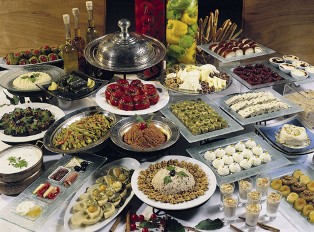
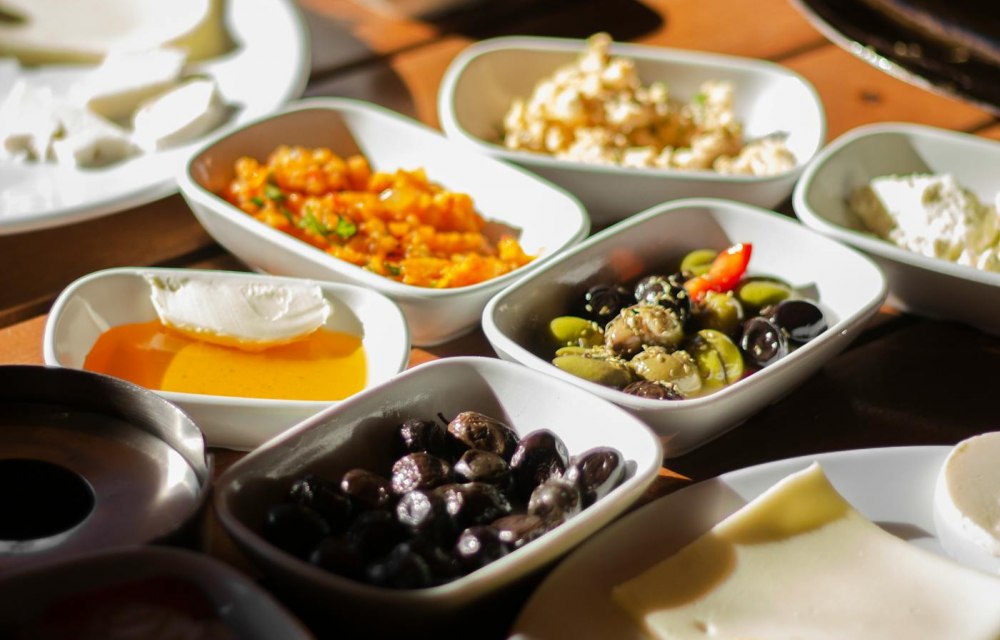
A proper meal often begins not with a single starter but with a table of meze, small cold and hot dishes meant for sharing and lingering. The cold ones lean on olive oil and yogurt: smoked aubergine, marinated beans, white cheese, the garlicky yogurt haydari, the pepper-and-walnut ezme, the fish-roe taramasalata and dolma. The hot meze run to börek pastries, fried liver in the Albanian style and grilled halloumi. Spread across a table with bread and the aniseed spirit rakı, the meze become a long, social meal in their own right, and our guide to Turkish appetizers goes through the classics.
Kebabs, Köfte and the Grill
The kebab is what most foreigners know first, and it is far more varied than the word suggests:
- Döner: the stacked, slow-roasted cone of meat shaved to order, the ancestor of the shawarma and the gyro, traced in full in our doner kebab guide.
- Adana and Urfa kebab: hand-minced lamb pressed onto wide skewers, the Adana spiced with red pepper and the Urfa mild.
- İskender: sliced döner laid over pieces of bread with tomato sauce, melted butter and yogurt, a speciality of Bursa.
- Şiş and beyti: cubes of marinated lamb or chicken grilled on skewers, and the minced beyti wrapped in flatbread and sliced into rounds.
- Testi kebabı: a Cappadocian speciality slow-cooked in a sealed clay pot that is cracked open at the table.
- Köfte: meatballs in countless regional forms, grilled, stewed in tomato, or simmered as tiny dumplings in the wedding soup.
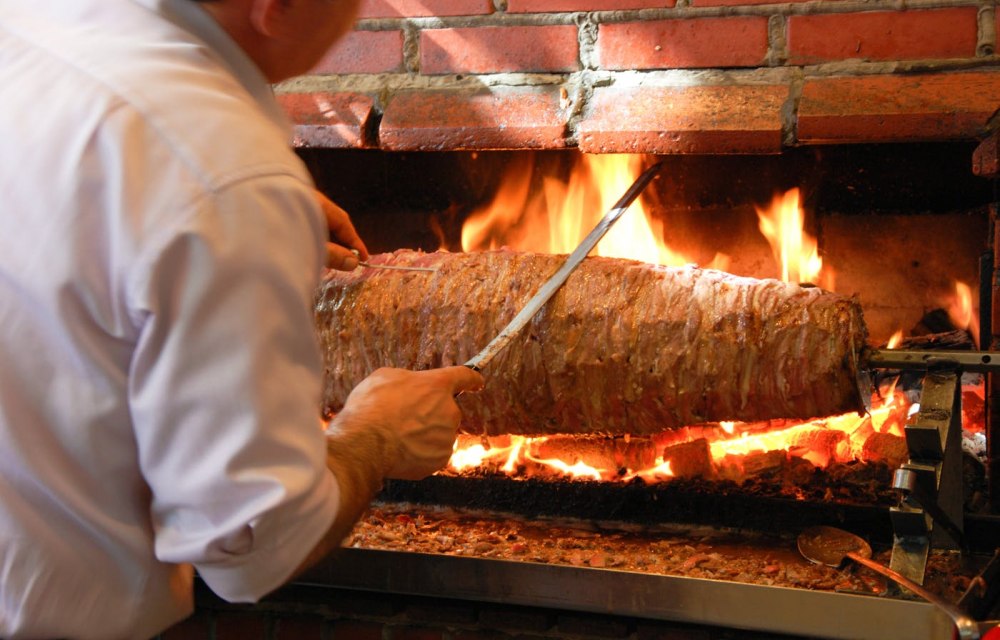
Many of these arrive with grilled peppers and tomato, a heap of bulgur pilavı, raw onion dressed in sumac and a flatbread to wrap it all. The whole grilled tradition reaches its social peak at the ocakbaşı, where diners sit around an open coal grill and the cook works in front of them.
Dough, Dumplings and Pastry
Turks do extraordinary things with flour, and a whole branch of the cuisine is built on it:
- Pide: the boat-shaped flatbread baked with toppings of cheese, minced meat or egg, often called Turkish pizza.
- Lahmacun: a thin, crisp round spread with spiced minced lamb, rolled up with parsley and lemon and eaten by hand.
- Gözleme: hand-rolled village flatbread folded over cheese, spinach or potato and cooked on a griddle.
- Börek: layered pastries of thin yufka, from the moist, baked su böreği to the crisp rolled sigara böreği.
- Mantı: the tiny lamb dumplings drowned in garlic yogurt and pepper butter, the most beloved of the steppe inheritance, covered in our Turkish ravioli recipe.
- Pilav: rice or bulgur cooked in butter and stock, including the festive iç pilav studded with liver, currants and pine nuts.
Stuffed, Stewed and from the Beans
Home cooking turns on the stuffed vegetable and the slow pot. Dolma and sarma cover anything wrapped or filled, from vine leaves and peppers to whole aubergines and courgette flowers, served warm with meat or cool in oil. The clay-pot güveç and the tas kebabı simmer lamb with vegetables until it falls apart. And the dish closest to a national one is the humblest: kuru fasulye, white beans in a tomato and pepper sauce, eaten with rice and pickles, set out in our guide to Turkish bean recipes. For a lighter meal there is menemen, eggs scrambled soft with tomato and green pepper, in our recipe for the baked Turkish egg.
The Turkish Breakfast
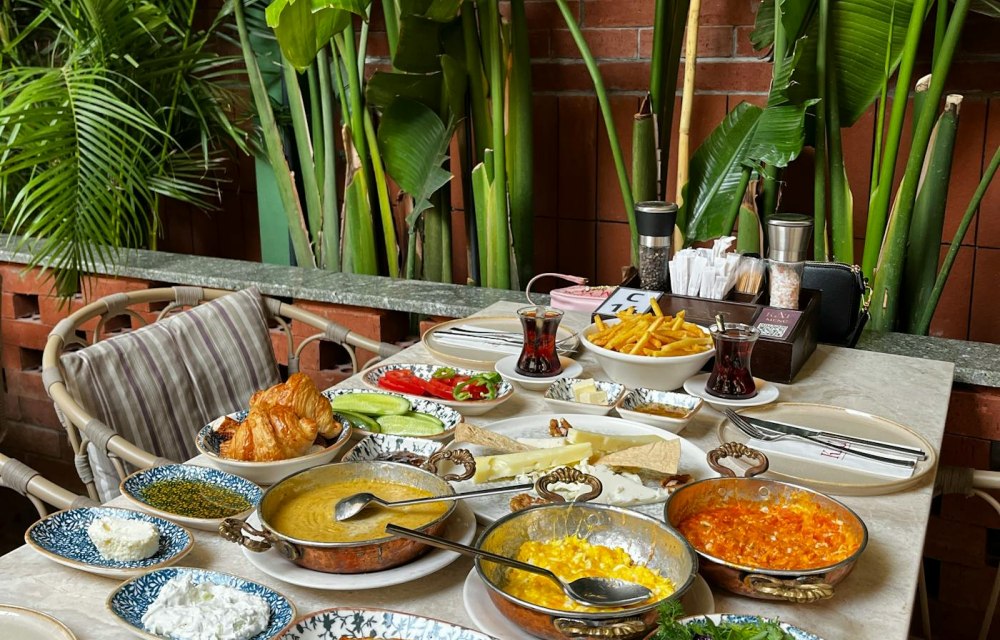
The Turkish breakfast, the kahvaltı, deserves its fame and is for many the best meal of the day, set out in our Turkish breakfast guide. It is a spread rather than a plate, and a full serpme breakfast can cover the whole table:
- Cheeses and olives: white beyaz peynir, aged kaşar and string cheese, with green and black olives.
- Bal-kaymak: honey poured over thick clotted cream, eaten on fresh bread.
- Eggs with sucuk: fried eggs cooked with the spiced, garlicky sausage, or a pan of menemen.
- Tomato, cucumber, jams and börek: the fresh vegetables, several jams, and a wedge of cheese pastry.
- Simit and endless tea: the sesame ring and glass after glass of black çay.
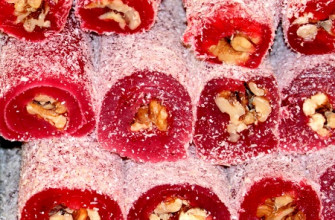
At the other end of the day comes the sweet course, the part of the cuisine that travels furthest. From the syrup-soaked baklava to the milk puddings and the rose-scented squares of lokum, the sweets are a world of their own, set out in our guide to Turkish desserts and, for the most famous of all, in our recipe for how to make Turkish delight.
Tea, Coffee and Other Drinks
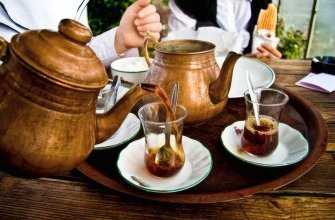
No description of the cuisine is complete without what fills the glass. Çay, black tea grown on the Black Sea around Rize and served in tulip-shaped glasses, is drunk from morning to night and is the social glue of the country. After a meal comes Turkish coffee, brewed thick and unfiltered in a cezve, so bound up with the culture that the UNESCO added it to its list of intangible heritage, and explained in our guide to how to make Turkish coffee. Alongside them sit the salty yogurt drink ayran, the national thirst-quencher, the fermented turnip juice şalgam that partners an Adana kebab, the aniseed rakı that Turks call lion’s milk for the way it clouds with water, and the winter warmers salep and the fermented millet boza.
The Culture of Eating
Food in Turkey is inseparable from hospitality. A guest is fed generously and pressed to eat more, dishes are shared from the middle of the table, and the cook is thanked with the phrase eline sağlık, health to your hands. The modest neighbourhood lokanta, serving home-style stews from a steam counter, is as central to the cuisine as any grand restaurant. The street feeds the country too, with the sesame simit sold from red carts, the grilled balık ekmek fish sandwiches by the Bosphorus, the stuffed mussels squeezed with lemon and the late-night kokoreç. The Antep pistachio that crowns the sweets, traced in our guide to Turkish pistachios, is just one thread in a cuisine that treats good ingredients as a birthright.
Frequently Asked Questions
What is Turkish cuisine known for?
Turkish cuisine is known for its kebabs and grilled meats, its long tables of meze, its olive-oil vegetable dishes, its syrup-soaked and milk-based desserts such as baklava and lokum, and its tea and coffee culture. It is a regional cuisine shaped by the Ottoman Empire and by the country’s varied landscapes, from the Black Sea coast to the southeastern plains.
What are the most famous Turkish dishes?
Among the best known are döner and Adana kebab, İskender, köfte meatballs, mantı dumplings, lahmacun and pide, stuffed vegetables, white beans in tomato sauce, menemen and the meze table, followed by the sweets baklava, künefe and Turkish delight, all washed down with tea or Turkish coffee.
Is Turkish food spicy?
It depends on the region. The southeast around Gaziantep and Şanlıurfa uses dried red pepper freely and can be genuinely hot, while the Aegean and the Black Sea are much milder, leaning on olive oil, herbs and butter rather than chilli.
What is the difference between Turkish and Middle Eastern food?
They overlap, especially in the southeast, sharing kebabs, hummus and baklava, but Turkish cuisine carries a stronger Central Asian thread in its yogurt, dumplings and dough, a distinct Ottoman palace tradition, and regional kitchens such as the seafood-and-anchovy cooking of the Black Sea that have no Middle Eastern parallel.
What is a Turkish breakfast?
A Turkish breakfast, or kahvaltı, is a shared spread of cheeses, olives, tomato and cucumber, honey and clotted cream, jams, eggs cooked with spiced sucuk sausage, bread and simit, accompanied by endless glasses of tea. It is a meal to linger over rather than a quick start to the day.
Sources and Further Reading
- Go Türkiye Gastronomy – the official tourism portal’s guide to Turkish food, regions and the gastronomy cities
- UNESCO Creative Cities Network – the listing of Gaziantep, Hatay and Afyonkarahisar as Cities of Gastronomy
- UNESCO Intangible Heritage: Turkish coffee – the inscription of Turkish coffee culture and tradition
- Türkiye Today – on the standout flavours of the Turkish UNESCO gastronomy cities