Roman Catholicism is the main religion in Argentina, with around 63 percent of the population identifying as Catholic on the 2019 CONICET national survey of religious beliefs, down from 92 percent in the early 1990s. The country is also the home church of Pope Francis, born Jorge Mario Bergoglio in Buenos Aires in 1936 and pope from March 2013 until his death in April 2025. Argentina hosts the largest Jewish community in Latin America, an established Muslim community concentrated around Buenos Aires, the fourth-largest Latter-day Saints population worldwide, growing evangelical Protestant churches, and indigenous spiritual traditions in the northwest, the Gran Chaco, and Patagonia. This article walks through each community, the 1994 constitutional reform that redrew the legal status of the Catholic Church, the post-Francis papal transition and the religious profile of President Javier Milei, the AMIA bombing case as it stands after the 2024-2025 Argentine court rulings, and the popular devotions to figures such as Gauchito Gil and the Difunta Correa that run alongside the formal church.
Argentina Religious Demographics at a Glance
The national picture of religious affiliation in Argentina has shifted across the past three decades. The CONICET second national survey of creencias y actitudes religiosas, published in 2019, stands as the most thorough data point to date, and its headline figures look as follows:
- Roman Catholics: around 63 percent of the population
- No religious affiliation: around 19 percent
- Pentecostal and other evangelical Protestants: around 15 percent
- Other Christian traditions, Jewish, Muslim, Buddhist, and indigenous communities: around 3 percent combined
The earlier CONICET survey of 2008 put Catholics at around 76 percent, and the 1960s national estimates ran above 90 percent. The unaffiliated category is the fastest-growing single block, with younger urban Argentines making up most of the increase. The figures cited in the sections below draw on the CONICET survey rounds, on the Argentine federal religion registry maintained by the Secretaria de Culto, and on community institutions such as AMIA and the Centro Islamico de la Republica Argentina. Our general country guide at facts and statistics for Argentina places these religious figures inside the wider demographic map of the country.
The national average masks a sharp regional split. The Catholic share holds strongest in the Northwest provinces, while Patagonia and the Northeast carry the country’s largest evangelical concentrations and Greater Buenos Aires holds the most non-religious population:
| Region | Catholic | Evangelical | No religion |
|---|---|---|---|
| Greater Buenos Aires | 56% | 15% | 26% |
| Northwest (NOA) | around 76% | 17% | low single digits |
| Northeast (NEA) | around 65% | 23% | around 9% |
| Patagonia | 51% | 24% | 24% |
A visitor walking the Salta and Jujuy festival calendar will see large parish processions and dense Catholic-Pachamama overlay, while a road trip through Bariloche, Trelew, or Comodoro Rivadavia in Patagonia exposes a thinner Catholic footprint and Pentecostal storefront churches in working-class neighbourhoods.
Catholicism and the 1994 Constitutional Reform
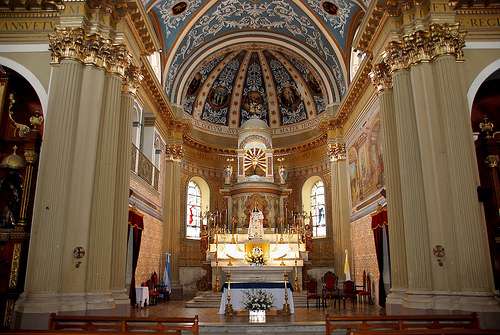
Roman Catholicism shaped Argentine public life from the colonial period through the second half of the twentieth century, and the colonial foundation of cities such as Cordoba, Santa Fe, and Buenos Aires carried a parish and cathedral structure that followed the spread of the population across the viceroyalty of the Rio de la Plata. The 1853 constitution required the head of state to be a member of the Roman Catholic Apostolic Church, a clause that stood in place until the wider reform of August 1994 when the Justicialist and Radical parties under President Carlos Menem negotiated its removal alongside the introduction of direct presidential election and other changes. The state still recognises the Catholic Church through a 1966 concordat with the Holy See and provides direct funding to bishops and seminaries under that arrangement, although several Argentine governments since 2015 have debated ending the financial relationship.
Weekly Mass attendance sits at around 10 to 14 percent of the population on recent CONICET survey rounds, with much higher figures for occasional attendance at baptism, marriage, and funeral services. The election of Jorge Mario Bergoglio as Pope Francis on 13 March 2013 produced a surge in church-related public interest in Argentina, and his pontificate closed with the canonisation of the Argentine laywoman Mama Antula on 11 February 2024 in St Peter’s Basilica, with President Javier Milei attending the ceremony. The fuller colonial and twentieth-century arc of the church in the country is traced in our religious history of Argentina.
Pope Francis died on Easter Monday, 21 April 2025, at his residence in Casa Santa Marta after a stroke, aged 88. The day before, he had given the urbi et orbi blessing from the loggia of St Peter’s and ridden through the square in the popemobile for fifteen minutes among the Easter crowd. Argentine reception of the news ran across the country: thousands gathered on Plaza de Mayo in front of the Buenos Aires Metropolitan Cathedral, the daily Clarin ran a front page reading “Santo ya,” and parishes from Salta to Ushuaia held memorial Masses through the week. The conclave of 7 to 8 May 2025 elected Cardinal Robert Francis Prevost on the fourth ballot, and he took the name Pope Leo XIV. Prevost had served as Prefect of the Dicastery for Bishops and as President of the Pontifical Commission for Latin America, and the Latin American cardinal bloc, joined by curia voices including Argentine theologian Emilce Cuda and Cardinal Carlos Castillo Mattasoglio of Lima, carried him over the threshold. Reporting from the conclave describes Leo XIV as broadly continuity with the Francis agenda rather than a course correction, although he shifts the Latin American papal centre of gravity from Buenos Aires to the Andes.
President Milei and the Religious Politics of 2024-2025
President Javier Milei took office in December 2023 with a religious profile no previous Argentine head of state has carried. Raised Catholic and a vocal critic of Pope Francis during the campaign, Milei reconciled with the pope at a one-on-one Vatican meeting on 12 February 2024, the day after the Mama Antula canonisation. He has publicly described himself as a student of the Torah, reads Jewish religious texts daily under the direction of Rabbi Axel Wahnish of the Buenos Aires Chabad-Lubavitch community, and announced his intention to convert to Judaism while keeping the formal step on hold because Sabbath observance would conflict with his presidential duties. Milei traced this trajectory to a Jewish maternal grandfather discovered late in his life. As a sitting head of state he visited the Ohel grave of Rabbi Menachem Mendel Schneerson in Queens, New York in November 2023.
The Milei administration has reshaped Argentine policy on the AMIA bombing case and on Iran. Argentina officially declared Iran and the Lebanese Shia movement Hezbollah responsible for the 1994 AMIA bombing and the 1992 Israeli embassy bombing, designated the Iranian Revolutionary Guard Corps as a terrorist organisation in 2024, and moved to pursue a trial in absentia for the Iranian suspects covered by the Interpol red notices. The shift contrasts with the 2013 Cristina Fernandez de Kirchner administration memorandum of understanding with Iran, which the post-2023 federal courts have since treated as the trigger for further investigations described in the section on the AMIA case below.
Modern Argentine Saints and Beati
Argentine Catholicism gained four formally recognised figures between 1999 and 2024, giving the country a more populated saintly calendar than at any point in its history. The four below appear in the order of their elevation, and each carries a pilgrimage site that travellers can still visit.
Hector Valdivielso Saez (canonised 1999)
Born in Buenos Aires in 1910 and trained as a La Salle Christian Brother in Spain, Valdivielso was shot in October 1934 during the Asturian miners’ rising, killed with seven other De La Salle brothers and one Passionist priest in the town of Turon. Pope John Paul II canonised the group on 21 November 1999, which made Valdivielso the first Argentine-born person ever raised to the altars. His remains rest in the De La Salle chapel in Bujedo, Burgos, and parish dedications in Buenos Aires and Cordoba mark the Argentine connection.
Ceferino Namuncura (beatified 2007)
Ceferino Namuncura was born in 1886 in Chimpay, in the Rio Negro province of Patagonia, son of the Mapuche cacique Manuel Namuncura. He entered Salesian schools in Buenos Aires, was sent to Rome to study for the priesthood, and died of tuberculosis in 1905 at the age of eighteen. Cardinal Tarcisio Bertone, papal Secretary of State and a Salesian himself, beatified him on 11 November 2007 in Chimpay, in front of a crowd of more than ten thousand that included Mapuche delegations in plumed headdresses. The town of Chimpay carries an annual pilgrimage on 26 August, the date of his death.
Cura Brochero (canonised 2016)
Jose Gabriel del Rosario Brochero, the Cura Gaucho, served the Sierras de Cordoba from 1869 until his death from leprosy in 1914, having caught the disease while tending to sick parishioners during decades of muleback travel. Pope Francis canonised him on 16 October 2016, the first Argentine diocesan priest raised to the altars at the Vatican. The pilgrim circuit through Mina Clavero, Traslasierra, and Villa Cura Brochero, the Cordoba town that carries his name, runs year-round.
Mama Antula (canonised 2024)
Maria Antonia de Paz y Figueroa, a consecrated laywoman from Santiago del Estero born in 1730, walked barefoot to Buenos Aires in 1779 carrying only a wooden crucifix to spread Ignatian spiritual exercises after the Spanish crown expelled the Jesuits from the Rio de la Plata. She founded the Casa de Ejercicios Espirituales, ran retreats for thousands of laywomen and clergy, and died in 1799. The beatification cause opened in 1905, the first miracle was approved in 2016, and Pope Francis recognised the second miracle, the recovery of Claudio Perusini from a severe stroke, in October 2023. She was canonised on 11 February 2024, with President Javier Milei attending the ceremony, and her relics rest at the Casa de Ejercicios on Avenida Independencia.
Evangelical and Protestant Growth
Evangelical and Protestant communities have grown faster than any other religious group in Argentina across the past three decades. The CONICET 2019 round put the combined evangelical and historic Protestant share at around 15 percent of the population, with the strongest growth among Pentecostal and neo-Pentecostal congregations in the urban working-class neighbourhoods of Greater Buenos Aires, Cordoba, Rosario, and the northern provinces of Chaco, Formosa, and Misiones. The older Protestant presence in Argentina runs through the Anglican Church, the Lutheran Church among Volga German communities in Entre Rios and Buenos Aires province, the Methodist Church, and several Reformed and Mennonite congregations with nineteenth-century roots in European migration.
The Alianza Cristiana de Iglesias Evangelicas de la Republica Argentina, known by the initials ACIERA, serves as the largest umbrella body for evangelical congregations and negotiates with the national government on legal recognition and tax status. The Secretaria de Culto national religion registry records several thousand evangelical congregations across the country, with new registrations filed each year. The growth runs parallel to the decline in formal Catholic practice and has drawn academic and journalistic attention since the early 2000s, with researchers at CONICET and the Universidad de Buenos Aires publishing regular work on the social base of the Pentecostal churches.
Buenos Aires Jewish Community and AMIA
Argentina holds the largest Jewish community in Latin America, with community institutions estimating a population of around 230,000 to 250,000 people, the great majority living in Buenos Aires. The community grew through several migration waves starting in the late nineteenth century, including Sephardic Jews arriving from Morocco and the Ottoman lands from the 1880s onward and a larger Ashkenazi migration from Russia, Poland, Romania, and the Austro-Hungarian Empire through the period before and after the First World War. The Asociacion Mutual Israelita Argentina, known by the initials AMIA, was founded in 1894 and remains the central institution of Argentine Jewish life, running burial societies, welfare programmes, cultural centres, and a historical archive on the community.
Its building in the Once neighbourhood of Buenos Aires was destroyed in the bombing of 18 July 1994 that killed 85 people and injured hundreds more, the deadliest single attack of its kind in Argentine history. The annual commemoration on 18 July remains a significant date in the country’s public life. Conservative, Reform, Orthodox, and Chabad-Lubavitch congregations all operate in Buenos Aires, and the community runs schools, youth organisations, and the Hebraica Argentina sports and cultural club in the Once and Villa Crespo neighbourhoods.
The AMIA case moved decisively in 2024 and 2025 after three decades of stalled prosecution. In April 2024 the Federal Court of Criminal Cassation ruled that the Islamic Republic of Iran organised and financed the 1994 AMIA attack and the 1992 attack on the Israeli embassy in Buenos Aires, with operational execution by Hezbollah, and labelled both as crimes against humanity. The lead prosecutor Alberto Nisman had filed the original 2006 accusation against Iranian officials and Hezbollah operatives, and his death on the night of 18 January 2015, the day before he was due to testify before the Argentine Congress, was reclassified as a murder by a federal court ruling in January 2025. In December 2024 the Argentine Supreme Court allowed the treason case against former president Cristina Fernandez de Kirchner and several of her ministers to proceed, on the question of whether the 2013 memorandum of understanding with Iran obstructed justice. The community’s annual 18 July commemoration in 2024 and 2025 drew larger crowds than in any prior year, and Argentine media now treat the case as an active judicial process rather than a historical injustice.
The Argentine Muslim Community
The Muslim community of Argentina numbers around 400,000 to 700,000 according to community sources, although the Secretaria de Culto registry lists a smaller figure and the Argentine national census has never included a religion question in a form that captures Islam with precision. Most members descend from late nineteenth and early twentieth century migrants from Syria, Lebanon, and Palestine, many of whom arrived under Ottoman passports during the final decades of the empire and are still described in Argentine Spanish as turcos regardless of actual origin. The King Fahd Islamic Cultural Center in the Palermo neighbourhood of Buenos Aires, opened in the year 2000 on land donated by the city government during the presidency of Carlos Menem, ranks among the largest mosques in Latin America and houses a library, classrooms, and a dedicated prayer hall.
The Centro Islamico de la Republica Argentina, founded in 1931, serves as the oldest Muslim institution in the country and maintains the historic mosque on Avenida San Juan in the San Cristobal neighbourhood. Several smaller Shia and Sunni congregations operate in Cordoba, Rosario, Mendoza, and in the northwestern provinces where earlier Syrian-Lebanese migration left a sustained community presence.
Latter-day Saints and Other Christian Minorities in Argentina
The Church of Jesus Christ of Latter-day Saints reported 491,160 members in Argentina at the end of 2024, the fourth-largest LDS country membership in the world after the United States, Mexico, and Brazil. The Argentine LDS community is roughly twice the size of the country’s Jewish community in raw member counts, although weekly active participation rates are lower than the formal membership figure suggests. The LDS Church operates 80 stakes and 14 missions across Argentina, with new temples dedicated in Mendoza in March 2024 and in Salta in September 2024, joining the existing Buenos Aires Argentina Temple and Cordoba Argentina Temple. The first LDS missionaries arrived in Argentina in 1925, and the Argentine Mission was the first formally organised LDS mission in South America.
Jehovah’s Witnesses count around 175,000 active publishers in Argentina according to community reports, with several thousand congregations across the country. Seventh-day Adventists run their own school and medical network including the Universidad Adventista del Plata in Entre Rios, founded in 1898 by German-speaking Adventists who arrived from Russia. Eastern Orthodox congregations descend from late nineteenth and twentieth century migrations and include the Russian Orthodox cathedral in San Telmo, completed in 1904 as the oldest Orthodox church building in South America, plus Antiochian, Greek, and Serbian congregations in Buenos Aires. The Anglican Cathedral of St John the Baptist on Avenida 25 de Mayo, consecrated in 1831, is the oldest non-Catholic place of Christian worship in the country and the seat of the Anglican Diocese of Argentina within the Province of South America.
Indigenous Spirituality and the Andean Pachamama
Indigenous spiritual traditions have survived in Argentina in the communities of the northwest, the Gran Chaco, the northeast, and Patagonia, often alongside Catholic practice. The Mapuche communities of the Patagonian provinces of Neuquen, Rio Negro, and Chubut maintain the ngillatun ceremony and its associated cosmology. The Wichi, Toba, and Pilaga peoples of the Gran Chaco in Chaco and Formosa provinces carry their own ritual and healing traditions.
The Guarani communities of Misiones province in the northeast preserve the nhemonguetara religious practice, and the Quechua and Aymara communities of Jujuy and Salta in the northwest continue the Andean Pachamama or Mother Earth devotion. The Pachamama ceremonies of early August in the northwestern highlands blend with Catholic festivals and the parish calendar, with offerings of food, coca leaves, and aguardiente poured into an open hole in the earth during the opening days of the month. The Argentine national census began collecting self-identification data on indigenous ancestry in 2001, and the 2022 round counted around 1.3 million Argentines who identify as indigenous across dozens of recognised peoples.
The Pachamama-Catholic blend goes deeper than calendar coexistence in Salta, Jujuy, and Catamarca. A Quechua family at a parish saint’s day in Tilcara will pour the first sip of wine, chicha, or aguardiente onto the soil as an offering to the Earth. The Virgin of Copacabana on parish altars across the puna receives offerings of coca leaves at her feet. The same farmer who brings a child to baptism on Sunday may visit a curandero or yatiri the following week, and survey researchers describe this overlap as religiosidad popular.
Popular Devotions: Gauchito Gil and Difunta Correa
Popular religious devotion to unofficial saints runs alongside the formal Catholic church across much of Argentina and draws hundreds of thousands of pilgrims each year. The Gauchito Gil devotion centres on Antonio Mamerto Gil Nunez, a folk figure venerated in Corrientes province in the northeast whose shrine at Mercedes draws around half a million pilgrims on 8 January each year, the anniversary of his execution in the 1870s according to the legend. Red ribbons tied to trees and roadside shrines across the country mark the reach of the devotion, which the official church has discouraged without much effect on the numbers.
The Difunta Correa devotion centres on Deolinda Correa, a woman who according to legend died of thirst in the deserts of San Juan province during the civil wars of the 1840s while her infant son survived nursing from her. Pilgrims visit the Vallecito shrine year-round and leave offerings of water bottles, scale models of houses, cars, and tools, and photographs of loved ones. CONICET survey work shows that around eight in ten Argentines believe in some form of divine healing or miraculous intervention regardless of formal religious affiliation, which places the popular saints at the centre of Argentine religious life rather than at its margins. For the wider context of these practices see our guide to culture and customs in Argentina.
Three older folk-saint figures predate the better-known shrines. Madre Maria, born Maria Salome Loredo y Otaola in Spain in 1854 and brought to Buenos Aires as a teenager, ran a free clinic and prayer mission in the city until her death in 1928; her tomb at the Chacarita cemetery still draws daily visitors who tape gratitude plaques to the marble. Pancho Sierra, the Gaucho Saint of Salto in Buenos Aires province, treated thousands of pilgrims at his Estancia El Porvenir from the 1870s until his death in 1891, charging nothing and prescribing only cold cistern water and prayer; his mausoleum in the Salto cemetery fills with white carnations on the 4 December anniversary. Miguel Angel Gaitan, born in 1966 in the Banda Florida hamlet on the Bermejo river in La Rioja province and dead from meningitis weeks short of his first birthday, became the Angelito Milagroso after a 1973 storm cracked open his coffin in the Villa Union cemetery and locals reported the body intact; his mausoleum there holds toys, school trophies, and rosaries left by pilgrims from La Rioja, Catamarca, and Cordoba.
The Iglesia Maradoniana sits at the secular edge of this folk-religious spectrum. Three Rosario fans of Diego Maradona founded the church on his thirty-eighth birthday on 30 October 1998, and it now claims 120,000 to 200,000 registered members across more than 130 countries. Its calendar starts at year zero in 1960, Maradona’s birth year, and counts forward in years AD, or After Diego, with 22 June, the date of the 1986 Hand of God goal against England, marking the equivalent of Easter. It is a parody, but its scale shows the appetite for vernacular cult-making that runs through Argentine religious life from Pancho Sierra to the present.
Frequently Asked Questions
What is the main religion in Argentina?
The main religion in Argentina is Roman Catholicism, with around 63 percent of the population identifying as Catholic on the CONICET 2019 national survey of religious beliefs. The Catholic share has fallen from 92 percent in the early 1990s and from 76 percent in the 2008 survey round, and the unaffiliated category has climbed from under 4 percent to around 19 percent across the same period.
What percentage of Argentina is Catholic?
Around 63 percent of the Argentine population identified as Roman Catholic on the CONICET 2019 national religion survey. Weekly Mass attendance sits closer to 10 to 14 percent, and much larger numbers attend the church for baptism, marriage, and funeral services without regular weekly practice.
What religions are practised in Argentina?
Roman Catholicism is the largest religion in Argentina, followed by Pentecostal and other evangelical Protestant churches at around 15 percent, historic Protestant traditions including Anglican, Lutheran, and Methodist congregations, a Jewish community of around 230,000 to 250,000 members, a Muslim community of around 400,000 to 700,000 depending on the source, and indigenous spiritual traditions maintained by Mapuche, Wichi, Toba, Guarani, Quechua, and Aymara communities. Around 19 percent of Argentines report no religious affiliation on the 2019 CONICET survey.
Is Argentina still officially a Catholic country?
Argentina has not required the head of state to be Roman Catholic since the constitutional reform of August 1994, and the state is not formally Catholic. The government still recognises the Catholic Church through a 1966 concordat with the Holy See and provides direct funding to bishops and seminaries under that arrangement, although the financial relationship has been debated in Congress during several recent legislative periods.
How large is the Jewish community in Argentina?
The Argentine Jewish community numbers around 230,000 to 250,000 people according to community estimates, the largest in Latin America. The great majority live in Buenos Aires, and the central institution of the community is the Asociacion Mutual Israelita Argentina, founded in 1894 and known by the initials AMIA.
What is the Gauchito Gil devotion?
The Gauchito Gil is a popular saint figure venerated across Argentina, centred on Antonio Mamerto Gil Nunez, a folk figure from Corrientes province in the northeast. Pilgrims gather at the Mercedes shrine on 8 January each year, the anniversary of his execution in the 1870s according to the legend, and red ribbons tied to trees and roadside shrines across the country mark the reach of the devotion.
Who are Argentina’s modern saints?
Four Argentines have been raised to the altars of the Catholic Church across the past three decades. Hector Valdivielso Saez was canonised in 1999 by Pope John Paul II, Ceferino Namuncura was beatified in 2007, Cura Brochero was canonised by Pope Francis in 2016, and Mama Antula was canonised by Pope Francis in February 2024 as the first Argentine woman raised to sainthood.
Did Pope Francis die?
Pope Francis died on Easter Monday, 21 April 2025, at the age of 88, the day after he gave the urbi et orbi blessing on St Peter’s Square. The conclave elected Cardinal Robert Francis Prevost on 8 May 2025 as Pope Leo XIV, the first United States-born pope, with more than two decades of missionary service in Peru behind him.
What religion is President Javier Milei?
Javier Milei was raised Roman Catholic and studies Jewish religious texts under the guidance of Rabbi Axel Wahnish of the Buenos Aires Chabad-Lubavitch community. He has announced his intention to convert to Judaism while holding off on the formal step because Sabbath observance would conflict with his presidential schedule. Milei traces this interest to a Jewish maternal grandfather and visited the Ohel grave of Rabbi Menachem Mendel Schneerson in Queens in November 2023. He met Pope Francis in February 2024 after his earlier campaign criticism of the pope, and his administration attended the Mama Antula canonisation that same week.
How many Mormons live in Argentina?
The Church of Jesus Christ of Latter-day Saints reported 491,160 members in Argentina at the end of 2024, the fourth-largest national LDS membership in the world. The Argentine LDS community is roughly twice the size of the country’s Jewish community in formal member counts. Four LDS temples now operate in the country, in Buenos Aires, Cordoba, Mendoza (dedicated March 2024), and Salta (dedicated September 2024).
Sources and Further Reading
- CONICET, Segunda Encuesta Nacional sobre Creencias y Actitudes Religiosas en Argentina, 2019, full PDF
- Vatican News, Pope Francis canonises Argentinian laywoman Mama Antula, 11 February 2024
- Vatican News, Pope Francis dies on Easter Monday aged 88, 21 April 2025
- Secretaria de Culto, Registro Nacional de Cultos, argentina.gob.ar
- Asociacion Mutual Israelita Argentina, institutional site
- Centro Islamico de la Republica Argentina
- Fortunato Mallimaci, El mito de la Argentina laica: Catolicismo, politica y Estado, Capital Intelectual, Buenos Aires, 2015
- Pew Research Center, Religion in Latin America: Widespread Change in a Historically Catholic Region, 2014
- Aldo Ameigeiras et al., Religiosidad popular y devociones en Argentina, CEIL-CONICET working papers, Buenos Aires