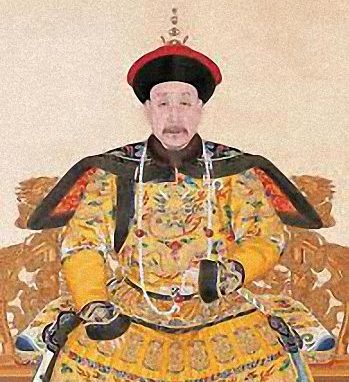
The social classes of ancient China formed a four-rank Confucian hierarchy of gentry scholars, peasant farmers, artisans, and merchants, known in Chinese as 士 (shì), 农 (nóng), 工 (gōng), and 商 (shāng), with the emperor and imperial court above the four classes and a slave and bonded-labour population below them. The hierarchy traces back to the Zhou dynasty around 1046 BCE and the feudal political order called 封建 (fēngjiàn) that followed. The official scheme stayed in place from the Zhou through the abdication of the last Qing emperor Puyi in 1912, but the working class structure of imperial China was always wider and more layered than the four-estate textbook formula admits.
This page covers the formal scheme and the real complexity: the Zhou five-tier feudal hierarchy, the 九品中正制 nine-rank aristocratic system that ran from 220 to 589 CE, the 科举 examination system with its actual pass-rate numbers across Tang through Qing, the Yuan dynasty’s four-caste ethnic ranking, the Ming hereditary occupational households, the 贱民 outcast classes freed by Yongzheng’s 1723 emancipation edict, the Qing 包衣 Manchu bondservants who staffed the Imperial Household Department, the eunuchs who ran a parallel inner-court power structure, and the Buddhist and Daoist clergy outside the class system. Each layer sits in dynastic histories and modern scholarship; most are missing or underdeveloped in the SERP for “ancient china social classes”. The walk-through covers the structure across dynasties from Zhou through Qing.
Ancient China Social Structure at a Glance
The ancient China social structure ran as a ranked system from the emperor down to slaves, with four occupational categories in between and several layers of hereditary special status off to the side. In descending order of formal Confucian rank:
- Emperor and imperial court: ruled under the Mandate of Heaven (天命 tiānmìng), with the empress, imperial concubines, eunuchs, princes of the blood, and senior central officials.
- Shi (士) gentry scholars: civil-service bureaucrats trained in the Confucian classics, originally a warrior aristocracy in the Zhou era.
- Nong (农) peasant farmers: the majority of the population, producing food and paying the land tax.
- Gong (工) artisans and craftsmen: potters, metalworkers, weavers, paper and porcelain producers.
- Shang (商) merchants and traders: at the formal bottom of the four classes despite substantial wealth.
- Slaves and bonded labour: drawn from war captives, criminals, debtors, and frontier prisoners.
Several categories sat outside or alongside the four-estate scheme. Aristocratic clans (门阀士族 ménfá shìzú) dominated public office between the Han collapse and the Tang exam-system maturation. Hereditary military households (军户 jūnhù) and artisan households (匠户 jiànghù) emerged in the Ming and were abolished under Yongzheng. The Yuan dynasty imposed a four-caste ethnic ranking (蒙古 / 色目 / 汉人 / 南人) from 1271 to 1368. The 贱民 outcast classes carried hereditary stigma through to the Qing. The Qing 包衣 Manchu bondservants held senior court roles. Buddhist and Daoist clergy operated outside the class system from the Han dynasty onward. Women were classified by the rank of their father and then their husband.
The Zhou Feudal Hierarchy: Five-Tier Pre-Imperial Order
Before the Qin unification of 221 BCE, the Zhou dynasty ran a five-tier feudal system from 1046 BCE down through the Spring and Autumn from 771 to 476 BCE and Warring States from 475 to 221 BCE periods. The structure differed from the imperial four-estate scheme in two ways: military rank outranked civilian, and the categories were hereditary rather than occupational.
- 天子 (tiānzǐ, Son of Heaven) – the Zhou king, ruling under the Mandate of Heaven over a network of vassal states.
- 诸侯 (zhūhóu, regional lords) – rulers of the 70 or so vassal states established under the Western Zhou enfeoffment system. Lords held five rank tiers: 公 (gōng, duke), 侯 (hóu, marquis), 伯 (bó, earl), 子 (zǐ, viscount), 男 (nán, baron).
- 卿大夫 (qīngdàfū, ministers and grandees) – state officials who managed administration and held land grants from the regional lord. Often hereditary within high-status clans.
- 士 (shì, knights and lower nobility) – originally a warrior aristocracy, later the source of the imperial scholar class. The original sense of 士 was military: a chariot-fighter or armoured retainer in the Zhou ranks.
- 庶人 (shùrén, commoners) – peasant farmers, workshop labourers, and small traders without land or rank. Paid corvee labour and military levies to the lord.
- 奴隶 (núlì, slaves) – war captives, debt bondsmen, and the descendants of conquered tribes. Used in Zhou royal workshops and on temple estates.
The Warring States period broke the older aristocracy. State chancellors like Shang Yang of Qin from 390 to 338 BCE and Wu Qi of Chu instituted reforms that promoted men by military and administrative merit, undermining the hereditary 卿大夫 layer. By the Qin unification, the five-tier feudal scheme was replaced by a centralized bureaucracy under the emperor. The 士 class survived the transition but converted from warrior aristocracy to scholar bureaucracy, and the term 士 took on its second meaning as “scholar” alongside its first meaning as “knight”. For broader context on the dynastic transitions, see the ancient China timeline.
The Confucian Four Estates: 士 农 工 商 in Theory
The four-estate framework (四民 sìmín) is recorded as early as the late Zhou period and was systematized in the Han dynasty under Confucian and Legalist reception. Mengzi, also known in the West as Mencius and active from 372 to 289 BCE, wrote in the 滕文公上 chapter that “those who labour with their minds govern others; those who labour with their muscles are governed”. The hierarchy expressed that judgement in occupational form: scholars first because they produced governance, farmers second because they produced food, artisans third because they produced tools, and merchants fourth because they moved goods without producing anything.
The framework was a moral and ideological model rather than a working census category. The Han Book of Rites (礼记 Lǐjì) and the Tang Tang Code (唐律 Tánglǜ) used the four-estate terminology in legal and ceremonial texts, but actual registration ran on different categories: 户 (hù, household type) for tax purposes, 籍 (jí, register) for military and corvee, and 品 (pǐn, rank) for the scholar-official bureaucracy. A Tang peasant who paid the land tax was registered as 良民 (liángmín, “good people”), while a war captive’s descendant who served at a frontier fort was registered as 部曲 (bùqǔ, semi-free military dependent). The four-estate words appeared in classical commentary; the registration ran on parallel state-administrative categories.
Wikipedia’s Four Occupations entry notes that the system “was not a hereditary system” and that individuals could in principle move between categories. This was true at the level of Confucian theory and partially true in practice for the merchant-to-gentry path. The hereditary stigma layers documented further down on this page (贱民, Ming 军户, 包衣) ran on a different logic.
The Emperor and the Imperial Court
The emperor sat at the top of the social order from the Qin unification of 221 BCE through the abdication of Puyi in 1912. The throne ruled under the 天命 (tiānmìng) Mandate of Heaven, a doctrine that gave the dynasty legitimacy as long as it maintained order, agricultural prosperity, and ritual observance. Natural disasters, peasant rebellions, and military defeats were read by court historians as signs the mandate was withdrawing. The doctrine was bidirectional: it justified absolute power while making each dynasty conditionally accountable.
The imperial household held substantial wealth, including direct ownership of large land estates, salt and iron monopolies in some periods, and the imperial workshops that produced silk, porcelain, and ritual objects. Throne succession ran through primogeniture in most periods, with the empress dowager exercising regency power during the reigns of underage emperors. The Tang dynasty saw four empress dowager regencies; the late Qing was dominated by Empress Dowager Cixi from 1861 until her death in 1908.
The imperial court included several layered groups beyond the emperor. The 后妃 (hòufēi, empress and concubines) hierarchy ran through formal rank tiers: empress (皇后 huánghòu), imperial noble consort (皇贵妃 huángguìfēi), noble consort (贵妃 guìfēi), consort (妃 fēi), and lower ranks. The princes of the blood (亲王 qīnwáng and 郡王 jùnwáng) carried hereditary titles passed through the male line. The 外戚 (wàiqī) maternal-clan officials, drawn from empress and dowager families, formed a recurring political class whose influence rose and fell with each reign. The Han Wang Mang seized power as the empress dowager’s nephew in 9 CE; the late-Han He Jin (大将军) acted as the empress’s brother before being assassinated in 189 CE.
Eunuchs (太监): A Parallel Power Class
Eunuchs (宦官 huànguān or 太监 tàijiàn) ran a parallel power structure inside the inner court that operated alongside but separately from the formal four-estate civilian hierarchy. The position was created originally to staff the women’s quarters (后宫 hòugōng) without sexual access risk, but the role expanded into administration, surveillance, military command, and at peak periods de facto rule.
Eunuch power peaked at three points in imperial history. The late Han dynasty saw the Ten Attendants (十常侍 shí cháng shì) dominate court politics in the 180s, leading directly to the Yellow Turban Rebellion of 184 and the dynastic collapse. The Tang dynasty late-period saw eunuchs control the Shenze Army (神策军), the imperial palace guard, and effectively choose emperors between 821 and 904. The Ming dynasty saw the largest eunuch establishment in Chinese history, with court records counting over 9,000 eunuchs in the late-Ming Forbidden City; the Eastern Depot (东厂 Dōngchǎng) intelligence agency was run by eunuchs from 1420 onward.
The case study most cited in Chinese history is Wei Zhongxian, in Chinese 魏忠贤, active in court until his fall in 1627, who controlled the late-Ming court under the Tianqi Emperor and ran an empire-wide patronage and persecution network. Wei held the formal title of 司礼监秉笔太监 (Director of Ceremonial Affairs), which carried the authority to read and respond to memorials in the emperor’s name. His clique persecuted the Donglin Faction reform movement, and his fall in 1627 came through a coup orchestrated by the new Chongzhen Emperor. The pattern repeated across dynasties: eunuchs provided the inner-court labour and intelligence the throne required, and the structural opportunity to convert that role into political power was never fully closed.
Eunuchs were drawn primarily from poor northern Chinese families; self-castration for court service was illegal but common in the late Ming and early Qing. They could not marry or adopt sons in many periods, and their property reverted to the state on death. The class was abolished in 1924 when the last Qing eunuchs were expelled from the Forbidden City after the warlord Feng Yuxiang’s coup.
The Nine-Rank System (九品中正制): 220-589 CE
Between the Han collapse in 220 CE and the Sui examination reforms of 587 CE, imperial recruitment ran on the 九品中正制 (jiǔpǐn zhōngzhèng zhì), the Nine-Rank System. The system was designed by the Wei dynasty official Chen Qun (陈群) in 220 CE as a method to staff the civil bureaucracy after the Han examination tradition had collapsed alongside the dynasty.
The mechanism worked through commissioners (中正 zhōngzhèng) appointed in each commandery to rate local candidates on a nine-rank scale (上上 to 下下) based on family pedigree (品 pǐn) and personal evaluation. The candidate’s rank determined the highest official position attainable. The intended aim was rigorous merit-screening; the actual outcome was aristocratic capture. By the Western Jin period after 280 CE, the saying “上品无寒门, 下品无世族” (shàngpǐn wú hánmén, xiàpǐn wú shìzú, “the upper ranks have no commoners, the lower ranks have no aristocrats”) summarized the structural inequality. Over six generations the system locked office-holding into a small set of leading families.
The Six Dynasties period from 220 to 589 CE under the Nine-Rank System produced the most aristocratically dominant phase of Chinese government in the imperial era. The Wang clan of Langya (琅琊王氏), the Xie clan of Chenliu (陈留谢氏), and a handful of other lineages provided most senior officials in the Eastern Jin and Southern dynasties courts. The phrase 王与马共天下 (“the Wang and Sima clans share the realm”) described the early Eastern Jin balance between the imperial Sima family and the leading Wang aristocrats.
The Sui Wendi Emperor from 589 to 604 CE and the Tang Taizong Emperor from 626 to 649 CE replaced the Nine-Rank System with the 科举 (kējǔ) examination model in stages. The Sui established the first imperial exam in 587 CE; the Tang formalized the 进士 (jìnshì) doctorate degree in 622 CE. The Nine-Rank System was formally abolished in the Sui-Tang transition, but aristocratic clans retained de facto influence for another two centuries, as documented in the next section.
The Examination System (科举) and Real Mobility Numbers
The 科举 (kējǔ) imperial examination system ran from 587 CE under the Sui through its abolition by Empress Dowager Cixi on 2 September 1905. The system selected men for the civil bureaucracy through written tests on the Confucian classics, mathematics, law, and policy, with the highest degree being the 进士 (jìnshì) doctorate awarded after the palace examination presided over by the emperor. The system survived for 1,318 years and produced quantitative records that allow real measurement of social mobility.
Pass-rate numbers by dynasty (per Wikipedia’s Imperial Examination article):
- Tang from 618 to 907 – 6,585 jinshi degrees awarded over 289 years, averaging 23 per year. Annual pass rate among examination candidates was 1-2%.
- Song from 960 to 1279 – 38,517 jinshi awarded across 118 examinations, averaging 326 per exam after the Wang Anshi reforms of 1069. The Song expansion was the largest in imperial Chinese history.
- Ming from 1368 to 1644 – 24,536 jinshi across 89 examinations, averaging 276 per exam.
- Qing from 1644 to 1912 – 26,622 jinshi across 112 examinations, averaging 238 per exam.
The pass-rate funnel for a Qing-era boy from a rural family ran through five stages. 童生 (tóngshēng, candidate without degree, millions across the empire); 秀才 (xiùcái, prefectural-level passer, around 600,000 living degree-holders by mid-Qing); 举人 (jǔrén, provincial-level passer, around 10,000 living degree-holders); 贡士 (gòngshì, metropolitan-exam passer, several hundred per cycle); 进士 (jìnshì, palace-exam doctorate, around 250 per triennial cycle on average). The compounded probability of a 童生 reaching 进士 in any single cycle ran below 0.0001%.
Ho Ping-ti’s 1962 study “The Ladder of Success in Imperial China: Aspects of Social Mobility, 1368-1911” analyzed 14,562 Ming-Qing jinshi and 26,622 juren from family-status records preserved in 进士登科录 (Lists of Doctoral Graduates). The findings: approximately 30% of jinshi came from families with no high-degree-holder among father, grandfather, or great-grandfather. The remaining 70% came from gentry families with at least one prior degree-holder. The data sat between two competing narratives: the “Confucian meritocracy” claim that the system was open to all, and the “aristocratic capture” claim that it served only existing elites. Ho’s quantitative answer was that meritocracy was real but partial, with substantial hereditary advantage that did not approach total closure.
Earlier evidence from the Song shows comparable patterns: about 57 percent of jinshi in 1148 and 1256 came from families without any father, grandfather, or great-grandfather of official rank, a higher commoner share than Ming-Qing reflects.
Aristocratic Clans (门阀士族) and the Tang-Song Transition
Even after the Nine-Rank System was formally replaced, aristocratic clans dominated public office through the Tang dynasty and into the early Song. The “Five Surnames Seven Lineages” (五姓七家 wǔxìng qījiā) were the leading aristocratic families: the Cui clan of Boling (博陵崔氏), the Cui clan of Qinghe (清河崔氏), the Lu clan of Fanyang (范阳卢氏), the Li clan of Zhao Commandery (赵郡李氏), the Li clan of Longxi (陇西李氏), the Wang clan of Taiyuan (太原王氏), and the Zheng clan of Xingyang (荥阳郑氏). These seven lineages held disproportionate Tang-era senior offices and married almost exclusively among themselves.
The Tang imperial Li family (the Longxi Li branch) was itself one of the seven, but the older non-imperial branches sometimes refused marriage proposals from the throne, considering imperial Li relatively new arrivals. Tang Emperor Taizong from 626 to 649 CE commissioned a revised aristocratic ranking, the 氏族志 (Shìzúzhì), to lower the older clans relative to the imperial family; the social ranking did not move much in practice. The 牛李党争 (Niú-Lǐ Dǎngzhēng) factional struggle of the 9th century pitted the Niu Sengru faction of exam-promoted commoners against the Li Deyu faction of hereditary aristocrats; the conflict ran from the 820s through the 840s without clear resolution.
The aristocratic clan system collapsed during the late Tang. The Naitō hypothesis, formulated by the Japanese sinologist Naitō Konan (内藤湖南) in 1922, attributes the collapse to the Huang Chao Rebellion of 875-884 CE. The rebel armies sacked Chang’an (modern Xi’an) and Luoyang and slaughtered aristocratic families across the Yellow River plain; the surviving clans lost their social registers, their land charters, and their patronage networks. The early Song that followed in 960 CE built its civil bureaucracy on exam-graduates from gentry rather than aristocratic backgrounds, completing the transition that the Sui-Tang exam system had started 350 years earlier. Modern historians debate the strict timing but accept the broad arc: the late-Tang violence ended an aristocratic order that had survived through three centuries of formal exam-system reform.
The Yuan Four-Caste Ethnic System
The Yuan dynasty from 1271 to 1368 under Mongol rule imposed a four-caste ranking based on ethnic origin. The system formalized in the 1280s under Kublai Khan and ran until the 1368 Ming founding. The four castes (四等人 sì děng rén):
- 蒙古 (Měnggǔ, Mongols) – the conquering ethnic group, holding the highest rank. Reserved senior military and administrative positions.
- 色目 (Sèmù, “various-eyed”) – Central and Western Asians who entered Mongol service: Persians, Turks, Tibetans, Tanguts, Uyghurs, and various Christian and Muslim communities. Wikipedia’s Semu article notes that placement depended on the timing of submission to the Mongols rather than strict ethnicity; earlier surrender meant higher rank.
- 汉人 (Hànrén, “Han people”) – northern Chinese plus Khitan and Jurchen subjects of the former Jin dynasty conquered in 1234.
- 南人 (Nánrén, “southern people”) – southern Chinese subjects of the former Southern Song dynasty conquered in 1279.
The differential treatment showed in criminal law, intermarriage rules, and office-holding access. A Mongol who killed a Han subject paid a fine; a Han who killed a Mongol faced execution. Marriage between the top two castes and the bottom two was discouraged though not formally prohibited. Senior Yuan offices (right-hand minister, branch secretariat chief) were almost exclusively reserved for Mongols and Semu; Han and Nan officials reached only second-rank positions. The Wikipedia Semu entry notes that some restrictions extended into religion: Genghis Khan and the early Yuan emperors banned halal butchering and circumcision among Muslim subjects, replacing them with Mongol slaughter methods, conditions oppressive enough to drive Muslim military commanders into anti-Yuan rebellions later in the dynasty.
The four-caste system was abolished by the Ming founding in 1368. The Ming Hongwu Emperor reversed the ethnic ranking and absorbed Mongol and Semu populations into the broader Han registry through forced surname changes and administrative integration. The Yuan model is one of the few formal ethnic-caste systems in Chinese imperial history and is often used in modern scholarship as a contrast case to the broader Confucian assimilation pattern of other dynasties.
Ming Hereditary Occupational Households
The Ming dynasty from 1368 to 1644 imposed a hereditary household-status system that classified families into occupational categories on registration and required them to remain in those categories across generations. The four primary types:
- 军户 (jūnhù, military households) – families assigned to provide one able-bodied male soldier per generation for the Wei-Suo (卫所) garrison system. Mid-Ming records counted over 1.7 million 军户 households, supporting an army of approximately 1.2 million conscripts.
- 匠户 (jiànghù, artisan households) – families assigned to imperial workshop labour producing weapons, ceremonial objects, silk, and porcelain. Around 270,000 匠户 households were registered by mid-Ming.
- 灶户 (zàohù, salt-producer households) – families assigned to the state salt monopoly, producing salt at coastal works in Zhejiang, Fujian, and the Lianghuai region.
- 乐户 (lèhù, entertainer households) – hereditary musicians and performers, often descended from political prisoners’ families. The 乐户 category overlapped with the 贱民 outcast classes covered below.
The hereditary status was not formally abolished by the Ming itself but by the Qing Yongzheng Emperor in a series of reforms from 1723 onward. Yongzheng’s 1723 emancipation edict (蠲除豁贱 juānchú huòjiàn) freed the lower-caste hereditary categories on paper, including 乐户, 疍家, and 堕民, and his successors extended the reforms to 军户 and 匠户 status. In practice the social stigma persisted in many regions for several generations after legal abolition. The household-status registry shaped lived experience across 350 years of Ming-Qing rule even though the four-estate Confucian ranking was the textbook framework.
The Outcast Classes (贱民): Hereditary Stigma
The 贱民 (jiànmín, “mean people”) were hereditary categories carrying legal disabilities and social stigma across generations. The categories were regional and occupational, and the legal foundations differed across dynasties; the common thread was that 贱民 status passed from parent to child, prohibited intermarriage with 良民 “good people”, and excluded the family from civil-service examinations.
- 乐户 (lèhù, entertainer outcasts) – hereditary musicians and performers, often descended from the families of political prisoners executed under the Ming. Concentrated in Shanxi and Shaanxi.
- 疍家 (dànjiā, boat-dwellers) – “tanka” or “boat people” of the Pearl River delta, Fujian coast, and Hainan. Banned from owning land, settling on shore, taking civil-service exams, or marrying 良民 partners across most of the Ming-Qing period.
- 堕民 (duòmín, “fallen people”) – Zhejiang outcasts, concentrated in Shaoxing and Ningbo. Worked as undertakers, matchmakers, and ritual specialists. Stigma traced to a legend that they were descended from the soldiers of a defeated rebel general, though the actual origin is disputed.
- 丐户 (gàihù, beggar households) – Wenzhou region hereditary beggar-class. Prohibited from civil exams and most occupations.
- 九姓渔户 (jiǔxìng yúhù, “Nine Surnames” boat people) – Hangzhou and Suzhou Yangtze-delta boat-dwellers, restricted to fishing and ferry work.
- 世仆 (shìpú, hereditary household servants) – inherited servant families bonded to specific gentry households in Anhui and Jiangsu.
Yongzheng’s 1723 emancipation edict 蠲除豁贱 formally abolished 贱民 status across all categories. The legal foundation for the stigma was removed; the social practice persisted for several generations. Republican-era surveys in the 1920s and 1930s found 疍家 communities still excluded from on-shore housing in Guangdong and Fujian, and 堕民 communities in Shaoxing still concentrated in undertaking and matchmaking.
Manchu Bondservants (包衣): Qing’s Hidden Power Class
The Qing dynasty from 1644 to 1912 established a category of hereditary servitude attached to the Manchu Eight Banners (八旗 bāqí) called 包衣 (bāoyī, from Manchu booi aha, “household person”). The 包衣 were not slaves in the classical Chinese sense; they were hereditarily bonded to specific banner-clan or imperial households and could rise to senior positions within that bondage relationship. The category functioned as a hidden power class that operated alongside the formal scholar-bureaucracy.
Wikipedia’s Booi Aha article notes that the Imperial Household Department (内务府 Nèiwùfǔ) managed 包衣 in three categories: company servants, half-company servants, and estate bannermen. The Imperial Household Department itself was staffed almost entirely by 包衣 and ran the inner court’s finances, ceremonies, kitchens, gardens, and the Yangzhou and Suzhou Imperial Silk Manufactories.
The 包衣 were divided by banner affiliation. The 上三旗 (shàng sān qí, “upper three banners” – Bordered Yellow, Plain Yellow, Plain White) were directly bonded to the imperial clan and provided the senior 包衣 officials. The 下五旗 (xià wǔ qí, “lower five banners”) were bonded to specific princely households and provided 包衣 to those clans. The system created a layered relationship between Manchu nobility and their hereditary servants that overlapped with the formal civil bureaucracy without replacing it.
The most-cited 包衣 family in modern Chinese cultural history is the Cao family. Cao Yin, in Chinese 曹寅, active from 1658 to 1712, served as Director of the Suzhou Imperial Silk Manufactory and was a senior 包衣 of the imperial Bordered Yellow Banner. His grandson Cao Xueqin, in Chinese 曹雪芹 and active from around 1715 to 1763, wrote the novel 红楼梦 Hónglóumèng, “Dream of the Red Chamber”, the canonical Qing-dynasty novel and one of the major works of world literature. The Cao family’s prosperity under Cao Yin and its decline after the 1728 confiscation under Yongzheng provides the autobiographical substrate for the novel’s portrayal of aristocratic rise and fall. Empress Dowager Cixi’s family was also of 包衣 background, drawn from the Yehe Nara clan within the Bordered Blue Banner. The 包衣 category was formally abolished alongside the Eight Banner system in the early Republic.
The Shi (士): Gentry Scholars in Detail
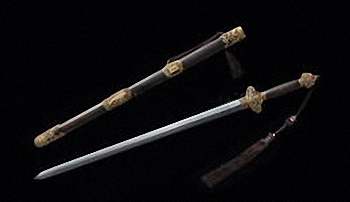 The 士 (shì) class began as a Western Zhou warrior aristocracy. The original meaning of 士 was a chariot-mounted fighter or armoured retainer holding a small land grant in exchange for military service. Bronze weapons from Warring States burial sites including the double-edged jian sword pictured here mark the period when the 士 still functioned as a military caste. By the Han dynasty, the warrior meaning had given way to the scholar meaning: 士 referred to men trained in the Confucian classics who staffed the imperial bureaucracy through patronage, recommendation, and after 587 CE the examination system.
The Han examination expanded under Emperor Wu in the 130s BCE allowed 士 from non-aristocratic backgrounds to enter the bureaucracy through demonstrated mastery of canonical texts. The system depended on the long history of Chinese writing as the medium through which classical learning was transmitted. From the Tang onward, the 士 were defined entirely by examination credentials rather than descent, with the 进士 doctorate as the canonical qualification. They held political influence well beyond their numbers and dominated local society as the gentry layer that mediated between the imperial bureaucracy and the village.
The 士 were not necessarily wealthy in the way large landowners and successful merchants were, although many gentry families also owned land farmed through tenant labour. The local gentry function included tax collection, dispute mediation, lineage genealogy maintenance, and Confucian ritual organization. The class survived the 1905 abolition of the examination system in modified form as the Republican-era educated elite; the Communist land reforms of the 1950s ended the gentry’s economic foundation by redistributing landholdings to peasant tenants.
The Nong, Gong, and Shang in Practice
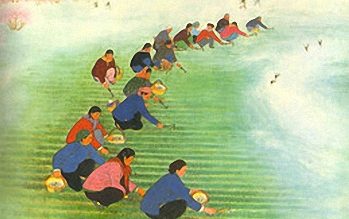 The 农 (nóng, peasant farmers) made up the great majority of the Chinese population across all imperial periods. Mid-Qing demographic estimates put the peasantry at 80-85% of the population, totalling 250-300 million by 1800. The Confucian framework placed farmers above artisans and merchants because farmers produced the food that fed the rest of society and paid the land tax that funded the state. The actual condition of 农 households varied enormously by region, period, and tenancy status.
In good periods on fertile land, smallholding families could accumulate enough surplus to send a son to study for the civil-service examinations; in hard periods or on marginal land, peasants fell into tenancy or debt bondage to larger landowners. Land tax structures changed across dynasties: the Tang equal-field system (均田制 jūntiánzhì) from 624 CE attempted periodic redistribution; the Ming Single-Whip Reform of 1581 (一条鞭法 yītiáobiānfǎ) consolidated taxes into silver payments; the Qing 摊丁入亩 reform of 1712 abolished the head tax and merged it into the land tax. For the broader economic context including the price-and-wage history that shaped peasant lived condition, see the ancient China economy reference.
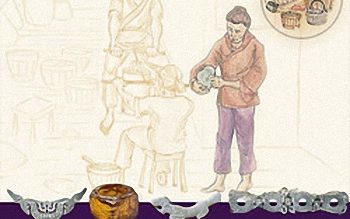 The 工 (gōng, artisans and craftsmen) sat third in the formal hierarchy. Artisan trades included pottery, metalwork, textiles, woodworking, lacquer ware, paper (after the Han), printing (after the Tang), and porcelain (after the Tang and Song). State-employed artisans worked in imperial workshops producing luxury goods, ceremonial objects, weapons, silk, and porcelain that became the principal Chinese exports along the Silk Road and later the maritime trade routes. Self-employed artisans operated workshops they passed from father to son, sometimes accumulating significant wealth despite remaining outside the gentry class. Artisan guilds organized by trade and region appeared from the Tang onward and elaborated through the Song and Ming. The technical knowledge of the Chinese artisan tradition produced several of the most influential inventions in world history, including paper, gunpowder, the compass, printing, and porcelain.
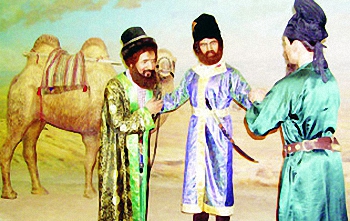 The 商 (shāng, merchants and traders) sat at the formal bottom of the four classes despite their growing wealth and economic significance. The Confucian framework treated merchants as parasitic on the labour of others, profiting from movement of goods between producers and consumers without producing anything themselves. The state legal framework imposed restrictions at various periods, including bans on merchants riding horses, wearing silk clothing reserved for higher ranks, taking the civil-service examinations, and holding land. These restrictions were widely ignored in practice, especially after the Tang. Wealthy merchants bought land and educated sons for the gentry-scholar class within a generation or two, completing one of the few well-documented social-mobility paths in imperial Chinese society. Long-distance trade across the Silk Road and the maritime routes during the Tang, Song, and Yuan made Chang’an, Yangzhou, Quanzhou, and Hangzhou into substantial commercial centres.
Slaves and Bonded Labour Across Dynasties
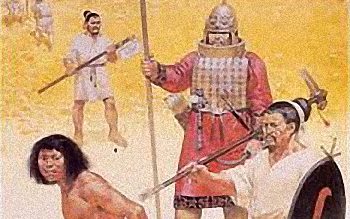 Below the four formal classes, a slave and bonded-labour population existed across all periods of imperial Chinese history, although its size and legal status varied. Slaves came from war captives, criminals sentenced to penal labour, debtors who had sold themselves or their children, and prisoners taken in frontier campaigns. The Han dynasty maintained a category of state slaves called 官奴 (guānnú) used in imperial workshops and on agricultural estates; private slavery existed but was less central to the Chinese economy than to many other ancient societies.
The legal framework around slavery shifted across dynasties. The Tang Code (唐律 Tánglǜ) restricted some forms of debt bondage and distinguished 良 (liáng, “free”) from 贱 (jiàn, “low”) status. The Song and later dynasties further reduced the formal slave category. Bonded servants (奴婢 núbì) without legal slave status remained a feature of wealthy households into the late Qing period. The lived conditions of bonded labour were harsh, with restricted legal rights and limited mobility, although the formal slavery category gradually shrank across the imperial period. Cixi’s late-Qing reforms in the 1900s and the Republican constitutional reforms of 1912 effectively ended the formal slave-status category, though informal bonded household service persisted into the 1940s in some regions.
Buddhist and Daoist Clergy Outside the Class System
Buddhist and Daoist clergy operated outside the four-estate class system from the Han dynasty onward. Both traditions established monastic orders whose members renounced family ties, took religious surnames (释 Shì for Buddhist monks from 释迦牟尼 Śākyamuni; Daoist masters used 道 Dào or temple-specific names), and lived under tax-exempt status that made their communities economically distinct from the surrounding peasant population.
The 度牒 (dùdié) ordination certificate system, formalized under the Tang and monetized under the Song, created a state-controlled market in monastic status. A 度牒 conferred legal monk status, exempted the holder from corvee labour and military conscription, and could be purchased from the state during fiscal crises. The Song Huizong Emperor sold 度牒 in bulk during the 1090s to fund military campaigns; the Yuan and Ming continued the practice. The result was that monastery populations included sincere religious devotees and tax-evasion entrants in approximately equal measure across many periods.
The tax-exempt status of monasteries triggered the most severe anti-Buddhist persecution in Chinese imperial history under the Tang Wuzong Emperor in 845 CE. The Wuzong persecution (会昌法难 Huìchāng Fǎnàn or 拆寺破佛 chāisì pòfó) destroyed approximately 4,600 monasteries, defrocked around 260,000 monks and nuns, confiscated monastery lands and bronze statues for the imperial mint, and returned the defrocked clergy to lay tax registers. The persecution was driven by fiscal pressure on the late-Tang state rather than purely doctrinal hostility, though Daoist court advisors helped frame the policy. Monasteries recovered partially under the late Tang and Song but never regained the scale they had held before 845.
Daoist clergy operated under a different organizational structure: the Celestial Masters tradition (天师道 Tiānshī Dào) ran hereditary lineages from the Han Zhang Daoling lineage, and the Quanzhen tradition founded in the 1170s ran celibate monastic orders. Daoist communities were generally smaller and less centrally organized than Buddhist ones; the 845 persecution affected them less. State patronage of Daoism peaked under the Tang Xuanzong from 712 to 756 CE and the Ming Jiajing from 1521 to 1567; the corresponding Buddhist patronage peaked under the Sui and Tang Wu Zetian from 690 to 705.
Women in the Social Order
Women in the formal Chinese social hierarchy were classified by the rank of their fathers and then their husbands rather than holding an independent status. The Confucian Three Obediences and Four Virtues framework, codified in the Han dynasty texts of Ban Zhao from 45 to 117 CE and elaborated in later commentary, placed women under the authority of the father in childhood, the husband in marriage, and the eldest son in widowhood.
Daughters of gentry families received literacy education in some periods and could write poetry, though the civil-service examinations remained closed to women across all imperial dynasties. Aristocratic and imperial women exercised real political influence through the inner court, with empress dowager regencies a recurring feature of the late Han, Tang, Song, Ming, and Qing. Empress Wu Zetian, who ruled in her own name from 690 to 705 CE, was the only woman to take the formal title of emperor in Chinese history. Empress Dowager Cixi exercised effective rule through three child-emperor regencies from 1861 to 1908.
Lower-class women worked in agriculture alongside their families or in textile production and household service. Foot binding, which began in the late Tang or early Song among court women, spread broadly across Han Chinese society during the Ming and Qing. Adoption rates varied by region and period: the practice was near-universal among Han gentry in northern China by mid-Qing, partial among rural northern peasants, and uncommon among Hakka, Manchu, and southern minority populations. The Republic of China formally banned foot binding in 1912, though the practice persisted in remote regions through the 1940s. For broader context on the lived day-to-day experience of imperial-era women and men across classes, including the contrasts between aristocratic luxury and peasant subsistence, see ancient Chinese life as contradictions between rich and poor.
Frequently Asked Questions
What were the four main social classes of ancient China?
The four occupational classes in the Confucian and Legalist framework were the 士 (shì, gentry scholars) at the top, followed by the 农 (nóng, peasant farmers), the 工 (gōng, artisans and craftsmen), and the 商 (shāng, merchants and traders) at the bottom. The framework was an ideological model rather than a working census category. Several other social layers operated alongside or outside the four estates: the imperial court, the eunuchs, the aristocratic clans, the Yuan four ethnic castes, the Ming hereditary occupational households, the 贱民 outcast classes, the 包衣 Manchu bondservants, and the Buddhist and Daoist clergy.
Why were merchants ranked lowest in ancient Chinese society?
The Confucian framework treated merchants as parasitic on the labour of others, on the grounds that they profited from moving goods between producers and consumers without producing anything themselves. The state legal framework imposed restrictions at various periods, including bans on merchants riding horses, wearing silk reserved for higher ranks, taking the civil-service examinations, and holding land. These restrictions were widely ignored in practice, and wealthy merchants often bought land and educated their sons for the gentry class within a generation or two, completing one of the few well-documented social-mobility paths in imperial China.
How did the examination system change Chinese class structure?
The 科举 examination system, formalized under the Sui in 587 CE and matured under the Tang, replaced the Six Dynasties Nine-Rank System and slowly unwound aristocratic dominance of public office. The Song raised the annual jinshi quota from the Tang average of 23 to over 300 after the Wang Anshi reforms of 1069. Ho Ping-ti’s 1962 study of 14,562 Ming-Qing jinshi found approximately 30% from families with no high-degree-holder among father, grandfather, or great-grandfather, evidence of real but partial meritocratic mobility. The system survived 1,318 years before its abolition by Empress Dowager Cixi on 2 September 1905.
What was the Nine-Rank System and when did it end?
The 九品中正制 (jiǔpǐn zhōngzhèng zhì) was an aristocratic recruitment system designed by the Wei dynasty official Chen Qun in 220 CE. Local commissioners rated candidates on a nine-rank scale based on family pedigree and personal evaluation, and the rank determined the highest office attainable. The system was supposed to screen merit but resulted in aristocratic capture, summarized in the saying 上品无寒门, 下品无世族 (“the upper ranks have no commoners, the lower ranks have no aristocrats”). It was formally replaced by the imperial 科举 examinations during the Sui-Tang transition, with the Sui establishing the first imperial exam in 587 CE.
Were there castes in ancient China?
The Yuan dynasty from 1271 to 1368 imposed a formal four-caste ethnic system: Mongols (蒙古) at the top, Semu (色目) Central and West Asians second, northern Han (汉人) third, and southern Han (南人) fourth. The system was abolished by the Ming founding in 1368. Hereditary occupational castes existed under the Ming through the 军户 / 匠户 / 灶户 system, abolished by Yongzheng from 1723 onward. Hereditary outcast classes (贱民) including 乐户, 疍家, 堕民, and 丐户 carried legal disabilities until Yongzheng’s 1723 emancipation edict, with social stigma persisting for several generations after. The Indian-style religiously justified caste system did not exist in China; the Yuan model was the closest analogue.
How easy was social mobility in imperial China?
Social mobility through the examination system was real but partial. Ho Ping-ti’s quantitative analysis of Ming-Qing 进士 graduates found approximately 30% from families with no high-degree-holding ancestors in three generations, while 70% came from gentry families with prior credential-holders. The pass-rate funnel was unforgiving: from 童生 (millions) to 秀才 (about 600,000 by mid-Qing) to 举人 (about 10,000) to 进士 (about 250 per triennial cycle), the compounded probability of any single peasant boy reaching 进士 ran below 0.0001%. The merchant-to-gentry path through land purchase plus son’s education was a documented secondary mobility route. Movement up from 贱民 outcast or 包衣 bondservant status was structurally far harder.
What happened to Chinese social classes after 1911?
The abdication of the last Qing emperor Puyi on 12 February 1912 ended the imperial four-estate framework as a legal structure. The civil-service examination system had been abolished seven years earlier in September 1905. The Republican government banned foot binding in 1912 and abolished the 包衣 banner system in stages through the 1910s and 1920s. The eunuch class ended in 1924 with the expulsion of the last Forbidden City eunuchs. The People’s Republic from 1949 dissolved the gentry through land reform that redistributed gentry landholdings to peasant tenants, and the household registration (户口 hùkǒu) system established in 1958 created a new urban-rural split that became the dominant social stratification of the modern era.
Sources and Further Reading
- Wikipedia – Four occupations (士农工商) – the Confucian framework’s structure and Zhou origins
- Wikipedia – Imperial examination – jinshi pass-rate numbers across Tang, Song, Ming, and Qing dynasties, with the 1905 abolition
- Wikipedia – Nine-rank system – Chen Qun’s design from 220 CE and the aristocratic capture phase that ran until 589 CE
- Wikipedia – Semu and the Yuan four-caste system – the ethnic ranking that ran from 1271 to 1368 and the differential treatment by caste
- Wikipedia – Booi Aha (包衣) – Manchu bondservant category, Imperial Household Department, 上三旗 vs 下五旗 split
- Ho Ping-ti, The Ladder of Success in Imperial China, Columbia University Press 1962 – quantitative mobility analysis of 14,562 Ming-Qing jinshi degree-holders