
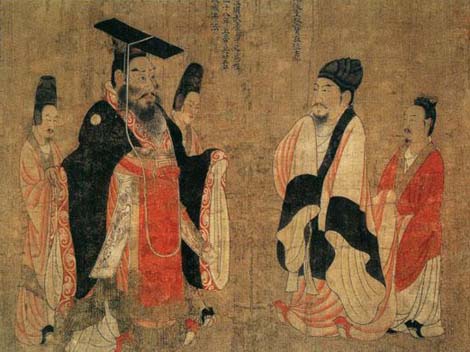
Forty-three Chinese dynasties and major regional kingdoms have ruled some part of what is now China across roughly four thousand years of recorded history, from the legendary Xia dynasty of around 2070 BCE through the abdication of the last Qing emperor Puyi in February 1912. Reading Chinese history through a single linear timeline misses the pattern of expansion, fragmentation, and reunification that runs through the record, although a clear chronological backbone remains the easiest way for a reader new to the subject to find a footing. This article walks through the major periods of Chinese history from the Neolithic Yellow River cultures through the imperial dynasties to the end of the Qing, with the working dates for each period and the central political and cultural events that organise each.
Major Dynasties and Periods
- Xia: ~2070-1600 BCE (legendary, debated historicity)
- Shang: ~1600-1046 BCE (oracle bone script, bronze casting)
- Western Zhou: ~1046-771 BCE (feudal Fengjian system)
- Eastern Zhou: 770-256 BCE, including Spring and Autumn (770-481) and Warring States (475-221)
- Qin: 221-206 BCE (first unification, Great Wall, terracotta army)
- Han: 206 BCE – 220 CE (Silk Road, Confucian state, paper invention)
- Three Kingdoms / Jin / Southern and Northern: 220-589 CE
- Sui: 581-618 CE (Grand Canal, reunification)
- Tang: 618-907 CE (cosmopolitan peak, poetry, civil examinations)
- Song: 960-1279 (printing, gunpowder, compass, commercial growth)
- Yuan (Mongol): 1271-1368 (Kublai Khan, Marco Polo)
- Ming: 1368-1644 (Zheng He voyages, Forbidden City, Great Wall rebuild)
- Qing (Manchu): 1644-1912 (largest territorial extent, final imperial dynasty)
Neolithic Cultures and the Legendary Xia
The earliest agricultural communities in what is now China appear in the archaeological record from around 7000 BCE in the middle Yellow River valley and along the Yangtze. The Yangshao culture flourished in the central Yellow River region from around 5000 to 3000 BCE and produced the painted pottery that gives the culture its name in modern archaeology. The Longshan culture followed in the same region from around 3000 to 1900 BCE and produced the wheel-made black pottery and the early walled settlements that mark the transition toward state formation.
The legendary Xia dynasty, dated by the standard Chinese chronology to roughly 2070 to 1600 BCE, is treated by traditional Chinese historiography as the first ruling dynasty of China, although its historicity remains debated by modern archaeologists. The Erlitou archaeological culture in central Henan province, dated to roughly 1900 to 1500 BCE, is identified by some Chinese archaeologists with the historical Xia and includes the foundations of large palace structures and bronze ritual vessels.
The Shang and Western Zhou Dynasties
The Shang dynasty, the first dynasty for which substantial written records survive, ruled the central Yellow River region from around 1600 to 1046 BCE. The oracle bone inscriptions from the Shang royal capital at Yinxu mark the starting point of the documented history of Chinese writing, with more than 150,000 inscribed fragments recovered from the site. The Shang capitals included Zhengzhou and the late Shang capital at Anyang, where the oracle bone inscriptions found from the late nineteenth century onwards provide the earliest known Chinese writing.
Shang ritual centred on the worship of royal ancestors, with bronze vessels cast in elaborate forms for ceremonial use and divination through the heating of ox scapulae and turtle plastrons. The Zhou conquest of the Shang around 1046 BCE under King Wu established the Western Zhou dynasty, which ruled from a capital near modern Xi’an until 771 BCE. The Western Zhou developed the Mandate of Heaven doctrine that legitimised dynastic change and established the feudal Fengjian system that distributed land and authority to royal relatives across the conquered territory. The Western Zhou collapsed in 771 BCE when nomadic peoples from the northwest sacked the capital and the dynasty moved east to Luoyang.
Spring and Autumn and Warring States
The Eastern Zhou period from 770 to 256 BCE divided into two named subperiods. The Spring and Autumn period from 770 to 481 BCE took its name from the Spring and Autumn Annals, a chronicle traditionally attributed to Confucius that records events in the state of Lu. The period saw the gradual decline of central Zhou authority and the rise of regional states, with the philosophical traditions of Confucianism, Daoism, and Mohism developing in response to the political fragmentation.
The Warring States period from 475 to 221 BCE saw the consolidation of seven major states (Qin, Chu, Qi, Yan, Han, Zhao, and Wei) and the gradual conquest of the smaller states by the larger ones. Iron working spread across the Yellow River basin and replaced bronze as the main metal for both weapons and tools. Coinage spread across the warring states with regional designs. The Hundred Schools of Thought, the broader period of Chinese philosophical activity, produced the foundational texts of Confucianism, Daoism, Legalism, and several smaller schools across these centuries.
The Qin Unification and the Han Dynasty
The Qin state in the northwest conquered the other warring states between 230 and 221 BCE under King Ying Zheng, who took the title of First Emperor or Shi Huangdi after the unification. The Qin dynasty lasted only fifteen years from 221 to 206 BCE but established the institutional template for the imperial Chinese state, including standardised currency, weights and measures, the cart axle width for the road network, and the small seal script as the official writing system. The Qin built large infrastructure projects including the first sections of the Great Wall and the Lingqu canal connecting the Yangtze and Pearl river systems.
The harshness of Qin labour mobilisation contributed to the dynasty’s collapse soon after the death of the First Emperor. The Han dynasty that followed ran from 206 BCE to 220 CE in two parts, the Western Han from 206 BCE to 9 CE with its capital at Chang’an and the Eastern Han from 25 to 220 CE with its capital at Luoyang, separated by the brief Xin dynasty under the usurper Wang Mang from 9 to 23 CE. The Han consolidated the imperial bureaucracy, expanded the territory south into modern Vietnam and west into Central Asia, opened the Silk Road trade routes, and established Confucianism as the official state ideology.
Three Kingdoms Through Sui and Tang
The Han dynasty collapsed in 220 CE and the country fragmented into the Three Kingdoms of Wei, Shu Han, and Wu, dramatised in the much later novel Romance of the Three Kingdoms. The period of disunion lasted nearly four centuries through the Jin dynasty from 265 to 420, the Northern and Southern Dynasties from 420 to 589, and ended with the Sui reunification under Yang Jian who founded the Sui dynasty in 581 and reunified the country in 589. The short Sui dynasty from 581 to 618 built the Grand Canal connecting the Yellow River and the Yangtze and reformed the civil service examination system before collapsing under the weight of its own ambitious public works.
The Tang dynasty from 618 to 907 is traditionally treated as the high point of imperial Chinese culture, with the capital at Chang’an reaching around one million inhabitants and acting as the largest cosmopolitan city in the world for much of the period. Tang poetry, painting, Buddhism, and the civil service examination system all reached mature forms. The Tang weakened after the An Lushan rebellion of 755 to 763 and finally collapsed in 907 into a brief Five Dynasties and Ten Kingdoms period.
Song Yuan Ming and Qing
The Song dynasty reunified most of the country in 960 under Zhao Kuangyin, the founder of the Northern Song. The Northern Song from 960 to 1127 saw the development of printing, paper money, gunpowder weapons, the magnetic compass for navigation, and the neo-Confucian philosophical revival under Zhu Xi. The loss of the north to the Jurchen Jin dynasty in 1127 reduced the Song to its southern territories, with the Southern Song ruling from Hangzhou until the Mongol conquest in 1279.
The Mongol Yuan dynasty under Kublai Khan ruled from 1271 to 1368 as the first foreign-led dynasty to rule the entire country. The native Han Chinese Ming dynasty replaced the Yuan in 1368 under Zhu Yuanzhang and ruled until 1644. The Ming saw the voyages of Zheng He between 1405 and 1433 that reached as far as East Africa, the rebuilding of the Great Wall in its present form, and the construction of the Forbidden City in Beijing under the Yongle emperor in the early fifteenth century.
The Manchu Qing dynasty replaced the Ming in 1644 and ruled until the abdication of the last emperor Puyi on 12 February 1912, ending more than two thousand years of imperial rule in China. The Qing dynasty doubled the territorial extent of the Chinese state through the campaigns of the Kangxi, Yongzheng, and Qianlong emperors across the seventeenth and eighteenth centuries, bringing Tibet, Xinjiang, Mongolia, and Taiwan under Beijing rule. The eighteenth century is sometimes called the High Qing period and saw a population increase from around 150 million in 1700 to around 300 million by 1800.
The nineteenth century brought a series of crises including the Opium Wars of the 1840s and 1850s with Britain, the Taiping Rebellion of 1850 to 1864 that killed around 20 million people, and the Boxer Uprising of 1899 to 1901 that drew foreign military intervention from eight powers. The Qing dynasty failed to recover from these compounding pressures and fell to the Xinhai Revolution that began in October 1911 in Wuhan and led to the formal abdication of the imperial system in February 1912. The end of the Qing closed a chapter that had run with only brief interruptions from 221 BCE under the Qin First Emperor through to the early twentieth century.
The Republic of China that replaced the imperial system in 1912 and the People’s Republic of China founded in 1949 belong to a separate chapter of Chinese history that lies outside the dynastic timeline traced in this article. The dynastic framework remains the standard organising principle for academic and popular Chinese history writing because it captures the political continuity of the imperial state through repeated cycles of expansion, fragmentation, and reunification that defined the country across two thousand years.
Frequently Asked Questions
How long was Chinese history?
Chinese historical records cover roughly four thousand years from the legendary Xia dynasty of around 2070 BCE to the end of the Qing dynasty in 1912. The archaeological record of agricultural settlement in the Yellow River and Yangtze valleys reaches back several thousand years further into the Neolithic period.
What was the first Chinese dynasty?
Traditional Chinese historiography names the Xia dynasty as the first ruling dynasty, dated to roughly 2070 to 1600 BCE. The historicity of the Xia is debated by modern archaeologists, although the Erlitou archaeological culture in central Henan province is identified by some scholars with the historical Xia. The first dynasty with substantial surviving written records is the Shang from around 1600 to 1046 BCE.
When did imperial China end?
Imperial China ended with the abdication of the last Qing emperor Puyi on 12 February 1912 after the Xinhai Revolution that began in October 1911. The Republic of China replaced the imperial system, ending more than two thousand years of imperial rule.
What is the Mandate of Heaven?
The Mandate of Heaven, called Tianming in Chinese, was the doctrine that the ruler of China held authority by the will of Heaven and lost that authority when the dynasty failed to maintain order and justice. The doctrine developed under the Western Zhou dynasty and was used across the imperial period to legitimise dynastic change.
The 12-animal Chinese zodiac signs system was codified during the Han dynasty in the first century CE, with Wang Chong’s Lunheng providing the oldest surviving complete list.
Sources and Further Reading
- The Cambridge History of China, multi-volume reference work, Cambridge University Press
- Patricia Buckley Ebrey, The Cambridge Illustrated History of China, Cambridge University Press
- Mark Edward Lewis, History of Imperial China series, Belknap Press of Harvard University Press
- Endymion Wilkinson, Chinese History: A New Manual, Harvard-Yenching Institute, latest edition
- Sima Qian, Shiji or Records of the Grand Historian, modern annotated translations including the Burton Watson edition