Colombia organises its traditional dress along the five natural regions that frame the country: Caribbean coast (Caribe), Pacific coast (Pacífica), Andean highlands (Andina), eastern plains (Orinoquía or Llanos), and Amazon basin (Amazonía). Each region carries a distinct costume tradition shaped by indigenous, Spanish-colonial, and African influences that arrived through colonial-era migration along the Magdalena River. The headline garments are the sombrero vueltiao, woven by Zenú artisans in Córdoba and recognised by UNESCO as Intangible Cultural Heritage of Humanity since 7 December 2008, the pollera colora skirt worn for cumbia dance along the Caribbean coast, and the ruana wool cape that the Muisca indigenous people of the central Andean highlands wore well before Spanish contact.
This article walks through the regional costume map, the Zenú caña flecha hat-making tradition, the Muisca origin of the ruana, the Paisa arriero outfit of the Coffee Axis, the Barranquilla Carnival characters that travel under UNESCO heritage status, the Joropo costume of the eastern plains, and the Yanchama bark-cloth costumes of the Amazon region.
Five Regions and Their Costume Traditions
Colombian traditional dress runs region by region rather than as a single national costume. The five regional traditions developed independently around local materials, climate, and the indigenous, Spanish, and African populations that settled each zone.
- Caribbean (Caribe): hot tropical climate, sombrero vueltiao, pollera colora, cumbia dance attire, Barranquilla Carnival characters including Marimonda, Garabato, and Cumbiambas
- Pacific (Pacífica): humid rainforest coast, San Pacho festival silks in tricolour yellow-blue-red, Afro-Colombian drumming and dance attire, Chocó region specialties
- Andean (Andina): cool mountain climate, ruana wool cape, Paisa arriero outfit with sombrero aguadeño and leather carriel bag, espadrilles called alpargatas
- Orinoquía or Llanos: eastern grass plains, Joropo dance costume with wide ruffled skirts for women and Llanero hat with rolled-up trousers for men
- Amazonía: tropical rainforest, no single fixed costume in daily wear, Yanchama bark-cloth garments made from tree bark and vegetable dyes for ritual use
Each region pairs its costume with a specific folk dance: cumbia for the Caribbean, currulao for the Pacific, bambuco for the Andes, joropo for the Llanos, and ritual dances for the Amazon communities. The Ministerio de Cultura keeps the official regional costume register, and Artesanías de Colombia certifies the artisans who produce vueltiao hats, ruanas, mochila bags, and other heritage objects. The regional festival calendar covered in our Colombian festivals guide tracks where each costume tradition appears across the year.
The Sombrero Vueltiao and the Zenú Tradition
The sombrero vueltiao is the single most recognisable Colombian object outside the country. The hat is woven from caña flecha palm fibre by Zenú indigenous artisans in Córdoba and Sucre departments, with the village of Tuchín known as the cuna or cradle of the tradition. The Zenú have been weaving the hat for hundreds of years, and the technique passed from indigenous craft to national symbol over the twentieth century.
The hat’s status sits on three layers of recognition:
- 2004: declared Symbol of National Culture (Símbolo Cultural de la Nación) by the Colombian congress
- 7 December 2008: UNESCO recognised the Zenú traditional weaving practice as part of the Intangible Cultural Heritage of Humanity
- 2022: the caña flecha braiding technique itself was declared Patrimonio Cultural Inmaterial de la Nación by the Ministerio de Cultura, providing dedicated state protection for the technique beyond the finished hat
Quality grades follow the number of pairs (vueltas) of fibre per turn of the hat band. A quinceano has 15 pairs and counts as everyday quality. A diecinueve has 19 pairs and runs midrange. A veintiuno has 21 pairs and counts as fine workmanship. A vueltiao of 23 or 27 pairs is the top tier, requiring weeks of weaving and selling for several hundred US dollars per hat at the workshop. Artisans process the caña flecha by cutting the palm stalks, soaking and dyeing them in mud baths for the black colour, and braiding them by hand into the tight spirals that form the hat crown.
Tuchín hosts an annual fiesta del sombrero vueltiao each summer, with artisan demonstrations, a hat-weaving competition, and stalls from across the Zenú resguardo. The municipality counts hat-weaving as the largest economic activity, with hundreds of households participating in some part of the production chain.
The Pollera Colora and Cumbia
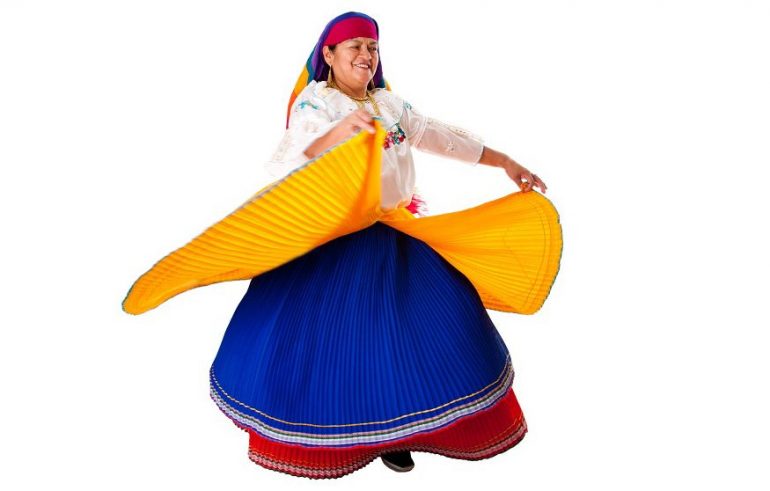
The pollera colora, literally the “brightly coloured skirt”, is the women’s costume worn for cumbia dance along the Caribbean coast. The outfit consists of a wide circular skirt in red, blue, yellow, or floral print, with multiple ruffled tiers below the hip, paired with an off-the-shoulder white or matching-colour blouse with embroidery around the neckline. Women dance barefoot and carry a lit candle in one hand, which gives the cumbia its distinctive slow circular silhouette.
Cumbia itself developed on the Caribbean coast through the meeting of three musical and choreographic traditions:
- African: the drum rhythms and percussion patterns, particularly the tambor llamador and tambor alegre
- Indigenous: the gaita flute (a tall vertical flute made from cactus stem and beeswax), which carries the melody
- Spanish-colonial: the European waltz silhouette and the candle-carrying motif that overlays the slower African rhythm
The choreography stages a courtship: the man circles the woman with a sombrero vueltiao in hand while she moves in tight clockwise circles holding her candle. The Wayuu dance tradition of La Guajira, covered in our yonna Colombian dance overview, uses different costume conventions tied to the indigenous community of the northern peninsula. Cumbia is one of the founding rhythms of Colombian popular music and spread across Latin America during the twentieth century, generating regional variants in Mexico, Argentina, and Peru that adapted the rhythm but largely dropped the original costume.
Men dance cumbia in a white linen shirt rolled at the sleeves, white linen trousers, a red neckerchief, and a sombrero vueltiao. The minimalist white silhouette contrasts with the bright pollera and gives the choreography its visual structure.
The Ruana and the Andean Muisca Heritage
The ruana is a thick wool poncho-cape from the Andean highlands, with the central department of Boyacá as the main producing region. The garment is a rectangle of wool, longer than a Mexican poncho, with a head slit in the centre. Its origin runs back to the Muisca confederation that occupied the Cundiboyacense plateau before Spanish arrival in 1538, well before the introduction of European wool production techniques.
The pre-conquest Muisca produced ruanas from cotton woven on backstrap looms, with patterns and colours signalling community of origin. After Spanish colonisation introduced sheep to the highland plateau, wool gradually replaced cotton as the standard ruana fibre because of its insulating quality in the cool 2,500-metre-altitude climate. Modern ruanas come in three weight grades:
- Ruana fina: lightweight wool, used in mild seasons, often dyed in solid colours or simple stripes
- Ruana de Iza: from the Iza municipality in Boyacá, mid-weight virgin wool with the characteristic small wool tufts on the surface
- Ruana de Nobsa: from the Nobsa municipality in Boyacá, the heaviest and warmest, woven with the unwashed sheep wool that retains lanolin and water resistance
The municipalities of Nobsa, Iza, Tibasosa, and Paipa in Boyacá form the modern ruana-producing belt. Each holds an annual ruana festival, and the Nobsa Festival of the Ruana, held each August, draws weavers from across the department for an artisan market and weaving competition. A handmade Nobsa ruana sells for around 300,000 to 600,000 Colombian pesos depending on wool grade and pattern complexity.
The Paisa Arriero Outfit and the Coffee Axis
The Paisa region of Colombia covers Antioquia, the Coffee Axis (Eje Cafetero) departments of Caldas, Risaralda, and Quindío, and parts of Tolima and Valle del Cauca. The traditional male costume of the region is the arriero outfit, modelled on the mule drivers who carried coffee, salt, and goods along the Andean ridges from the mid-nineteenth century through to the road-building era of the mid-twentieth century.
The arriero outfit assembles several components:
- Sombrero aguadeño: a fine-woven palm hat from Aguadas in Caldas, lighter and floppier than the Zenú vueltiao
- Camisa de cuello tirilla: a long-sleeved cotton shirt with a band collar, traditionally white
- Pantalón doblado: drill trousers rolled up at the ankle, originally to keep them clean on muddy mountain trails
- Poncho or pañuelo rabo de gallo: a small red-and-white checked neckerchief tied at the throat
- Carriel: a leather satchel hung from the shoulder, with internal compartments for coins, tobacco, a knife, and personal documents, a craft tradition centred in Jericó and Envigado
- Alpargatas: rope-soled espadrilles for daily wear, replaced by leather boots for muleteering
- Machete and ruana: carried on muleteer journeys, the ruana doubling as a sleeping blanket
The arriero figure became the symbol of Paisa identity through twentieth-century literature, particularly Tomás Carrasquilla’s novels, and through the popular Antioqueño song tradition. The coffee-growing economy that the arrieros built remains central to the region today, as our Colombian coffee overview describes. The Desfile de Silleteros at Medellín’s Feria de las Flores in August features the modern descendants of the arriero figure carrying flower arrangements on wooden frames, and many silleteros wear the full traditional outfit during the procession.
Carnival of Barranquilla Characters
The Carnival of Barranquilla, held each February or early March on the four days before Lent, is the second-largest carnival in Latin America after Rio and was recognised by UNESCO as a Masterpiece of the Oral and Intangible Heritage of Humanity in 2003. The carnival’s costume catalogue runs to dozens of recurring characters, each with a specific outfit:
- Marimonda: long-nosed mask costume in bright clashing colours, satirising the Spanish-Caribbean upper class, originating in a working-class neighbourhood of Barranquilla in the early twentieth century
- Garabato: black-and-yellow outfit with a wooden hook (garabato) used in a death-versus-life choreography, paired with red elements
- Cumbiamba: cumbia performer in the full pollera colora and white-shirted-man pairing, often grouped into competing cumbiamba neighbourhoods
- Negrita Puloy: a stylised dark-skinned doll figure with a red dress and white polka dots, a character that has drawn revisionist critique in recent years
- Monocuco: a hooded full-body suit in bright fabric, with a mask covering the face, that allowed anonymous mocking of city authorities
- Congo: African-Colombian dance group costume with feathered headdress, animal masks, and bright tunics, tracing roots to enslaved communities of the colonial period
The Reina del Carnaval (Carnival Queen) parades in a custom-designed gown that incorporates elements of pollera colora, traditional embroidery, and modern haute-couture work by Colombian designers. The Battle of Flowers (Batalla de Flores) and the Grand Parade (Gran Parada de Tradición) form the two largest costume processions of the carnival week.
Joropo and the Llanero Outfit
The Llanos Orientales, the great grass plains east of the Andes that stretch from Colombia into Venezuela, run their own costume tradition tied to the joropo dance and the cattle-ranching lifestyle of the llanero cowboy. The Joropo costume diverges sharply from the Andean and Caribbean styles:
- Women: a wide ruffled skirt in floral print or solid bright colour, often with ribbon trim, paired with a fitted off-the-shoulder blouse with sleeves, and the hair tied with flowers
- Men: a long-sleeved closed-collar shirt with large buttons (camisa liquiliqui), straight or rolled-up trousers, alpargatas for daily wear, and a Llanero straw hat with a wide brim
The liquiliqui became the formal dress of the Venezuelan and Colombian Llanos, often in white linen for special occasions. Gabriel García Márquez wore a liquiliqui to receive the Nobel Prize in Literature in 1982, deliberately choosing the Llanero costume over a tuxedo to signal his Caribbean Colombian identity at the Stockholm ceremony.
The joropo dance itself is a fast 3/4 rhythm performed in close partner position, with the man leading sharp foot stamps (zapateos) while the woman follows in a sliding step. The dance is the national folk dance of Venezuela and the symbolic dance of the Colombian Llanos, with major festivals at Villavicencio (Meta) and Yopal (Casanare) drawing thousands of dancers each year.
Pacific and Amazon Region Traditions
The Pacific coast runs its own Afro-Colombian costume tradition tied to the Chocó, Valle del Cauca, Cauca, and Nariño departments. The San Pacho festival in Quibdó, held in September and October and recognised by UNESCO as Intangible Cultural Heritage in 2012, brings out silk costumes in the Colombian national colours of yellow, blue, and red. Marimba ensembles accompany the currulao dance, which the dancers perform in long white skirts and embroidered blouses for women, and in white loose trousers with rolled-up sleeves for men.
The Amazon region of Colombia, covering Amazonas, Putumayo, Caquetá, Guaviare, Vaupés, and Guainía departments, holds no single regional costume in daily wear. The indigenous communities of the region, including Tikuna, Witoto, Bora, Ticuna, and Cocama peoples, maintain ritual costumes made from Yanchama bark cloth. The Yanchama tree (Poulsenia armata) yields long sheets of inner bark that artisans soften by beating, then decorate with vegetable dyes including achiote red, huito black, and yellow extracted from local plants.
Yanchama costumes appear at community rituals rather than at tourist-facing performances, and the right to make and wear them is protected within the resguardo system of indigenous territorial autonomy. Outside the ritual context, Amazonian Colombian communities now dress in modern clothing while keeping traditional headdresses, body paint, and accessories for ceremonial events.
Where Traditional Dress Lives Today
Traditional Colombian dress appears today at folk festivals, regional carnivals, indigenous community events, and folkloric dance performances rather than in daily wear. The biggest annual displays sit on the festival calendar:
- Carnival of Barranquilla, February to March, the largest assembly of Caribbean costume characters
- Feria de las Flores, Medellín, August, Paisa arriero outfits and the Desfile de Silleteros
- San Pacho, Quibdó, September to October, Pacific Afro-Colombian silks
- Festival Internacional Folclórico, Ibagué, June and July, full national costume rotation
- Fiesta del Sombrero Vueltiao, Tuchín, summer, Zenú artisan showcase
- Fiesta de la Ruana, Nobsa, August, Boyacá weavers and ruana sales
- Torneo Internacional del Joropo, Villavicencio, June and July, Llanero dance and costume
Beyond the festival cycle, the sombrero vueltiao and the mochila Wayuu or Arhuaca bag have crossed into Colombian everyday urban fashion, with both items worn outside their traditional context across the country. Colombian designers including Silvia Tcherassi and Esteban Cortázar have incorporated ruana silhouettes and vueltiao motifs into modern collections, and the Wayuu mochila bag became a global fashion item in the 2010s through influencer adoption.
Frequently Asked Questions
What is the most famous traditional Colombian dress?
The pollera colora, the brightly coloured ruffled skirt worn with a white off-the-shoulder blouse, is the most internationally recognised Colombian women’s costume, paired with the male cumbia outfit of white shirt, white trousers, red neckerchief, and sombrero vueltiao. The pair appears in cumbia performances and at Caribbean coast festivals.
What is the sombrero vueltiao made of?
The sombrero vueltiao is woven from caña flecha palm fibre by Zenú indigenous artisans in Córdoba and Sucre departments, with the village of Tuchín as the cradle of the tradition. Quality grades count the pairs of fibre per band turn: 15 pairs (quinceano) for everyday quality, 19 (diecinueve) midrange, 21 (veintiuno) fine, and 23 or 27 pairs for top-tier workmanship. The hat received UNESCO Intangible Cultural Heritage status in 2008.
What is a ruana and where is it from?
The ruana is a thick rectangular wool cape with a head slit, originating with the Muisca indigenous people of the Cundiboyacense plateau before Spanish arrival in 1538. The main producing region today is Boyacá, particularly the municipalities of Nobsa, Iza, Tibasosa, and Paipa. Production grades run from light ruana fina to the heavy lanolin-rich Ruana de Nobsa that resists water in the cool 2,500-metre Andean climate.
What is the Paisa arriero outfit?
The arriero outfit is the traditional male costume of Antioquia and the Coffee Axis, modelled on the muleteers who transported goods along the Andean ridges from the mid-nineteenth century. The outfit includes a sombrero aguadeño from Aguadas, a long-sleeved cotton shirt, rolled-up drill trousers, a red-and-white checked neckerchief, a leather carriel satchel from Jericó or Envigado, and alpargatas espadrilles.
What did Gabriel García Márquez wear to the Nobel Prize ceremony?
García Márquez wore a liquiliqui, the traditional Caribbean and Llanero closed-collar formal suit with large buttons, to the 1982 Nobel Prize in Literature ceremony in Stockholm. He chose the liquiliqui over a Western tuxedo as a deliberate signal of his Caribbean Colombian identity. The garment is still worn at formal Llanos and Caribbean coast occasions.
What costumes appear at the Carnival of Barranquilla?
The Carnival of Barranquilla, a UNESCO Masterpiece of Intangible Heritage since 2003, features recurring characters including the long-nosed Marimonda, the Garabato life-versus-death pair, the Cumbiambas in pollera colora, the Negrita Puloy in red and white polka-dot, the hooded Monocuco, and the Congo Afro-Colombian dance groups. The Carnival Queen wears a custom couture gown incorporating traditional Caribbean elements.
Sources and Further Reading
- Artesanías de Colombia, official artisan certification body
- Ministerio de Cultura de Colombia, intangible heritage register
- UNESCO Intangible Cultural Heritage, Colombian inscriptions
- Museo Nacional de Colombia, costume and textile collections
- Marca País Colombia, official tourism portal on regional costumes
- Carnaval de Barranquilla, official carnival organisation
- Colombia.com, regional folklore and dance reference