Cleopatra VII Philopator, the last active ruler of the Ptolemaic Kingdom of Egypt, adopted a complex set of Egyptian symbols to bind her Macedonian Greek dynasty to three thousand years of pharaonic tradition. The symbols of Cleopatra appear across temple reliefs, coinage, stelae, and inscriptions dated to her reign (51-30 BC). Her signature iconography combined the triple uraeus (three rearing cobras arranged side by side as her personal emblem), the Isis crown with its cow horns and solar disc, the vulture headdress of Upper Egypt, the Hathor sistrum, the winged solar disc of Horus of Edfu, the Isis knot (tyet), the ankh of eternal life, and the lotus of regeneration. Her royal cartouche – the oval hieroglyphic ring enclosing her name – survives on the Dendera Temple and the Temple of Hathor at Dendera, providing the most complete visual record of any Ptolemaic queen. This guide walks through each symbol, its mythological meaning, and where the carved or cast originals can still be seen today.
The Triple Uraeus: Cleopatra’s Personal Emblem
The triple uraeus – three rearing cobras arranged in a horizontal row – is the single symbol most closely identified with Cleopatra VII. Earlier pharaohs wore a single uraeus on the brow to symbolise royal authority over Lower Egypt, or occasionally a double uraeus paired with the vulture of Upper Egypt. Cleopatra is the first ruler in the Egyptian record to consistently use three cobras as her formal royal crest, on stelae, reliefs, and a limited number of surviving portrait busts.
Two interpretations of the triple uraeus circulate among Egyptologists. The first reads the three cobras as the three territories Cleopatra claimed to rule: Upper Egypt, Lower Egypt, and the territory gained through Roman alliance (specifically Cyprus and Coele-Syria, returned to Ptolemaic control by Julius Caesar and Mark Antony in succession). The second reads them as the three men who shared her political life – her father Ptolemy XII Auletes, Julius Caesar, and Mark Antony – with Cleopatra positioning herself as the woman around whom all three Roman-era power centres revolved.
The triple uraeus appears on the pink granite stela now in the Bibliotheque Nationale in Paris, dated to 51 BC, and on the relief carvings at the Dendera Temple where Cleopatra appears beside her son Caesarion. The symbol is absent from earlier or later Egyptian royal iconography, marking it as a unique Cleopatran innovation rather than a borrowed tradition.
Cleopatra as Isis: Crown, Knot, and Vulture
Cleopatra styled herself as the living embodiment of Isis, the goddess of motherhood, magic, and royal protection. The identification was deliberate political theatre, reinforced by coin inscriptions calling her “Thea Neotera” (the New Goddess) and Greek-language dedications naming her Isis incarnate. Her symbol of Isis iconography takes several forms:
- The Isis crown: A pair of cow horns cradling the solar disc, worn over a flat headdress with a uraeus at the brow. The horns reference Hathor, whose attributes Isis absorbed during the Ptolemaic period. Cleopatra wears this crown on the Dendera Temple exterior south wall relief with Caesarion.
- The Isis knot (tyet): A looped amulet resembling an ankh with folded arms, symbolising protection and the blood of Isis. Small tyet amulets from the Ptolemaic period survive in faience, carnelian, and red jasper; several pieces attributed to Cleopatra’s court are held in the Cairo Museum.
- The vulture headdress: A gold vulture, wings folded over the head, representing Nekhbet (protector of Upper Egypt) and Mut (mother goddess). Cleopatra’s temple reliefs show her wearing this headdress in combination with the Isis crown, an unusual doubling that emphasised her divine motherhood claim.
- The sistrum: A handheld rattle sacred to Hathor and Isis, shown in Cleopatra’s hands on the Dendera relief as a ritual instrument of worship and celebration.
The combination of Isis, Hathor, and Mut attributes in a single portrait is a hallmark of Cleopatran symbolism. No earlier queen’s reliefs show this specific combination, and the iconographic merger allowed Cleopatra to present herself simultaneously as mother, consort, protector, and cosmic principle.
The Cartouche of Cleopatra
The royal cartouche – the oval hieroglyphic ring enclosing a monarch’s throne name – is among the most studied symbols for Cleopatra because its decoding played a direct role in the decipherment of Egyptian hieroglyphs. Jean-Francois Champollion used the Cleopatra cartouche from the Philae obelisk (now held at Kingston Lacy in Dorset, England) alongside the Rosetta Stone to confirm that hieroglyphs had phonetic as well as symbolic values.
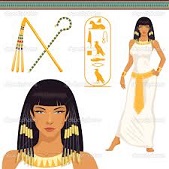
Cleopatra’s cartouche typically reads, left to right: a lion (L), a reed leaf (I or Y), a placenta disc (P? or KH), a throne (Aset/Isis), and a semicircle with a shepherd’s crook (the feminine marker and “her” suffix). The full transliteration gives “Qlwpdrt” or similar, matching the Greek Kleopatra. A second cartouche carries her throne name “Nefer-nebu-ankh” (“Beautiful of lord, living one”), which appears more rarely in temple contexts but shows up on dedicatory stelae.
For a broader overview of cartouches in Egyptian royal tradition – and how pharaohs from the Old Kingdom to the Roman conquest used them – see our article on ancient Egyptian cartouches.
The Winged Solar Disc and Horus of Edfu
Above the portico of every Ptolemaic temple sits the winged solar disc – a flat disc with outstretched wings, flanked by two uraei. The image represents Horus of Edfu in his form as the sun-falcon who flies through the sky to drive back darkness. Cleopatra’s reliefs place her directly beneath this symbol, visually linking her protection to the Edfu Horus and by extension to her son Caesarion, whom she presented as the child Horus in human form.
The Edfu Temple itself, built during the Ptolemaic era and largely completed during Cleopatra’s own reign, holds the largest surviving collection of winged solar disc carvings from the late Ptolemaic period. The Dendera Temple displays a similar programme on the outer walls, with Cleopatra and Caesarion positioned as Isis-and-Horus pairs under repeated winged disc motifs. The iconographic logic reads: Horus protects the living king, Cleopatra presents her son as Horus, therefore Cleopatra’s dynasty is under perpetual divine guard.
The Ankh and the Lotus
The ankh – the looped cross of eternal life – is not unique to Cleopatra but features prominently in her reliefs, held in her hand or extended toward Caesarion as a blessing of immortality. The Dendera reliefs show Cleopatra offering the ankh to her son, visually transferring the promise of eternal life from mother to heir. The gesture echoes older Egyptian royal iconography but carries extra political weight in the Ptolemaic context, where succession disputes had repeatedly broken the dynasty.
The lotus appears in Cleopatra’s iconography in two forms: the blue lotus (Nymphaea caerulea), linked to rebirth and the sun rising at dawn, and the white lotus (Nymphaea lotus), linked to Upper Egypt and creation mythology. Small handheld lotuses or lotus buds in hair ornaments appear on portrait statuettes and intaglios from her reign. The symbol bridges Greek and Egyptian aesthetic traditions – Greek royal portraits had used wreaths and diadems, and the lotus provided an Egyptian-readable equivalent.
The broader landscape of Egyptian symbolic vocabulary beyond Cleopatra is covered in our overview of the meaning of Egyptian symbols and in our piece on Egyptian symbols for earth, wind, fire, and water.
Coinage: The Greek Side of Cleopatra’s Symbols
The symbols on Cleopatra’s coins differ sharply from those on her Egyptian temple reliefs. Greek tradition demanded portrait realism, and Cleopatra’s silver tetradrachms and bronze coins show her with a prominent nose, strong chin, and tight-curled hair bound by a diadem. The reverse of these coins usually carries an eagle on a thunderbolt (the Ptolemaic dynastic emblem inherited from Ptolemy I), a cornucopia double-bound by a royal fillet (prosperity and royal bounty), or the Greek inscription “Kleopatras Basilisses” (of Queen Cleopatra).
Coins minted at Alexandria, Antioch, Ascalon, and Cyprus during her reign circulated across the eastern Mediterranean and carried her image to audiences who never saw her temple reliefs. The political strategy was bilingual and bicultural: Egyptian subjects saw Isis-Cleopatra on temple walls, while Greek-speaking citizens of the Hellenistic world saw a Ptolemaic queen in diadem and portrait mode on every silver coin they handled.
- Tetradrachm of Antioch (36 BC): Portrait of Cleopatra on one side, Mark Antony on the reverse – a direct visual statement of political alliance.
- Ascalon mint bronze (49 BC): Cleopatra as a young queen, modest diadem, no religious imagery – aimed at the Levantine mercantile population.
- Cyprus bronze (47-30 BC): Cleopatra with child Caesarion in her arms, inscribed “Thea Neotera” – the closest numismatic parallel to the Dendera relief.
- Alexandria drachm (47-41 BC): Portrait only, with the Ptolemaic eagle on reverse and Greek legend – the standard Alexandrian dynastic issue.
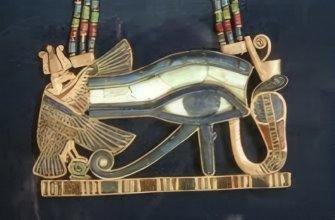
For the wider context of royal protective imagery and the cobra specifically, see our piece on the Egyptian wadjet, the Eye of Horus amulet that shares a protective function with the uraeus.
Where to See the Original Reliefs Today
Four locations hold the best-preserved originals of Cleopatra’s symbolic iconography:
- Dendera Temple Complex, Egypt: The outer south wall of the Temple of Hathor shows Cleopatra VII beside Caesarion offering to a lineup of Egyptian deities. This is the most famous Cleopatra relief in existence and the primary visual source for most scholarship on her symbolism. Located about 60 km north of Luxor.
- Temple of Isis at Philae, Egypt: Reliefs dated to Cleopatra’s reign (and her predecessors’ Ptolemaic programme) cover the interior walls. The site was moved to Agilkia Island after the construction of the Aswan High Dam in the 1960s.
- Bibliotheque Nationale de France, Paris: Holds the pink granite stela with the triple uraeus, dated 51 BC, the earliest surviving example of the triple-cobra motif.
- Kingston Lacy, Dorset, England: Houses the Philae obelisk whose bilingual Greek-hieroglyphic inscription helped decipher the Cleopatra cartouche. A National Trust property open to the public.
- British Museum, London: Several tetradrachms and smaller bronze coins of Cleopatra are on permanent display in the Coins and Medals department.
- Metropolitan Museum of Art, New York: Holds a limestone stela with the Greek inscription “Thea Neotera” and several faience amulets linked to her reign.
The broader visual record of Ptolemaic Egypt – and the gods who populated Cleopatra’s symbolic vocabulary – is explored in our piece on Hathor, the Egyptian goddess, whose cow-horn crown Cleopatra adapted for her own iconography.
Cleopatra Symbols in Modern Culture
The symbols for Cleopatra have outlived their original political purpose by more than two thousand years and continue to appear in jewellery design, film costume, and pop culture shorthand for Egypt itself. The triple uraeus, the Isis crown, and the cartouche are the three most frequently reproduced Cleopatran motifs in 20th and 21st century design.
Film iconography – Elizabeth Taylor’s 1963 Cleopatra, Theda Bara’s 1917 silent film, and Gal Gadot’s announced production – typically compresses the symbols for visual immediacy: the uraeus becomes a single cobra on the brow, the Isis crown reduces to a sun-disc headband, and the cartouche is often worn as a gold pendant. Academic Egyptology distinguishes these modern shorthand versions from the specific triple-uraeus and full vulture-and-Isis headdress combination that Cleopatra herself used.
Jewellery designers have used the Cleopatra cartouche as a personalised gold-pendant template since the Cartier Egyptian Revival designs of the 1920s. Modern ateliers such as Azza Fahmy in Cairo and Lalounis in Athens still produce cartouche pendants and triple-uraeus rings inspired directly by the Dendera relief. A personalised hieroglyphic cartouche in 18k gold from the Khan el-Khalili goldsmiths’ district in Cairo typically runs 300-800 USD depending on weight and inscription complexity.
Frequently Asked Questions
What was Cleopatra’s main symbol?
The triple uraeus – three rearing cobras arranged side by side – was Cleopatra VII’s personal royal emblem, found only on her inscriptions and not on those of earlier or later pharaohs. It appears on the pink granite stela of 51 BC in Paris and on the Dendera Temple reliefs. She also regularly wore the Isis crown (cow horns cradling the solar disc) and combined it with the vulture headdress of Nekhbet.
What does the Cleopatra cartouche look like?
Cleopatra’s cartouche is an oval hieroglyphic ring enclosing the signs that spell her name phonetically – a lion, a reed leaf, a disc, a throne (representing Isis), and a feminine-marker semicircle with the shepherd’s crook of the hereditary monarch. The famous Philae obelisk cartouche played a key role in Champollion’s decipherment of hieroglyphs in the 1820s.
Why did Cleopatra associate herself with Isis?
Cleopatra used the Isis identification to connect her Macedonian Greek dynasty to the three-thousand-year Egyptian tradition of divine queenship. Isis represented motherhood, magic, and royal protection – all politically useful associations. By appearing on temple reliefs in the Isis crown with her son Caesarion as Horus, she visually argued that her family line was a living incarnation of the Isis-Osiris-Horus cycle, the core myth of Egyptian kingship.
What is the winged solar disc and how does it relate to Cleopatra?
The winged solar disc is a symbol of Horus of Edfu, the sun-falcon who flies through the sky to drive back darkness. It appears above the portico of every Ptolemaic temple. Cleopatra’s reliefs position her directly beneath this symbol, visually linking her protection to the Edfu Horus and reinforcing her claim that Caesarion was Horus-in-human-form.
Where can I see Cleopatra’s original symbols today?
The best-preserved originals are at the Dendera Temple in Egypt (the famous south-wall relief), the Temple of Isis at Philae (now on Agilkia Island), the Bibliotheque Nationale in Paris (pink granite stela with triple uraeus), Kingston Lacy in Dorset (Philae obelisk with bilingual inscription), the British Museum, and the Metropolitan Museum of Art in New York.
What symbols for Cleopatra appear on her coins?
Cleopatra’s coins use Greek rather than Egyptian symbolism: portrait realism with prominent nose and tight-curled hair bound by a diadem on the obverse, and the Ptolemaic eagle on a thunderbolt, a double-bound cornucopia, or a Greek inscription “Kleopatras Basilisses” on the reverse. The Cyprus bronze coins showing her with Caesarion are the closest numismatic parallel to the Dendera temple imagery.
How is Caesarion depicted in Cleopatra’s symbolism?
Caesarion (Ptolemy XV) appears on the Dendera Temple reliefs beside Cleopatra, styled as Horus-the-child. He wears the sidelock of youth, holds his own smaller ankh, and stands beneath the winged solar disc. The visual pairing cast mother and son as Isis-and-Horus, the divine royal family of Egyptian tradition.
Sources and Further Reading
- Diana Kleiner – “Cleopatra and Rome” – Harvard University Press, 2005
- Duane Roller – “Cleopatra: A Biography” – Oxford University Press, 2010
- British Museum – Ptolemaic Egypt collection – britishmuseum.org
- Metropolitan Museum of Art – Cleopatra and the Dendera reliefs – metmuseum.org
- Bibliotheque Nationale de France – Cleopatra stela catalogue – bnf.fr
Cleopatra’s symbolic programme drew on the gods and motifs catalogued in our ancient Egyptian mythology guide, which walks through the major deities she cultivated politically.