Three recognised wolfdog breeds carry German Shepherd blood in their foundation pedigrees, and four more experimental programmes included shepherds at various points through the twentieth century. The shepherd’s ancestral proximity to the wolf, combined with its trainability and physical structure, made the breed the obvious choice for every serious wolfdog project from the Saarloos in 1935 through the Kunming military programme in the 1950s. This history traces the breed’s wild cousins, the documented wolfdog crossings, the genetic picture that research has filled in since the 1990s, and the practical difference between a wolfdog and a shepherd for prospective owners.
Shared Ancestry and the Wolfdog Premise
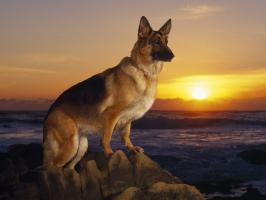
All domestic dogs descend from ancient wolf populations diverged between 15,000 and 40,000 years ago, depending on which genetic study is consulted. The German Shepherd’s similar silhouette and mask markings reflect both that common origin and deliberate late-19th-century breeding choices by Max von Stephanitz, who selected dogs that retained lupine features along with working ability.
Wolfdog projects emerged in the early twentieth century with three stated goals: improve the trainability of captive wolves, improve the hardiness of working dogs, or create a novel breed with the physical presence of a wolf and the biddability of a shepherd. None of the three goals worked as cleanly as the founders hoped, though the programmes produced four breeds that are now stable populations.
The genetic mixing drops predictably across generations. A first-generation wolf-dog cross (F1) carries 50 percent wolf DNA and typically displays wild behaviour incompatible with household life. Back-crossing F1 offspring to domestic dogs produces F2, F3, and F4 generations with 25 percent, 12.5 percent, and 6.25 percent wolf content respectively. Recognised wolfdog breeds today sit around F4 or later, which is where predictable domestic temperament stabilises.
The Saarloos Wolfdog
Leendert Saarloos, a Dutch breeder, began crossing German Shepherds with captive Eurasian wolves in 1935 with the goal of producing a hardier working shepherd. The initial cross was a male shepherd named Gerard bred to a female wolf named Fleuri at Saarloos’s kennel in Rotterdam.
The first-generation pups proved too wild for utility work. Saarloos back-crossed the F1 offspring to shepherds through several generations, producing an F4 population by the 1960s that could live as pets and working dogs. The Dutch Kennel Club recognised the breed as the Saarloos Wolfhound in 1975, and the FCI followed in 1981 under standard number 311.
Modern Saarloos are 6 to 12 percent wolf DNA and show strongly in coat texture, ear carriage, and social structure. The breed forms tight pack bonds with human families but remains reserved with strangers and retains a flight response to novel stimuli that no amount of socialisation fully eliminates.
The Czechoslovakian Wolfdog
The Czechoslovakian military ran a breeding programme from 1955 through 1965 with the stated goal of producing border patrol dogs that could withstand the cold winters of the Soviet frontier. The founders crossed German Shepherds with four Carpathian wolves captured in the mountain regions, producing F1 hybrids that were back-crossed to shepherds over three generations.
The programme closed in 1965 when the military concluded that regular shepherds performed just as well for border work at lower cost and without the temperament variability. Civilian breeders in Slovakia continued the line, and the breed gained FCI recognition as the Czechoslovakian Wolfdog in 1982 under standard 332.
Today’s Czechoslovakian Wolfdog, known as the Ceskoslovensky Vlcak in its home country, carries 6 to 12 percent wolf genetics and requires experienced handlers. The breed has gained popularity in central Europe and competes in IGP sport, though the pack-social pattern complicates single-handler work more than a standard shepherd does.
The Kunming Dog and the Lupo Italiano
China’s People’s Liberation Army opened a breeding programme in Kunming, Yunnan Province, in 1953 to produce a military working dog adapted to southern Chinese climates. The programme crossed German Shepherds imported from the USSR with local dogs and, at several points in the first decade, with regional wolf populations to add cold tolerance.
The Kunming Dog emerged as a stable breed by the 1980s with shepherd proportions, a straighter topline than modern Western shepherds, and a slightly squarer head. The breed is widely used in Chinese military and police roles and has expanded into civilian ownership through the 2000s, though it has not received FCI recognition.
Italy’s Lupo Italiano programme began in 1966 in the Apennine mountains with a single natural cross between a German Shepherd bitch and a local Italian wolf. The breeder, Mario Messi, documented the offspring and back-crossed to shepherds through three generations. The Italian state recognised the Lupo Italiano in 1984 under a special statute, and the dogs serve primarily in mountain rescue and military roles rather than civilian homes.
Experimental Wolfdog Programmes
Several other programmes crossed shepherds with wolves with mixed outcomes. The American Tundra Shepherd, developed in the 1930s by crossing shepherds with Alaskan wolves, aimed at cold-climate sledding work. The breed failed to achieve kennel club recognition and essentially disappeared by the 1960s.
Soviet programmes in the 1970s crossed shepherds with Central Asian Ovcharkas and Russian Laikas to produce cold-adapted military dogs. These programmes produced working stock rather than a distinct breed and largely merged back into regional working dog populations after 1991.
The American Wolfdog market developed outside formal breed programmes from the 1970s onward, with hobbyist breeders crossing wolves with various domestic breeds including shepherds. These dogs carry wide variation in wolf content, behavioural stability, and legal status across US states. Many end up in wolfdog sanctuaries rather than permanent homes because the wild behaviours overwhelm the owners within the first two years.
Wolfdog Versus Shepherd: What Ownership Actually Means
Recognised wolfdog breeds at F4 or later generations require more specialised handling than standard shepherds but stay within the realm of possible household ownership for dedicated owners. Higher wolf-content hybrids, particularly F1 through F3, are rarely workable in home settings and often cross into illegal ownership under state wildlife laws.
Specific differences an owner should expect with a recognised wolfdog breed:
- Escape drive higher than shepherd, requiring six-foot fencing with dig-guards
- Pack social structure that struggles with single-handler households
- Reserved temperament with strangers, slower to bond than a shepherd
- Flight response rather than fight response under novel stress
- Food guarding and resource management more pronounced than standard breeds
- Lifespan comparable to the shepherd, around 12 to 14 years for most wolfdog breeds
Prospective owners should prefer a recognised wolfdog breed from a registered breeder over an informal cross. Paperwork, health testing, and breed club support protect the buyer from the variability that plagues the unregistered wolfdog market.
Daily management is different from ordinary dog ownership. Exercise needs match shepherd levels at two hours of structured activity, but the content of that exercise matters more. Wolfdogs need enrichment rather than repetition, with scent games, novel environments, and problem-solving tasks performing better than standard obedience drills.
Frequently Asked Questions
Are wolfdogs legal in the US?
Legal status varies by state and county. Some states ban wolf hybrids outright, others require permits, others permit private ownership of dogs under a specified wolf percentage. Check state fish and wildlife regulations and county ordinances before pursuing any wolfdog purchase.
Can a wolfdog be trained like a shepherd?
Recognised wolfdog breeds respond to marker training but require more patient handling, fewer repetitions per session, and higher tolerance for independent behaviour. The breed does not match the shepherd’s eagerness to please, and handlers expecting shepherd responsiveness often become frustrated.
What percentage of wolf is in a recognised wolfdog breed?
Saarloos, Czechoslovakian Wolfdog, and Lupo Italiano typically test at 6 to 12 percent wolf DNA. The rest of the genome is domestic dog, primarily German Shepherd. The phenotype looks more wolf than the DNA suggests because wolf traits are often dominant.
Why did the shepherd become the base breed for these crosses?
The shepherd combines three traits that matter for wolfdog projects: physical similarity to the wolf, proven trainability, and reliable genetic testing. Other large breeds lack one or more of these, which is why no serious wolfdog programme used mastiffs or labradors as the domestic parent.
Are wolfdogs healthier than German Shepherds?
Not systematically. Wolfdog breeds avoid some shepherd-specific conditions like degenerative myelopathy at lower rates, but they inherit other issues through their mixed background. Lifespan is comparable, and veterinary care often costs more due to difficulty finding vets comfortable with the breed.
For the foundation breed from which these wolfdog projects drew, see our German Shepherd breed overview. The white coat variant that also traces unusual genetic history is covered in white German Shepherds. For the long-coat variant related to coat genetics, read long-haired German Shepherds.
Sources and Further Reading
- Fédération Cynologique Internationale, Standards 311, 332, and related wolfdog breed entries
- Saarloos Wolfhound Club of the Netherlands, breed history archives
- Slovensky Klub Chovatelov Ceskoslovenskeho Vlciaka, breed records
- Canine genetics publications on wolf-dog admixture (Nature Communications 2013 onward)
- Italian government statutes recognising the Lupo Italiano under special designation