Search “miniature German Shepherd puppies” and you will find breeders charging $1,500 for a dog they call a pint-sized version of the classic breed. The American Kennel Club does not recognise any such breed. What people actually buy when they pay for a mini GSD falls into one of three categories: a planned cross between a German Shepherd and a smaller breed, a dog born with pituitary dwarfism, or the runt of a standard litter marketed as something it is not.
This guide covers what each of those three really means, what size and temperament to expect from a genuine cross-breed, the serious health problems of pituitary dwarfism, typical prices in 2026, and the questions to ask a breeder before paying.
The Three Meanings of “Miniature German Shepherd”
The name gets used for three distinct things, and buyers often cannot tell which one they are looking at until after the sale.
1. A deliberate cross-breed. A breeder pairs a standard German Shepherd with a smaller dog, usually a Border Collie, Poodle, or small-working breed, and the puppies inherit a size somewhere between the parents. These dogs are legitimate hybrids with predictable adult size. The Shepadoodle (GSD crossed with a Poodle) and the Shollie (GSD crossed with a Border Collie) are the two most common examples.
2. A dog with pituitary dwarfism. Pituitary dwarfism is a recessive genetic disorder on chromosome 9 that prevents the dog’s pituitary gland from producing enough growth hormone. A puppy born with two copies of the defective gene grows to about 30 pounds as an adult, has a severely compromised coat, suffers chronic skin issues, and often has underdeveloped kidneys. These dogs look like proportional miniatures but their internal organs are not miniature, and they typically live three to five years.
3. A runt marketed as a breed. Some unscrupulous sellers take the smallest puppy in a standard German Shepherd litter and market it as a “miniature”. The dog grows to 70 or 80 pounds as an adult and is indistinguishable from any other GSD. Buyers who believed they were getting a 30-pound dog end up with an 80-pound working dog that outgrows their home.
The Common Mini German Shepherd Crossbreeds
A responsibly bred miniature German Shepherd is always a cross with a specific smaller breed. The cross affects size, coat, energy level, and health in predictable ways depending on the second parent.
Shepadoodle: German Shepherd and Poodle Mix
The Shepadoodle crosses a standard GSD with either a Standard Poodle or a Miniature Poodle. A Standard Poodle cross produces a dog of 50-65 pounds, while a Miniature Poodle cross drops the adult weight to 30-50 pounds. The Poodle parent brings a curly or wavy coat that sheds less than a standard German Shepherd’s double coat, which attracts owners with mild dog allergies. The intelligence of both parent breeds makes the Shepadoodle highly trainable but also demanding: bored Shepadoodles chew furniture, dig, and develop separation anxiety.
Shollie: German Shepherd and Border Collie Mix
The Shollie crosses a GSD with a Border Collie, producing a dog of 70-80 pounds, which is less mini than the name suggests. The appeal is not size but the working intelligence of both parents: Shollies excel at agility, obedience, herding, and search-and-rescue work. A Shollie needs at least two hours of active exercise and mental challenge every day, otherwise the herding instinct redirects into chasing cars, bikes, and small children.
Other Crosses Sold as Miniature German Shepherds
Breeders also cross German Shepherds with Huskies (the Gerberian Shepsky), Labradors (the Sheprador), Australian Shepherds, and Stumpy Tail Cattle Dogs. For a different GSD cross that stays in the full-size range, our profile of German Shepherd Rottweiler mixes illustrates how crossbreed outcomes shift with the second parent’s size. Each cross shifts size, coat, and drive. A Husky cross adds cold tolerance and stubbornness. A Labrador cross softens the guarding temperament. An Australian Shepherd cross doubles the herding intensity. None of these crosses produces a truly small dog; the honest floor for an adult mini GSD cross-breed is about 30 pounds, achieved only through crossing with a genuinely small breed like a Miniature Poodle.
Size, Weight, and Appearance
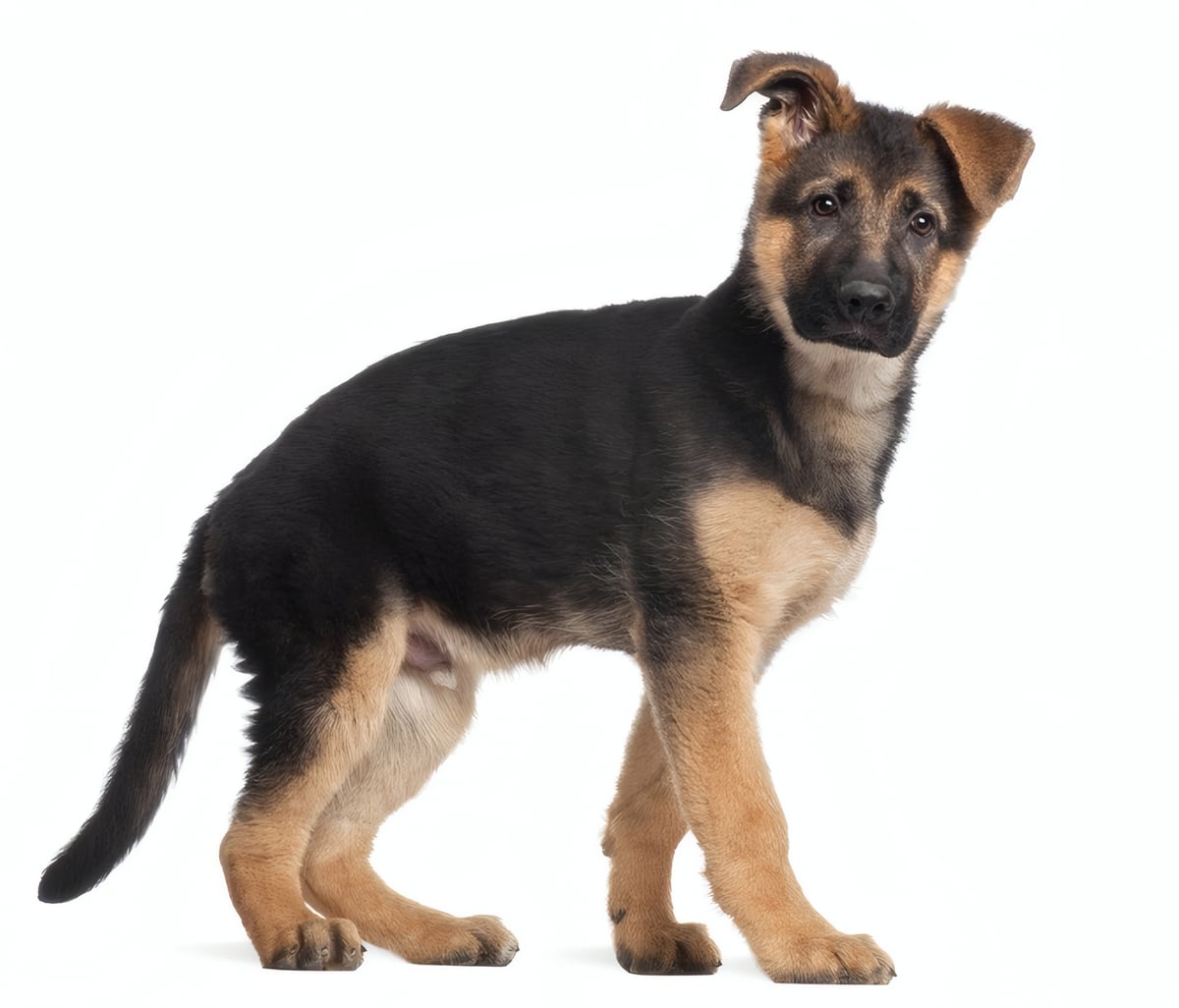
A full-grown miniature German Shepherd cross-breed stands 15-20 inches tall at the shoulder and weighs 30-50 pounds. Our Belgian Malinois vs German Shepherd comparison covers the closest working-dog alternative if a different breed’s size profile fits your household better. A standard German Shepherd, for comparison, stands 22-26 inches and weighs 50-90 pounds. The mini version looks like a scaled-down GSD from a distance, but side-by-side the differences show: the snout is often shorter and softer, the ears less perfectly pricked, and the coat varies with the second parent’s genetics.
Coat colour in mini GSDs follows the dominant genes from the German Shepherd parent in most cases: black and tan, sable, or pure black. A separate profile covers the long-haired German Shepherd puppy variety, a recessive coat trait that appears in both standard and miniature lines. A Poodle cross can introduce cream or silver, and a Collie cross can bring merle patterns. Puppies do not settle into their adult colour until four to six months of age, so the brown-and-black tiny puppy in the breeder’s photo may look quite different by its first birthday.
The lifespan of a cross-bred mini GSD runs 10-14 years, about the same as a standard German Shepherd. Dogs born with pituitary dwarfism, as noted, live much shorter lives because of organ complications.
Temperament and Training
A mini German Shepherd cross-breed keeps most of the working temperament of the GSD parent. This means loyalty to family, suspicion of strangers, strong guarding instinct, high trainability, and a constant need for something to do. The same traits make full-size GSDs one of the world’s most common K9 working breeds; see our piece on German Shepherd police dogs for the professional applications. The hybrid does not produce a lapdog; it produces a smaller working dog with the same psychological needs as its full-size cousin.
The owner commitment starts before the puppy comes home. A mini GSD that sits on the couch for eight hours while you are at work will redirect its energy into destructive behaviour within weeks. Daily exercise must include both physical work (30-60 minutes of off-leash running or structured play) and mental work (training sessions, puzzle feeders, scent games). Weekend-only exercise leaves the dog anxious and badly behaved by Tuesday.
Training should start the day the puppy arrives at eight weeks old. Positive reinforcement, consistent rules, early socialisation with other dogs and strangers, and crate training all matter more for a GSD cross than for less intense breeds. An under-socialised mini GSD can become fear-aggressive, and a German Shepherd of any size that bites is a serious problem.
Professional puppy classes help more than YouTube videos for first-time GSD owners. The trainer watches the puppy’s specific behaviour and adjusts the approach, which is what a written guide or video cannot do. Expect to pay $150-400 for a six-week group puppy class in a US city.
Pituitary Dwarfism: The Medical Version
Pituitary dwarfism in German Shepherds is a recessive genetic disorder. Both parents must carry one copy of the defective gene for any puppy to be born with the full condition. A carrier parent shows no symptoms, so two genetically tested-but-untested German Shepherds can produce dwarf puppies without the breeder realising the risk. This is why responsible breeders test both parents for the LHX3 gene mutation, which causes the condition.
A dwarf puppy looks normal at birth but stops growing at around three months of age. By six months, the contrast with healthy littermates is unmistakable. Adult dwarfs reach about 30 pounds, stand 12-14 inches tall, and have foreshortened legs in proportion to their bodies.
The health problems of dwarf German Shepherds are severe:
- Skin and coat: Thin, woolly puppy coat that never develops into an adult coat. Most dwarfs lose hair across their bodies and suffer chronic bacterial skin infections.
- Kidneys: The condition affects kidney development, and many dwarfs develop renal failure by age three or four.
- Thyroid: Secondary hypothyroidism requires daily medication for life.
- Teeth: Permanent teeth fail to come in, or come in malformed.
- Lifespan: Three to five years is typical, against 10-14 for healthy GSDs.
Treatment extends life but does not cure the condition. Synthetic growth hormone costs $100-300 per month, thyroid medication adds $30-50 per month, and dermatological care runs hundreds of dollars per quarter. A dwarf German Shepherd’s total lifetime medical cost typically runs $20,000-40,000.
No responsible breeder markets a dwarf German Shepherd as a “miniature German Shepherd”. A seller offering a tiny GSD puppy at an unusually low price, without papers and without proof of LHX3 testing on the parents, is often selling a dwarf. Walk away.
Health Issues in Cross-Bred Mini German Shepherds
A mini GSD cross-breed inherits risks from both parent breeds. From the German Shepherd side: hip dysplasia, elbow dysplasia, degenerative myelopathy, gastric dilatation-volvulus (bloat), and exocrine pancreatic insufficiency. For the full background on how these conditions emerged through the breed’s history, see our history of the German Shepherd wolf-dog lineage. From the second parent: the breed-specific risks of that breed. A Poodle cross may inherit progressive retinal atrophy, a Border Collie cross may inherit collie eye anomaly, and a Husky cross may inherit hereditary cataracts.
Responsible breeders screen both parents for the major conditions and provide certificates (OFA hip and elbow evaluations, CERF eye exam, breed-specific DNA tests). A puppy from health-tested parents costs more up front but typically costs less over its lifetime in veterinary bills. A cross-breed from untested parents can arrive with hip dysplasia that needs $4,000-6,000 in surgical correction by age three.
Price and Where to Buy
A mini German Shepherd cross-breed puppy from a responsible breeder costs $800-1,500 in the US, with higher prices ($1,500-2,500) for rare crosses like the Shepadoodle with Standard Poodle. Adoption from a shelter or breed-specific rescue runs $100-300 and often includes vaccinations, microchipping, and spay/neuter surgery.
A genuine breeder will:
- Show you both parent dogs on site, not just photos.
- Provide written health clearances (OFA hips, elbows, eye exams, breed-specific genetic tests).
- Ask you detailed questions about your home, work schedule, and experience with working breeds.
- Refuse to sell a puppy under eight weeks old.
- Offer a health guarantee in writing, usually two years.
- Take the puppy back at any point in its life if you cannot keep it.
A scam breeder will ship puppies sight-unseen, avoid questions about the parents’ location, offer “miniature” or “dwarf” puppies at prices above $2,000 with no documentation, and push payment through untraceable methods. The combination of a low price and no questions asked is almost always a warning that something is wrong.
How to Tell a Responsible Breeder from a Scam
The easiest test is to ask about the parents’ health testing and watch the answer. A responsible breeder answers with specific test names, certificate numbers, and photos of the documentation. A scam breeder answers vaguely, says the parents are “healthy” without documentation, or claims the tests are unnecessary because the dogs “look fine”.
A second test is to ask about return policy. A responsible breeder includes a lifetime take-back clause in the contract because they do not want their puppies ending up in shelters. A scam breeder sells the puppy and moves on.
A third test is to visit the breeder in person. A responsible breeder welcomes visits, shows you the parents, the kennel conditions, and lets you see how the puppies interact with their mother. A scam breeder meets you in a parking lot or ships the puppy by air freight without any face-to-face contact. Ship-only sales are a strong signal that the breeder has something to hide about the conditions or the parents.
Frequently Asked Questions
Are miniature German Shepherds recognised by the American Kennel Club?
No. The AKC recognises only the standard German Shepherd, and any dog sold as a “miniature German Shepherd” is either a cross-breed or a dog with pituitary dwarfism. Neither qualifies for AKC registration as a German Shepherd.
How big does a miniature German Shepherd get?
A cross-bred mini GSD reaches 30-50 pounds and 15-20 inches tall at the shoulder, depending on the second parent’s size. A Poodle cross is usually at the smaller end, a Border Collie cross at the larger end. Dogs with pituitary dwarfism reach about 30 pounds but are medically ill, not simply small.
What is the difference between a mini German Shepherd and a dwarf German Shepherd?
A mini German Shepherd is a healthy cross-breed between a GSD and a smaller breed. A dwarf German Shepherd is a purebred GSD born with pituitary dwarfism, a genetic disorder. The dwarf lives a shorter life with multiple chronic health conditions. The cross-breed lives a normal lifespan and is typically healthy.
How much exercise does a miniature German Shepherd need?
At least 60-90 minutes of active exercise per day, plus 20-30 minutes of mental stimulation through training, puzzle toys, or scent work. The mini GSD inherits the working drive of the full-size GSD and does poorly without daily physical and mental outlets.
Are mini German Shepherds good with children?
A well-socialised mini GSD raised in a family home is typically good with children in that family. The dog’s protective instinct can mean wariness or resource-guarding around visiting children, so supervision and clear boundaries matter, especially with toddlers.
What should I ask a breeder before buying a miniature German Shepherd puppy?
Ask to see hip and elbow OFA certificates for both parents, eye exam results, and any breed-specific DNA tests. Ask whether either parent has been tested for the LHX3 gene mutation that causes pituitary dwarfism. Ask to visit the breeder in person. Ask for references from previous buyers. A breeder who refuses any of these is not one you should buy from.
Sources and Further Reading
- Miniature German Shepherd breed facts – dogster.com/dog-breeds/miniature-german-shepherd
- Miniature German Shepherd information – caninejournal.com/miniature-german-shepherd
- GSD Pituitary Dwarfism – gsdpituitarydwarfism.weebly.com/gsd-pituitary-dwarfism.html
- German Shepherd Dog Club of America breed standard – gsdca.org
- OFA Hip and Elbow Dysplasia Database – ofa.org
Miniature variants can appear in any colour, with black among the rarer options; our black German Shepherd puppies guide covers the standard-size breed black variant.