German edged weapon production between 1933 and 1945 generated over a million dress daggers across dozens of organisational patterns, and the surviving examples have become a specialist field in military history research with serious legal and ethical complications. German criminal law under Section 86a restricts items carrying symbols of unconstitutional organisations, while museum and academic study continues under documented exceptions. This article surveys the main WWII-era German dagger categories from a museum-oriented perspective, covering the Heer army officer pattern, Luftwaffe variants, Kriegsmarine naval daggers, manufacturing centres and maker codes, denazification history, and the authentication challenges that separate genuine research objects from the modern reproduction market.
Solingen: The Manufacturing Centre
Solingen in North Rhine-Westphalia had been the centre of German edged-weapon manufacturing for over five centuries before 1933. The city’s medieval sword-making guild traditions carried into industrial-scale knife and blade production through the 19th and early 20th centuries, with firms including Weyersberg, Kirschbaum, Eickhorn, and Puma operating continuously since the 1700s or earlier.
The concentration of expertise meant that when the Third Reich required large-scale organisational dagger production after 1933, the infrastructure already existed. Contracts flowed to around 30 Solingen manufacturers under a coordinating body called the Reichszeugmeisterei established in 1934. The RZM assigned production codes and oversaw quality control.
Major RZM-coded manufacturers included E. u. F. Horster (RZM M7/6), Carl Eickhorn (M7/66), Paul Weyersberg (M7/37), and Alcoso (M7/80). Each firm produced for multiple organisations simultaneously, with proof marks and maker codes allowing researchers today to cross-reference production origin with organisational issue records held in military archives.
Heer Officer Dagger (Model 1935)
The Heer officer dagger, officially adopted in May 1935 by order of Werner von Blomberg, served as the dress accoutrement for German army officers and certain senior NCOs. The pattern featured a 25 cm nickel-plated blade with a fullered centre, orange-amber grip with spiral wire wrap, and a cast aluminium crossguard and pommel bearing oak leaf motifs.
The Hoheitszeichen eagle-and-swastika appeared on the pommel and scabbard throat, bringing the pattern within Section 86a restrictions for modern private possession in Germany. Production ran continuously from 1935 through 1943 when war economy priorities redirected manufacturing capacity to combat weapons.
Variations appeared over the production period. Early patterns used silver-plated fittings, mid-production shifted to cheaper nickel-plating, and late-war production showed visible quality reduction in plating and casting precision. Etching patterns on the blade, produced by acid-etched damascened steel in some higher-grade examples, command specific academic attention as examples of interwar German metallurgy.
Luftwaffe Dagger Patterns
Luftwaffe edged weapons evolved through two distinct pattern families. The first-pattern Luftwaffe dagger, adopted in 1935 and produced through 1937, featured a pronounced Luftwaffe swastika-and-winged-eagle emblem on the pommel and a blue leather scabbard. The pattern was modified to the second-pattern in 1937, which carried simplified fittings in response to production cost pressures.
Production volumes for Luftwaffe daggers exceeded 250,000 units across the two patterns, according to archival records held at the Bundesarchiv-Militararchiv in Freiburg. The first-pattern daggers remain more academically interesting because of the distinctive Spreizflugel eagle design that departed from standardised military iconography.
Senior officer patterns including the Hermann Goering-authorised personal presentation daggers represent a specific subset within academic catalogues. These items were presented to select commanders and generally carry documented provenance through the post-war period, unlike the bulk production daggers where provenance is often weaker.
Kriegsmarine Naval Officer Daggers
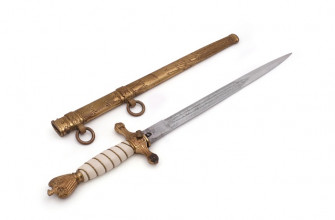
Kriegsmarine officers continued using the Imperial German Navy dagger pattern with modifications introduced in 1938. The blade remained at 25 cm with fullered profile, and the ivory grip with brass fittings preserved the nineteenth-century naval tradition. The 1938 modification replaced the Imperial crown on the pommel with a Hoheitszeichen eagle.
Manufacturing for Kriegsmarine daggers centred on Eickhorn and Horster with smaller runs from Paul Seilheimer and WKC. Production records document approximately 40,000 to 50,000 Kriegsmarine officer daggers across the 1938-1945 period, making them substantially rarer than Heer or Luftwaffe patterns.
The pattern’s continuity with Imperial German Navy tradition creates an academic complication. Pre-1938 Imperial Navy daggers from the Kaiserliche Marine carry no Nazi-era symbology and are not restricted under Section 86a. The 1938 modification introduces the prohibited symbols, with the distinction sometimes requiring expert examination to confirm which side of the 1938 cutoff a specific example falls on.
Other Organisational Patterns
Beyond the three main military branches, WWII-era German dagger production covered numerous smaller organisational categories. Academic catalogues document over 40 distinct dagger patterns produced during the period.
- Customs service (Zoll): dual-edged pattern with green leather scabbard
- Forestry service: hunter-style knife with boar-head pommel
- Railway (Bahnschutz): dress sidearm for railway protection police
- Labour Front (DAF): hewing knife form with cast iron components
- Diplomatic corps: ornate court sword pattern for foreign service officers
- Red Cross: small dress dagger for medical corps NCOs
Each pattern carries specific production history, issuing authority, and subsequent museum classification. Academic catalogues maintained by researchers including Thomas Johnson, Thomas Wittmann, and Dr. Frederick Stephens provide detailed technical references for researchers studying this production history.
Denazification and Post-War Disposition
Allied denazification policy after 1945 ordered the destruction or Allied custody of most surviving Nazi-era militaria including daggers. Directive 23 of the Allied Control Council specified surrender of organisational items to military government officers, with implementation varying across the four occupation zones.
Items passing through US, British, and French soldier trophy routes between 1945 and 1948 constitute the majority of examples in the contemporary collector market. These objects typically carry documented provenance back to wartime capture or liberation-era possession, which is the standard of evidence most academic researchers accept when studying the production and distribution of these items.
The Federal Republic of Germany’s 1949 constitutional framework reaffirmed the prohibition on Nazi symbology under Section 86a. Subsequent court rulings have clarified that even historical items carrying these symbols fall within the prohibition unless covered by specific academic, museum, or civic education exceptions under Paragraph 86 Absatz 3.
Authentication and Museum Access
Authenticating WWII-era German daggers requires specialist expertise across several technical domains. Blade steel composition, maker marks and RZM codes, crossguard and pommel casting examination, grip material analysis, and scabbard construction all provide authentication data points.
A substantial portion of the international market consists of post-war reproductions produced in India, Pakistan, and occasionally Eastern European workshops. These reproductions have improved in quality since the 1990s and now often require specialist examination to distinguish from period originals. Authentication services through established experts typically cost 200 to 500 US dollars per object.
Academic museum access for research purposes operates through formal institutional requests. The Militarhistorisches Museum der Bundeswehr, the Imperial War Museum, and the US Army Heritage and Education Center all maintain research collections accessible to credentialed researchers with documented research programmes. Private collector access to museum items is generally not available.
Legal exposure for private buyers extends beyond import and display restrictions. Several US states and European jurisdictions have enacted additional statutes around symbols of hate or discriminatory display that apply regardless of possession legality. Insurance coverage for collector items typically excludes objects that cannot be legally imported or publicly displayed in the owner’s jurisdiction, leaving private buyers uninsured for theft, fire, or damage to these items.
Frequently Asked Questions
Are these daggers legal to import to Germany?
Items carrying the Hoheitszeichen or other prohibited symbology cannot be legally imported to Germany for private possession or public display. Academic and museum exceptions require documented research purposes and institutional affiliation approved under Paragraph 86 Absatz 3.
What does an RZM code mean?
RZM stands for Reichszeugmeisterei, a central quality-control body that assigned production codes to approved manufacturers. The letter-number combinations (such as M7/66 for Carl Eickhorn) allow researchers to identify the factory of origin for a specific item.
How do I tell a period dagger from a reproduction?
Through professional authentication. Home identification from online guides is unreliable because reproduction quality has improved significantly since the 1990s. Specialist examination of blade steel, casting details, and material characteristics is required for reliable identification.
Are pre-1918 Imperial German daggers restricted?
Generally no. Imperial German daggers from the Kaiserliche Marine, Imperial army, and civil service organisations carry no Nazi-era symbology and are not restricted under Section 86a. The 1933-1945 period is the specific focus of the legal restrictions.
Why do museums continue to acquire these items?
Museums acquire these objects under documented educational and research exemptions for historical teaching about the period and its crimes. Proper museum presentation includes explicit contextualisation rather than any aesthetic or heritage framing, and display text names the victims of the regime alongside the objects themselves.
For other WWII-era military history topics, see our German dagger overview, our officer dagger history, and our WWII German helmet historical overview. For pre-Nazi military history context, see our Imperial German army uniforms.
Sources and Further Reading
- Thomas M. Johnson and Thomas T. Wittmann, Collecting the Edged Weapons of the Third Reich
- Frederick Stephens, Edged Weapons of the Third Reich technical catalogues
- Militarhistorisches Museum der Bundeswehr, Dresden, exhibition catalogues
- Bundesarchiv-Militararchiv, Freiburg, production and issue records
- Allied Control Council Directive 23 of 1945, denazification documentation