Roughly 135 soldiers in striped Renaissance uniform guard the Pope, making up the smallest standing army in the world and one of the oldest, founded in 1506. They are not costumed extras for the tourists: the Pontifical Swiss Guard is a working force that controls the gates of the Vatican, protects the Pope and seals the conclave, and every recruit is a trained Swiss soldier. This guide covers where the corps came from, the bloody day behind its oath, who can join, and the truth about that famous uniform, as part of a wider visit to the Vatican.
The World’s Smallest Army
The guard was founded in 1506, when Pope Julius II hired a company of Swiss mercenaries, then the most feared infantry in Europe, to defend him and the papal palace. The first 150 men marched through the gate in January of that year, and the corps has served almost continuously ever since.
The Swiss had earned that trust on the battlefield, as the pike-armed infantry who dominated European warfare around 1500. After the slaughter of 1527 the guard was rebuilt, and apart from breaks during the Napoleonic upheaval and Italy’s seizure of Rome in 1870 it has protected every pope down to the present.
Today it numbers around 135 guards. They are a real security force, not a ceremonial relic: they man the entrances at the Bronze Door and the Porta Sant’Anna, stand watch over the papal apartments, screen visitors, and lock down the Sistine Chapel during a conclave. Their barracks sit just inside the wall by Sant’Anna gate. The corps has its own commander, a chaplain and a small fife-and-drum band that plays at Vatican ceremonies, a self-contained little military world inside the smallest country on earth.
The Oath and the Sack of Rome
New recruits are sworn in every year on 6 May, and the date is no accident. On that day in 1527, the mutinous army of the emperor Charles V, thousands of German Landsknechte, stormed into Rome in the episode known as the Sack of Rome.
Of the 189 Swiss Guards on duty, 147 were killed fighting on the steps of St Peter’s, buying time for the survivors to hustle Pope Clement VII along the Passetto di Borgo, the raised corridor, to safety in Castel Sant’Angelo. The modern oath honours that sacrifice: each recruit grips the corps banner, raises three fingers for the Holy Trinity, and swears loyalty in his own language in the San Damaso courtyard. The vow is explicit: to serve the Pope faithfully and, if need be, to lay down his life for him.
Who Can Join
The entry rules are strict and have changed little in centuries. To be accepted into the guard, a man must meet every one of these conditions:
- Swiss: he must be a citizen of Switzerland, a tradition more than 500 years old.
- Catholic: a practising Roman Catholic of good standing in his parish.
- Male and single: women are not admitted, and a recruit must be unmarried on joining.
- Aged 19 to 30, and at least 1.74 metres tall.
- Trained: he must already have completed basic training with the Swiss armed forces, and bring a certificate of good conduct.
The minimum commitment is around two years. A guard may only marry once he has reached 25, served at least five years, and agreed to stay on, and the pay is modest, a small monthly salary on top of board, lodging and uniform. The appeal is the honour and the unusual life rather than the money.
Those who pass the paperwork travel to Rome for a probation and a basic course, pick up enough Italian to work, and learn the posts before taking the oath. Many serve their two years and return home; some stay on for a career and rise through the ranks under the corps commander.
The Uniform and the Halberd
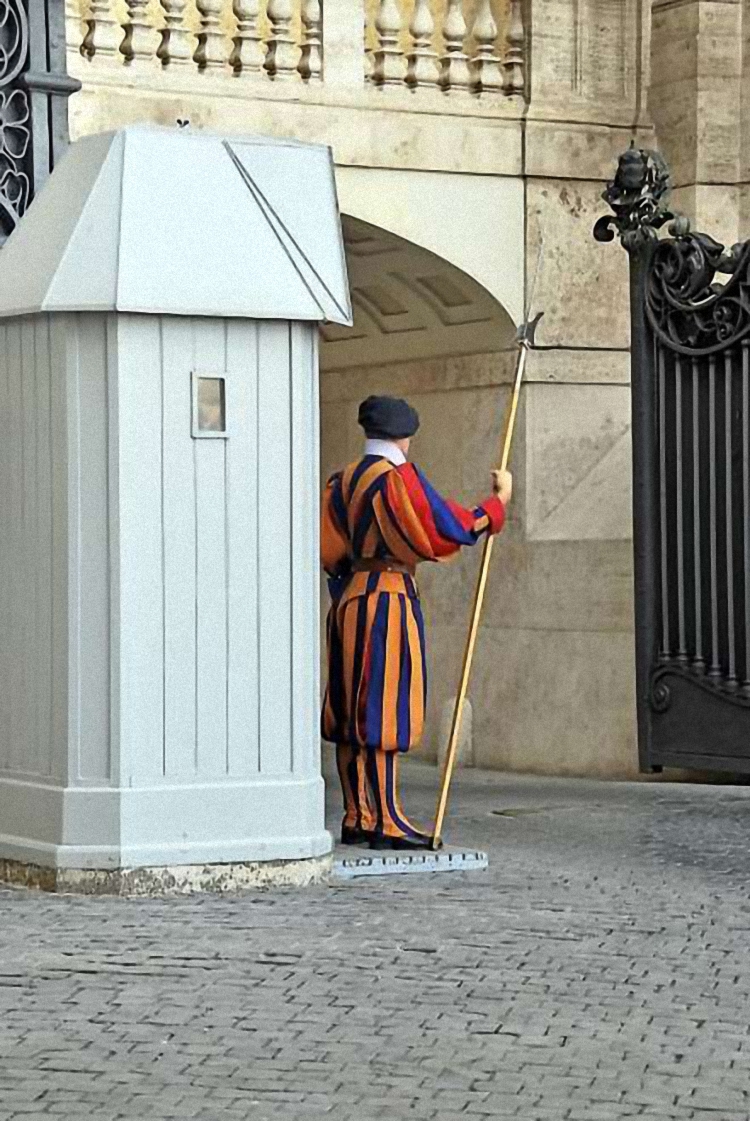
The blue, red and yellow stripes are among the most photographed clothes in Rome, and they come wrapped in a myth. They were not designed by Michelangelo or Raphael, as guides often claim. The colours are those of the Medici and della Rovere papal families, but the uniform in its present form was standardised only in 1914, by the guard’s commander Jules Repond, who based it on Renaissance paintings.
For ceremonies a guard adds a steel morion helmet, sometimes plumed with ostrich feathers, and a breastplate, and carries the long-handled halberd and a sword. None of this is only for show. Behind the historic dress the guards train with the Swiss Army, learn close protection and firearms, and carry modern weapons out of sight when the job calls for it.
Training and Daily Duty
Behind the pageantry is a modern security job. Recruits arrive having already served in the Swiss Army, then take a course that adds close protection, unarmed combat, first aid and firearms, much of it taught with help from Swiss police and the Italian authorities.
On any given day, guards hold fixed posts at the gates around the clock, control access to the papal apartments, and accompany the Pope at audiences and on his travels. Shifts are long and the discipline is strict, and the corps has taken on extra anti-terror and crowd training in recent years. The halberd, in other words, is the ceremonial half of a serious brief, carried for show while the real protection work goes on quietly behind it.
Seeing the Guards at the Vatican
You will meet them the moment you reach the edge of Vatican territory.
- At the gates: the most reliable sightings are at the Bronze Door beside St Peter’s Square and the Porta Sant’Anna, where guards check everyone entering the city.
- At ceremonies: they line papal audiences and great services in their full dress uniform.
- The swearing-in: the 6 May oath ceremony, with parades and the new recruits, is the one day a year to see the whole corps on display.
You can photograph them, but they are on duty, so do not block their post or expect a chat; a guard will calmly stop anyone who steps out of line. From their gates it is a short walk to St Peter’s Basilica and the rest of the Vatican.
Frequently Asked Questions
Are the Swiss Guards a real army or just for show?
A real one. They are trained soldiers responsible for the Pope’s security, the Vatican gates and the conclave, and they carry modern weapons when needed. The Renaissance uniform and halberds are the ceremonial face of a working close-protection force.
Why does the Pope have Swiss guards?
Because in 1506 Swiss mercenaries were the most respected soldiers in Europe, and Pope Julius II recruited them for their skill and loyalty. The link with Switzerland has been kept as a tradition ever since, and recruits must still be Swiss citizens to this day.
Did Michelangelo design the uniform?
No, that is a popular myth. The striped uniform in its current form was designed by the guard’s commander Jules Repond in 1914, inspired by Renaissance art, using the colours of the Medici and della Rovere families.
How do you become a Swiss Guard?
You must be a Swiss, Catholic, unmarried man aged 19 to 30, at least 1.74 metres tall, with completed Swiss military training and a clean record. Accepted recruits commit to at least two years and are sworn in on 6 May.
When can you see the swearing-in ceremony?
Every year on 6 May, the anniversary of the 1527 Sack of Rome, in the San Damaso courtyard of the Vatican. It is the one day the entire corps appears in full dress for the public.
How much do the Swiss Guards earn?
A modest amount: a small tax-free monthly salary on top of free board, lodging, meals and uniform inside the Vatican. The role is taken for the honour and the experience rather than the pay, and most guards serve a couple of years before returning to civilian life in Switzerland.
Have the Swiss Guards ever died defending the Pope?
Yes. Most famously, 147 of them were killed during the Sack of Rome in 1527 while covering Pope Clement VII’s escape to Castel Sant’Angelo. That day is the reason recruits are sworn in every 6 May, and the modern oath still binds each guard to protect the Pope with his life.
Sources and Further Reading
- Pontifical Swiss Guard – the corps’ official site on history, recruitment and the oath
- The Holy See – the Vatican’s portal, including the guard’s role
- About Switzerland, the Swiss Guard – the Swiss federal account of the corps
- UNESCO, Vatican City – the World Heritage state the guard protects