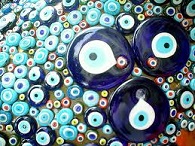
A Greek grandmother in a village on the Mani peninsula will still spit three small dry spits over a newborn baby’s head when a visitor tells her the child is lovely. The spits are for protection against the evil eye, and the grandmother is not rude. She is following a rule that runs through Greek daily life alongside church bells, coffee fortunes, blue glass beads on car mirrors, and a calendar of lucky and unlucky dates that predates the arrival of Christianity in the country by a long stretch. Few European traditions carry this many small domestic rituals into the present day, and a traveller who notices them will read a Greek living room, a taxi dashboard, or a wedding reception differently within a week of arrival.
Tuesday the Thirteenth and the Weight of an Old Defeat
Greeks treat Tuesday the thirteenth as the unlucky day of the month, where English, French, and American folklore usually pick Friday the thirteenth. The reason reaches back to 29 May 1453, a Tuesday, when the Ottoman army of Sultan Mehmed the Second took Constantinople and ended the Byzantine empire. The fall of the City, as Greeks still call it in conversation, left Tuesday marked as a day of bad luck for centuries afterwards, and the thirteenth took on the European unlucky-number colour from the same medieval stock that shaped Friday the thirteenth elsewhere. Greek shopkeepers will avoid opening a new business on a Tuesday the thirteenth, Greek couples will avoid scheduling a wedding on the date, and Greek travellers will sometimes postpone a long journey by a day. A visitor who arrives in Athens on a Tuesday the thirteenth and finds a shuttered shop on a street that was open the week before has seen the rule in practice. The date is observed more strongly by older Greeks and in rural areas than by younger Athenians, although even secular urban households will raise the subject when the date comes around.
The Evil Eye, the Mati, and the Blue Glass Bead
The belief in the mati, the evil eye, runs across Greek society from the villages of Epirus to the Athens suburbs. The idea is that a stranger or an acquaintance who compliments a baby, a new car, a farm animal, or a household item can by the force of envy alone bring bad luck, headaches, or illness on the object of the compliment. The protection against the mati takes several forms. A small blue glass bead with a white-and-black eye painted on it, called a mati after the evil it deflects, is pinned to a baby’s clothes, hung on a car mirror, worn as a bracelet, or nailed above the front door of a house. A Greek grandmother who hears a compliment on a child will often spit three small dry spits to the side, ftou ftou ftou, to carry the envy away from the child. A Greek mother who thinks her child has been struck by the mati will call an older woman from the family to perform the xematiasma, a short prayer-and-oil ritual where a drop of olive oil is dropped into a glass of water. If the drop spreads and disperses the child is said to be affected, and the older woman reads a silent prayer while yawning to release the spell. The xematiasma is not taught openly. An older woman passes the words to a younger female relative only on the evening of Good Friday, the one night of the year when the transmission is said to hold its power. Younger Greeks will often claim to be sceptical of the mati and then check for the blue bead on a friend’s baby in the same breath.
Salt, Water, Wood, and the Small Gestures of a Greek House
A Greek household carries a set of small protective gestures that run through an ordinary day. Throwing a pinch of salt over the left shoulder after a stranger leaves the house is meant to clear any bad luck the visitor may have brought in. A glass of water poured onto the street behind a traveller leaving for a long journey is a wish for the journey to run as smoothly as the water flows. Knocking on wood, a gesture shared with much of Europe, is standard in Greek conversation when a speaker mentions a piece of good fortune and wants to avoid inviting its opposite. A pair of scissors placed open on a table is taken as a signal of a coming argument and is closed at once by whoever notices it. A chair knocked over on its back is righted within seconds because a fallen chair is read as a sign of illness in the household. Handing a knife to another person directly is avoided, and the knife is placed on the table for the other person to pick up instead. A broom swept across the feet of an unmarried person is said to spoil the marriage prospects of that person, and a Greek aunt sweeping a kitchen floor will lift the broom over the feet of a niece or nephew who is standing in the way rather than brush them by accident.
Coffee Fortunes, New Year Card Games, and Name Days
The Greek coffee cup, the small white porcelain cup in which a shot of thick sweet black coffee called ellinikos kafes is served, carries a second use after the coffee has been drunk. The cup is turned upside down onto the saucer, left for a minute for the grounds to slide, and then read by an older woman in the household for patterns that stand for travel, love, a letter, a new friend, or a loss. The practice, called kafemanteia, has no church blessing and is treated by most Greeks as a semi-serious parlour game rather than a real divination. A traveller offered a coffee reading in a Crete or Thessaloniki kitchen will usually be told a friendly and broadly positive reading shaped to the mood of the table. On New Year’s Eve, Greek households will play cards for small sums and test their luck for the year ahead. The tradition runs on the idea that the first game of the year predicts the colour of the year’s luck, and the stakes stay small because the game is for the omen rather than the winnings. The host of a New Year’s Eve table will also bake a vasilopita, a sweet cake with a single coin hidden inside, and the guest whose slice holds the coin is said to carry the luck of the year. Name days, the feast days of the Orthodox saint a Greek is named after, are celebrated alongside birthdays and sometimes above them. A Greek called Maria will celebrate on 15 August, the feast of the Dormition of the Theotokos, and will hold open house for friends and relatives who drop by without an invitation during the afternoon and evening.
Weddings, Crowns, and the Breaking of a Pomegranate
A Greek Orthodox wedding carries several gestures that a visitor will not see at a western European ceremony. The bride and groom wear crowns called stefana, joined by a white ribbon, during the service, and the koumbaros or koumbara, the best man or maid of honour, swaps the crowns between the two heads three times at a set point in the liturgy. After the ceremony a plate is broken at the reception as a call to good luck, a custom shared with parts of the Balkans and with Jewish wedding tradition. At a village wedding in Crete or Epirus the families will sometimes break a pomegranate on the ground in front of the couple as they enter the reception, scattering the red seeds as a wish for fertility and prosperity. The broken pomegranate belongs to the older layer of Greek folklore that reaches back through the Byzantine period to the classical cult of Persephone, whose return from the underworld was tied to the same fruit. A traveller invited to a Greek village wedding in August or September may see the pomegranate gesture alongside the modern custom of pinning banknotes to the couple’s clothes during the dancing.
Frequently Asked Questions
Why is Tuesday the thirteenth unlucky in Greece?
The date carries the memory of 29 May 1453, a Tuesday, when Constantinople fell to the Ottoman army and the Byzantine empire ended. Greek folklore marked Tuesday as an unlucky day from that point onwards, and the thirteenth picked up the European unlucky-number colour from the same medieval stock that shaped Friday the thirteenth elsewhere.
What is the mati and how do Greeks protect against it?
The mati is the evil eye, a belief that an envious glance or compliment can bring bad luck or illness on the object of the envy. Protection takes the form of a blue glass bead with a painted eye worn or hung on a doorway or a car mirror, a small spitting sound from an older relative when a child is praised, and the xematiasma ritual with olive oil and water for a child believed to be affected.
Do Greeks celebrate name days as well as birthdays?
Yes. A Greek celebrates the feast day of the Orthodox saint they are named after, and in older households the name day runs above the birthday in importance. The host holds open house on the day and friends and relatives drop by without a formal invitation.
What happens to the scissors on a Greek kitchen table?
A pair of open scissors left on a table is read as a signal of a coming argument in the household and is closed at once by whoever notices them. The gesture sits alongside the broader set of small protective habits that run through a Greek home.
Sources and Further Reading
- Academy of Athens, Hellenic Folklore Research Centre, kentrolaografias.gr
- Margaret Alexiou, The Ritual Lament in Greek Tradition, Rowman and Littlefield
- Charles Stewart, Demons and the Devil: Moral Imagination in Modern Greek Culture, Princeton University Press
- Richard and Eva Blum, The Dangerous Hour: The Lore of Crisis and Mystery in Rural Greece, Chatto and Windus
- Greek National Tourism Organisation, culture and festivals pages, visitgreece.gr