The historical evidence for widespread body marking among Celtic warriors is thinner than popular accounts suggest. Roman writers from Julius Caesar to Herodian mention painted or dyed bodies among the Britons and the Picts, but only the Picts are consistently described as tattooed. The Irish Gaelic warriors of the pre-Christian and early medieval period left no surviving tattoo record, and modern “Celtic warrior tattoo” designs are mostly nineteenth- and twentieth-century reconstructions based on the metalwork patterns of the Book of Kells and the Ardagh Chalice rather than documented battle body-art.
This guide covers the actual historical record of Celtic body marking, the medieval manuscript patterns that form the basis of contemporary Celtic tattoo designs, the main tattoo motifs associated with Irish and Celtic heritage (trinity knot, triquetra, Celtic cross, claddagh, warrior shield, serpent, spiral), the symbolic meanings attached to each, and the cultural and legal context for Irish tattooing today.
The Historical Evidence for Celtic Warrior Tattoos
Julius Caesar’s Commentarii de Bello Gallico, written around 50 BCE, states that the Britons “all stain themselves with woad, which produces a blue colour, and makes their appearance in battle more terrible”. The passage describes painting rather than tattooing, and the woad reference applies to the Britons rather than to the Gaels of Ireland. Later Roman writers (Herodian, around 230 CE) describe the Picts of modern Scotland as tattooed, using iron needles and coloured pigments to mark their bodies with animal and geometric designs.
The Irish Gaels (the Scotti of Latin writers) left no comparable Roman description. Irish mythological and legal texts from the Old Irish period (600-900 CE) mention body painting for ritual purposes but do not describe tattooing as a standard warrior practice. The term “Celtic warrior tattoo” in modern usage therefore blends Pictish tattooing, British woad painting, and Irish Gaelic body culture into a single category that the ancient sources did not recognise.
The Christianisation of Ireland from the fifth century forward produced a cultural break with whatever pre-Christian body-marking traditions existed. By the medieval period (800-1500 CE), tattooing was strongly discouraged by the Church, and no Irish manuscript or archaeological record documents widespread tattooing in Gaelic Ireland. The body art that modern Celtic tattoos draw on is therefore primarily the painted and carved ornament of medieval Irish and Scottish metalwork and manuscript illumination rather than documented battlefield tattoos.
The Design Source: Medieval Celtic Ornament
The visual vocabulary used in modern Celtic warrior tattoos comes from four main medieval sources. The Book of Kells, produced around 800 CE on the island of Iona and later at Kells in County Meath, contains the most elaborate surviving insular manuscript ornament. Its interlaced knots, spiral patterns, and zoomorphic initials provide the core of what modern tattoo artists call “Celtic knotwork”. The Book of Durrow, the Lindisfarne Gospels, and the Ardagh Chalice extend this visual vocabulary into earlier and more sculptural territory.
Stone high crosses, carved across Ireland from the eighth to tenth centuries, preserve the same interlaced patterns on a larger scale and document the same designs used by warriors and noble families. The interlacing follows a strict rule of continuous line: each knot or spiral uses a single unbroken cord that loops and crosses without ever ending. This rule expresses eternity and continuity, which becomes the symbolic weight of Celtic tattoo designs today.
Viking-age metalwork from the Irish coastal settlements adds another layer. Scandinavian smiths in Dublin, Waterford, and Limerick from the 840s onward produced hybrid Norse-Celtic ornament that survives in Viking swords, belt buckles, and brooches. Several modern “Celtic warrior” tattoo designs draw on this hybrid vocabulary rather than on pure insular manuscript tradition.
The Main Celtic Warrior Tattoo Motifs
Modern tattoo artists working in the Celtic genre offer several standard motifs, each with an attached symbolic meaning:
- Trinity Knot (Triquetra): Three interlocking arcs forming a three-pointed shape. Pre-Christian interpretations tie it to three-phase cycles (past-present-future, maiden-mother-crone). Christian interpretations tie it to the Father, Son, and Holy Spirit. Common as a standalone tattoo or as a component of a larger design.
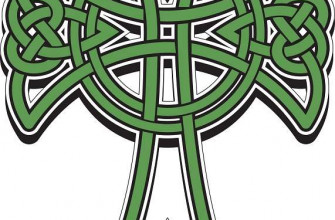
- Celtic Cross: A cross with a circular ring around the intersection. Specifically Irish in origin, with stone examples from the eighth century. Used as a tattoo to signal Irish Catholic identity, though some wearers use it in a secular heritage sense.
- Dara Knot: A complex interlaced square pattern with four or eight-fold symmetry, said to represent the root system of an oak tree (dara). Strongly associated with strength and resilience. Common for men’s Celtic warrior-style chest and arm pieces.
- Celtic Warrior Shield: A round knotwork pattern enclosed in a circle, modelled on the round shields used by Irish and British warriors from the Iron Age. Carries meanings of protection, courage, and loyalty to a warband.
- Spiral (Triskele): A triple spiral, one of the oldest documented pre-Celtic symbols in Ireland, carved on the Newgrange passage tomb around 3200 BCE. Often read as motion, progression, and life force.
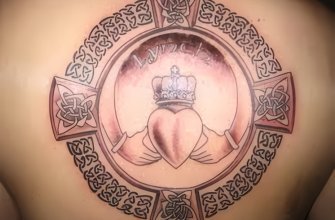
- Claddagh: The heart held by two hands with a crown on top. Popularly associated with love, loyalty, and friendship in Irish tradition. Less frequently tattooed as a “warrior” motif but common in family and heritage contexts.
- Ogham Inscription: The early Irish alphabet, used from around 400 CE for short stone inscriptions. Modern tattoos render a name or phrase in Ogham as a line of notches and strokes along a stem line. Our overview of Irish Celtic symbols covers the broader visual vocabulary these motifs draw from.
Cu Chulainn and the Warrior Tradition in Irish Mythology
Ireland’s mythological warrior tradition centres on the hero Cu Chulainn (Cuchulainn), the protagonist of the Ulster Cycle and the Tain Bo Cuailnge (Cattle Raid of Cooley). The earliest surviving version of the Tain was written down around 1100 CE but draws on oral traditions that may reach back to the Iron Age. Cu Chulainn undergoes the riastrad or warp-spasm in battle, a physical transformation that distorts his body into a frightening form; the texts describe his hair standing on end, his muscles swelling, and one of his eyes retreating into his head.
Modern Irish Celtic warrior tattoos sometimes incorporate Cu Chulainn imagery or reference the warp-spasm through twisted, asymmetric designs. The bronze Death of Cu Chulainn statue by Oliver Sheppard at the General Post Office in Dublin (commissioned in 1911, installed in 1935) became a national icon after the 1916 Easter Rising and provides the image most commonly copied in modern tattoo art. Our piece on Irish gang tattoos covers the darker modern iconography that developed from some of the same Celtic warrior symbols in nineteenth- and twentieth-century diaspora communities.
The Picts: The Actual Tattooed Warriors
The Picts of northern and eastern Scotland were the Celtic people the Romans consistently described as tattooed. The name Picti (“painted ones”) is a Latin exonym that entered the historical record around 297 CE. Roman writers describe Pictish warriors covered in tattoos of animals, geometric shapes, and spiral designs, applied using iron needles and blue or black pigments. The tattoos were thought to serve both as identity markers and as ritual protection in battle.
The Picts disappeared as a distinct people after their kingdom merged with Dal Riata (the Gaelic kingdom that crossed from Ulster into western Scotland) to form the Kingdom of Alba around 843 CE. No Pictish tattoos survive archaeologically because skin decays and the Pictish population converted to Christianity in the sixth and seventh centuries, ending whatever living tradition had existed. The visual record of Pictish design survives only through the Pictish stones, carved standing stones with animal figures, mirror-and-comb motifs, and interlace patterns that provide the closest indirect evidence of what Pictish body art might have looked like.
Some modern Celtic warrior tattoo artists specifically identify their work as Pictish rather than Gaelic, using the designs on the Aberlemno stones, the Meigle stones, and the Class III cross-slabs as direct visual source material. This approach produces tattoos that are more historically defensible than generic “Celtic warrior” designs and gives a clear reference point for discussion between tattoo artist and client.
Modern Tattoo Studios and Pricing
Irish and Irish-heritage tattoo studios in Dublin, Cork, Galway, Belfast, and the major diaspora cities (Boston, New York, Chicago, Melbourne, Sydney) specialise in Celtic designs. Typical pricing for a piece in 2020s rates:
- Small trinity knot or Celtic cross (3-5 cm): €80-150 in Dublin, US$150-250 in major American cities.
- Medium Dara knot or warrior shield (10-15 cm): €250-450 in Dublin, US$400-700 in US cities.
- Half-sleeve Celtic warrior piece (15-25 cm): €800-1,500 in Dublin, US$1,500-3,000 in US cities. Usually across 2-4 sessions.
- Full back piece with interlaced knotwork: €2,500-5,000 in Dublin, US$4,000-8,000 in US cities. 6-10 sessions over 6-18 months.
Studios with genuine Celtic specialisation publish portfolios online and typically offer a design consultation before the first tattoo session. Clients bringing their own reference images from the Book of Kells or from Pictish stones often end up with better results than clients who pick a generic design from a flash sheet. The field has developed enough that several established Celtic tattoo artists publish books and teach workshops, and the distinction between a serious Celtic-specialist studio and a generic shop that “does Celtic knots” becomes visible in the portfolio.
Cultural Sensitivity and Heritage
Irish and Celtic heritage tattoos occupy a middle ground between open cultural ownership and sensitive identity markers. Unlike Maori moko or Polynesian tribal tattoos, Celtic designs are generally considered appropriate for anyone to wear, and there is no Irish community objection to non-Irish people getting Celtic tattoos. The designs are seen as part of a European decorative tradition that has become global.
Some exceptions apply. Tattoos of specific tribal or clan symbols with unclear origin (for example, a design advertised as “the coat of arms of the O’Neills”) often turn out to be modern inventions rather than documented historical arms. Buyers should verify with Irish heraldic authorities before committing to a clan or family-specific design. Similarly, designs labelled as “the symbol of the Knights Templar” or “the ancient Druid rune for strength” are almost always modern constructions with no documented historical basis. A reputable Celtic tattoo artist will tell a client when a requested design is historically dubious rather than accepting the work silently.
Our article on Irish Celtic symbols covers the documented historical record of these designs in more depth, and our piece on Irish Celtic rings covers the parallel tradition in jewellery. For readers interested in the wider cultural context, our guide to medieval castles in Ireland covers the physical settings where the original warriors who carried these visual motifs actually lived and fought.
Frequently Asked Questions
Did Irish Celtic warriors really have tattoos?
The historical evidence is thin. Roman writers describe the Britons as painted and the Picts (of northern Scotland) as tattooed, but they do not describe the Irish Gaels as tattooed. Pre-Christian Irish sources mention body painting for ritual purposes but not as a standard warrior practice. Modern “Irish Celtic warrior” tattoo designs are mostly based on medieval manuscript and stone ornament rather than documented battlefield body-art.
What does a Celtic warrior tattoo symbolise?
Common symbolic readings include courage, strength, loyalty to a clan or warband, protection in battle, and pride in Irish or Celtic heritage. Specific motifs carry specific meanings: the trinity knot represents threefold cycles, the dara knot represents the strength of an oak, the Celtic warrior shield represents protection, and the Celtic cross represents Irish Catholic identity. The symbolism is mostly a modern elaboration of medieval visual tradition rather than a direct inheritance from Iron Age warriors.
What is the difference between a trinity knot and a Celtic knot?
The trinity knot (triquetra) is a specific three-pointed design with three interlocking arcs. A “Celtic knot” is the general term for any interlaced pattern in the medieval insular tradition, including the trinity knot, dara knot, sailor’s knot, endless knot, and many others. All trinity knots are Celtic knots, but not all Celtic knots are trinity knots.
Are Celtic tattoos appropriate for non-Irish people?
Generally yes. Celtic designs are considered an open European decorative tradition without the restrictions that apply to Polynesian or Indigenous tattoo traditions. Specific clan or tribal markers should be verified with Irish heraldic authorities before being tattooed, because many commercial “family coat of arms” designs turn out to be modern inventions rather than documented historical arms.
How much does a Celtic warrior tattoo cost?
Small trinity knots or crosses run €80-150 in Dublin, US$150-250 in the United States. Medium Dara knots or warrior shields cost €250-450 in Dublin, US$400-700 in the US. Half-sleeve and full back Celtic warrior pieces cost €800-5,000 in Dublin and US$1,500-8,000 in the US, usually spread across 2-10 sessions.
What was the woad used by the Britons?
Woad (Isatis tinctoria) is a European plant whose leaves produce a blue pigment similar to indigo. Julius Caesar’s description of blue-painted Britons is the earliest reference to its use as a body dye. Whether the Britons tattooed the woad into the skin or painted it on the surface for battle is unclear from the texts. Modern experimental archaeology suggests woad makes a poor tattoo pigment because the active ingredient breaks down when applied with needles; painting is the more likely original practice.
Sources and Further Reading
- Celtic knot history and types – en.wikipedia.org/wiki/Celtic_knot
- Picts and Pictish symbols – en.wikipedia.org/wiki/Picts
- Book of Kells digitised manuscript – digitalcollections.tcd.ie
- Cu Chulainn and the Ulster Cycle – en.wikipedia.org/wiki/Cu_Chulainn
- Roman accounts of British and Pictish body art – Julius Caesar, Bello Gallico Book 5