An Irish engagement ring carries a story in metal. Each design pulls from centuries of Celtic craftsmanship, from the hand-clasped hearts of Galway to the interwoven knots on medieval stone crosses. Couples choose these rings for the same reason people have chosen them since the 1700s: the symbols mean something specific, and the workmanship shows.
This guide covers the main Irish engagement ring styles, the metals and gemstones that pair well with Celtic work, the traditional rules for wearing a Claddagh, price ranges across popular designs, and where to find rings hallmarked by the Dublin Assay Office.
The Claddagh Ring: Ireland’s Most Recognisable Design
The Claddagh ring shows two hands holding a crowned heart. Each part has a fixed meaning: the heart stands for love, the hands for friendship, and the crown for loyalty. A silversmith named Richard Joyce made the first Claddagh in the late 1600s in the fishing village of Claddagh outside Galway, and the design has held its shape for over three hundred years.
The ring belongs to a broader family called fede rings, from the Italian mani in fede, hands joined in faith. Roman couples exchanged similar hand-clasp rings as engagement tokens. The Claddagh added the crown, turning a Roman idea into something specifically Irish.
A Claddagh works as an engagement ring when the wearer turns it so the heart points inward, toward the wrist. The rule matters because the same ring encodes four different relationship statuses:
- Right hand, heart pointing out: single
- Right hand, heart pointing in: in a relationship
- Left hand, heart pointing out: engaged
- Left hand, heart pointing in: married
This positioning tradition comes from the fishing community that produced the first rings. A woman wearing a Claddagh on the left hand with the heart turned inward signaled that her marriage was settled, a useful piece of information in a small port town.
Contemporary Claddagh engagement rings often set a diamond or other precious stone in the heart. A 14kt gold version with a diamond heart typically costs $1,800 to $2,500. Silver versions start around $200 and suit couples who want the symbol without the gold price tag. Platinum Claddagh settings run $2,500 and up.
Celtic Knot Engagement Rings
Celtic knots predate the Claddagh by more than a thousand years. Monks drew them in the Book of Kells around the year 800, and stonemasons carved them into high crosses across Ireland. Our overview of Irish Celtic symbols covers the broader visual vocabulary that Celtic knotwork draws from. The knots have no start and no end, which gives them their meaning: an unbroken loop stands for eternity, for love that continues past any single lifetime.
Trinity Knot
The Trinity Knot, also called the Triquetra, uses three interlocking arcs to form a three-pointed shape. Christian interpretation ties it to the Father, Son, and Holy Spirit. Older pagan readings connect it to three-stage cycles: maiden, mother, crone; earth, sea, sky; past, present, future. Either reading works for engagement symbolism. The three points can represent the relationship’s past friendship, present commitment, and future marriage.
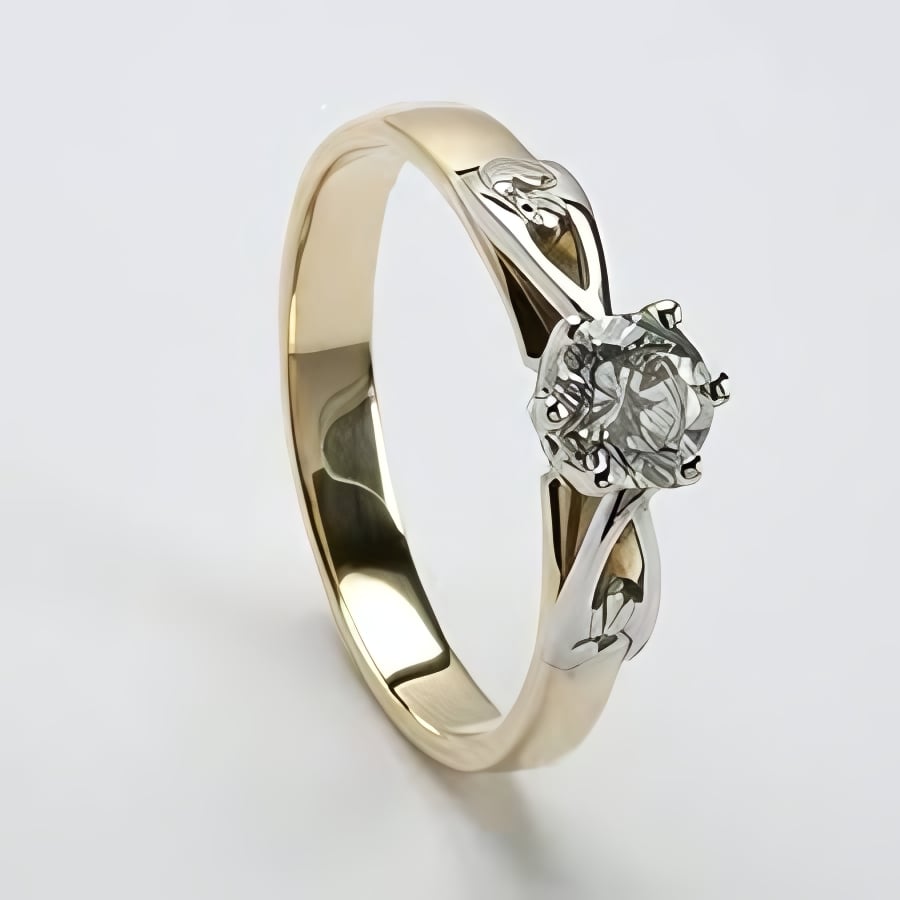
Trinity Knot engagement rings often place a single diamond or sapphire at the center of the knot, with the three arcs framing the stone. The design suits a round or princess-cut stone well because the symmetry of the knot matches the symmetry of the cut. Prices for 14kt gold Trinity Knot engagement rings with a center diamond run $1,000 to $3,500 depending on the carat weight and clarity grade.
Celtic Love Knot
The Celtic Love Knot shows two interwoven ropes that form a shape like two hearts bound together. The same interwoven pattern appears on medieval Irish stonework, and our guide to medieval castles in Ireland shows where visitors can see the design carved into original masonry. Irish sailors carried the design first, according to one origin story: a man leaving for long sea voyages would knot a rope as a keepsake for the woman he loved, and the ring version grew out of that practice.
A Love Knot engagement ring reads as softer and more feminine than the Trinity Knot. The interwoven ropes suggest intimacy rather than the geometric order of three-fold designs. Love Knot rings often use rose gold or mixed-metal settings, and pair well with smaller accent diamonds along the band rather than a single large center stone.
Celtic Warrior Shield
The Warrior Shield ring draws from the round shields carried by Irish warriors from roughly 500 BCE to 500 CE. The design arranges Celtic knots within a circular frame that evokes the shield’s shape. Warrior Shield rings carry meanings of courage, strength, and protection, which some couples prefer over the love-and-loyalty symbolism of the Claddagh. The design works well for men’s engagement or wedding rings, though more couples now choose matching Warrior Shield bands for both partners.
Eternity Knot
An Eternity Knot engagement ring uses a single continuous line that loops around the entire band without visible start or end. The pattern can be woven tight, like rope, or spread open with gaps between the strands. Eternity Knot bands pair well as wedding rings to match a Claddagh or Trinity Knot engagement ring, because the continuous knot complements the discrete symbols of the engagement design.
Metals Used in Irish Engagement Rings
Irish jewellers work in the same metals as jewellers anywhere, but Celtic designs favour yellow gold more than contemporary non-Celtic engagement rings do. The warm tone of yellow gold brings out the depth of carved knotwork in a way that white gold tends to flatten.
Gold options and their typical price implications:
- 14 karat yellow gold: The standard for Irish engagement rings. Durable, warm-toned, moderately priced. 14kt means 58.3% pure gold alloyed with copper and silver.
- 18 karat yellow gold: Richer colour, softer metal, about 30% more expensive than 14kt. Shows carved detail better but scratches more easily.
- 14 and 18 karat white gold: Gold alloyed with palladium or nickel and rhodium-plated. Modern look. Cheaper than platinum but needs rhodium replating every few years.
- Rose gold: Gold alloyed with copper for a pink tone. Popular for Love Knot designs because the warm copper shade softens the knotwork’s appearance.
- Platinum: Density and weight give a noticeable heft. Naturally white without plating. Typically 50-80% more expensive than equivalent 14kt gold.
- Sterling silver: Entry-level option, costs a fraction of gold, but tarnishes and bends more easily. Suits Claddagh rings with symbolic rather than investment value.
A ring hallmarked at the Dublin Assay Office carries four or five stamps: the maker’s mark, the metal fineness (for example 585 for 14kt gold), a date letter, the Hibernia mark (a seated figure representing Ireland), and sometimes the Dublin Castle mark. The Hibernia mark confirms the ring meets the metal purity stated by the maker. Readers visiting Ireland to collect the ring themselves often combine the trip with a tour of the country’s historic sites; our guide to famous castles in Ireland covers the stops worth adding around Dublin. Rings made in Ireland but sold abroad often keep these hallmarks, which is one way to check authenticity when buying from an overseas retailer.
Gemstones That Pair with Celtic Designs
The stone choice changes the whole character of an Irish engagement ring. A diamond center in a Trinity Knot reads as formal and modern. An emerald in the same setting reads as traditionally Irish. The right stone depends on what the wearer wants the ring to say.
Diamond: The default. Clear, hard, bright. Works with every Celtic design. A round brilliant or princess cut suits geometric knotwork; oval or pear shapes flatter the softer Love Knot. Expect to pay $1,500 to $8,000 for a Celtic setting with a half-carat to one-carat diamond of decent quality. GIA-certified stones add confidence on clarity and colour grading.
Emerald: The strongest tie to Irish identity, matching the green of the landscape. Emeralds are softer than diamonds (7.5 to 8 on the Mohs scale versus 10 for diamond), so they need more protective settings. Bezel or halo settings work better than high prong settings for daily wear. Irish-made emerald Celtic rings run €1,200 to €4,000 depending on stone size and clarity.
Moonstone: Pale blue-white, with a drifting inner glow called adularescence. Celts viewed moonstone as sacred, tied to the moon and to intuition. Moonstones suit engagement rings where the couple wants something less conventional than a diamond. The stone is softer (6 to 6.5 Mohs), so it needs a protective bezel.
Tanzanite: Deep violet-blue, found only in northern Tanzania. Celtic rings with tanzanite appeared in the 2000s as designers looked for alternatives to sapphire. A 14kt gold Celtic ring with a half-carat tanzanite runs about $1,500 to $2,000.
Sapphire: Blue sapphires pair well with white gold or platinum Celtic settings. Harder than emerald (9 Mohs) and better suited to everyday wear. Kate Middleton’s sapphire-and-diamond halo ring pushed sapphire engagement rings back into mainstream demand, and Celtic versions of this look are now common.
How to Wear an Irish Engagement Ring
The Claddagh’s four-position rule applies only to Claddagh rings. Trinity Knot, Love Knot, and other Celtic engagement rings follow normal Western conventions: left hand, fourth finger from the thumb. The tradition of wearing engagement and wedding rings on the left ring finger comes from the ancient Roman belief in the vena amoris, a vein that supposedly ran from that finger directly to the heart. Anatomy proved this wrong, but the tradition stuck.
On the wedding day, a woman typically moves her engagement ring to her right hand during the ceremony, receives her wedding band on her left ring finger, then moves the engagement ring back on top. This order keeps the wedding band closest to the heart, with the engagement ring stacked above. Some couples reverse this, though the closer-to-heart tradition is older.
Claddagh wearers sometimes inherit a ring from a grandmother or mother. A heirloom Claddagh passes the love-loyalty-friendship symbolism between generations, which adds weight to the engagement. Couples writing their own vows often draw on short Irish sayings for phrases that carry the same cultural weight as the ring itself. Inherited rings might need resizing; a competent jeweller can adjust most gold Claddaghs by one to two sizes up or down without damaging the design.
Pricing Guide for Irish Engagement Rings
Prices vary widely depending on the metal, the stone, the maker, and whether the ring is hand-crafted in Ireland or mass-produced. Rough guides by design type:
- Sterling silver Claddagh without stone: $150 to $350
- 14kt gold Claddagh with small diamond heart: $800 to $1,800
- 18kt gold Claddagh with larger diamond: $2,000 to $5,000
- 14kt gold Trinity Knot with half-carat diamond: $1,200 to $2,500
- 14kt gold Trinity Knot with one-carat diamond (GIA certified): $3,500 to $8,000
- Platinum Celtic knot with one-carat diamond: $5,000 to $12,000
- 14kt gold Love Knot with accent diamonds: $1,500 to $3,500
- Celtic ring with emerald center: €1,500 to €5,000
- Three-stone Celtic engagement ring, 18kt gold: €3,500 to €11,000
A 2026 buyer in the US paying $3,000 to $5,000 can expect a handcrafted 14kt Celtic ring with a half-carat to three-quarter-carat diamond of VS2 clarity and G-H colour, hallmarked in Dublin. The same budget at a non-Irish chain retailer buys a similar-looking ring that lacks the Hibernia mark and the handcrafted work, and the knotwork detail tends to be shallower.
Where to Buy Authentic Irish Engagement Rings
The Dublin Assay Office stamps every ring made in Ireland above a minimum gold content, and the Hibernia mark is the clearest signal of Irish origin. A few well-established Irish makers ship internationally:
- Claddagh Design (Dublin): Handcrafts every ring in their Dublin workshop. Full lifetime resizing and repair service on their rings.
- Glencara (Dublin): Family-run since the 1950s. Wide range of Celtic and Claddagh engagement rings with GIA-certified diamonds.
- John Weldon Jewellers (Dublin): Specialises in higher-end Celtic engagement rings with diamonds up to three carats.
- The Irish Jewelry Company (Dingle): Based on the Dingle Peninsula, focuses on traditional Claddagh designs.
- Walker Metalsmiths (New York, Irish-heritage maker): US-based but trained in Irish craft traditions, useful for American buyers who want faster shipping and domestic returns.
Buying directly from an Irish maker carries a premium of 15-30% over a US chain retailer, but the ring arrives hallmarked, handcrafted, and with documentation that survives resale. For couples who plan to pass the ring to a daughter or granddaughter, the documentation matters more than the price difference. Our companion article on creative Irish gifts lists the kinds of pieces that work as wedding-gift additions alongside the engagement ring itself.
Engagement Ring and Wedding Band: Matching the Set
Irish engagement ring sets usually include a matching wedding band. A Trinity Knot engagement ring pairs with a plain Trinity band or a narrow Eternity Knot band. A Claddagh engagement ring pairs with a plain gold band or a second, smaller Claddagh. Love Knot engagement rings match best with a simple rope-twist wedding band.
Some couples buy the engagement ring and wedding band as a bridal set from the same maker. Advantages: the metal tone matches exactly, the proportions sit flush against each other, and the shop often offers a modest discount on the pair. A separate engagement ring and wedding band bought years apart rarely achieve a perfect flush fit without a jeweller’s custom contouring, which adds $200-500 to the band.
Frequently Asked Questions
What makes an engagement ring Irish?
An engagement ring counts as Irish when it uses recognised Celtic or Claddagh symbolism and when a jeweller in Ireland hand-crafted it. The Hibernia hallmark from the Dublin Assay Office is the documentary proof. Rings that copy Celtic designs without Irish making or hallmarking are Celtic-style, not Irish.
Can a Claddagh ring serve as both engagement and wedding ring?
Yes. A wearer can keep the same Claddagh ring through engagement, marriage, and beyond, changing only the orientation. The ring turns on the day of the wedding: heart outward during engagement becomes heart inward on the wedding day. Some couples buy a second, slightly smaller Claddagh as a wedding band, giving the wearer a stacked pair.
Is it bad luck to buy your own Claddagh ring?
A folk tradition says a Claddagh should be given, not bought for oneself. The idea tracks the ring’s original meaning: love, friendship, and loyalty are given by someone else, not chosen alone. The belief isn’t universal across Ireland and many people do buy their own Claddagh. The tradition matters if it matters to the wearer, which is usually the only test that counts.
How do I resize an Irish engagement ring with carved knotwork?
A competent jeweller can resize most Celtic engagement rings by one to two sizes without visible damage to the knotwork, because the adjustment happens at the base of the band where the design is simplest. Resizing by three or more sizes risks breaking the pattern, and the jeweller may need to re-carve or re-cast sections. Ask the original maker first; they know their own pattern and can usually do the best job.
What are the current trends for Irish engagement rings?
Sculptural gold bands are the strongest current trend, where the metal itself carries the design weight without relying on a large center stone. Textured and hammered finishes pair well with Celtic knotwork. Coloured gemstones are replacing diamonds in a rising share of bespoke Celtic engagement rings, with emerald, sapphire, and morganite as the three most requested alternatives. Yellow gold has returned to dominance after a long period where white gold led the market, which suits Celtic designs because carved knotwork reads better in warm metal.
Sources and Further Reading
- Claddagh ring history and symbolism – en.wikipedia.org/wiki/Claddagh_ring
- Meaning and origin of the Claddagh – claddaghrings.com/the-meaning-and-origin-of-the-claddagh-ring
- Iconic Symbols of Ireland: The Claddagh Ring – theirishstore.com/blogs/the-irish-store/iconic-symbols-of-ireland-the-claddagh-ring
- Assay Office Dublin and Irish hallmarks – assayoffice.ie
- Celtic Engagement Rings Guide – diamondsfactory.co.uk/blog/celtic-engagement-rings-guide