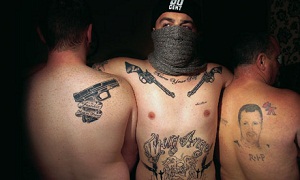
Irish gang tattoos is a phrase used in English-language journalism to describe a small set of Celtic motifs such as the claddagh, the shamrock, the Celtic cross, and the interlaced knotwork of the Book of Kells that have been adopted as identity markers inside Irish-American organised crime groups, prison subcultures, and the broader Irish-American community of the twentieth century. The same motifs also appear in commemorative heritage tattoos worn by people with Irish ancestry and in the athletic branding of the University of Notre Dame Fighting Irish, which makes the imagery difficult to read without the wearer’s biography.
This article handles the topic as cultural sociology rather than as design inspiration. The aim is to explain where the imagery comes from, who has used it, what the academic literature on prison and gang ethnography says about its function, the Fighting Irish branding associated with Notre Dame and the Irish-American boxing tradition, and why the same symbols carry very different meanings depending on who is wearing them.
Celtic Imagery and Its Borrowing
The visual vocabulary that English-language journalism groups under the label Irish gang tattoos draws on a small repertoire of older Irish and Celtic imagery, much of it lifted from the medieval manuscript tradition of the Insular Gospel books such as the Book of Kells and the Lindisfarne Gospels. The interlaced knotwork, spiral patterns, animal heads, and high cross designs of those manuscripts entered the modern tattoo flash repertoire through the late twentieth-century revival of Celtic design as a marker of Irish heritage.
Cultural sociologists who study tattoo practice in the Irish diaspora, including the work of Margo DeMello on the social history of tattooing, have traced how the same Celtic motifs appear in contexts as different as middle-class commemorative tattoos for Irish descent, prison ink in American correctional facilities, and the identification practices of small Irish-American street crews in the second half of the twentieth century. The shared origin in medieval manuscript art does not make the contexts equivalent.
Identity Marking in Closed Communities
Sociological work on tattoo practice in closed communities, including prisons, military units, and street organisations, treats body marking as a form of identity claim and group signalling. The argument running through this literature, from earlier work by Clinton Sanders and through more recent ethnography on prison tattooing, is that the meaning of a tattoo depends almost entirely on the community of readers around it and not on the design itself.
A Celtic knot on a forearm signals heritage in one context, gang affiliation in another, and a memorial commitment in a third, with no single correct reading available to an outside observer. Researchers who have studied the small Irish-American organised crime groups of the twentieth century, including the Westies of Hells Kitchen in Manhattan and the Winter Hill Gang in the Boston area, have noted that tattoos within those circles ran the full range from family commemorations to identity markers that could put a wearer at risk if recognised by police or by rival groups.
Why the Symbols Cannot Be Standardised
The straightforward question of what an Irish gang tattoo looks like has no clean answer because the underlying communities have never functioned as standardised institutions. American Latino prison gangs and Russian prison subcultures have generated relatively codified tattoo systems with documented meanings, partly because their respective groups have organised internal hierarchies that make signalling reliable.
Irish-American organised crime, by contrast, has remained much smaller in scale and much more informal, with crews operating through family and neighbourhood ties rather than through ranked membership structures. The result is that any catalogue of so-called Irish gang tattoos compiled from journalism or true-crime writing tends to fall apart on closer inspection.
The symbols listed are usually generic Celtic designs that any tattoo studio offers off the wall, and the meanings attached to them in popular sources are often projected backward from the meaning the writer wants the symbol to carry. The academic ethnographic record on Irish-American street groups is sparse compared with the literature on Latino, Asian, or African-American gangs.
Common Motifs and Their Dual Readings
The main motifs that appear across both heritage and street contexts are:
- Shamrock: Irish national identity since the 18th century, but also adopted by Aryan Brotherhood-linked groups in the prison system
- Claddagh: love, loyalty, and friendship in mainstream use; neighbourhood loyalty in Boston-area crew context
- Celtic cross: Christian heritage and Catholic identity for most wearers; coded identity marker for white supremacist groups
- Irish harp: national symbol on the Irish coat of arms and euro coins, fewer ambiguous readings
- Tricolour flag: Irish national flag, primarily heritage usage across the diaspora
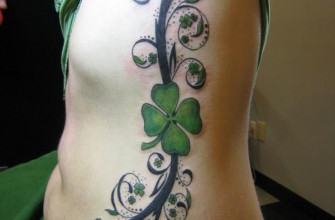
Several specific images appear in both Irish heritage tattooing and in the documented tattoo practices of Irish-American street groups. The shamrock, a three-leafed plant associated with St. Patrick and with Irish national identity since the 18th century, shows up in commemorative heritage pieces and in shamrock tattoo designs sold at every tattoo shop that stocks Celtic flash. The same shamrock appears in FBI documentation of Aryan Brotherhood-linked groups that adopted Irish imagery in the California and federal prison systems during the 1980s and 1990s, where it carried a racial rather than a national meaning. A shamrock on a forearm tells you nothing about the wearer without the rest of the biography.
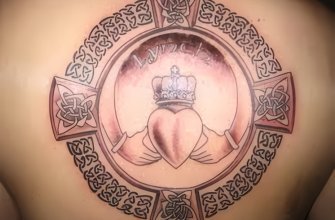
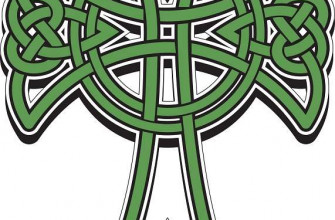
The claddagh, a design showing two hands holding a crowned heart that originated in the Galway fishing village of Claddagh, functions as a symbol of love, loyalty, and friendship in mainstream Irish culture. Claddagh rings are standard gifts at Irish weddings and graduations. The same image has been documented in tattoo form among individuals connected to Boston-area Irish-American crews, where researchers have noted it carried connotations of neighbourhood loyalty alongside the romantic associations. The Celtic cross, combining the Christian cross with a ring at the intersection, carries a similar dual track: it marks heritage and Catholic identity for most wearers but has been adopted by white supremacist groups in the United States and Europe as a coded identity marker.
The Irish harp, a national symbol that appears on the Irish coat of arms and on euro coins minted in Ireland, and the tricolour flag show up in tattoo work across the diaspora. These carry fewer ambiguous readings than the knotwork and shamrock motifs, though law enforcement analysts note that any national symbol can be repurposed inside a closed community when combined with other identifying marks like crew initials, neighbourhood abbreviations, or date references.
The Fighting Irish Tattoo: Notre Dame and the Boxing Tradition
The phrase Fighting Irish carries two distinct meanings in American tattoo culture, neither of which is strictly about organised crime. The first and most widespread is the athletic branding of the University of Notre Dame in Indiana, whose sports teams have been nicknamed the Fighting Irish since the early twentieth century. The name was adopted informally around 1909 and was officially sanctioned by Notre Dame President Matthew Walsh in 1927, and it has been paired with the leprechaun mascot in boxing stance since the 1960s.
Notre Dame Fighting Irish tattoos typically show the leprechaun logo, often alongside the interlocking ND monogram, the school colours of gold and blue, and occasionally the football schedule or a championship year. These are heritage and sports fandom pieces, worn by alumni and supporters of the university, and carry no gang or criminal connotations. They sit in the same category as tattoos commemorating any major American university or professional sports franchise.
The second meaning draws on the Irish-American boxing tradition of the late nineteenth and early twentieth centuries, when Irish and Irish-American fighters dominated professional boxing in the United States. John L. Sullivan, the last bare-knuckle heavyweight champion, retained the title from 1882 to 1892 and was celebrated as a Fighting Irish hero in working-class American communities. James J. Corbett, Jack Dempsey (of Irish descent on his mother’s side), and later Jerry Quarry continued the association between Irish identity and American boxing into the twentieth century.
Fighting Irish tattoos drawn from the boxing tradition often show a boxer in fighting stance, a pair of boxing gloves, the Irish tricolour flag, or the shamrock paired with a fist. These pieces celebrate a working-class heritage of physical courage and community pride. The boxing theme also appears in commemorative tattoos worn by people who trained at Irish-American boxing gyms in Boston, New York, and Chicago across the twentieth century.
The phrase has been picked up by Irish-American street culture and occasionally by organised crime groups as a loose identity marker, but this narrow usage does not exhaust the meaning of the imagery. Most Fighting Irish tattoos fall into the Notre Dame fandom or boxing heritage categories rather than the criminal one.
Reading Tattoos with Context
The takeaway for any reader interested in the topic for serious reasons is that a Celtic tattoo cannot be read in isolation. A serious researcher needs the wearer’s biography, the community context, and the regional history before a confident reading is possible.
Law enforcement gang identification guides published by the FBI and by state correctional departments include sections on Celtic and Irish-themed tattoos used by specific documented organisations, and those guides are explicit that the same designs appear in entirely benign contexts as well.
Anthropologists and historians who work on tattoo practice in the Irish diaspora point out that the longest-running modern use of Celtic body art has been by people commemorating Irish heritage rather than by organised crime, and that the public association of the imagery with crime is a relatively narrow framing built up by media coverage over the past three or four decades.
Editorial Note on Treatment
This article does not provide design templates, motif catalogues, or any material that could be used as inspiration for a tattoo intended to imitate gang imagery. The reader who arrived here through a search engine looking for that material will not find it on this page. The Celtic imagery discussed above carries meaning within its original communities, both the older medieval manuscript tradition and the modern Irish-American identity context, and is not a stylistic template for outsiders. Anyone considering a Celtic tattoo for personal heritage reasons should work with an Irish or Irish-American tattoo artist who understands the imagery and its context rather than picking designs off a search results page.
Frequently Asked Questions
What is a Fighting Irish tattoo?
A Fighting Irish tattoo refers to one of two traditions. The first and most common is the University of Notre Dame athletic branding, with the leprechaun mascot and the ND monogram worn by alumni and sports fans. The second draws on the Irish-American boxing tradition of the late nineteenth and early twentieth centuries, with imagery of boxers, boxing gloves, the tricolour flag, or the shamrock paired with a fist. Neither tradition is primarily about organised crime.
What does a Fighting Irish tattoo mean?
Fighting Irish tattoos most often celebrate Notre Dame University sports fandom or the Irish-American boxing heritage associated with champions such as John L. Sullivan, James J. Corbett, and Jerry Quarry. A secondary and much narrower meaning has been documented in some Irish-American street culture contexts, but this is a small subset of the overall usage. The imagery functions as a marker of community pride, physical courage, and Irish-American working-class heritage.
Are Celtic tattoos always linked to gangs?
No. Celtic knotwork, spirals, and high cross designs have been used as heritage commemorations by people of Irish descent for several decades and remain the most common context for the imagery. The gang association is a narrow framing built up by media coverage of specific historical organisations.
What was the Westies?
The Westies were a small Irish-American organised crime group based in the Hells Kitchen neighbourhood of Manhattan from the 1960s through the 1980s. The historian T. J. English documented the group in his 1990 book.
Should I get a Celtic tattoo?
That decision is yours and depends on your relationship to the imagery. Anyone researching the topic for personal heritage reasons should work with a tattoo artist who understands Irish and Celtic visual traditions rather than picking designs from a generic source.
What is the difference between Irish gang tattoos and Irish heritage tattoos?
The visual motifs overlap. Celtic knotwork, shamrocks, claddagh hearts, and high crosses appear in both contexts. The distinction lies in the wearer’s biography and community, not in the design. A heritage tattoo commemorates Irish ancestry or cultural connection. A gang-associated tattoo functions as an identity marker within a specific closed group. Researchers and law enforcement analysts agree that the design alone cannot determine which meaning applies.
Did the Winter Hill Gang use specific tattoos?
The Winter Hill Gang, based in Somerville and the broader Boston area from the 1960s through the 1990s, operated through family and neighbourhood networks rather than through a formal ranked membership structure. Journalistic accounts mention Celtic and Irish imagery among members, but no standardised tattoo code comparable to those documented in Latino or Russian prison gang systems has been identified. The group’s informal structure made systematic tattoo signalling less necessary than in larger, more hierarchical organisations.
Sources and Further Reading
- Margo DeMello, Bodies of Inscription: A Cultural History of the Modern Tattoo Community, Duke University Press, 2000
- Clinton Sanders, Customizing the Body: The Art and Culture of Tattooing, Temple University Press, revised edition 2008
- FBI National Gang Intelligence Center, National Gang Threat Assessment, public reports series, fbi.gov
- T. J. English, The Westies: Inside New York’s Irish Mob, St. Martin’s Press, 1990