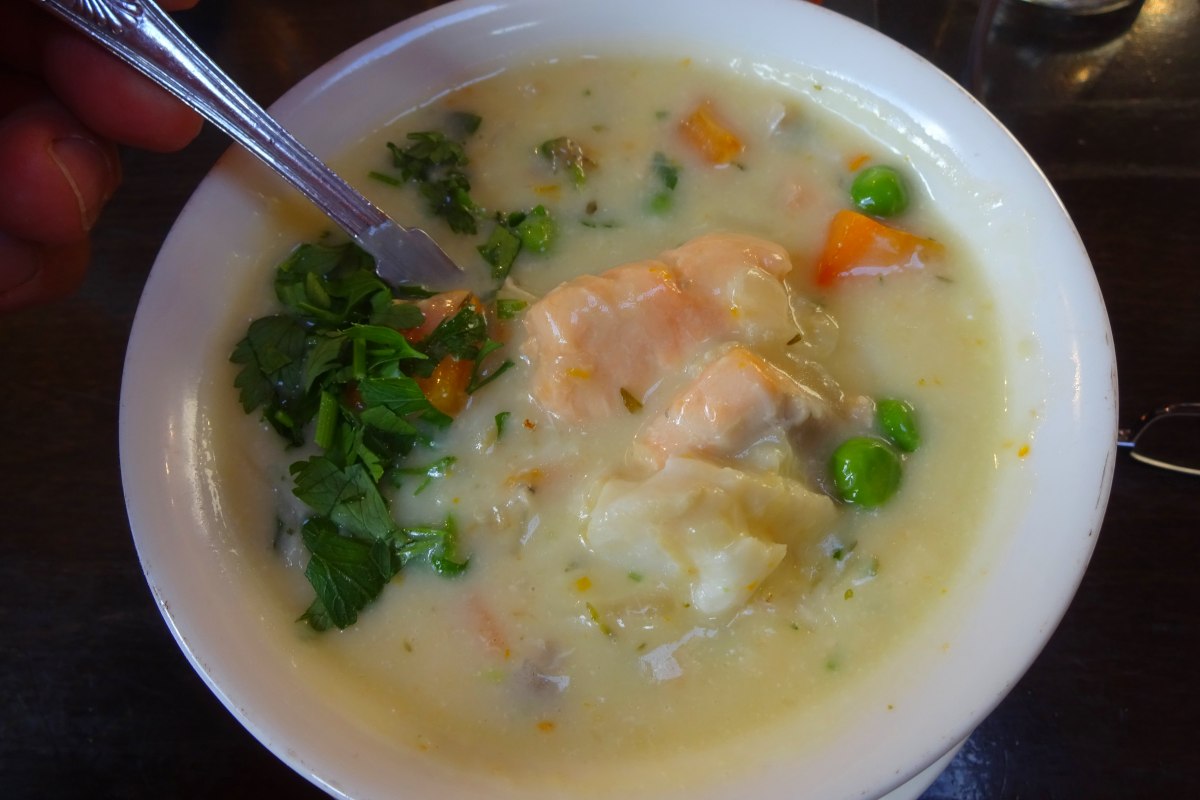
On the Irish coast, the word stew bends toward chowder. Irish seafood stew is a creamy pot of white fish, smoked fish and shellfish pulled from cold Atlantic water, built on potato and a little bacon, finished with cream and parsley. Every fishing village from Dingle to Howth makes its own, and the difference between a flat one and a memorable one comes down to two choices: the mix of fish you use and the piece of smoked fish you hide in it.
What goes into an Irish seafood stew
The pot is built from three kinds of seafood, and the balance matters more than any single ingredient.
- Firm white fish gives the body. Cod, haddock, hake or pollock hold their shape in chunks and stay sweet.
- Oily fish adds richness. A little salmon brings colour and depth without taking over.
- Shellfish brings the sea. Mussels, clams, and prawns or shrimp finish the pot and perfume the broth as they open.
- Smoked fish is the secret. A piece of smoked haddock or smoked salmon stirred through gives the whole stew a savoury depth that fresh fish alone never reaches. This is the step most home versions skip and most great ones keep.
Use whatever the fishmonger has fresh that day rather than chasing an exact list. A coastal stew was always made from the morning’s catch.
The seafood that makes it Irish
The provenance is the part no inland recipe can copy, and Irish waters are named on menus for good reason. Along the Wild Atlantic Way the cold, clean sea grows shellfish that chefs single out.
- Dublin Bay prawns, the langoustines of the east coast, are a member of the lobster family and the prize of an Irish seafood pot.
- Galway Bay and Killary Harbour mussels have been harvested for centuries, first wild off the rocks and now rope-farmed in the sheltered fjord water.
- Burren Smokehouse salmon, cured near the Burren in County Clare since 1989, is among the most respected smoked fish in the country and ideal for that depth-giving smoked layer.
- Galway oysters and west coast clams round out a region built around its shellfish.
Galway in particular treats the dish seriously. The King’s Head in the city has taken national honours for a chowder judged on sustainable sourcing, the kind of recognition that tells you the seafood, not the recipe, is the real prize.
The All-Ireland Chowder Cook-Off
Irish chowder has its own national contest, and it tells you more about the dish than any single recipe. The All-Ireland Chowder Cook-Off is held each April in Kinsale, County Cork, run by the Kinsale Good Food Circle, the food-tourism group founded in the town in 1976. Up to thirty-two chefs, one representing each county, cook against each other for the title of National Chowder Champion, judged partly by public vote. The winners map the dish onto the coast: Nancy’s Barn in Ballyliffin, Donegal, and the Killybegs Seafood Shack, also Donegal, have both taken the crown, the northwest fishing ports beating the rest of the island at their own broth. The lesson for a home cook is the one the judges reward: the best chowders win on the quality and generosity of the seafood, not on a clever twist. A pot built on the morning’s landing beats a fancier recipe made with tired fish.
Cream, broth, and the chowder question
Irish cooks split on how rich the stew should be. The pub standard leans creamy, a double-cream base that coats the spoon. The lighter, older coastal version stays closer to a clear fish broth with just a splash of cream at the end. Neither is wrong, but the technique that protects both is the same: add the cream off the heat, or at the gentlest simmer, and never let it boil, because a hard boil splits the cream and toughens the fish. A spoon of flour or a few extra floury potatoes will thicken a creamy version without a heavy roux.
Timing is the other rule. Seafood cooks in minutes, so it goes in near the end. The potatoes and base do the long cooking; the fish and shellfish poach gently for the last five minutes, just until the white fish turns opaque and the mussels open. Any mussel that stays shut after cooking gets thrown out.
Regional Irish chowders
A Galway chowder is not a Dingle chowder, and neither is a Donegal one. The coastline shapes each pot around its local landings, and the differences are worth knowing before you fix on a recipe.
- Galway and the west. Mussel and oyster country, so the stew leans on shellfish and a generous cream finish, often with a smoked salmon note from the nearby Burren Smokehouse.
- Dingle and Kerry. Built on the day’s white-fish landing, frequently lighter on cream and heavier on cod, hake and prawns.
- Donegal and the north west. Cooler waters bring crab and white fish to the fore, and some kitchens keep the broth clearer in the older style.
- Cork and the south. The harbour towns add their own smoked fish and sometimes a splash of cider or white wine to the base.
None of these is the one correct version. Each is a record of what comes off the local boats, which is exactly why a seafood stew tastes of its place.
Tips for a better seafood stew
- Make a quick stock from the shells. Simmer prawn shells or mussel liquor in the stock for ten minutes, then strain. It deepens the whole pot for no extra cost.
- Cut the fish in even chunks. Pieces of a similar size cook at the same rate, so nothing overcooks while you wait on the rest.
- Hold the delicate seafood to the very end. Prawns and scallops need only a minute or two, so add them last to keep them sweet.
- Season carefully. Smoked fish, bacon and mussel liquor all bring salt, so taste before you reach for the salt cellar.
An Irish seafood stew recipe
This serves six and comes together in about forty minutes, with the seafood added only at the finish.
Ingredients
- 300 g firm white fish, cod or haddock, in chunks
- 200 g salmon, in chunks
- 150 g smoked haddock or smoked salmon, in pieces
- 500 g mussels, scrubbed and de-bearded
- 150 g prawns or shrimp
- 2 rashers of smoked bacon, diced
- 3 floury potatoes, in small cubes
- 1 onion and 1 leek, finely chopped
- 600 ml fish or light chicken stock
- 150 ml cream
- A knob of butter, chopped parsley and chives, lemon
Method
- Soften the bacon, onion and leek in butter for a few minutes without colouring.
- Add the potatoes and stock, and simmer until the potatoes are tender, about fifteen minutes.
- Lower the heat to a gentle simmer. Add the white fish, salmon and smoked fish and the mussels, and push them under the liquid.
- Cook for five minutes, until the fish is opaque and the mussels have opened. Discard any that stay shut.
- Add the prawns and the cream, warm through without boiling, and check the seasoning.
- Finish with parsley, chives and a squeeze of lemon, and serve with brown soda bread.
Unlike the meat stews in this family, seafood stew is best eaten the day it is made, since reheating overcooks the fish.
Where to eat it
The coast is the place for it. Galway city, with its oyster festival and Atlantic harbour, is the spiritual home, and houses like Moran’s Oyster Cottage at Kilcolgan on Galway Bay draw people for shellfish straight from the water. Moran’s is a thatched cottage on the weir that has been run by the same family for seven generations across more than two hundred and fifty years, and its chowder is the dish reviewers tell each other to order before anything else. In Dingle and along the Kerry coast, harbourside kitchens serve a chowder built on the day’s landing. The recurring praise in reviews of the best of them is consistent: generous chunks of fish rather than a thin, potato-heavy broth, and a depth that gives away a hidden piece of smoked fish. The recurring complaint is the mirror image, a watery, potato-padded bowl with the seafood stretched too thin, which is exactly the fault a good home cook can avoid by loading the pot.
Common questions
What seafood is best for Irish seafood stew?
A mix works best: firm white fish like cod or haddock for body, a little salmon for richness, mussels and prawns for the sea flavour, and a piece of smoked haddock or salmon for depth. Buy whatever is freshest.
Is Irish seafood stew the same as chowder?
In practice, yes. The Irish coastal stew is a chowder, thickened with potato and usually finished with cream. The name changes from kitchen to kitchen more than the dish does.
How do you stop the cream from curdling?
Add it off the heat or at the lowest simmer and never boil the stew once it is in. Boiling splits the cream and toughens the fish. Gentle warmth keeps it smooth.
Can you make seafood stew ahead of time?
Make the potato and stock base a day early and keep it in the fridge, then add the seafood and cream only when you reheat it to serve. Cooking the fish in advance and reheating it makes it rubbery, so always poach the seafood at the last minute.
What do you serve with Irish seafood stew?
Brown soda bread and Irish butter are the classic partners, good for soaking up the creamy broth. A crisp green salad or a glass of cold white wine balances the richness without competing with the fish.
How is it different from meat Irish stew?
Completely. The traditional Irish stew is a slow lamb or mutton dish cooked for hours. Seafood stew is quick, creamy and coastal, with the fish cooked for only minutes at the end.
Related recipes
For the full background and every variation, see the Irish stew guide. For the meat versions, read Irish lamb stew and Irish beef stew.
Sources
- Bord Bia, the Irish Food Board, seafood
- Burren Smokehouse, County Clare, smoked Irish salmon
- Bord Iascaigh Mhara, the Irish Sea Fisheries Board
- Teagasc, potato varieties
- Fáilte Ireland, National Tourism Development Authority
- The Irish Times, food and drink
- Good Food Ireland
- Benreis, seafood chowder photograph, Wikimedia Commons, licensed CC BY 3.0