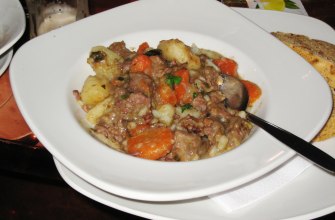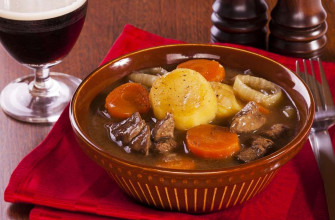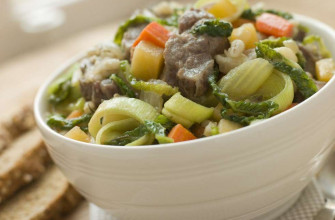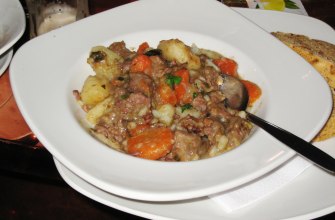
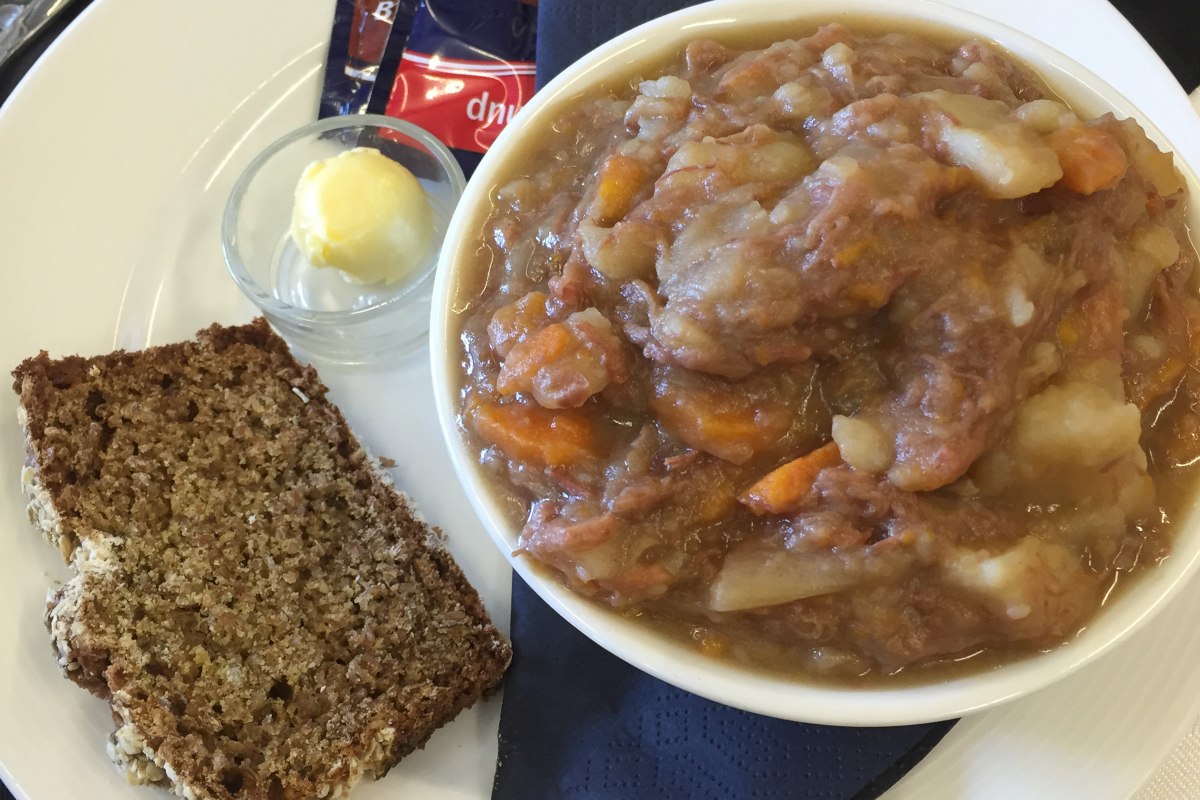
Three ingredients, no more. The strictest version of traditional Irish stew is mutton, onions and potatoes simmered in water until the meat falls apart and the broth turns pale and thick. No carrots, no stock cube, no stout, no browning. That bare recipe is the one Irish cookbook writers have defended for a century, and it tastes of the animal and the field rather than a spice rack. This is the authentic stew, the cottage version, and why the purists guard it so closely.
What makes a stew traditional rather than modern
The traditional dish is a white stew. The raw meat goes into the pot cold, never seared, so the broth stays the colour of weak tea instead of turning brown. Potato is the only thickener, breaking down into the water as it cooks. The flavour comes from long slow time, not from added richness. Set that against the modern pub version, which browns the meat, builds a flour gravy and often pours in Guinness, and you have two different dinners sharing one name.
The dish was poverty food. A cottage had one pot over a turf fire, a few onions, potatoes from the ridge and whatever sheep was past its working life. There was no oven to roast in and no money for cuts of prime meat. The stew is the direct record of that kitchen, which is why adding luxuries to it changes what it is.
The purists and what they ban
Irish food writers have argued the boundaries of this dish for generations, and the loudest voices draw a hard line at vegetables. Theodora FitzGibbon, in her 1968 book A Taste of Ireland, put it plainly: the pure flavour is spoilt if carrots, turnips or pearl barley are added. For her the stew was mutton, onion, potato and nothing else.
Florence Irwin carried the same authority a generation earlier. A domestic science teacher who travelled the north of Ireland around the turn of the last century showing country households how to cook on the new gas stoves, she set down the rural recipes in The Cookin’ Woman, published in 1949. Her Irish stew is the plain northern version, built on neck mutton and onion, a document of what farm kitchens actually made rather than a restaurant idea of it.
The modern Galway chef JP McMahon, who runs the Michelin-starred Aniar, has written about the food ways of the stew and lands in the same place: the dish is defined by restraint, and most of what gets added to it over the years is drift away from the original. You do not have to obey the purists. Many families have added a carrot for generations and call that traditional too. The point is to know which version you are making and why.
Mutton, lamb, and the right cut
Originally the meat was mutton, from a sheep more than a year old, because sheep were kept for wool and only old animals ended up in the pot. Mutton is stronger and fattier and needs three hours to soften, which suits a stew that cooks all afternoon. The cut matters more than the grade: neck and gigot chops on the bone give the broth its body, because the bone and gristle melt into gelatine. A lean boneless cut makes a thin, dull stew.
Lamb took over in modern kitchens because it is milder and cooks faster, and it is no accident that lamb stew became the Saint Patrick’s Day dish. Lamb comes into season around March and April, exactly when the feast falls, so a March stew made with new-season lamb is a seasonal choice as much as a traditional one. For the best provenance, Connemara Hill Lamb carries European Protected Geographical Indication status registered in 2007, reserved by law for hill lamb raised in that part of County Galway on wild upland grazing.
| Version | Meat | Added vegetables | Liquid |
|---|---|---|---|
| Strict traditional | Mutton, bone in | Onion and potato only | Water |
| Common home version | Lamb or mutton | Onion, potato, carrot | Water or light stock |
| Ulster style | Mutton or hogget | Onion, potato, pearl barley | Water |
| Modern pub (not traditional) | Browned lamb or beef | Root vegetables | Stock and stout |
The history behind the pot
Writers recognised Irish stew as a distinct dish by around 1800, though the pot itself is older than any record of it. The meat tells the social story. Sheep earned their keep through wool and milk, so a farmer killed one only when it stopped producing, which meant tough old mutton that demanded hours of slow cooking to become edible. The neck, the cheapest part of the cheapest meat, was the cut that defined the dish. Nothing was wasted, and nothing was bought that the holding did not already grow.
The Great Famine of the 1840s pushed the recipe even closer to the bone, since potatoes and a scrap of mutton were often all a family had. When emigration scattered Irish households across Britain, the United States and Australia, the stew travelled with them as a taste of home, picking up local meat and vegetables along the way. That is how beef and carrots crept in abroad while the strict version held on in the west of Ireland. The dish became a national symbol precisely because it carried the memory of hard years, and food historians have traced its path through cookbooks for two centuries to map how a peasant supper turned into an emblem.
Getting the white stew right
The traditional method is forgiving on ingredients and strict on technique. A few habits separate a clean, pale, properly thick stew from a grey, watery one.
- Layer the pot. Onions and thin potato on the bottom, meat on top. The base vegetables melt into the liquid and do the thickening.
- Never boil. A bare simmer keeps the meat tender and the broth clear. A hard boil turns mutton stringy and breaks the potatoes into mush too soon.
- Split the potatoes. Thin slices early to dissolve and thicken, big chunks in the last hour to stay whole. One floury variety added all at once gives you either thin broth or grey paste.
- Skim the fat. Mutton throws a lot of fat. Lift it off once or twice so the finished stew is rich, not greasy.
- Rest it. Ten minutes off the heat, or better a night in the fridge, lets the broth set and the flavour settle. Reheated stew is the best stew.
How to make a traditional Irish stew
This is the strict white method. It serves six. Mutton wants the full three hours; young lamb is ready in two. Keep the heat low the whole way, because a boil shreds the meat and clouds the pot too early.
Ingredients
- 1.4 kg mutton or lamb neck and gigot chops, bone in, fat trimmed
- 6 medium floury potatoes, Rooster or Kerr’s Pink, half thinly sliced and half in large chunks
- 4 large onions, thickly sliced
- 1 litre cold water
- 1 bay leaf, optional
- Sea salt and freshly ground black pepper
- Chopped parsley and chives to finish
Method
- Trim the hard fat off the chops but leave the bones in. Do not brown the meat.
- Spread the onions and the thinly sliced potatoes over the base of a heavy pot. They will melt down and thicken the broth.
- Lay the chops on top, season well with salt and pepper, and tuck in the bay leaf if you want it.
- Pour in cold water until the meat is barely covered. Bring it up to a gentle simmer slowly, never a rolling boil.
- Cover and cook on the lowest heat. Skim the fat once or twice. Give lamb two hours and mutton closer to three, until the meat slides off the bone.
- Add the chunky potatoes for the final hour so they hold their shape while the early ones finish thickening the liquid.
- Rest the pot off the heat for ten minutes. The broth should coat a spoon. Scatter the parsley and chives over and serve with brown soda bread.
Make it the day before if you can. A night in the fridge lets the broth set and the flavour deepen, and it reheats better than almost any other dish.
Serving and what to drink
A traditional stew needs little beside it. Bread to mop the broth is the only real requirement, either soda bread or a plain brown loaf, with cold Irish butter. A pot of strong tea suits the cottage spirit of the dish, and a glass of stout works if you serve it alongside rather than cooking it in. Keep the table simple. The stew is the meal.
Frequently asked questions
What is the difference between traditional and modern Irish stew?
The traditional version uses raw mutton or lamb, onion, potato and water, cooked pale without browning. The modern version browns the meat, thickens with flour and often adds stout and root vegetables. Both are good, but only the first is the old cottage recipe.
Do you put carrots in traditional Irish stew?
The strict version leaves them out. Writers like Theodora FitzGibbon argued that carrots, turnips and barley spoil the pure flavour. Plenty of households add a carrot anyway, so treat it as a family choice rather than a fixed rule.
Is Irish stew made with lamb or mutton?
Originally mutton, the meat of an older sheep, which is fattier and stronger and needs long cooking. Lamb is the modern default because it is milder and faster, and new-season lamb in spring is why the dish belongs to Saint Patrick’s Day.
Why is traditional Irish stew not browned?
Cottage kitchens had no oven and no roasting tradition, so the meat went into the pot raw. The pale broth that results is the mark of an authentic stew. Browning is a later restaurant technique that changes both the colour and the taste.
Related recipes
For the full picture of the dish and every variation, start with the Irish stew guide. For the everyday modern version, see Irish lamb stew, and for the browned, stout-rich pub dish, see Irish beef stew.
Sources
- Theodora FitzGibbon, A Taste of Ireland, 1968
- Florence Irwin, The Cookin’ Woman: Irish Country Recipes, 1949
- Bord Bia, the Irish Food Board
- Connemara Hill Lamb protected geographical indication register
- Teagasc, potato varieties
- Dúchas, the National Folklore Collection of Ireland
- Fáilte Ireland, National Tourism Development Authority
- The Irish Times, food and drink
- Kenneth C. Zirkel, Irish stew photograph, Wikimedia Commons, licensed CC BY-SA 4.0