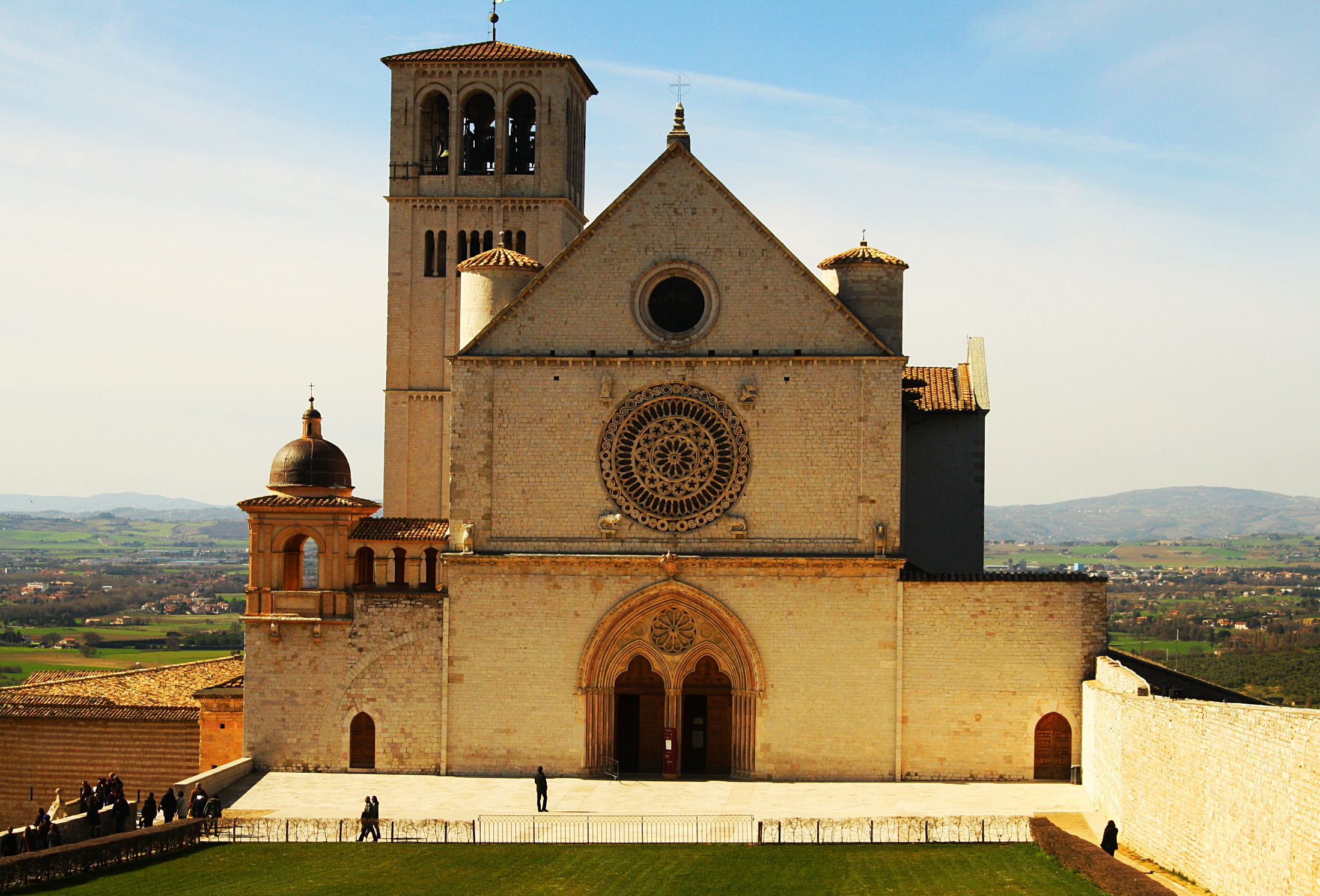
The Basilica of Saint Francis of Assisi sits on the edge of the old town in the Umbrian hill town where Francis was born in 1181 and where he is buried in a plain stone tomb below the lower church. Construction began in 1228, two years after his death, and the basilica was consecrated in 1253. It holds one of the most important fresco cycles in Western art: 28 scenes from the life of Saint Francis painted by Giotto di Bondone and his workshop between 1296 and 1304 in the Upper Church, plus earlier and later frescoes by Cimabue, Simone Martini, Pietro Lorenzetti, and the Master of the Assisi Vaults. UNESCO added the basilica to its World Heritage list in 2000.
This guide covers the layout of the two churches and the crypt, the Giotto fresco cycle and how to read it, the works by Cimabue and the Sienese masters in the transepts, practical information for visitors (opening hours, admission, photography rules, dress code), the 1997 earthquake that damaged the upper church and the restoration that followed, and how to plan a day trip to Assisi from Rome, Florence, or Perugia. The basilica fits naturally into a wider Italian itinerary covered in our piece on culture in Italy.
Layout: Upper Church, Lower Church, Crypt
The basilica consists of two stacked churches built into the side of Mount Subasio. The Lower Church (Basilica Inferiore), entered from the western facade, was completed first around 1230-1253 and has a low, wide, dimly lit interior with heavy stone vaulting designed for pilgrim processions. The Upper Church (Basilica Superiore), entered from the upper piazza at a higher elevation, was built above the lower structure between the 1230s and 1253 and has a tall, luminous Gothic interior with large stained-glass windows.
The Crypt (Cripta) sits below the Lower Church and contains the tomb of Saint Francis, rediscovered in 1818 after being hidden during the thirteenth-century construction to protect the remains from theft. The tomb is a plain stone sarcophagus surrounded by the simpler tombs of four of Francis’s original companions (Brothers Leo, Rufino, Masseo, and Angelo). Candles and silent prayer define the crypt atmosphere; cameras and loud voices are discouraged.
Visitors typically enter through the Lower Church, descend to the Crypt to visit the tomb, return to the Lower Church to view the frescoes by Cimabue and the Sienese masters, then climb the side staircase to the Upper Church for the Giotto cycle. The whole visit takes 90-120 minutes at an unhurried pace.
Giotto’s Fresco Cycle in the Upper Church
The 28 frescoes depicting the Legend of Saint Francis run around the lower walls of the Upper Church’s nave and transepts, painted between 1296 and 1304 by Giotto and his workshop. The series follows the saint’s life from his conversion through his posthumous miracles, based on the official biography written by Saint Bonaventure in 1263. Each fresco occupies a roughly three-metre-wide panel and carries the saint’s story forward in sequence, making the cycle readable as a biographical narrative.
The famous scenes include the Renunciation of Worldly Goods (where Francis strips naked before his father in the Assisi piazza), Francis Preaching to the Birds, the Confirmation of the Rule (where Pope Innocent III accepts the Franciscan order), the Stigmata (where Francis receives the wounds of Christ on Mount La Verna in 1224), and the Death of the Saint. The Sermon to the Birds (scene 15) has become the visual emblem of the Franciscan relationship with nature and is reproduced on every Assisi postcard.
Art historians debate how much of the cycle Giotto painted himself and how much is the work of his assistants. The standard view attributes the overall design and the main figures to Giotto, with workshop assistants completing the backgrounds, secondary figures, and decorative framework. The cycle’s importance lies in its clear narrative composition, its use of perspective and naturalistic space, and its break with the flat Byzantine style of earlier Italian painting.
Cimabue, Simone Martini, and Pietro Lorenzetti
The Upper Church also holds frescoes by Cimabue (around 1277-1283) in the transepts and apse, including a Crucifixion scene in the left transept that has been severely darkened by oxidation over seven centuries. Cimabue’s frescoes were Giotto’s immediate inspiration, and the relationship between the older master’s more vertical compositions and Giotto’s more horizontal storytelling defines a key transition in Italian art.
In the Lower Church, the Sienese master Simone Martini painted the Chapel of Saint Martin (1312-1317) with ten scenes from the life of that saint, in a refined Gothic style that contrasts with Giotto’s more naturalistic work in the upper building. Pietro Lorenzetti painted the left transept of the Lower Church (1310s-1320s) with a Crucifixion scene that spreads across an entire wall, and a remarkable Madonna with Saints Francis and John the Evangelist.
The Master of the Assisi Vaults, a Giotto workshop painter whose identity remains debated, painted the famous vault above the main altar of the Lower Church between 1315 and 1320. The vault contains four allegories: the Triumph of Saint Francis, and the three Franciscan vows of Obedience, Poverty, and Chastity. The Allegory of Poverty (Francis marrying Lady Poverty) is one of the most reproduced images from the basilica after Giotto’s bird-sermon scene.
The 1997 Earthquake and Restoration
Two earthquakes struck Umbria on 26 September 1997. The second tremor collapsed two sections of the Upper Church vaulting, killing four people (two friars and two restoration inspectors) and destroying fresco fragments by Cimabue and the Giotto workshop. Italian restorers recovered more than 300,000 fragments of the fallen plaster and reassembled the vaults during a four-year restoration project.
The Upper Church reopened to the public on 28 November 1999. The restoration used modern seismic reinforcement techniques hidden within the original Gothic structure. The visible frescoes include reconstructed sections with faint outlines marking areas where original paint was lost. Art historians consider the restoration one of the most successful large-scale earthquake recoveries in European heritage practice.
Planning Your Visit: Hours, Admission, Rules
The basilica is open daily throughout the year. Opening hours:
- Lower Church and Crypt: 06:00-18:50 daily.
- Upper Church: 08:30-18:50 daily.
- Sacro Convento: open to visitors with guided tours only.
Admission is free for individual visitors; groups of more than 10 people pay €1 per person. The basilica operates as a working religious site, and mass schedules may close parts of the church to sightseeing for 30-60 minutes at a time. Morning visits (before 10:00) give the best light for the Giotto cycle because the eastern windows illuminate the Upper Church frescoes at that time of day.
Dress code is strictly enforced: shoulders and knees must be covered for both men and women. Shawls are available at the entrance for visitors who arrive in tank tops or shorts. Photography is prohibited throughout the basilica without exception. Silence is required in the Crypt and during mass. Large bags must be left at the cloakroom near the entrance.
Saint Francis of Assisi: A Short Biography
Francesco di Bernardone (1181-1226) was born to a wealthy cloth merchant’s family in Assisi and lived the typical life of a rich young man until a spiritual crisis in his early twenties. He renounced his inheritance in the famous 1206 scene where he stripped naked before his father in the Assisi piazza, returned his clothes, and walked out of town to begin a life of voluntary poverty. He founded the Franciscan Order in 1209 with eleven companions, received papal approval from Innocent III in 1210, and spent the next sixteen years preaching poverty, peace, and reverence for creation across Italy, France, Egypt, and the Holy Land.
Francis received the stigmata (the five wounds of Christ) on Mount La Verna in September 1224, the first documented case of this phenomenon in Christian history. He died on 3 October 1226, aged 44, at the Porziuncola chapel below Assisi. Pope Gregory IX canonised him on 16 July 1228, less than two years after his death, and construction of the basilica began that same year. Pope Francis (Jorge Mario Bergoglio, elected 2013) took his papal name from Saint Francis of Assisi, the first pope to do so. Our companion piece on religion in Italy covers the broader Catholic context that surrounds Francis’s order.
Getting to Assisi
Assisi is a hilltown in the Umbria region, roughly 175 km north of Rome and 160 km southeast of Florence. Public transport options:
- Train from Rome: Direct and one-change services from Roma Termini to Assisi station take 2-2.5 hours. Fare €10-25.
- Train from Florence: Indirect via Terontola-Cortona, 2.5-3 hours total, €14-20. The Florentine itinerary including the Uffizi (where Giotto’s Madonna in Maesta hangs) is covered in our piece on Florence sightseeing.
- Train from Perugia: 25-30 minutes, €3-5. Perugia makes a natural base for Assisi visitors who want to stay in a larger Umbrian city.
Assisi train station sits 4 km below the old town, so visitors take the local bus (line C) up to the historic centre for €1.50. The basilica is a 10-minute walk from the central Piazza del Comune. Drivers can park in the Matteotti, Giovanni Paolo II, or San Pietro car parks around the perimeter of the old town (the centre is closed to non-resident traffic) and walk in.
A day trip from Rome or Florence is possible but tight: Assisi deserves at least a full afternoon at the basilica plus a short walk through the old town to see the Santa Chiara church (with the tomb of Saint Clare, founder of the Poor Clares) and the Temple of Minerva (a Roman temple now converted into a Catholic church). An overnight stay at one of the pilgrim hotels or smaller pensions allows a more unhurried visit and a quieter morning in the basilica before the day-trippers arrive.
Frequently Asked Questions
Is the Basilica of Saint Francis free to visit?
Yes. Individual visitors enter free of charge. Groups of more than 10 people pay €1 per person. The basilica operates as a working religious site and charges no admission, though the Sacro Convento museum and certain guided tours require a separate fee.
How long does a visit to the basilica take?
A thorough visit to both churches and the crypt takes 90-120 minutes. Visitors who want to study the Giotto cycle in detail should plan an additional 30-60 minutes. Visitors combining the basilica with the other sites of old Assisi (Santa Chiara, Temple of Minerva, Porziuncola in Santa Maria degli Angeli) need at least half a day in total.
Can I take photographs inside the basilica?
No. Photography is prohibited throughout the basilica, including the Upper Church, Lower Church, and Crypt. Audio guides are available for purchase at the entrance and cover the main works in English, Italian, Spanish, French, and German.
What is the Giotto fresco cycle?
The Legend of Saint Francis is a series of 28 frescoes painted by Giotto di Bondone and his workshop between 1296 and 1304 in the Upper Church. The series depicts scenes from the life of Saint Francis based on Bonaventure’s 1263 biography. It is one of the most important fresco cycles in Western art and marks a key moment in the transition from Byzantine to naturalistic Italian painting.
Was the basilica damaged in the 1997 earthquake?
Yes. The 26 September 1997 earthquakes collapsed two sections of the Upper Church vaulting, killing four people and destroying fresco fragments by Cimabue and the Giotto workshop. The basilica reopened on 28 November 1999 after a four-year restoration during which Italian conservators reassembled more than 300,000 fragments of fallen plaster. The annual Italian holidays and festivals calendar still includes the feast day of Saint Francis on 4 October as a national observance.
How do I get to Assisi from Rome?
Take a train from Roma Termini to Assisi station. Direct services take around 2 hours, and one-change services via Foligno run 2-2.5 hours, at fares between €10 and €25 depending on the train category. Travellers combining Assisi with the Italian capital can consult our overview of things to do in Rome. From Assisi station, take local bus line C to the old town for €1.50.
Sources and Further Reading
- Basilica of Saint Francis of Assisi – en.wikipedia.org/wiki/Basilica_of_Saint_Francis_of_Assisi
- Official basilica tourist information – sanfrancescoassisi.org
- Visit Assisi municipal tourism site – visit-assisi.it
- UNESCO Assisi World Heritage listing – whc.unesco.org/en/list/990
- Web Gallery of Art, Giotto frescoes in Assisi – wga.hu/html_m/g/giotto/assisi