Jamaica produced five distinct music genres between the 1890s and the 1980s – mento, ska, rocksteady, reggae, and dancehall – and each genre brought its own set of instruments to the stage. The island’s instrumental tradition pulls from West African drumming, European string and brass traditions, and homegrown innovations built from bamboo, cow horn, and wooden boxes. Around 90% of Jamaica’s population traces ancestry to Africa, and that demographic fact shaped the percussive backbone of every genre the island exported. This article breaks down the traditional instruments, the genre-specific setups, and how Jamaican musicians adapted tools from other cultures into something original.
Traditional Jamaican Percussion Instruments
The rumba box (also spelled rhumba box) serves as the bass instrument in mento music. A large wooden box with metal or bamboo tongues mounted on one side, it works on the same principle as the African mbira or thumb piano, scaled up to produce deep bass tones. The player sits on top of the box and plucks the tongues with one hand while tapping the box surface with the other. Rumba boxes likely descended from large lamellophones used in the Cameroon Grasslands and Eastern Nigeria, brought to Jamaica through the slave trade.
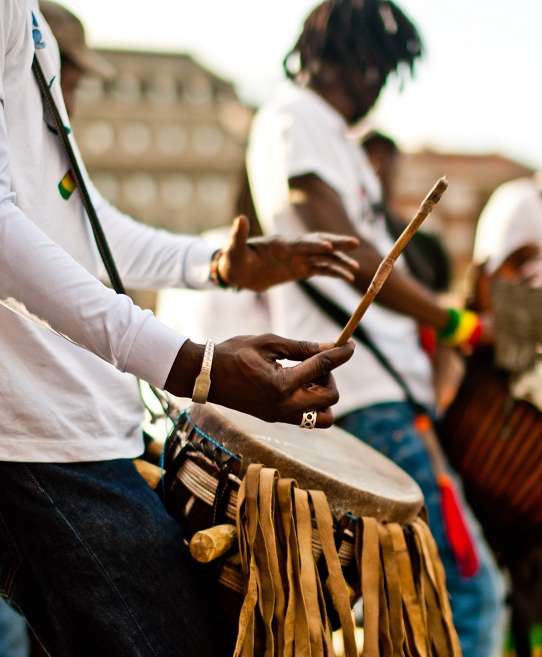
Nyabinghi drums form the rhythmic core of Rastafarian ceremonial music and fed directly into reggae’s drum patterns. The set consists of three drums, each with a specific role:
- Thunder (bass drum) – a large double-headed drum played with a padded mallet, providing the deep foundation beat
- Funde – the middle-sized drum that maintains a steady heartbeat rhythm, anchoring the tempo
- Repeater (kete) – the smallest and highest-pitched drum, used for improvisation and accenting beats 2 and 4
Count Ossie, a Rastafarian drummer active in Kingston from the 1950s, shaped the modern Nyabinghi style by combining traditional Kumina drumming patterns with rhythms he studied from recordings of Nigerian musician Babatunde Olatunji. His group, the Mystic Revelation of Rastafari, recorded with ska and reggae artists and helped bring Nyabinghi rhythms into mainstream Jamaican music.
Wind and Signal Instruments
The abeng holds a place as Jamaica’s national instrument. Made from a cow horn with a rectangular mouthpiece cut into the side, it produces two base pitches that the player modifies by placing and lifting the thumb over the horn’s wide end. Jamaican Maroons – descendants of escaped enslaved Africans who established independent communities in the Blue Mountains – used the abeng to communicate across valleys, sending coded messages that the British colonial military could not decipher. The instrument remains a symbol of Maroon resistance and appears in Jamaican national ceremonies.
The bamboo saxophone (or bamboo sax) is a homemade wind instrument built from a length of dried bamboo with finger holes drilled along its body. Mento musicians developed it as a cheap alternative to the metal saxophone, and it produces a raspy, buzzing tone that became a signature sound in rural mento bands. The fife, a small bamboo flute, fills a similar melodic role in traditional music from the eastern parishes of Jamaica.
String Instruments in Jamaican Music
The banjo arrived in Jamaica through the same West African roots that brought it to the American South. Jamaican mento players favored a four-string version tuned for rhythmic strumming rather than the five-string picking style common in Appalachian music. The banjo provided the rhythmic chop that drove mento’s tempo, sitting between the rumba box’s bass and the hand drums’ percussion.
The acoustic guitar replaced the banjo as the primary string instrument in Jamaican music during the mid-twentieth century. Mento guitarists played a syncopated strumming pattern that carried forward into ska and reggae as the “skank” – a choppy upstroke on beats 2 and 4 that became reggae’s most recognizable guitar sound. Electric guitars entered Jamaican studios in the late 1950s and dominated from ska onwards, though acoustic guitars never disappeared from mento and folk recordings.
How Instruments Changed Across Five Jamaican Genres
Mento bands in the 1940s and 1950s played entirely acoustic: rumba box, banjo or guitar, hand drums, bamboo sax, and shakers. The sound was rural, built for outdoor parties and hotel tourist shows. As Jamaica moved toward independence in 1962, musicians in Kingston began blending mento rhythms with American R&B and jazz they heard on radio stations broadcasting from Miami and New Orleans.
Ska emerged from that blend in the late 1950s. The instrumental lineup shifted to electric guitars, bass guitar, drum kit, piano or organ, and a brass section – trumpets, trombones, and saxophones. The Skatalites, formed in 1964, set the template with their horn-driven arrangements. Ska’s tempo ran fast, and the brass section carried the melody while the guitar chopped on the offbeat.
Rocksteady slowed the tempo around 1966. Bass guitar moved to the front of the mix, and vocal harmonies replaced the horn section as the lead melodic element. The drum kit shifted to a sparser pattern. Keyboard instruments – first piano, then organ, then synthesizers – gained prominence.
Reggae crystallized in the late 1960s with the “one-drop” drum pattern: the snare and bass drum hit together on beat 3, leaving beat 1 empty. Bob Marley, Peter Tosh, and Bunny Wailer built their sound on this rhythm with heavy bass guitar, skank guitar, and organ. Nyabinghi drums appeared on many roots reggae recordings alongside the standard drum kit. Dub producers like King Tubby and Lee “Scratch” Perry stripped reggae tracks down to bass and drums and added studio effects – echo, reverb, delay – turning the mixing board itself into an instrument.
Dancehall shifted to digital production in 1985 when King Jammy released the Sleng Teng riddim, built entirely from a Casio MT-40 keyboard preset. Live instruments gave way to drum machines, synthesizers, and samplers. The deejay’s voice – rhythmic spoken lyrics over pre-made instrumental tracks called riddims – became the lead instrument in everything but name.
The Role of the Studio as an Instrument
Jamaica’s recording studios functioned differently from studios in the United States or United Kingdom. Producers like Coxsone Dodd at Studio One, Lee “Scratch” Perry at Black Ark, and King Tubby at his home studio in Waterhouse treated the mixing desk as a performance tool. They re-recorded existing tracks by muting instruments, adding tape delay, and feeding signals through spring reverb units to create dub versions – stripped-down, echo-heavy remixes that highlighted the bass and drums.
This production approach influenced electronic music worldwide. British post-punk bands, American hip-hop producers, and European electronic artists all traced techniques back to Jamaican dub studios of the 1970s. The concept of the remix – reworking a finished recording into a new piece of music – originated in Kingston before the term existed in other music industries.
Traditional Instruments in Modern Jamaican Performance
Mento bands still perform at hotels, cultural festivals, and community events across Jamaica, keeping the rumba box, bamboo sax, and banjo in active use. The Jamaica Cultural Development Commission organizes annual competitions in traditional music and folk forms that require acoustic instrumentation. The Maroon communities of Accompong and Moore Town maintain abeng-playing traditions and demonstrate the instrument at annual celebrations of Maroon treaties with the British Crown.
Reggae artists occasionally return to acoustic and Nyabinghi instrumentation for unplugged recordings and live performances. The annual Nyabinghi gatherings, called groundations, can last several days and feature continuous drumming on the thunder, funde, and repeater. These events connect Rastafarian spiritual practice to the musical traditions that shaped reggae’s rhythmic identity. Meanwhile, Kingston’s studios continue to export riddims and production techniques that reach dancehall, afrobeats, and pop charts worldwide.
Frequently Asked Questions
What are the main traditional Jamaican instruments?
The main traditional instruments include the rumba box (a large thumb piano used for bass), Nyabinghi drums (thunder, funde, and repeater), the abeng (cow horn signal instrument), the bamboo saxophone, hand drums, shakers, the banjo, and the acoustic guitar. These instruments formed the backbone of mento, Jamaica’s original folk music.
What instruments are used in reggae music?
Reggae uses electric bass guitar, drum kit with the one-drop pattern, skank guitar playing upstrokes on beats 2 and 4, keyboards (organ or synthesizer), and sometimes Nyabinghi drums. Dub reggae adds studio equipment as instruments – mixing desks, tape delay units, and reverb processors that producers manipulate during recording.
What is the abeng and why is it important to Jamaica?
The abeng is a cow horn instrument considered Jamaica’s national instrument. Jamaican Maroons used it to send coded messages across mountain valleys during their resistance against British colonial forces. It produces two base pitches modified by thumb placement over the horn’s open end.
How did Jamaican music shift from acoustic to digital instruments?
Mento in the 1940s-1950s was entirely acoustic. Ska in the early 1960s introduced electric guitars, bass, and brass sections. Reggae in the late 1960s added studio effects as instruments through dub production. Dancehall completed the shift in 1985 when King Jammy’s Sleng Teng riddim, built from a Casio keyboard preset, proved that digital production could replace live musicians.
Sources and Further Reading
- Talking Jamaica – Traditional Instruments Used in Jamaican Music (talkingjamaica.com)
- RastaSeed – Nyabinghi Rasta Heartbeat Drumming (rastaseed.com)
- Reggae Groove – Timeline of Reggae Music: From Mento to Dancehall (reggaegroove.com)
- Jamaica Land We Love – The Evolution of Jamaican Music (jamaica-land-we-love.com)