Japanese expresses love not through a single character but through three main kanji that carry different registers of meaning: 愛 (ai) for deep abiding love, 恋 (koi) for ardent romantic love, and 好き (suki) for warm liking or affection. Tattoo and jewellery markets outside Japan often simplify the category to a single 愛 kanji, which misses the cultural distinction that matters inside the language. Add the compound 愛情 (aijou) for tender affection, the rarer 慈愛 (jiai) for merciful love, and the modern loan ラブ (rabu, the transliterated English love), and the field expands to a set of symbols each carrying its own emotional weight. This guide covers the main kanji for love, the etymology behind each character, the Meiji-era coinage of 恋愛 (ren’ai), the calligraphic forms, common compound words, the akai ito red-thread legend, and practical notes for anyone considering a tattoo or gift with one of these characters.
The Three Core Kanji for Love
The three characters 愛 (ai), 恋 (koi), and 好き (suki) cover most Japanese expressions of affection, but they are not interchangeable. A native speaker chooses among them based on the type of love and the relationship involved.
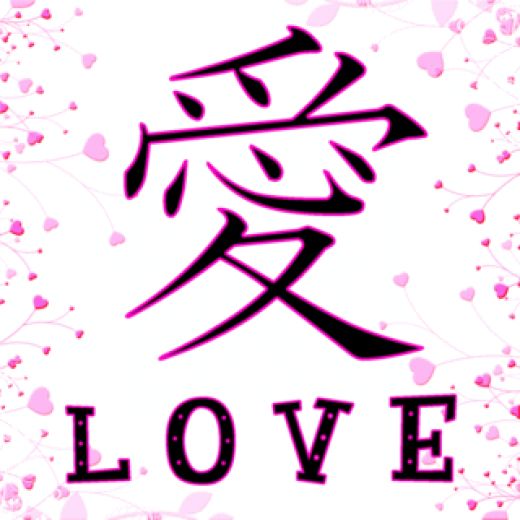
愛 (ai) covers the broadest and deepest sense of love. The character works for family, country, animals, and abiding romantic partnership. The composition combines 心 (kokoro, heart) at the centre with surrounding strokes that originally depicted 旡 (a person turning backward) above and 夂 (slow feet) below, producing the image of a person walking slowly with the heart pulled back toward someone left behind. 愛 is the character that appears on wedding announcements, parental dedications, and philosophical writing about human kindness.
恋 (koi) specifically means romantic ardent love, the intense emotion of infatuation and yearning. The character also contains 心 (heart) at the base and carries a connotation of desire and longing. Japanese poetry from the Heian period through today uses 恋 far more than 愛 when depicting romantic plots. The older form 戀 used two 絲 (tangled silk threads) above 言 (speech) with 心 (heart) at the base, picturing a heart whose threads cannot be untangled.
好き (suki) literally means liking, and it sits at the softer end of the affection spectrum. A Japanese speaker saying 好きだ (suki da) to a partner conveys warm affection without the weight of 愛してる (aishiteru, I love you). Many Japanese couples use 好き throughout a relationship and reserve 愛してる for exceptional moments. The compound 大好き (daisuki) lifts it to “really like” and is the everyday romantic register for confessions.
Etymology and the Mood Behind Each Character
The two main characters carry different emotional textures that go back to their classical Chinese and early Japanese roots. The difference is one of the cleaner cultural distinctions that English translation collapses into a single word.
愛 shares its on’yomi reading “ai” with 哀 (ai, to grieve, to mourn, to feel pity). Classical Japanese poetic sensibility treats the two as semantically adjacent: love carries an undercurrent of impending loss, of holding onto something that may not stay. The 8th-century Man’yōshū anthology already uses 愛 with this melancholy register, and the word “aware” (哀れ), often translated as “the pathos of things”, grew from the same root cluster.
恋, in its earlier reading “kohi”, was sometimes written 孤悲, literally “lonely sadness”. This phonetic-character pairing carried the meaning of yearning for someone absent, which is closer to the core meaning of 恋 today: longing for the unattainable rather than enjoying the present. Man’yōshū poems on 恋 cluster around expressions like 会いたい (want to meet), 独り占めにしたい (want to have exclusively), and 一緒になりたい (want to be together), all framing love as desire pointed toward what is not yet here.
The practical effect is that 愛 and 恋 carry slightly different weights even in modern usage. 愛 leans toward steady, established, sometimes weighted with the awareness of loss. 恋 leans toward fresh, urgent, directed at someone not yet fully present in the speaker’s life. A poem about a married couple of forty years uses 愛. A pop song about a first crush uses 恋.
The Meiji Coinage of 恋愛 (Ren’ai)
The compound 恋愛 (ren’ai), the modern Japanese word for romantic love as a general concept, did not exist in classical Japanese. Western missionaries, translators, and intellectuals of the Meiji era between 1868 and 1912 needed a word for the European notion of romantic love as a basis for marriage, which had no direct equivalent in pre-Meiji Japanese culture. The coinage 恋愛 emerged in the 1870s and 1880s as a translator’s compound combining 恋 (koi, romantic longing) with 愛 (ai, deep love), treating the two characters as a paired concept rather than separate registers.
Before Meiji, Japanese marriage was an arrangement between families with romantic love treated as a separate and not necessarily relevant emotion. The Meiji shift toward Western-style love marriage required a vocabulary for the new social pattern, and 恋愛 served that purpose. Early Meiji novelists, particularly Tsubouchi Shōyō and Mori Ōgai, used the new term in fiction that introduced Western romantic concepts to a Japanese reading audience.
Today 恋愛 is the standard word for romantic relationship across Japanese media, dating apps, and casual conversation. 恋愛結婚 (ren’ai kekkon, love marriage) remains a distinct category from 見合い結婚 (miai kekkon, arranged marriage), and Japanese demographic surveys still track the two separately, though love marriage has been the majority pattern since around 1970.
Stroke Order and Calligraphic Forms
愛 consists of 13 strokes drawn in a specific order that calligraphers learn during elementary school. The standard sequence starts with the upper horizontal and dot components, moves through the middle 心 heart radical, and ends with the lower strokes that suggest accepting hands. Proper stroke order matters for tattoo and calligraphy work, since incorrect order produces an off-balance character that trained eyes recognise immediately.
恋 uses 10 strokes with 心 at the base. The simpler upper portion reflects the character’s origin as a compound describing the heart pulled by threads of emotion. Calligraphic renderings often emphasise the lower heart radical to carry the emotional weight of the meaning. The traditional form 戀 with 23 strokes still appears in formal Chinese and some classical Japanese contexts but is replaced by the simplified 恋 in everyday writing.
The four main calligraphy scripts each produce a different visual character:
- Kaisho (楷書): the standard printed form, squared and legible, used in formal contexts and signage
- Gyosho (行書): semi-cursive, the everyday handwriting form, flowing but readable
- Sosho (草書): full cursive, artistic and often abstract, harder to read without training
- Reisho (隷書): clerical script, used in seals and certain formal signs, retains ancient proportions
Tattoo clients should specify which script they want. A Sosho 愛 looks dramatically different from a Kaisho 愛, and confusion between them causes recurring tattoo-regret stories involving Japanese characters on Western clients.
Compound Words That Use These Kanji
Japanese builds most of its vocabulary through compound words, and the love kanji appear in dozens of practical combinations.
Compounds built on 愛 (ai):
- 愛情 (aijou): affection, tender feeling, common in everyday speech
- 愛人 (aijin): lover, often with an illicit connotation in modern Japanese, not “wife”
- 愛妻 (aisai): beloved wife, used in formal or literary contexts
- 愛犬 (aiken): beloved dog, used for prized pets
- 愛国 (aikoku): patriotism, love of country
- 慈愛 (jiai): merciful love, often religious or parental
- 恋愛 (ren’ai): romantic love as a Meiji-era concept, combining 恋 and 愛
Compounds built on 恋 (koi):
- 恋人 (koibito): boyfriend or girlfriend, romantic partner
- 初恋 (hatsukoi): first love, a poetic term recurring in literature and song
- 失恋 (shitsuren): broken heart, lost love
- 片想い (kataomoi): one-sided love, unrequited affection, written with 想 (omoi, thought) rather than 恋
- 恋文 (koibumi): love letter, an older literary term
Love Beyond Kanji: Akai Ito, Tanabata, and Other Symbols
Japanese visual culture includes love-related imagery and folklore beyond the kanji characters. Several traditional motifs appear in wedding art, wedding kimono, decorative items, and popular romance media.
The akai ito (赤い糸), or red string of fate, is the most cited Japanese romantic legend in modern fiction. The concept entered Japan from Chinese Taoist folklore around the figure of the Old Man Under the Moon (月下老人, Yuè Xià Lǎorén), the lunar matchmaker who ties an invisible red string between destined lovers. The Japanese version places the string from a man’s thumb to a woman’s little finger, where the Chinese original tied it around the ankles of both parties. The phrase 運命の赤い糸 (unmei no akai ito, the red string of destiny) appears in countless Japanese songs, dramas, and manga.
The Tanabata festival (七夕), held on 7 July, celebrates the once-a-year reunion of Orihime (織姫, the Weaver Princess) and Hikoboshi (彦星, the Cowherd Star), separated lovers represented by the stars Vega and Altair on either side of the Milky Way. Couples and individuals write romantic wishes on tanzaku paper strips and tie them to bamboo branches. The festival entered Japan from the Chinese Qixi tradition during the Nara period but evolved its own Japanese ritual forms.
The crane (tsuru) and turtle (kame) together symbolise eternal partnership, since folklore attributes 1,000 years of life to the crane and 10,000 to the turtle. Pairs of cranes appear on wedding kimono and folded origami wedding ornaments across Japanese tradition. The thousand-cranes string (千羽鶴, senbazuru) carries the wish that, when folded, the maker’s love or healing wish will be granted.
The cherry blossom (sakura) carries an indirect love association through its seasonal transience, often appearing in poetry about fleeting passion. The plum blossom (ume) carries a different connotation tied to endurance and constancy through cold weather, making it a symbol of fidelity in long relationships. Classical Chinese-derived motifs include 連理の枝 (renri no eda, entwined branches) and 比翼の鳥 (hiyoku no tori, twin birds with one wing each, only able to fly as a pair), both quoted in Japanese love poetry to mark inseparable partners.
The mythological pair Izanagi and Izanami, the creator deities of the Kojiki and Nihon Shoki mythology, appear in contemporary Shinto wedding ceremonies as archetypal lovers. Shrines to married-couple deities such as Izumo Taisha draw couples seeking blessing for engagements and marriages.
Love Tattoos: Common Mistakes to Avoid
Japanese kanji tattoos remain popular outside Japan, and several recurring errors show up on Western clients. Awareness of these common pitfalls can save years of regret.
The first issue is using 愛 with a partner’s name in a way that produces awkward grammar. A tattoo reading 愛 followed by a name reads like a label on a file folder rather than a romantic declaration. Proper phrasing uses particles and verbs.
The second issue is mirror-imaging or rotating the character. Some tattoo artists unfamiliar with Japanese misread printed references, and a flipped 愛 reads as gibberish to Japanese speakers. Always verify orientation with someone who reads the language.
The third issue is choosing the wrong register. A large 愛 on a prominent body part reads heavy in Japan, while 好き conveys a similar meaning more casually. Japanese visitors to tattoo studios in Western countries often note this distinction, and the mismatch creates an impression of earnestness that surprises native speakers.
The fourth issue is paying for custom calligraphy that turns out to be machine-generated font. Genuine Japanese calligraphy shows variation in stroke weight and ending style that no typesetting software produces. Paying premium prices for custom calligraphy requires verifying the artist’s credentials before the needle touches skin.
Using 愛 and 恋 in Japanese Media
Japanese popular music, film, and television illustrate the practical distinction between the love kanji. Song titles and movie names follow patterns that a non-Japanese audience can use for reference.
J-pop ballads typically use 恋 in titles about unrequited or new love: 恋の季節 (Season of Koi), 恋のしずく (Drops of Koi). The character conveys the specific romantic yearning that suits ballad territory. Utada Hikaru’s First Love used the compound 初恋 in its Japanese title.
Historical dramas (jidaigeki) use 愛 in titles about abiding commitment: dramas about samurai wife loyalty, long-married couples, or family dynasty often frame with 愛. Modern romantic comedies split between 愛 for serious marriage plots and 好き for lighter romantic-interest plots.
Contemporary anime and manga, which now travel widely outside Japan, use all three kanji with nuance. Translators working for Western subtitles often face the choice of whether to render 愛 and 恋 with the same English word “love” or to distinguish with “love” versus “romance”, with editorial decisions varying by publisher and project.
Frequently Asked Questions
Which kanji should I choose for a love tattoo?
The choice depends on the meaning. 愛 for deep abiding love, philosophical or family affection. 恋 for romantic passion or infatuation. 好き reads too casual for most tattoo uses. Most Western tattoo clients choose 愛 for its breadth and cleaner visual symmetry, although Japanese speakers note that 恋 better expresses the specific feeling most tattoo buyers actually mean.
What is the difference between 愛 and 恋?
愛 is steady, established, broad in scope, suitable for family, country, pets, and long romantic partnership, and carries an undertone of melancholy from its phonetic link to 哀 (sadness). 恋 is ardent, urgent, directed at someone not yet fully present, and carries a yearning quality from its old reading 孤悲 (kohi, lonely sadness). 愛 fits a forty-year marriage, 恋 fits a first crush.
When did 恋愛 (ren’ai) become a Japanese word?
The compound 恋愛 was coined in the 1870s and 1880s during the Meiji era as Japanese translators needed a word for the Western concept of romantic love as a basis for marriage. Early Meiji novelists, including Tsubouchi Shōyō and Mori Ōgai, popularised the term in fiction. Today it is the standard word for romantic relationship across modern Japanese media and conversation.
Is writing 愛してる on a card to a Japanese partner appropriate?
Possibly too strong unless the relationship is long and serious. 愛してる (I love you) carries significant weight in Japanese and native speakers reserve it for exceptional moments. 好きだよ (I like you) or 大好きだよ (I really like you) fit most romantic contexts better.
What is the akai ito red string of fate?
Akai ito (赤い糸) is the romantic legend that destined lovers are connected by an invisible red string tied by a divine matchmaker. The concept entered Japan from Chinese Taoist folklore around the Old Man Under the Moon (月下老人). The Japanese version ties the string from a man’s thumb to a woman’s little finger; the Chinese original tied it around the ankles. The string may stretch or tangle but never break.
How do Japanese couples typically express love in daily life?
Through actions rather than verbal declarations. Preparing favourite food, remembering small preferences, taking care of household tasks, and attending to a partner’s well-being carry more weight than verbal 愛してる. Japanese culture has historically emphasised demonstrated love over spoken love, and modern relationship culture continues that pattern.
For related cultural context, our guide to Japanese kanji symbols covers the broader family of characters, and our Japanese good luck symbols entry covers related folk motifs that often appear in wedding and romantic gift settings.
Sources and Further Reading
- Mark Spahn and Wolfgang Hadamitzky, The Kanji Dictionary reference
- Jack Halpern, The Kodansha Kanji Learner’s Dictionary
- Japan Foundation, cultural notes on Japanese language and society
- Gogen Yurai Jiten, etymology entry for 恋
- Kotobank, classical and modern dictionary entry for 恋
- Red Thread of Fate, comparative myth reference
- Shikinobi, Manyōshū and Hyakunin Isshu love-poetry anthology