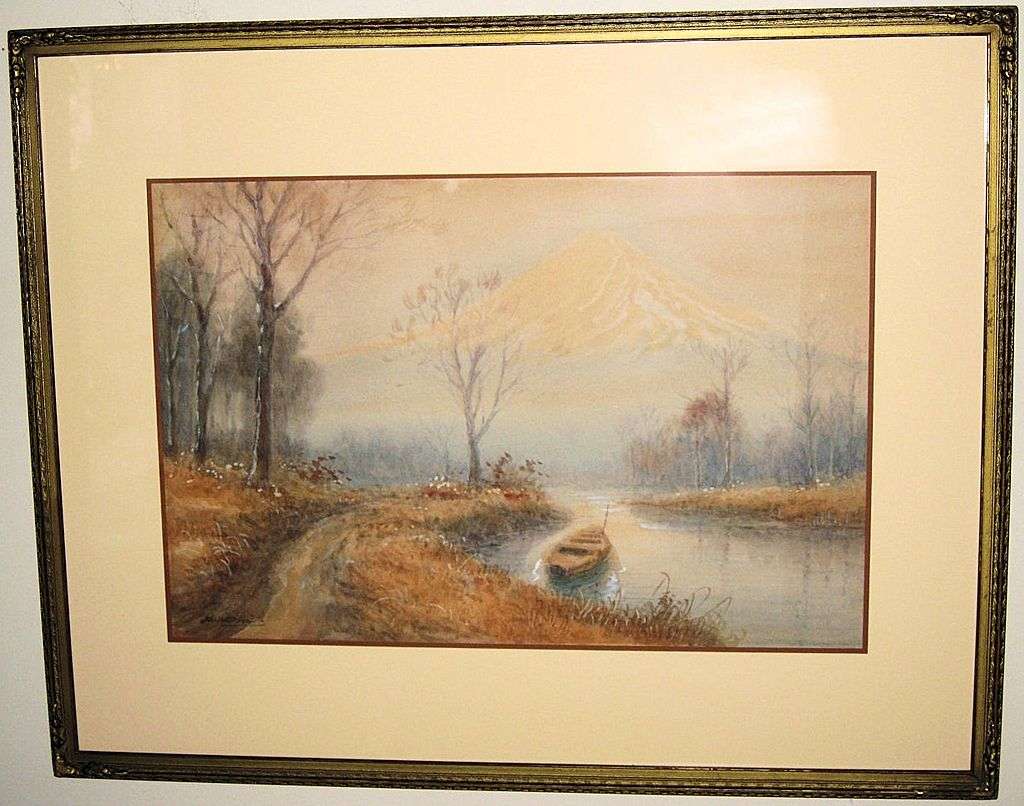
Watercolor reached Japan only in the closing decades of the 1800s, yet within a single generation it had a bestselling manual, a magazine of its own, and a following that ran from art schools to weekend sketchers. The phrase Japanese watercolor covers two separate things: the imported Western technique the Japanese call suisaiga, and the older tradition of gansai, the mineral-bright paint cakes used in classical work. This page keeps the two apart, traces how Western watercolor took hold in the Meiji era through painters like Asai Chu and Oshita Tojiro, and sets out the materials and methods that still shape the form.
The Two Things “Japanese Watercolor” Means
Most English writing on the subject collapses everything into sumi-e, the monochrome ink painting Japan borrowed from China centuries earlier. That blurs the real picture. In Japanese the water-based traditions split cleanly.
- Suisaiga (水彩画): Western transparent watercolor, brought in during the late nineteenth century and treated as part of the yoga, or Western-style, movement.
- Gansai (顔彩): traditional Japanese watercolor in hard cakes, bound with animal glue, used to tint prints, calligraphy and classical painting.
- Nihonga (日本画): the classical Japanese style proper, painted with ground mineral pigments rather than commercial watercolor.
| Form | Japanese | Paint and binder | Support | Roots |
|---|---|---|---|---|
| Suisaiga | 水彩画 | Western transparent watercolor, gum arabic | Paper | Imported, Meiji era |
| Gansai | 顔彩 | Pigment cakes bound with nikawa glue | Paper, prints | Traditional Japanese |
| Nihonga | 日本画 | Iwa-enogu mineral pigments, nikawa | Washi, silk | Classical Japanese |
| Sumi-e | 墨絵 | Black ink only | Washi, silk | From China |
Sumi-e sits behind all of them as the ink-only ancestor. The story English sources rarely tell is how the imported suisaiga became a national craze in the space of about twenty years.
How Watercolor Reached Japan
Western painting entered Japan as the country opened in the years around the Meiji Restoration of 1868. The new government hired foreign instructors and sent students abroad, and oil and watercolor arrived together as foreign skills worth learning for engineering drawing as much as for art.
Watercolor suited the moment. It was portable, cheap next to oil, and quick to learn, which made it the natural medium for the sketching that art schools used to teach Western drawing. By the 1890s it had outgrown the classroom and become a pursuit in its own right.
The pivot point was a school. In 1876 the government opened the Kobu Bijutsu Gakko, the Technical Fine Arts School, and hired the Italian painter Antonio Fontanesi to teach Western drawing, oil and watercolor. His students included Asai Chu and Koyama Shotaro, the men who would carry Western painting into the next century. The school lasted only to 1883, but the circle it trained set the direction for everything that followed.
Oshita Tojiro and the Watercolor Boom
One painter did more than any other to carry watercolor to a mass public: Oshita Tojiro, who lived from 1870 to 1911. In 1901 he published a how-to manual, Suisaiga no shiori, a guide to watercolor painting, and it became a genuine bestseller, putting brushes in the hands of students, clerks and hobbyists across the country.
Four years later, in 1905, Oshita founded a magazine devoted to the medium and named it Mizue, an old spelling that simply means water picture. Mizue printed reproductions, lessons and criticism, and it set out to establish watercolor as a serious art form rather than a beginner’s exercise. Under Oshita it ran until his early death in 1911, and the title outlived him by decades, closing only in the early 1990s, one of the longest runs of any Japanese art magazine. The 1900s watercolor movement effectively grew up around that manual and that magazine.
Asai Chu and the Meiji Watercolorists
The artistic weight behind Western-style painting came from Asai Chu, who lived from 1856 to 1907. A founder of the yoga movement, he first trained under Fontanesi in Tokyo, then travelled to France around the time of the 1900 Paris Exposition, absorbed an Impressionist looseness, and brought it home. He spent his last years teaching in Kyoto at the school that grew into the Kansai Bijutsuin, shaping a second generation of painters.
He worked alongside a generation that included Koyama Shotaro, his fellow advocate of Western drawing, and Miyake Kokki, who became known specifically for watercolor. Together they gave the medium the credibility that Oshita’s manual then spread to everyone else. They moved inside the wider Western-art push of the era, centred on the Hakubakai, the White Horse Society that Kuroda Seiki and others founded in 1896 and ran until 1911, the period’s main stage for yoga painting.
The movement soon built its own institutions. In 1913, painters from the Mizue circle founded the Nihon Suisaiga-kai, the Japan Watercolour Association, which still holds exhibitions today. Its creation marks the point where watercolor stopped being a Meiji novelty and settled in as a permanent branch of Japanese art.
Gansai: The Traditional Japanese Watercolor
Long before suisaiga, Japan had its own water paint. Gansai comes in firm cakes of pigment bound with nikawa, an animal glue, and it behaves differently from a Western pan. The glue gives it a faint sheen, the pigment load is heavy, and the colors sit brighter and more opaque than a Western wash of the same hue.
Gansai was the coloring paint of the classical world: used to tint woodblock prints, to add color to ink painting and calligraphy, and to fill in the lighter passages of decorative work. The trade survives in named makers: Kuretake of Nara, founded in 1902, sells its Gansai Tambi cakes worldwide, while Tokyo’s Kissho supplies the denser professional sets Japanese painters favour. Modern Japanese watercolorists and calligraphers still reach for it when they want that dense, slightly glossy color, and our look at Japanese calligraphy art shows the same brush-and-pigment tradition at work.
Brushes, Paper, and the Tarashikomi Effect
The tools carry over from older Japanese painting. Brushes, fude, are cut from soft animal hair and hold a great deal of water, which lets a painter lay a long stroke or a broad wet field without reloading. Paper is usually washi, made from plant fibre, absorbent and strong enough to take repeated wetting.
One technique deserves its own name. Tarashikomi means dropping a second color into a first while it is still wet, so the two bleed and pool into soft, mottled shapes. It came out of the Rinpa school of decorative painting and remains a signature move in Japanese water-based work, prized for the way it lets the paint, rather than the brush, draw the final edge.
Watercolor and Nihonga: Close Cousins, Different Paint
Suisaiga and nihonga look related on the surface and part ways at the paint tray. Nihonga uses iwa-enogu, pigments ground from minerals, shells and earths, mixed fresh with nikawa glue and laid on washi or silk in careful layers. It is closer to a craft tradition with fixed materials than to free watercolor.
Suisaiga, by contrast, is the imported article: commercial transparent watercolor on Western or Japanese paper, valuing speed and the glow of white paper through thin color. The split between transparent watercolor and opaque gouache that Western painters know maps directly onto the Japanese distinction between toumei and futoumei suisai.
Japanese Watercolor Today
The Meiji enthusiasm never fully faded. Watercolor remains a standard part of Japanese art education and a popular amateur medium, supported by a deep home market for gansai sets, fude brushes and washi blocks that travels well beyond Japan. Urban sketching and travel journaling, both watercolor-heavy, have given the old medium a fresh and younger audience.
For visitors, the thread is easy to follow in person: museum collections of Meiji yoga painting, art-supply districts in Tokyo and Kyoto, and the same seasonal subjects that fill Japanese cherry blossom art turning up again in watercolor on gallery walls.
Frequently Asked Questions
Is Japanese watercolor the same as sumi-e?
No. Sumi-e is monochrome ink painting borrowed from China. Japanese watercolor splits into suisaiga, the imported Western technique using transparent color, and gansai, the traditional Japanese pigment cakes. They share brushes and paper but use different paint and come from different roots.
What is gansai watercolor?
Gansai is traditional Japanese watercolor sold in hard cakes, with pigment bound by nikawa animal glue. It is brighter, denser and slightly glossier than a Western pan, and it has long been used to color prints, calligraphy and classical painting.
When did watercolor become popular in Japan?
In the Meiji era, peaking in the early 1900s. Oshita Tojiro’s 1901 manual Suisaiga no shiori and his 1905 magazine Mizue turned watercolor from a school exercise into a nationwide pursuit.
What is tarashikomi?
Tarashikomi is a wet-into-wet technique where a second color is dropped onto a still-wet first layer, letting the pigments bleed into soft, mottled shapes. It originated with the Rinpa school of decorative painting.
What is the difference between nihonga and suisaiga?
Nihonga is the classical Japanese style painted with mineral pigments, iwa-enogu, bound in animal glue on washi or silk. Suisaiga is imported Western watercolor in commercial tubes or pans, valued for transparency and speed. Nihonga is a fixed-material craft tradition; suisaiga is the freer Western medium.
Sources and Further Reading
- Tokyo National Research Institute for Cultural Properties – research on Meiji-era painters and the yoga movement
- Agency for Cultural Affairs, Japan – national framework for painting and cultural properties
- Artscape art glossary (Dai Nippon Printing) – Japanese definitions of suisaiga, nihonga and gansai
- National Diet Library, Portraits of Modern Japanese Historical Figures – record of Asai Chu and Meiji artists
- Hiroshima Museum of Art – Asai Chu and yoga painting collection
- National Museum of Modern Art, Tokyo – modern Japanese watercolor and yoga holdings
- Tojiro Oshita on Google Arts and Culture – works by the watercolor pioneer and Mizue founder