African art runs from charcoal animals drawn on a Namibian cave wall more than twenty-five thousand years ago to a Nigerian portrait that sold in London for over a million pounds. In between lie the terracotta of the Nok, the naturalistic bronze heads of Ife, the looted brasses of Benin, the soapstone birds of Great Zimbabwe and the masks that changed the course of modern European art. It is not one tradition but hundreds, across a continent of more than fifty countries, worked in stone, clay, bronze, gold, ivory, wood, cloth and beads. This guide traces the major traditions roughly in the order they appeared, explains the materials and meanings behind them, follows the line into modern and contemporary art, and covers the restitution reckoning now reshaping the world’s museums.
Rock art: the oldest images
Long before any metal was cast, Africans were painting and engraving on stone, and some of the oldest figurative art anywhere on earth comes from the continent.
- The Apollo 11 stones: painted slabs from a Namibian cave carry animal figures made more than twenty-five thousand years ago, among the earliest dated figurative art known.
- The green Sahara: the rock shelters of Tassili n’Ajjer in the Algerian desert hold thousands of paintings of cattle, hunters and wild animals from a time when the Sahara was grassland, a UNESCO-listed record of a vanished climate.
- San rock art: the San peoples of southern Africa left tens of thousands of paintings across the Drakensberg and beyond, many tied to the trance rituals of their healers, a tradition that continued into recent centuries.
The ancient north: Egypt, Nubia and Aksum
The oldest monumental art traditions sit along the Nile and the Red Sea, where African kingdoms built in stone on a colossal scale.
- Ancient Egypt: the longest continuous art tradition in human history, with a canon of proportion, relief and sculpture that held for three thousand years along the lower Nile.
- Kush and Nubia: upriver in present-day Sudan, the kingdoms of Kerma, Napata and Meroe raised their own pyramids, far more numerous than Egypt’s, and a distinct art that borrowed from and rivalled their northern neighbour.
- Aksum: the Ethiopian kingdom carved giant granite stelae and, after its conversion, founded a Christian tradition of painting, illuminated manuscripts and rock-hewn churches that runs unbroken to today.
The Nigerian sequence: Nok to Benin
No region holds a denser run of early sculpture than present-day Nigeria, where four traditions in succession worked metal and clay to a standard that startled the outsiders who first dated them.
- Nok terracotta: the Nok culture fired clay heads and figures from around 500 BCE to 200 CE, with stylised triangular eyes and elaborate hairstyles. Outside ancient Egypt, these are the earliest large figurative sculptures known in Africa.
- Igbo-Ukwu bronzes: by the ninth century, smiths at Igbo-Ukwu were casting ceremonial vessels of such intricacy that when the archaeologist Thurstan Shaw radiocarbon-dated them, the early dates were at first disbelieved. They show full command of lost-wax casting centuries before any European contact.
- Ife heads: between roughly the eleventh and fifteenth centuries, sculptors at Ife, the spiritual cradle of the Yoruba, made copper and brass portrait heads so naturalistic that when the German Leo Frobenius found one in 1910 he refused to believe Africans had made it, and invented a theory that it came from a lost Atlantis. Later scholars, among them Frank Willett and Bernard Fagg, established the truth: this was Yoruba art of the first rank.
- Benin bronzes: the Kingdom of Benin, in present-day Edo State, raised court art to its height, with thousands of brass plaques and heads recording the oba and his court across several centuries.
Stone, gold and the wider continent
Major traditions rose right across Africa, each tied to a state or a trade network.
- Great Zimbabwe: the stone city of the Shona, built between the eleventh and fifteenth centuries, gave the carved soapstone birds that crowned its walls. Looted in the colonial period and scattered, the birds became the symbol of the modern nation and appear on Zimbabwe’s flag, and their return has been a long campaign.
- The Inland Niger Delta: around Djenne in Mali, terracotta figures were modelled from the twelfth to the sixteenth centuries, while the Sahelian empires of Ghana, Mali and Songhai moved the gold that drew the wider world to West Africa.
- Asante gold: in present-day Ghana, the Asante worked gold into regalia and the small brass weights used to measure gold dust, each weight a tiny sculpture carrying a proverb.
- The Kongo and Central Africa: the Kongo kingdom carved power figures bristling with nails and the Kuba, Chokwe and Luba peoples built deep traditions of sculpture, masks and textile.
Masks and the living tradition
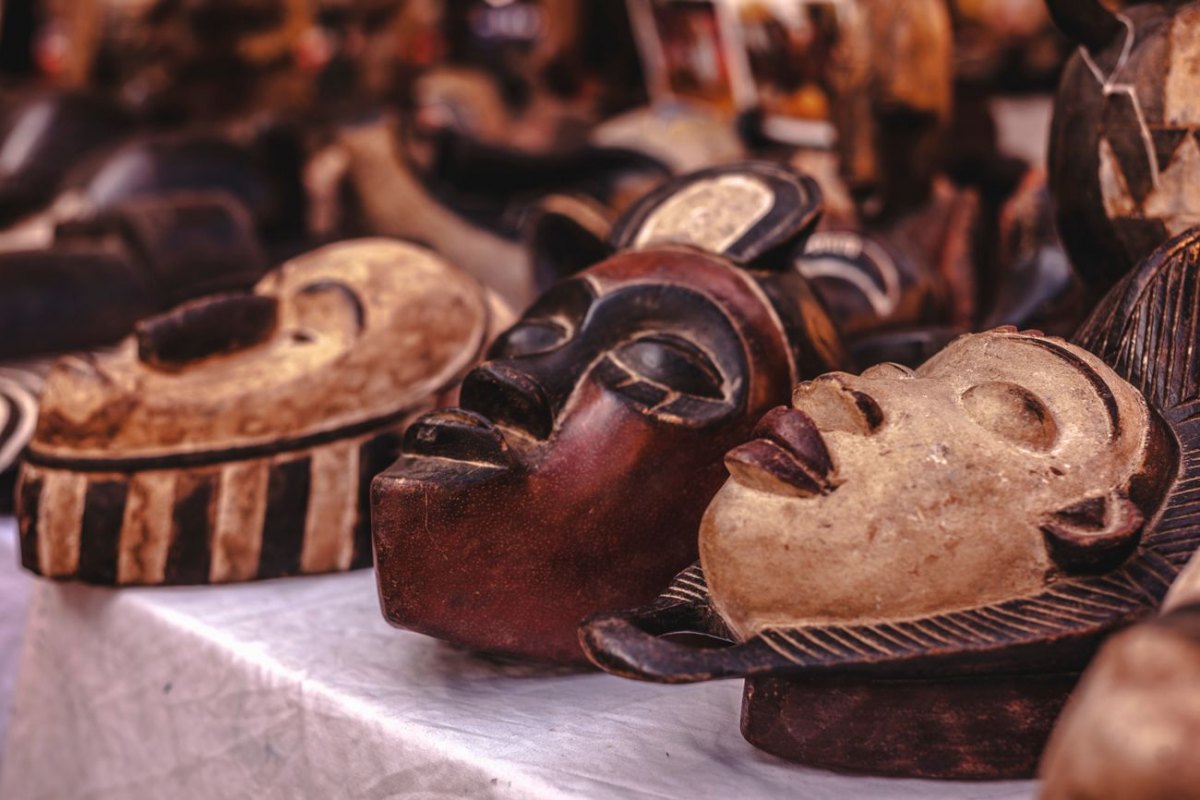
For most of Africa, the mask is the best-known form, and it is the most misunderstood in a museum case. A mask was never meant to hang on a wall. It is one part of a costume worn in performance, animated by music, movement and the spirit it is believed to summon.
- The great mask peoples: the Dan and Senufo of the Ivory Coast and Mali, the Dogon of the Bandiagara cliffs with their towering kanaga planks, the Baule with their idealised faces, the Chokwe of Angola, and the Fang and Kota of Gabon, whose abstract reliquary figures guarded the bones of ancestors.
- Masquerade, not object: masks appear at funerals, harvests, initiations and judgements, where the masked dancer becomes an ancestor or a spirit rather than a person in costume. The Yoruba Gelede and Egungun masquerades honour mothers and the dead in just this way.
- Why styles vary: a smooth, idealised Baule face and a charged, horned Dogon plank serve different ends, one beauty and order, the other power and the wild, so the range of African masks reflects the range of jobs they do.
Materials and what they mean
African art reads more clearly once you know what a material signals. The medium often carries as much meaning as the form.
- Bronze and brass: cast by the lost-wax method, in which a clay-cored wax model is encased, melted out and replaced with molten metal, copper alloys were royal and sacred, reserved in places like Benin and Ife for the court and the shrine.
- Wood: the everyday material of masks, figures and stools, carved fresh and expected to age, decay and be remade rather than preserved forever, which is why few very old wooden pieces survive.
- Textiles: kente strip-cloth woven by the Asante and Ewe with named patterns that carry proverbs, mud-dyed bogolan from Mali, indigo adire from the Yoruba, and the cut-pile raffia cloth of the Kuba each encode status and identity in pattern.
- Beads and gold: beadwork marks rank and message among the Zulu, Ndebele, Maasai and Yoruba, whose beaded crowns veil the face of a king, while gold signalled kingship across the forest states of West Africa.
The line into modern Western art
African sculpture changed the course of European art in the early twentieth century. Picasso, Matisse, Derain and the German Expressionists collected African masks and figures, and the faces of Picasso’s Les Demoiselles d’Avignon borrow directly from them.
That encounter is double-edged. It carried African form into the centre of modern art, but it filed it under the label primitive, stripped of the names of the artists and the meanings of the objects, treated as raw inspiration rather than the mature art of living traditions. A famous show at the Museum of Modern Art in the 1980s that paired modern and tribal works drew heavy criticism for exactly this, for showing African objects as anonymous influences rather than art in their own right. Restoring authorship, context and respect is one of the main projects of African art history today.
The contemporary boom
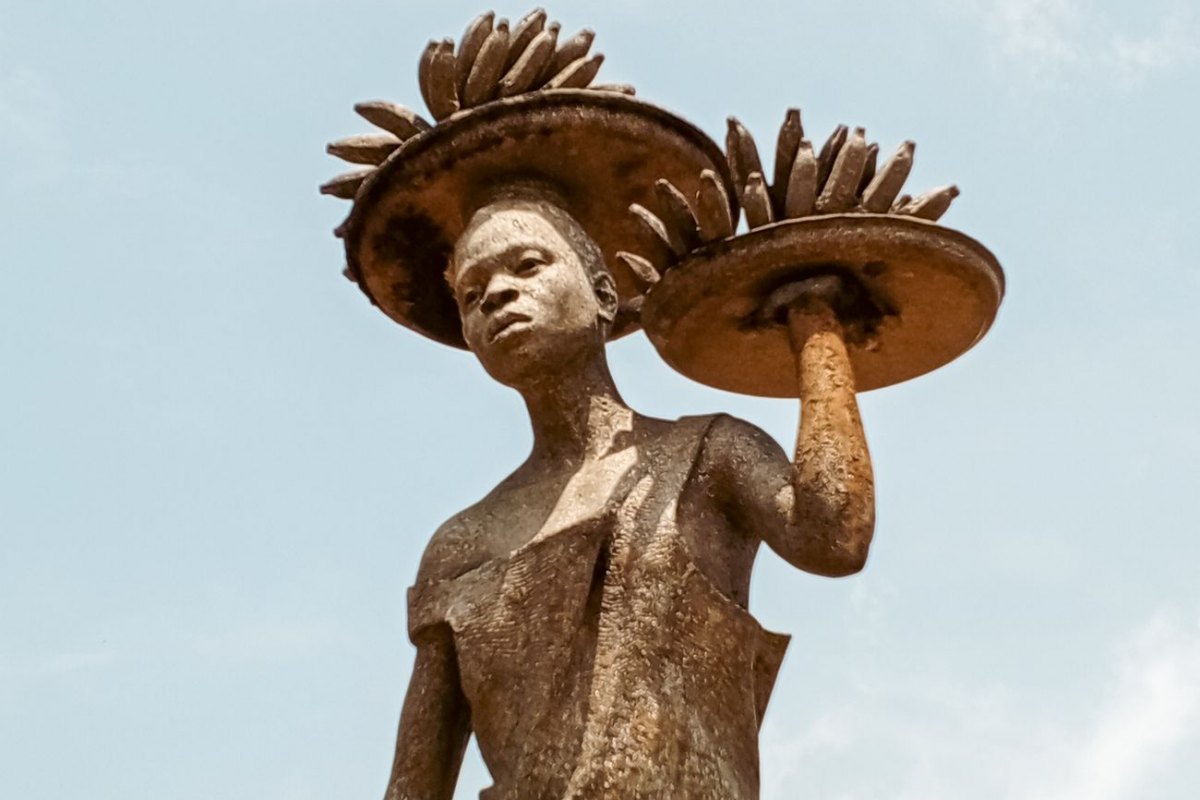
African art is not only a story of the past. The contemporary scene is among the most dynamic anywhere, and it now commands serious money and attention worldwide.
- El Anatsui: the Ghanaian sculptor who builds shimmering metal hangings from thousands of flattened bottle tops received the Golden Lion for lifetime achievement at the Venice Biennale, the field’s highest honour.
- The record breaker: Tutu, a 1973 portrait of an Ife princess by the Nigerian artist Ben Enwonwu and nicknamed Africa’s Mona Lisa by the novelist Ben Okri, was lost for decades, found in a London flat and sold at Bonhams for more than 1.2 million pounds, a record for modern Nigerian art.
- A wide generation: the British-Nigerian Yinka Shonibare, the South African William Kentridge, the Kenyan-American Wangechi Mutu and the Nigerian-American Njideka Akunyili Crosby work across painting, film, sculpture and installation at the top of the global scene.
- Markets and museums: the 1-54 fair, devoted to contemporary African art, dedicated auction departments, and the Zeitz Museum of Contemporary Art Africa in Cape Town, carved from a grain silo, have moved African artists from the margin to the centre.
The restitution reckoning
No subject sits heavier over African art than how so much of it left the continent. A large share of the masterpieces in European and North American museums was taken by force in the colonial era.
The Benin bronzes are the defining case. British forces sacked Benin City in 1897 and carried off more than five thousand objects, which were sold across the museums of Europe and America. After decades of campaigning those holdings are now coming back, with the Netherlands, Germany and others returning theirs to Nigeria under an agreement between the Oba of Benin and the federal government. The argument runs well beyond Benin, to the soapstone birds of Great Zimbabwe, the treasures British troops took from Maqdala in Ethiopia, and Asante gold, and the museums still debate ownership, security and access while African institutions assert the plain point that looted heritage belongs at home.
The reckoning is as much about building as about returning. A new generation of African museums is rising to house the art: the Museum of Black Civilisations opened in Dakar, and the Museum of West African Art, designed by Adjaye Associates on a plan inspired by historic Benin City, has opened in Benin City itself to receive the returning bronzes.
Where to see African art
The art is split between the museums that hold it and the places it came from, and a full picture needs both.
- The major holdings abroad: the British Museum in London, the Musee du quai Branly in Paris, the Smithsonian National Museum of African Art in Washington and the Metropolitan Museum in New York hold the deepest collections outside the continent.
- On the continent: the Zeitz MOCAA in Cape Town for the contemporary, the Museum of Black Civilisations in Dakar, the national museums of Nigeria and the new Museum of West African Art in Benin City for the classical court art, and Ethiopia’s churches and museums for its Christian tradition.
- Beyond the case: the living traditions of mask and textile are still made and worn at festivals across West and Central Africa, the truest place to meet the art as it was meant to be seen. Our look at the continuity and change in African cultures sets that living context, and the art runs alongside the continent’s many language families.
One thing visitors increasingly notice in the big Western museums is that the African galleries have become as much about history as about beauty. Reviewers of the British Museum and the quai Branly often single out the Benin displays, where the looting of 1897 and the case for return now draw as much comment as the craft of the bronzes themselves. Going in with that context makes the rooms read very differently.
Frequently Asked Questions
What is the oldest African art?
The oldest known figurative paintings in Africa are the animal figures on the Apollo 11 cave stones in Namibia, made more than twenty-five thousand years ago, among the earliest figurative art anywhere. The oldest sculpture in sub-Saharan Africa is the terracotta of the Nok culture in Nigeria, from around 500 BCE.
What are the Benin bronzes?
The Benin bronzes are thousands of brass and bronze plaques and sculptures made for the royal court of the Kingdom of Benin, in present-day Nigeria, over several centuries. British forces looted them when they sacked Benin City in 1897, and they were sold to museums worldwide. Many are now being returned to Nigeria.
Why is African art often stylised rather than realistic?
Most African sculpture was made to do a job, to embody a spirit, mark a rank or serve a rite, not to copy a face. Form follows that purpose. The naturalistic Ife heads, so lifelike that a European scholar at first refused to believe Africans made them, show that African artists could work realistically when the purpose called for it and chose stylisation when it did not.
How did African art influence modern art?
In the early twentieth century, European artists including Picasso, Matisse and Derain collected and studied African masks and figures, and their bold simplification of form fed directly into Cubism and modern art. Picasso’s Les Demoiselles d’Avignon is the clearest example. Art historians today work to restore the names and meanings that the early label of primitive art erased.
Who are the most famous contemporary African artists?
El Anatsui of Ghana, honoured with the Golden Lion at the Venice Biennale, is among the best known, alongside Yinka Shonibare, William Kentridge, Wangechi Mutu and Njideka Akunyili Crosby. The Nigerian modernist Ben Enwonwu set an auction record when his portrait Tutu sold for more than 1.2 million pounds.
Where can you see African art?
The largest collections outside Africa are at the British Museum, the Musee du quai Branly in Paris, the Smithsonian National Museum of African Art and the Metropolitan Museum. On the continent, the Zeitz MOCAA in Cape Town leads on contemporary work, the Museum of Black Civilisations in Dakar and the new Museum of West African Art in Benin City hold the classical traditions, and Ethiopia keeps its Christian art.
Sources and Further Reading
- The British Museum, African collection
- Smithsonian National Museum of African Art
- The Metropolitan Museum of Art, arts of Africa
- Musee du quai Branly, Paris
- Zeitz Museum of Contemporary Art Africa, Cape Town
- National Commission for Museums and Monuments, Nigeria