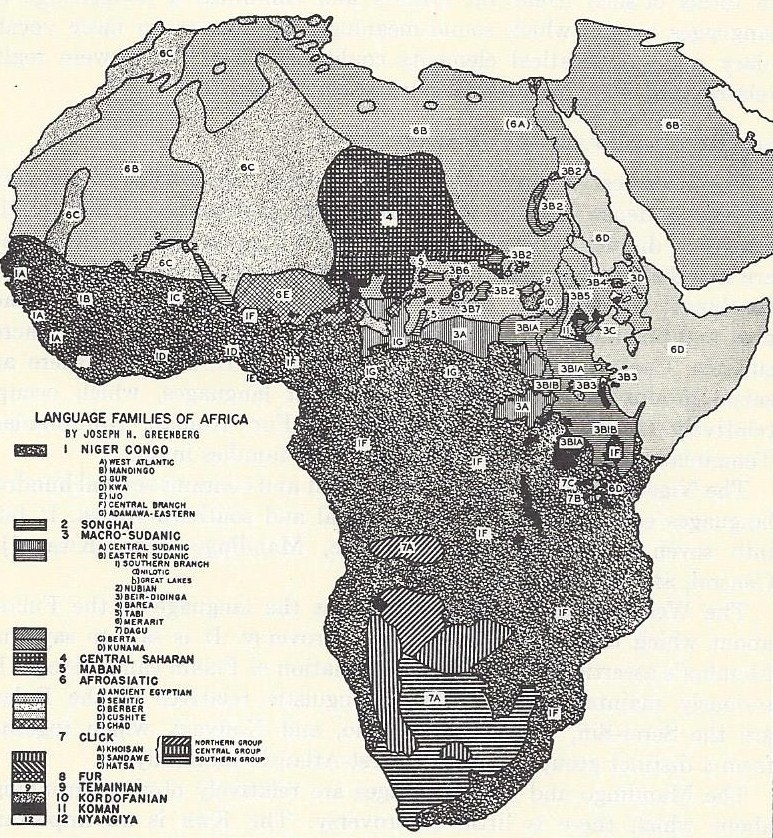
Africa is the most linguistically dense continent on earth, home to roughly two thousand languages, close to a third of all the languages spoken anywhere. They range from Arabic and Swahili, each used by hundreds of millions, to click languages of the Kalahari with only a few hundred speakers left. Since the work of the linguist Joseph Greenberg in the mid-twentieth century, these languages have been grouped into four great families, and a fifth set of writing traditions and lingua francas ties them together. This guide explains the four families, the migrations that spread them, the click sounds and scripts that set them apart, and the trade languages that let the continent talk across its own diversity.
The four language families
Greenberg’s classification, refined since but still the standard framework, sorts almost every African language into four families. Their distribution maps the deep history of the continent.
- Niger-Congo: the largest family in the world by number of languages, with well over a thousand, covering most of sub-Saharan Africa. It includes the huge Bantu group, plus Yoruba, Igbo, Fula, Akan and Wolof.
- Afroasiatic: the family of the north and the Horn, reaching into the Middle East. It carries Arabic, Amharic, Hausa, Somali, Oromo and the Berber languages, and its extinct branch included ancient Egyptian.
- Nilo-Saharan: a looser grouping across the Sahel and the upper Nile, including the Nilotic languages of the Maasai, Dinka, Nuer and Luo, along with Songhai, Kanuri and Nubian.
- Khoisan: the click languages of southern Africa and a couple of outliers in Tanzania, the smallest grouping and the one modern linguists treat as several unrelated families that share click sounds rather than a single ancestry.
The classification debate
Greenberg’s four families are a working framework, not the last word, and linguists still argue over the edges of it.
- Nilo-Saharan is the loosest: it is the family scholars trust least, a grouping of languages across the Sahel and the upper Nile that some specialists doubt forms a single ancestral family at all.
- Khoisan is not really one family: the click languages were lumped together for convenience, but most linguists now treat them as several unrelated families that happen to share click sounds, rather than relatives.
- True isolates: a few languages fit nowhere. Hadza and Sandawe in Tanzania, both with clicks, sit apart from every family, the linguistic equivalent of living fossils.
- Niger-Congo runs deep: even the giant family is being re-sorted, with Bantu now understood as a late, fast-spreading branch rather than the core of it.
The Bantu expansion
One migration shaped the language map of the southern half of the continent more than any other. The Bantu languages, a branch of Niger-Congo, all trace to a homeland on the borders of present-day Nigeria and Cameroon.
Beginning several thousand years ago, Bantu-speaking farmers and ironworkers moved south and east in one of history’s great population spreads, reaching southern Africa within the first millennium. The result is that a Swahili speaker on the Kenyan coast and a Zulu speaker in South Africa, separated by thousands of kilometres, speak related languages with recognisably shared roots. Around five hundred Bantu languages, including Swahili, Zulu, Shona, Kikuyu and Lingala, descend from that single expansion.
Click consonants
The click sounds of southern Africa are the continent’s most distinctive feature to an outside ear, made by drawing air against the teeth, palate or side of the mouth rather than pushing it from the lungs.
- The Khoisan core: clicks are central to the San and Khoekhoe languages, some of which use dozens of distinct click consonants, a complexity found almost nowhere else.
- Borrowed into Bantu: the Nguni languages Xhosa and Zulu picked up clicks through long contact with Khoisan neighbours, which is why the word Xhosa itself begins with one.
- The oldest layer: many linguists see the click languages as a remnant of the continent’s most ancient speech, once far more widespread before farming peoples expanded across it.
Lingua francas: how Africa talks across itself
With so many languages in close quarters, Africans have always been multilingual, and a handful of trade languages carry communication across whole regions.
- Swahili: the great success story, a Bantu language enriched with Arabic vocabulary through centuries of Indian Ocean trade. It serves as a first or second language for well over a hundred million people across East Africa, is official in Kenya, Tanzania and Uganda, and the African Union has adopted it as a working language.
- Hausa: the trade tongue of the West African Sahel, spoken across northern Nigeria, Niger and beyond as a market and media language.
- Lingala and others: Lingala carries the river trade and the music of the Congo basin, Wolof binds Senegal, and Amharic is the working language of Ethiopia.
- The colonial layer: French, English, Portuguese and Arabic sit on top as official languages of government and schooling, a legacy of empire that most African states still use to bridge their internal diversity.
Multilingual by default
In most of Africa, speaking several languages is not a special skill but the normal condition of daily life. The pattern repeats across the continent in a rough three-layer stack.
- A mother tongue: the language of home and community, often one of the smaller local languages, learned first and used with family.
- A regional lingua franca: a trade language like Swahili, Hausa or Lingala used in the market, on the street and across ethnic lines.
- An official language: usually a colonial inheritance such as French, English or Portuguese, used in government, secondary school and national media.
A single conversation can move between all three, and code-switching mid-sentence is so common it has become its own urban style, as in the Sheng slang of Nairobi that blends Swahili and English. This deep multilingualism shapes how the continent’s peoples mix and adapt, a theme that runs through the continuity and change in African cultures, and it sits close to the visual traditions traced in our guide to African art through the ages.
Swahili, the language of a continent
One language has travelled further than any other indigenous tongue in Africa, and it is worth a closer look.
Swahili, or Kiswahili, grew on the East African coast where Bantu-speaking communities traded with Arab, Persian and later Indian merchants across the Indian Ocean. The grammar stayed Bantu while the vocabulary absorbed a deep layer of Arabic, and the language spread inland along the caravan routes. Today it is a first or second language for well over a hundred million people, official in Kenya, Tanzania and Uganda and widely used in the eastern Congo. The African Union has adopted it as an official working language, the first African language to be so honoured, and the United Nations marks World Kiswahili Language Day on the seventh of July. It is the clearest proof that an African language can serve a whole region as fully as any world language.
African writing systems
The idea that African languages were only ever spoken is a myth. The continent holds ancient and invented scripts, several still in daily use.
- Ge’ez: the Ethiopic script, used for Amharic, Tigrinya and the liturgical Ge’ez language, is one of the oldest writing systems still in use, with its own syllabic letters.
- Tifinagh: the script of the Berber, or Amazigh, peoples of North Africa, descended from ancient Libyco-Berber writing and revived today for Tamazight.
- Ajami: the use of the Arabic script, adapted with extra letters, to write African languages such as Hausa, Fula and Swahili, a tradition centuries old.
- Invented scripts: the Vai syllabary of Liberia, devised in the nineteenth century, and the Nsibidi symbols of southeastern Nigeria show that African societies created writing of their own.
- The N’Ko alphabet: created by the Guinean scholar Solomana Kante in 1949 to write the Manding languages of West Africa, and now used in books, newspapers and online.
- Royal and modern scripts: the Bamum script invented by a sultan in Cameroon in the early twentieth century, and the Osmanya script devised for Somali, show the same impulse to give a language its own letters.
Endangered and thriving
The continent’s languages are pulling in two directions at once. The big lingua francas are growing fast, while hundreds of small languages are slipping away.
Swahili, Hausa and the national languages gain speakers every year as cities grow and media spreads. At the same time, many of the smallest languages, especially the click languages of the Kalahari and isolated tongues of the forest and the Sahel, have only a few elderly speakers left, and some fall silent each decade. Mother-tongue education, radio and a growing body of African-language publishing are the main forces working the other way, and bodies like the African Academy of Languages press governments to give indigenous languages a formal place.
A traveller’s language map
For a visitor, one or two languages open most doors across whole regions, and a few words of the local lingua franca are always welcomed. The continent splits into broad language zones.
- East Africa: Swahili carries you from Kenya through Tanzania and into Uganda and the eastern Congo. A jambo for hello and asante for thank you go a long way.
- West and Central Africa: French is the working language across a long belt from Senegal to the Congo, alongside local giants like Wolof and Hausa, while English serves Nigeria, Ghana and the Gambia.
- North Africa and the Horn: Arabic dominates the north, with French widely understood in the Maghreb, while Amharic anchors Ethiopia and Somali the Horn.
- Southern Africa: English reaches almost everywhere, sitting beside Zulu, Xhosa, Shona, Portuguese in Mozambique and Angola, and Afrikaans in the far south.
Travellers consistently report that effort matters more than fluency. A greeting attempted in the local language, however clumsy, changes the warmth of an encounter, and English or French plus patience handles the practical rest across most of the continent.
Frequently Asked Questions
How many languages are spoken in Africa?
Africa has roughly two thousand languages, close to a third of the world’s total. They fall into four families: Niger-Congo, Afroasiatic, Nilo-Saharan and the click languages once grouped as Khoisan. Most Africans speak more than one, typically a local mother tongue, a regional lingua franca and an official language.
What is the most spoken language in Africa?
By total speakers, Arabic and Swahili lead, each used by hundreds of millions as a first or second language. Swahili is the most widely spoken indigenous sub-Saharan language and a working language of the African Union, while Hausa, Yoruba, Amharic and Oromo each count tens of millions of speakers.
What are the click languages?
Click languages use consonants made by suction against the teeth or palate rather than airflow from the lungs. They are central to the San and Khoekhoe languages of southern Africa, once grouped as Khoisan, and were borrowed into the Bantu languages Xhosa and Zulu. Some use dozens of distinct clicks.
Did African languages have writing?
Yes. The Ethiopic Ge’ez script is among the oldest still in use, the Berber Tifinagh descends from ancient writing, and the Arabic-based Ajami tradition wrote African languages for centuries. Africans also invented scripts of their own, such as the Vai syllabary of Liberia and the Nsibidi symbols of Nigeria.
What is the Bantu expansion?
The Bantu expansion was the spread of Bantu-speaking farmers from a homeland near the Nigeria-Cameroon border across most of central, eastern and southern Africa over the past few thousand years. It explains why around five hundred related languages, from Swahili to Zulu, are spoken across that vast area.
Sources and Further Reading
- Ethnologue, Languages of Africa
- UNESCO Atlas of the World’s Languages in Danger
- African Union, on Swahili as a working language
- Encyclopaedia Britannica, African languages overview