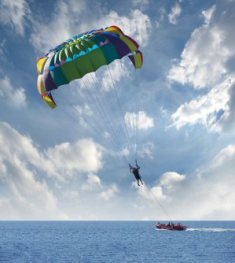
Parasailing operators lift tourists 300 to 500 feet above Nassau’s turquoise waters from Cable Beach, Paradise Island, and several cruise-port staging points, with most operators running 8 to 12 minute flights from purpose-built winch boats. The activity has been regulated by the Port Department and the Bahamas Maritime Authority since a 2014 incident review, making guided commercial parasailing the only legal option for visitors. Costs run 70 to 95 US dollars per adult for single-rider flights, with tandem flights adding 30 to 50 dollars. This guide covers how commercial parasailing works, the main operators and booking points, safety rules and regulations, weather and season considerations, what to wear and bring, and how the activity fits a typical Nassau cruise or resort day.
How Commercial Parasailing Works
The operator’s boat, called a winch boat, tows a specially designed parachute attached to the rider by a harness and tow rope. The boat’s winch system pays out the line to gain altitude and reels it in to lower the rider. A properly conducted flight starts with a brief instruction session on the boat, a harness fitting, and a take-off from the boat’s deck platform.
A typical Nassau flight runs between 300 and 500 feet of altitude, higher than the Palm Beach operators but lower than some destinations in Florida. Flight duration averages 8 to 12 minutes from lift-off to touchdown, with the winch boat typically motoring parallel to the coast during the ascent phase.
Tandem and triple rides let two or three riders fly together, which suits couples and families. Most Nassau operators offer tandem from 10 years old, though age thresholds vary. Weight limits usually cap single rides at 300 pounds and tandem at 450 pounds combined.
The boat launches parasailers directly from the back deck with a controlled winch release, and retrieves riders with a reverse winch that lowers them to the boat deck. Water touchdowns, common at other parasailing destinations, are rare in Nassau where operators prefer deck-to-deck flights for safety.
Operator Staging Points in Nassau
Several staging points around Nassau host commercial parasailing operators. Each has its own character and best-suited visitor type.
- Cable Beach: the longest continuous beach strip on New Providence, with operators stationed in front of the larger resorts including Baha Mar properties
- Paradise Island: operators stationed at Atlantis properties and nearby small beaches, suited to guests staying on the island
- Cabbage Beach: a public beach on Paradise Island with several operator kiosks, busier and more tourist-focused
- Junkanoo Beach: the main public beach adjacent to the Nassau cruise port, convenient for cruise passengers with shorter day visits
- Bay Street cruise port: some operators run pick-up tenders directly from the cruise terminals, which saves transfer time for cruise passengers
Cable Beach and Paradise Island operators tend to run higher-end equipment and slightly pricier bookings. Junkanoo Beach operators run the most affordable options but with occasional wait times during peak cruise days when multiple large ships are in port.
Booking and Pricing
Rates for 2024 and current market conditions run in a fairly narrow band across operators:
- Single rider flight: 70 to 95 US dollars
- Tandem (2 riders): 110 to 140 US dollars total
- Triple (3 riders): 150 to 180 US dollars total
- Cruise excursion package: often 90 to 130 dollars through the cruise line, with transport included
Booking directly with the operator at the beach saves 10 to 25 dollars per rider compared to cruise-line excursion packages, but cruise passengers may prefer the excursion route for transport logistics and return-to-ship guarantees.
Cash, credit card, and most resort charge systems work at the major operators. Smaller beach-kiosk operators sometimes prefer cash, and travellers should bring enough US dollars for the booking plus a modest tip (10 to 15 percent is standard for local operators).
Safety Regulations and Licensing
The Bahamas Port Department regulates commercial parasailing under a 2014 framework that followed safety reviews across Caribbean destinations. Operators must hold current vessel registration, marine insurance, and operator certification. Reputable operators display their licence and insurance certificates on request at the kiosk.
Key safety checks a rider should verify before flying:
- The boat displays current Bahamas registration numbers on the hull
- The operator provides a fitted harness, not a one-size-fits-all strap
- The tow line looks clean and undamaged, without visible fraying
- The parachute fabric looks intact with no rips or discolouration
- The instructor briefs the rider before boarding on take-off, flight, and landing signals
- Wind conditions are checked by the operator before launch
Refuse to fly if any of these checks fail. The modest cost savings from a cheaper operator that skips safety protocols is not worth the risk. Accidents at poorly maintained operators have been documented across Caribbean destinations and remain possible despite the regulatory framework.
Weather and Best Season
Parasailing runs year-round in Nassau with weather windows that change seasonally. Wind speed is the primary limiting factor: most operators cancel flights above 20 knots (37 km/h) and proceed normally below 15 knots.
November through April offers the most reliable flying weather with the trade winds producing steady but manageable conditions. Sea state remains calm inside New Providence’s sheltered waters during this window, and the operators rarely cancel except during frontal passages.
May through October brings higher humidity and occasional tropical disturbances. Hurricane season runs June through November, and operators track weather closely during these months. Most flights still operate on days without direct tropical influence, but schedule flexibility helps during the wet season.
Morning flights (9:00 to 11:00) tend to offer calmer conditions and better visibility. Afternoon flights carry more risk of thunderstorm cancellations, particularly July through September when convective storms develop regularly over Bahamas waters.
What to Wear and Bring
A swimsuit with sun protection over it works best for most flights. The take-off and landing happen on the boat deck rather than in the water, so dry clothing is feasible but sun and spray can wet clothing during the boat ride to the flight area.
Essential items for the boat trip:
- Swimsuit as the base layer with a quick-dry shirt over the top
- Sunscreen applied before boarding (reapplication on the boat is difficult)
- Sunglasses with a secure strap (they fall off during flight otherwise)
- A hat with a chin strap (also liable to loss without one)
- Sandals or barefoot for easy boat-deck movement
- Water bottle and a snack for the 45 to 90 minute full trip
- Waterproof phone case if you want to take photos during the flight
What to leave behind. Jewellery, loose items, and expensive cameras all carry a risk of loss to water or wind. The boat operators provide basic lockers or secure storage, but high-value items are safer left at the hotel. Professional photos taken by the operator’s onboard photographer are usually available for 25 to 50 dollars per flight.
Flight Experience and Views
The moment of take-off from the winch boat’s deck is smoother than first-timers expect. The boat accelerates, the parachute inflates, and the rider lifts off the deck with minimal jolt. The initial climb happens over a few seconds as the winch releases line.
At maximum altitude the view covers most of New Providence Island’s north coast, with Cable Beach extending to the west, Paradise Island visible to the east, and the open ocean stretching north toward the Abacos. Clear weather reveals coral reefs as darker shapes below the turquoise water.
The actual flight is quieter than first-timers expect. The wind noise drops as the boat’s engine moves further below, and the parachute’s fabric produces a rhythmic flutter rather than continuous loud sound. Most riders can converse with a tandem partner during the flight.
Descent proceeds in reverse, with the winch slowly reeling in line and the rider descending to the boat deck. Landing is usually smooth with a gentle step onto the deck, though wind can make the final few metres slightly uncertain.
Parasailing and a Full Nassau Day
A typical parasailing outing takes 1.5 to 2 hours from arrival at the beach to return. The flight itself is 8 to 12 minutes, with the rest covering the boat ride out, other riders’ flights if in a shared boat, and the ride back.
Fitting parasailing into a Nassau day allows for other activities the same day. Morning parasailing pairs well with afternoon beach time at Cabbage Beach or Cable Beach, an Atlantis water park visit, or shopping on Bay Street. Afternoon parasailing can follow a morning Atlantis Marine Habitat visit or downtown exploration.
Cruise passengers with tight schedules should book morning flights to allow buffer time for returning to the ship. Most cruise lines require passengers back onboard 30 minutes before departure, and weather delays in parasailing can compress that margin unexpectedly.
Frequently Asked Questions
Is parasailing in Nassau safe?
Commercial operators running under current Port Department regulation operate with reasonable safety margins. Major incidents are rare but not impossible. Selecting a licensed operator and following their safety briefing reduces the risk substantially. Self-organised parasailing without a certified operator is illegal and dangerous.
Can children parasail?
Most operators allow children from 6 to 10 years old on tandem flights with a parent, depending on the specific operator’s policy. Weight minimums apply for single-rider flights, usually requiring at least 100 to 130 pounds. Check the operator’s rules before booking for younger riders.
Do I get wet during the flight?
Typically no. Nassau operators prefer deck-to-deck flights without water touchdowns, unlike some Florida operators who include a water splash as part of the experience. The boat ride to and from the flight area may produce some spray, but the flight itself stays dry.
Can I bring my phone or camera?
A phone in a waterproof case with a lanyard strap works for most riders. Loose phones and cameras carry a real risk of dropping to the water. The operator’s onboard photographer offers professional shots that avoid the equipment risk and usually produce better images.
What happens if the wind picks up during my flight?
The operator brings you down. Operators monitor wind conditions throughout the flight and reel in the line immediately if conditions change. Weather-related cancellations during the flight itself are rare because operators would not launch in marginal conditions.
How far ahead should I book?
For single flights, walk-in bookings at the beach work for most dates outside peak cruise-ship arrival times. For groups of 4 or more, or for specific high-demand windows (holidays, spring break), booking 24 to 48 hours ahead is sensible.
Are there parasailing locations beyond Nassau?
Yes, though most of the Bahamas commercial parasailing is concentrated on New Providence. Grand Bahama (Freeport) has a small number of operators, and Eleuthera occasionally runs seasonal operations. For the widest selection and most established operators, Nassau remains the primary destination.
For other Nassau activities that pair well with parasailing, see our Nassau kiteboarding guide, our Nassau kayaking overview, and our best Nassau snorkelling sites.
Sources and Further Reading
- Bahamas Port Department, commercial vessel regulations
- Bahamas Maritime Authority, watersports operator registry
- Parasail Operators of America, safety standards documentation
- Bahamas Ministry of Tourism, activity licensing records
- National Transportation Safety Board, commercial parasailing incident reviews