An underwater scooter in Nassau lets you drive along a reef with your head in a pocket of air, breathing normally, even if you cannot swim. It is the closest thing to a personal submarine on a cruise day, and it solves the one problem that keeps non-swimmers and nervous snorkellers out of the water. This guide explains what the underwater scooter actually is, how it differs from a helmet walk and from snorkelling, who it suits, and what to expect off the reefs of New Providence.
The activity is sometimes sold under brand names like SUB, so the first job is to cut through the marketing and explain what you are really booking, because three very different underwater experiences get lumped together in the listings.
What an Underwater Scooter Actually Is
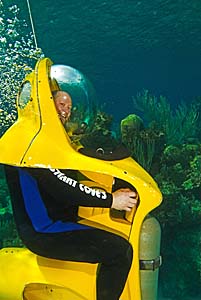
An underwater scooter is a small one-person machine you sit on with a clear dome over your head. The dome traps a bubble of air fed from the surface, so your head stays completely dry and you breathe as normal, no mask over the face and no regulator in the mouth.
- How it works: you sit upright behind the controls, the dome seals around your shoulders, and the scooter motors along a set route over the reef while a guide leads and a safety diver shadows the group.
- No skills needed: you do not need to swim, dive or even get your hair wet, which is the whole appeal. People who wear glasses can keep them on inside the dry dome.
- The depth: the scooters run at a shallow depth of around four to five metres, close enough to the surface for good light and colour on the coral.
- The pace: it is a guided, gentle ride rather than free exploration, so you follow the leader along the reef rather than wandering where you like.
Scooter, Helmet Walk or Snorkel: Which to Pick
Nassau operators run several no-experience underwater activities, and they are not the same thing. Choosing the right one saves disappointment.
- Underwater scooter: dry head, sit and steer, breathe normally, no swimming. Best for non-swimmers and anyone who hates water on their face but wants to be down on the reef.
- Sea Trek helmet walk: you wear a heavy glass helmet fed with air and walk along the seabed on a fixed path. Also dry-faced and no swimming, but you are on foot rather than riding, and your body is in the water.
- Snorkelling: cheapest and most flexible, but it needs you to float face-down and breathe through a tube, which is exactly what puts off the people the scooter is built for.
- Scuba diving: the most immersive, but it needs training or a supervised discovery dive, and the mask-and-regulator setup is a barrier for the nervous.
If you can snorkel happily, a reef snorkel trip gives more freedom for less money. The scooter earns its price when swimming or a face mask is the dealbreaker.
Who It Suits, and Who Should Skip It
The underwater scooter is built around accessibility, but it still has limits worth checking before booking.
- Good for: non-swimmers, families with older children, glasses-wearers, and anyone curious about being underwater without the gear or the training.
- Age and health: operators set a minimum age, usually around twelve, and ask that riders be in reasonable health, because the dome changes pressure as you descend.
- Skip it if: you are pregnant, have serious heart or breathing conditions, or have ear problems that make equalising pressure painful, since the descent works on your ears like any dive.
- Claustrophobia: the dome is open and bright rather than enclosed, but anyone who panics in tight headgear should think twice.
What You See on the Reef
The scooter routes run over the same shallow reefs that the snorkel boats use, so the marine life is the standard Bahamian reef cast, seen from a seated, eye-level position.
- Reef fish: schools of grunts, snapper, sergeant majors and the odd parrotfish working the coral heads alongside the track.
- Rays and the sandy floor: stingrays cruising the open patches between the reef sections.
- The coral itself: shallow hard corals and sea fans, best in the clear, calm water of the winter months.
For more reef without the machine, see our guide to snorkelling sites around Nassau, and for how the underwater scooter fits a wider port day, our overview of things to do in Nassau and how to book through Nassau shore excursions.
What to Expect, Step by Step
Knowing the shape of the trip takes the nerves out of a first dive in the dome. The day follows the same pattern with every operator.
- The briefing: on the boat a guide explains the hand signals, how to clear your ears, and what to do if you feel uneasy, since you cannot talk once the dome is on.
- Getting in: you climb down a ladder at the back of the boat, the dome is lowered over your head and shoulders once you are seated, and the air keeps the water out at chin level.
- The descent: you sink slowly to the reef while pinching your nose and swallowing to equalise your ears, the same trick divers use, and the guide controls the speed.
- The ride: the group moves in a line along the reef for the main stretch of the experience, with the guide pointing out fish and the safety diver taking photos to buy afterwards.
- Coming up: the scooters rise gently back to the surface, the dome lifts, and you climb out the way you came in.
The one skill that matters is clearing your ears, so tell the guide early if your ears feel blocked rather than pushing through the discomfort.
Booking It on a Cruise Day
The underwater scooter is a practical cruise-day activity because Nassau docks ships right at the wharf, and the dive operators sit a short ride away on the south-west coast.
- Time needed: the trips usually run a half day with transfers, while the time in the dome itself is shorter, around an hour, so it fits a port day with room to spare.
- What is provided: the operator supplies everything, since there is no personal gear to bring beyond a swimsuit and a towel.
- Book ahead: places are limited by the number of scooters, so reserve rather than relying on a walk-up, and leave a buffer before your all-aboard time.
Frequently Asked Questions
Do you need to swim to use an underwater scooter in Nassau?
No. The underwater scooter is designed for non-swimmers. You sit behind a clear dome that keeps your head dry and lets you breathe normally, and the scooter moves you along the reef on a guided route, so no swimming, diving or face mask is involved.
How deep does the underwater scooter go?
The scooters run at a shallow depth of roughly four to five metres, close enough to the surface for bright light and good colour on the coral, with a guide leading and a safety diver shadowing the group throughout.
What is the difference between the underwater scooter and Sea Trek?
Both keep your head dry and need no swimming. On the underwater scooter you sit and steer a small machine over the reef, while on a Sea Trek you wear a weighted helmet and walk along the seabed on a fixed path. The scooter rides; the helmet walk is on foot.
Who should not do the underwater scooter?
It is not suitable if you are pregnant, have serious heart or breathing conditions, or have ear problems that make equalising pressure painful, because descending in the dome affects your ears like a dive. Operators also set a minimum age, usually around twelve.
Can you wear glasses on the underwater scooter?
Yes. Because your head stays inside a dry air dome, you can keep glasses on and see the reef clearly, which is one of the activity’s advantages over snorkelling or diving, where a mask makes wearing glasses awkward.
Is the underwater scooter worth it compared with snorkelling?
It depends on you. If you snorkel comfortably, a reef snorkel trip is cheaper and gives more freedom to roam. The scooter earns its higher price when swimming, floating face-down or wearing a mask is the thing stopping you from getting in the water at all.
Sources and Further Reading
- Stuart Cove’s Dive Bahamas – the main Nassau operator running underwater scooter and reef trips off the south-west coast
- Bahamas Ministry of Tourism – the official guide to water activities across the islands
- Nassau Paradise Island – the official destination guide to Nassau reef experiences