Brazil has run through nine different currencies since 1942. The current one, the real, arrived in July 1994 and has held the line against a hyperinflation history that sent Brazilian households in the 1980s rushing to the supermarket on payday before that afternoon’s price rise. A traveller in 2026 buying a coconut on Ipanema beach, paying a Sao Paulo taxi fare through the Pix instant-payment system, or withdrawing cash at a Banco do Brasil ATM in Salvador is working with a currency that is the survivor of a long run of failed predecessors and that carries the memory of those failures in the way Brazilians still talk about money.
The Real and the Plano Real of 1994
The real, abbreviated BRL and written with the symbol R dollar, was launched on 1 July 1994 as the centrepiece of the Plano Real, a stabilisation programme designed by a team of economists under the then finance minister Fernando Henrique Cardoso. Inflation in Brazil had run above 1000 percent a year through much of the late 1980s and early 1990s, and earlier stabilisation attempts under the Cruzado, Bresser, Verao, and Collor plans had each collapsed within a year or two. The Plano Real worked in three stages. The first stage cut government spending and raised taxes to reduce the fiscal deficit. The second stage introduced a unit of real value called the URV, which tracked the dollar and served as a parallel accounting unit that prices and wages could be quoted in. The third stage, in July 1994, converted the URV one-for-one into the new real currency and retired the old cruzeiro real at a rate of 2750 to 1. Monthly inflation, which had run at almost 50 percent in June 1994, fell to below 2 percent within three months. The real has survived several crises since, including the 1999 devaluation, the 2002 pre-election run on the currency, and the 2015 to 2016 recession, and the central bank has allowed the exchange rate to float against the dollar since January 1999.
From Reis to Cruzeiro: the Currency History Before 1986
Brazil’s currency history runs back to the colonial real of the Portuguese empire, a silver coin whose plural form reis gave its name to the Brazilian currency for most of the period from independence in 1822 until the cruzeiro reform of 1942. Nineteenth-century Brazilian prices were quoted in mil-reis, a unit of one thousand reis, and the currency carried through the end of the Empire in 1889 and into the first fifty years of the Republic with repeated episodes of inflation and gold-standard suspensions. In 1942 the government of Getulio Vargas retired the mil-reis and introduced the cruzeiro at a rate of one cruzeiro to one thousand reis, dropping three zeros and adopting a modern decimal subunit called the centavo. The cruzeiro held its value in the 1940s and 1950s, lost ground through the high-inflation late 1950s, and was reformed in 1967 as the cruzeiro novo at a rate of 1000 old cruzeiros to 1 new cruzeiro, again dropping three zeros. The cruzeiro novo was renamed back to cruzeiro in 1970 without a conversion rate change, and this second-generation cruzeiro carried Brazil through the high-growth military years of the 1970s and into the debt crisis of the early 1980s.
The 1986 to 1994 Run of Failed Stabilisation Plans
Between February 1986 and July 1994 Brazil cycled through five different currencies and five stabilisation plans, each one an attempt to break the inflationary spiral the cruzeiro had fallen into during the debt crisis. The Plano Cruzado in February 1986 replaced the cruzeiro with the cruzado at a rate of 1000 to 1 and froze prices. The price freeze held for six months, collapsed under shortages as producers pulled goods off the shelves, and left the cruzado with rising inflation by late 1986. The Plano Bresser of 1987 and the Plano Verao of 1989 tried variations on the same formula without success. In January 1989 the cruzado was replaced with the cruzado novo at a rate of 1000 to 1, once again dropping three zeros. The cruzado novo lasted fourteen months before the Plano Collor of March 1990 replaced it with a relaunched cruzeiro at a rate of one to one, without dropping any zeros this time, and froze around 80 percent of household bank balances for eighteen months in an attempt to squeeze money out of circulation. The Collor plan failed, inflation returned, and in August 1993 the cruzeiro real replaced the cruzeiro at a rate of 1000 to 1, dropping another three zeros. The cruzeiro real lasted eleven months before the real arrived in July 1994. The compound effect of these conversions and three-zero drops across the 1986 to 1994 period was the removal of eighteen zeros from the face value of the currency in eight years.
Notes, Coins, and the Animal Series
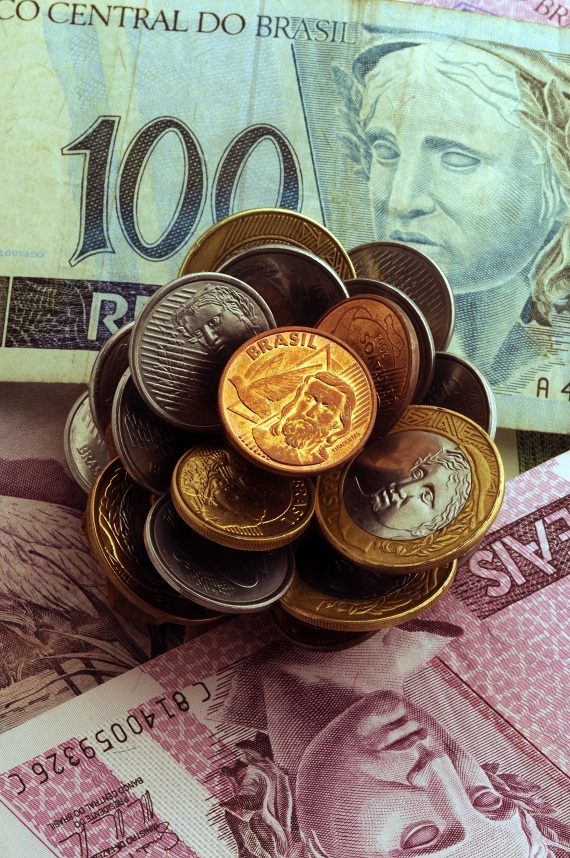
The real comes in banknotes of 2, 5, 10, 20, 50, 100, and 200 reais, and in coins of 5, 10, 25, and 50 centavos and 1 real. The 1 real banknote was withdrawn from circulation in 2005 and replaced by the 1 real coin, and the 1 and 2 centavo coins were retired in 2006. The 200 real note, a new high denomination, was introduced by the Banco Central do Brasil in September 2020 and carries an image of the maned wolf, the lobo-guara. The other notes in the current series, launched between 2010 and 2013, carry Brazilian wildlife on the reverse: the hummingbird on the 1 real note before its withdrawal, the hawksbill turtle on the 2 real note, the great egret on the 5 real note, the green-winged macaw on the 10 real note, the golden lion tamarin on the 20 real note, the jaguar on the 50 real note, and the dusky grouper fish on the 100 real note. The obverse of every current note carries an allegorical female figure representing the Republic, the same stylised head that runs across the whole Second Family series and replaces the portrait of a specific founding figure that most Latin American currencies use. The series was designed in consultation with Brazilian naturalists and is one of the more widely recognised wildlife currency designs in the world.
Exchange Rates, Cash, Cards, and Pix
The real has floated against the dollar since January 1999, and the exchange rate has swung between around 1.7 reais per dollar at the strongest point of the mid-2000s commodity boom and above 6 reais per dollar during the pandemic-era weakness of 2020 to 2021. A traveller in 2026 should check the current rate on the Banco Central do Brasil website or a reliable financial data service before exchanging money, since the rate moves with commodity cycles, domestic fiscal news, and global dollar flows. Cash withdrawals in reais through international bank cards are available at Banco do Brasil, Bradesco, Itau, and Santander ATMs in the major cities and at most airport arrival halls, with per-withdrawal limits that vary by bank and by card network. Card payment is accepted at the great majority of Brazilian restaurants, hotels, and urban shops, and contactless payment is standard in the large cities. The most striking change in the way Brazilians handle money since the mid-2010s is Pix, the instant-payment system launched by the central bank in November 2020. Pix moves money between bank accounts in seconds at zero cost for personal transactions, works through QR codes and through phone-number or tax-ID lookups, and has passed debit and credit cards in transaction volume across much of domestic retail. Foreign visitors generally cannot use Pix without a Brazilian tax ID and a Brazilian bank account, although the central bank has piloted an extension for foreign travellers through selected fintechs.
Practical Tips for a Trip in 2025 or 2026
Carrying a mixture of cash in reais and a contactless debit or credit card covers most travel situations in Brazil. Small beach kiosks, rural taxis, and informal market stalls may still want cash, while most restaurants, supermarkets, hotels, and urban taxis accept cards without fuss. Avoid exchanging large amounts at airport cambio windows, where the spreads run wider than at city-centre banks and authorised exchange houses called casas de cambio. Withdrawing reais from an ATM with an international card usually gives a better rate than airport cash exchange, although some ATMs levy a foreign-use surcharge on top of the interbank rate. Tipping in Brazilian restaurants follows a fixed pattern: most sit-down restaurants add a servico of 10 percent to the bill, which is optional in law but expected in practice. Rounding up a taxi fare is common although not required. Brazilian banknotes of 100 and 200 reais can be hard to break at small shops, so keep smaller notes for everyday purchases and hold the larger ones for hotel and restaurant bills. The coin colours follow a rough yellow-and-silver pattern with the 1 real coin in a two-tone ring and centre, although several older variants still circulate alongside the current issue.
Frequently Asked Questions
Which currency does Brazil use today and how is it written?
The currency of Brazil is the real, with the plural form reais, abbreviated as BRL in international markets and written locally with the symbol R dollar. One real divides into one hundred centavos.
Can I use US dollars or euros to pay in Brazil?
No. Brazilian retailers accept only reais for payment, and foreign currency must be exchanged at a bank or an authorised casa de cambio or withdrawn as reais from an ATM. A small number of hotels and tourist shops in resort areas will quote prices in dollars, although payment still goes through in reais at the day’s exchange rate.
Is the Pix system available to foreign travellers?
Not in the standard form. Pix requires a Brazilian bank account linked to a CPF tax ID, which foreign visitors usually do not hold. The central bank has piloted extensions for foreign travellers through selected fintechs, and a visitor planning a longer stay can apply for a CPF at a Brazilian consulate before travel.
Why does Brazil have so many old currencies in its history?
Brazil lived through a long inflationary episode from the late 1950s through the early 1990s that peaked with hyperinflation in 1989 to 1993. Each new currency marked an attempt to break the price spiral by dropping zeros and resetting expectations. The real, launched in 1994 under the Plano Real, was the first of these attempts to hold.
Sources and Further Reading
- Banco Central do Brasil, currency history and exchange rate data, bcb.gov.br
- Gustavo Franco, O Plano Real e outros ensaios, Francisco Alves
- Werner Baer, The Brazilian Economy: Growth and Development, Lynne Rienner
- Edmar Bacha and Herminio Blumenschein, editors, Brazilian Economic Thought, FGV Editora
- Instituto Brasileiro de Geografia e Estatistica, price index series, ibge.gov.br