President Chester A. Arthur signed the Chinese Exclusion Act into law on 6 May 1882, making it the first piece of United States federal legislation to bar a national group from immigration on the basis of ethnicity. The law remained in force for sixty-one years until its repeal by the Magnuson Act of December 1943, when wartime alliance with the Republic of China made the continued exclusion politically untenable.
The Chinese Exclusion Act had a profound impact on Chinese-American communities, on the broader history of US immigration law, and on US-China relations across more than half a century. This article walks through the legal mechanism, the political context that produced it, the social conditions of Chinese workers in the United States before and after passage, the long process of repeal, and the broader legacy of the law in twentieth and twenty-first century immigration policy.
Key Dates in the Chinese Exclusion Act Timeline
- 1848-1860s: Chinese workers arrive in California for the Gold Rush and railroad construction
- 1875: Page Act restricts Chinese women from entering the United States
- 6 May 1882: President Chester A. Arthur signs the Chinese Exclusion Act
- October 1888: Scott Act bars re-entry of Chinese labourers who left temporarily
- 1892: Geary Act extends exclusion for ten years and requires internal certificates of residence
- 1902-1904: Exclusion extended again and made effectively permanent
- 1910-1940: Angel Island Immigration Station operates in San Francisco Bay
- 17 December 1943: Magnuson Act repeals exclusion and sets token annual quota of 105
- 1965: Hart-Celler Act abolishes national-origins quotas and opens Chinese immigration
- 2011-2012: Senate and House formally express regret for the Chinese Exclusion Act
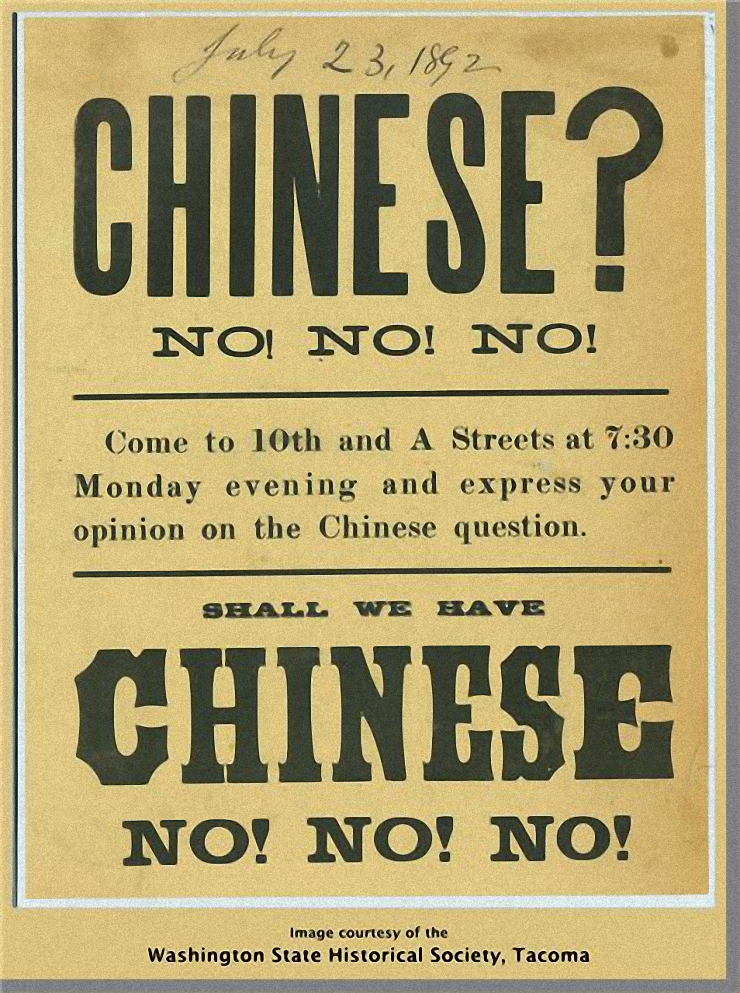 Anti-Chinese handbill from 23 July 1892
The California Gold Rush and Chinese Migration
The California Gold Rush that began in January 1848 with the discovery of gold at Sutter’s Mill drew migrants from across the world to the new state of California, including a substantial wave of Chinese workers from the Guangdong province on the south coast of China. The first Chinese arrivals reached San Francisco in 1849 and a much larger second wave followed across the 1850s and 1860s. By 1860 the United States census recorded around 35,000 Chinese-born residents in California, the great majority of them young men who had come to work the gold fields and to support families back in Guangdong.
The 1860s saw a second major wave of Chinese recruitment by the Central Pacific Railroad Company, the western half of the first transcontinental railroad project that joined the Union Pacific in Utah on 10 May 1869. Around 12,000 Chinese workers built the most difficult sections of the Central Pacific line through the Sierra Nevada mountains, including the long tunnels and the snow-covered passes. The completion of the railroad released this workforce into the wider California labour market.
Anti-Chinese Sentiment and the Workingmen’s Party
The completion of the railroad in 1869 and the depletion of accessible surface gold by the same period combined with a wider American economic downturn after the financial Panic of 1873 to drive sharp competition for jobs in the western United States. Chinese workers became a focus of organised labour hostility through the late 1860s and 1870s, with the Workingmen’s Party of California founded in 1877 by the Irish-born labour activist Denis Kearney as the most visible vehicle for the campaign. Kearney’s slogan, the Chinese must go, became the central rallying cry of the Sandlot meetings in San Francisco and similar gatherings across the West.
Several earlier state and local laws had already targeted Chinese residents, including the Foreign Miners’ Tax of 1850 that imposed a discriminatory levy on non-citizen miners and was applied almost exclusively to Chinese workers. The 1854 California Supreme Court decision in People v. Hall barred Chinese witnesses from testifying against white defendants. The Page Act of 1875 was the first US federal restriction on immigration and barred the entry of Chinese women suspected of being brought for prostitution, with the practical effect of restricting Chinese family formation in the United States.
The 1882 Act and Its Provisions
The Chinese Exclusion Act passed Congress in spring 1882 with substantial bipartisan support and was signed by President Chester A. Arthur on 6 May 1882. The law contained several core provisions:
- Suspended immigration of Chinese skilled and unskilled labourers for ten years
- Barred Chinese residents from applying for US naturalisation (citizenship)
- Exempted Chinese merchants, students, teachers, diplomats, and travellers from the exclusion
- Required exempt travellers to carry certificates from the Chinese government and US consular officials
The act suspended the immigration of Chinese skilled and unskilled labourers for an initial period of ten years and prevented Chinese residents already in the United States from becoming naturalised citizens.
Chinese merchants, students, teachers, diplomats, and travellers were exempt from the exclusion but had to obtain certificates from the Chinese government and from US consular officials confirming their non-labour status. The Scott Act of October 1888 tightened the law further by barring the re-entry of Chinese labourers who had left the United States temporarily, even those holding return certificates issued under the original 1882 act. The Geary Act of 1892 extended the exclusion for a further ten years and added the requirement that all Chinese residents carry an internal passport called a certificate of residence at all times, with deportation as the penalty for failure to produce one.
The Geary Act provisions were upheld by the US Supreme Court in Fong Yue Ting v. United States in 1893. The exclusion was extended again in 1902 and made effectively permanent by 1904 legislation.
Effects on Chinese-American Communities
The Chinese Exclusion Act and its successor laws had a profound effect on the Chinese-American population for the next sixty years. The total Chinese-born population of the United States dropped from around 107,000 in 1890 to around 75,000 in 1910 and continued to decline through the early twentieth century. The skewed gender ratio of the existing community, with women making up under 5 percent of the Chinese-American population in 1900, prevented family formation for most Chinese men in the United States and produced the bachelor society that defined Chinatowns in San Francisco, New York, and other cities for decades.
Chinese-American children born in the United States were citizens by birth under the Fourteenth Amendment, and the 1898 Supreme Court case United States v. Wong Kim Ark confirmed this right against an attempted government challenge. The exclusion laws produced an elaborate system of paper sons, Chinese men who entered the United States by claiming to be the children of US-born Chinese citizens whose birth records had been destroyed in the 1906 San Francisco earthquake and fire. The Angel Island Immigration Station in San Francisco Bay, which operated from 1910 to 1940, processed Chinese arrivals through long detentions and detailed interrogations designed to catch paper sons.
The 1943 Magnuson Act and Repeal
The repeal of the Chinese Exclusion Act in 1943 came through the Magnuson Act, signed by President Franklin D. Roosevelt on 17 December 1943, which ended Chinese exclusion and allowed Chinese residents of the United States to apply for naturalisation. The shift was driven by the wartime alliance between the United States and the Republic of China against Japan.
The 1943 act set a token annual quota of 105 Chinese immigrants under the national-origins formula of the 1924 Immigration Act, well below the levels reached before exclusion but the first formal opening since 1882. The next major shift came with the Immigration and Nationality Act of 1965, also called the Hart-Celler Act, which abolished the national-origins quota system and replaced it with preference categories based on family reunification and skilled labour. The 1965 reform produced the largest wave of Chinese immigration to the United States in the country’s history, with the Chinese-American population growing from around 237,000 in 1960 to over 5 million in the most recent estimates. The 2012 House of Representatives resolution and the 2011 Senate resolution formally expressed regret for the Chinese Exclusion Act, more than a century after its passage.
Long-Term Legacy and Recent Recognition
The Chinese Exclusion Act set the legal precedent for several later restrictions on immigration based on national origin, including the Immigration Act of 1917 that established a literacy test and an Asiatic Barred Zone, the National Origins Act of 1924 that effectively excluded most Asian immigration alongside southern and eastern European migration, and the Tydings-McDuffie Act of 1934 that restricted Filipino immigration. Modern legal scholars treat the Exclusion Act and its successor cases as a foundational episode in the development of US immigration law, including the plenary power doctrine that gives Congress broad authority over immigration matters that survives in current case law. The 2012 House resolution acknowledged the role of Chinese workers in building the transcontinental railroad and other major American infrastructure projects, and the 2014 induction of Chinese railroad workers into the US Department of Labor Hall of Honor gave the workforce its first formal federal recognition.
Several Angel Island and Chinatown historic sites, including the Angel Island Immigration Station in San Francisco Bay and the Chinese Historical Society of America museum in San Francisco, document this history for current visitors. The Museum of Chinese in America in New York City, founded in 1980 and currently operating from temporary premises after a 2020 fire damaged its archive, holds the largest collection of material on Chinese American history east of the Mississippi. Academic conferences marking the centenary of the 1882 act and the eightieth anniversary of the 1943 Magnuson Act repeal have produced new scholarship on the social history of the exclusion era.
The descendants of paper sons whose families used coached identities to enter the United States in the early twentieth century have begun to publish family histories that document the lived experience of the system, including the long-term effects on family identity, naming, and inherited memory of the period. The legal and social legacy of the Chinese Exclusion Act remains a subject of active historical research more than 140 years after its passage. Several US universities including Stanford and the University of California system run dedicated Asian American studies departments that maintain ongoing research programmes on the period and its aftermath.
Frequently Asked Questions
What was the Chinese Exclusion Act?
The Chinese Exclusion Act was a United States federal law signed on 6 May 1882 that suspended the immigration of Chinese labourers for ten years and barred Chinese residents from becoming naturalised US citizens. It was the first US federal law to restrict immigration on the basis of ethnicity. The exclusion was extended in 1892 and 1902, made permanent in 1904, and repealed by the Magnuson Act on 17 December 1943.
When was the Chinese Exclusion Act passed?
President Chester A. Arthur signed the Chinese Exclusion Act into law on 6 May 1882. The law was the first piece of United States federal legislation to bar a national group from immigration on the basis of ethnicity.
When was the Chinese Exclusion Act repealed?
The Magnuson Act, signed by President Franklin D. Roosevelt on 17 December 1943, repealed the Chinese Exclusion Act and allowed Chinese residents of the United States to apply for naturalisation. The 1943 act set a token annual quota of 105 Chinese immigrants. The full opening of Chinese immigration came with the Immigration and Nationality Act of 1965.
Who was Denis Kearney?
Denis Kearney was an Irish-born labour activist who founded the Workingmen’s Party of California in 1877. His slogan, the Chinese must go, became the central rallying cry of organised anti-Chinese sentiment in San Francisco and the wider western United States during the late 1870s and early 1880s.
What were paper sons?
Paper sons were Chinese men who entered the United States during the exclusion era by claiming to be the children of US-born Chinese citizens whose birth records had been destroyed in the 1906 San Francisco earthquake and fire. The system relied on coached identities and was a major focus of the interrogations conducted at the Angel Island Immigration Station from 1910 to 1940.
Sources and Further Reading
- Erika Lee, At America’s Gates: Chinese Immigration during the Exclusion Era 1882-1943, University of North Carolina Press, 2003
- Mae Ngai, Impossible Subjects: Illegal Aliens and the Making of Modern America, Princeton University Press, 2004
- U.S. Library of Congress, Immigration to the United States 1789-1930 collections, loc.gov
- National Archives, records of the Chinese Exclusion Act, archives.gov
- Angel Island Immigration Station Foundation, aiisf.org