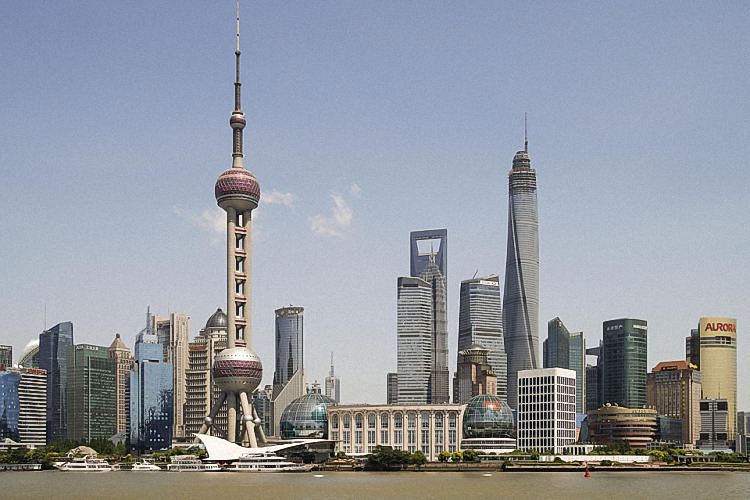
On one bank of the Huangpu River stand the stone banking houses of the 1920s; on the other rises the tallest tower in China. Between those two skylines Shanghai keeps a third city that most visitors walk straight past: the longtang, the lane neighbourhoods where the everyday life of the place still runs behind stone gateways. This guide covers the famous waterfront and the towers, the lane houses and old concessions that explain how Shanghai got here, the food, and the practical detail of moving around a city of 25 million.
The Bund and Pudong: Two Skylines Face Off
The single view that defines Shanghai is the Huangpu River at dusk, with a century of history on one side and the future on the other.
The Bund (Waitan)
The Bund is the mile-long waterfront on the west bank, lined with 52 grand buildings in Gothic, Baroque, neoclassical and Art Deco styles, a row known in Chinese as the “museum of international architecture”. These were the banks, trading houses and hotels of the 1920s and 1930s, when Shanghai was the financial capital of Asia. Walk it from the Waibaidu Bridge down past the old Customs House and the Peace Hotel.
Pudong and the Towers
Across the water, Pudong was farmland until the 1990s and now holds one of the densest clusters of supertall towers on earth. The Shanghai Tower, at 632 metres, is the tallest building in China and the second tallest in the world, beside the Jin Mao Tower, the bottle-opener-shaped World Financial Center and the Oriental Pearl. Cross between the banks on foot, by metro, or through the gaudy Bund Sightseeing Tunnel.
The Longtang and Shikumen: Shanghai’s Lane Houses
The most Shanghainese thing in the city is not on either skyline. It is the shikumen, the “stone-gate” house, a terrace of two and three-storey homes opening through a carved stone doorway with thick black-lacquered doors, packed along narrow lanes called longtang or lilong.
The form was born of crisis. When the Taiping wars of the 1850s and 1860s drove wealthy families from the surrounding Jiangnan towns into the safety of the foreign concessions, developers threw up dense rows of these Sino-Western houses to hold them, and they became the standard Shanghai home for a century. Three places show the range:
- Xintiandi: a block of shikumen restored into upscale bars and shops, and home to the site of the Chinese Communist Party’s first congress of 1921, set in an original lane house.
- Tianzifang: a tighter warren of lanes in the French Concession turned into craft studios, cafes and galleries, closer to the original scale.
- A working longtang: step into almost any ordinary lane off the main streets to see laundry on bamboo poles, shared kitchens and the lived-in version.
The Concessions and the Hudec Trail
For nearly a century Shanghai was carved into foreign concessions, and the former French Concession is the loveliest legacy: quiet streets shaded by plane trees, villas, boutiques and cafes, best wandered on foot around Wukang Road and Anfu Road.
The buildings that gave this era its glamour were largely the work of one man, the Hungarian-Slovak architect Laszlo Hudec, and tracing them makes a fine walk:
- Wukang Mansion: Hudec’s 1924 apartment block, shaped like the prow of a ship, now the single most photographed building in Shanghai.
- Park Hotel: his 1934 tower on People’s Square, the tallest building in Asia for nearly three decades.
- Grand Cinema and the Paramount: the Art Deco picture palace and ballroom that defined Shanghai’s jazz-age nightlife.
This blend of East and West is what locals call Haipai, “Shanghai style”, and it runs through the city’s architecture, food and dialect alike.
Little Vienna: the Shanghai Jews
One corner of the city carries a history few visitors expect. In the late 1930s, as other ports turned them away, Shanghai took in around twenty thousand Jewish refugees fleeing Nazi Germany and Austria, asking no visa of them.
They settled in Hongkou, around Tilanqiao, in such numbers that the district became known as “Little Vienna”, with its own cafes and newspapers, and later a confined wartime quarter. The story is told today at the Shanghai Jewish Refugees Museum, built around the restored Ohel Moshe Synagogue, one of the more moving stops in the city.
Old Shanghai: Yu Garden and the Old Town
Before the concessions there was a walled Chinese town, and its heart survives around the Yu Garden, a classical Ming-dynasty garden finished in 1577 by a court official for his parents. Pavilions, rockeries and carp ponds pack its two hectares.
The garden is wrapped in the Yuyuan Bazaar, a maze of Ming-style halls now full of shops, and sits beside the City God Temple and the much-painted Huxinting tea house on its zigzag bridge. This is also the place to eat the original Nanxiang soup dumplings at their century-old shop, if you can face the queue.
Eating Shanghai: Benbang and the Soup Dumpling
Shanghai cooking is rich, slightly sweet and built on soy, sugar and rice wine. The home-style tradition is called benbang, and a few dishes are worth hunting down:
- Hongshao rou: red-braised pork belly, glossy and sweet, the benchmark of benbang cooking.
- Xiaolongbao: the soup dumpling, a thin skin holding hot broth and pork, originally from Nanxiang.
- Shengjianbao: pan-fried pork buns with a crisp base, the city’s favourite street breakfast.
- Hairy crab: the autumn delicacy from nearby Yangcheng Lake, steamed and eaten with vinegar and warm wine.
For the cosmopolitan side, the same Haipai spirit shows in the city’s deep bench of international restaurants and old coffee houses.
Nanjing Road and Shopping
Nanjing Road is one of the busiest shopping streets in the world, running from the Bund to People’s Square, part of it a pedestrian strip of malls, department stores and crowds. It is more spectacle than bargain.
For something with more character, the lanes of Tianzifang and the restored blocks of Xintiandi sell design, craft and clothing in a setting worth the walk in itself.
Museums and Modern Art
Shanghai’s museums punch well above the city’s age, and several of the best are free.
- Shanghai Museum: on People’s Square, holding the country’s finest collection of ancient Chinese bronzes, ceramics and calligraphy, with a huge new East branch now open in Pudong.
- Power Station of Art: China’s first state contemporary-art museum, in a converted riverside power plant from the 2010 Expo.
- M50: a warren of galleries and studios in old textile mills on Moganshan Road by Suzhou Creek.
- Propaganda Poster Art Centre: a private basement collection of Mao-era posters, one of the city’s odder and more memorable stops.
Getting There and Around
Shanghai has two airports, Pudong for most international flights and Hongqiao for domestic and regional ones, plus a vast high-speed rail hub. Inside the city the metro is one of the largest networks on earth and the easiest way to move.
- The Maglev: the magnetic-levitation train from Pudong Airport to Longyang Road hits 430 kilometres an hour, the fastest commercial service in the world, and covers 30 kilometres in under eight minutes.
- Metro: clean, cheap and bilingual, paid by QR code through Alipay or a transit card.
- High-speed rail: Hangzhou in about 50 minutes, Suzhou in under half an hour, Beijing in around four and a half hours.
Setting up a payment app and an offline map before arrival saves a lot of friction, as our wider China travel guide explains.
Day Trips: Water Towns and Suzhou
The flat, watery country around Shanghai holds some of China’s prettiest old towns, all reachable in a day.
- Zhujiajiao: a 1,700-year-old canal town an hour west on metro line 17, with stone bridges and boat rides, the easiest “Venice of Shanghai”.
- Suzhou: under half an hour by high-speed train, famous for its UNESCO-listed classical gardens and silk.
- Hangzhou: about 50 minutes away, built around West Lake, covered in our Hangzhou city guide.
When to Go
Shanghai has a humid subtropical climate, and the shoulder seasons are far more comfortable than the extremes.
- Spring and autumn (March to May, September to November): mild and clear, the best windows, with autumn bringing hairy-crab season.
- Summer: hot, sticky and prone to typhoons, with a wet “plum rain” spell in June.
- Winter: cold, grey and damp, but quiet and cheap.
- Avoid the National Day week in early October and Chinese New Year, when crowds and prices spike.
Frequently Asked Questions
How many days do you need in Shanghai?
Three days cover the Bund and Pudong, the lane houses and concessions, Yu Garden and the food. A fourth day lets you add the Jewish quarter in Hongkou or a day trip to a water town or to Suzhou.
Should you see the skyline from the Bund or from Pudong?
The classic view is from the Bund looking across at the Pudong towers, best at dusk as the lights come on. For the reverse, go up the Shanghai Tower or the World Financial Center for the view back over the old city.
What are shikumen and longtang?
Shikumen are Shanghai’s traditional “stone-gate” terrace houses, and longtang are the narrow lanes they line. They were built from the 1860s as the city filled with refugees, and you can see them polished at Xintiandi, lived-in at Tianzifang, and ordinary in any back lane.
Is the Maglev worth riding?
As an experience, yes. The train from Pudong Airport to Longyang Road reaches 430 kilometres an hour, the fastest in commercial service anywhere, and the trip takes under eight minutes. From Longyang Road you connect to the metro into the centre.
What food is Shanghai known for?
Benbang, the sweet, soy-rich local cooking, with red-braised pork as its signature. The must-try snacks are xiaolongbao soup dumplings and pan-fried shengjianbao, and in autumn the hairy crab from nearby lakes.
How do you get from Pudong Airport to the city?
The fastest way is the Maglev to Longyang Road, then a metro connection. Metro Line 2 runs all the way into the centre more cheaply but slowly, and taxis take around an hour depending on traffic.
Sources and Further Reading
- Meet in Shanghai – the official municipal tourism portal on sights and events
- Shanghai Jewish Refugees Museum – the Hongkou refuge and the Ohel Moshe Synagogue
- Shanghai Tower – the 632-metre observation deck and building
- Shanghai Maglev – timetables and fares for the 430 km/h airport line
- UNESCO, the Classical Gardens of Suzhou – the day-trip gardens half an hour away
- Shanghai Municipal Government – official city information and history