German military helmets from 1842 to the present span four distinct engineering eras, each defined by a specific threat that drove its design. The 1842 Pickelhaube with its leather shell and brass spike addressed sabre cuts and ceremonial prestige more than ballistic protection. The 1916 Stahlhelm, developed at the Technical University of Hannover under Professor Friedrich Schwerd, answered the shrapnel casualties of trench warfare. The 1953 Bundeswehr M1 adopted US design principles during the Cold War rearmament. The current composite helmets use aramid and para-aramid fibres against modern fragmentation threats. This guide covers the development of each pattern, the key manufacturers and proof marks, the academic and legal framework for studying Third Reich era examples, the main museum collections, and authentication considerations for surviving pieces in private and institutional hands.
The Pickelhaube Era: 1842 to 1916
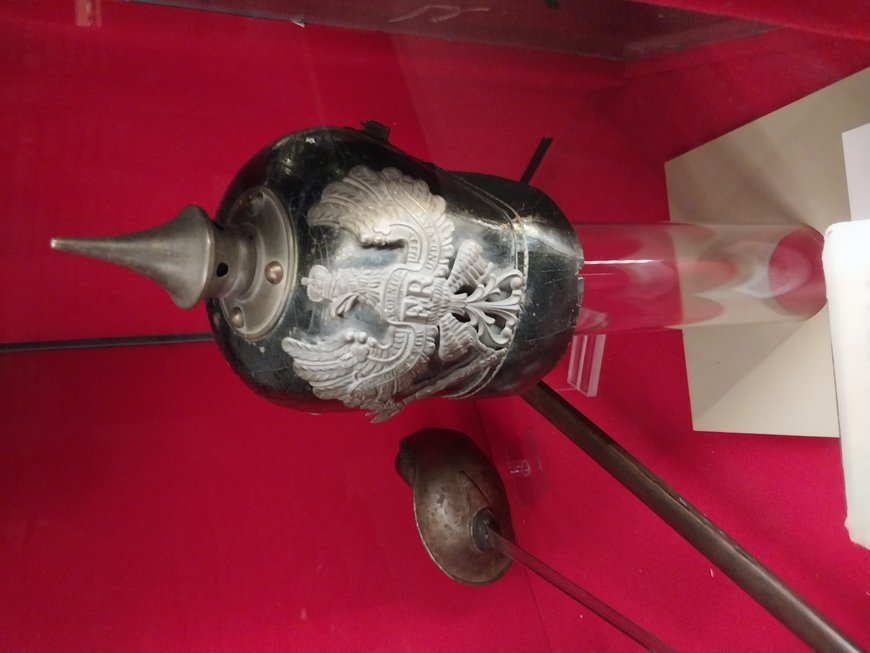
The Pickelhaube, officially introduced by Prussia in 1842, served as the standard German infantry headgear for over seven decades. The design combined a leather shell (usually boiled bullskin or hide) with brass mountings, regimental plates, and the characteristic spike (Pickel) that gave the helmet its name.
The helmet’s evolution through the 19th century tracked regiment and rank distinctions. Line infantry wore the standard Mannschaften pattern with brass fittings. Officer helmets used gilded fittings with more elaborate front plates. Cavalry regiments wore variant forms including the Kurassier helmet with a forward-sweeping scale crest and the Ulan czapka with its square top derived from Polish tradition.
Manufacturing concentrated in Solingen and Leipzig with secondary workshops across the German states. The Prussian army standardised production through Staatliche Waffenkommission inspection and proof marks appear on the interior shell lining and chin scales. Collectors and researchers can trace production through these marks to specific workshops and approximate dates.
The outbreak of the First World War in 1914 tested the Pickelhaube against modern battle conditions and exposed its inadequacy. Shrapnel fragmentation caused far more head wounds than sabre or bayonet strikes, and the leather shell offered essentially no protection against steel shards. Head injuries dominated German field hospital admissions by 1915, triggering the crash development that produced the Stahlhelm.
The Stahlhelm: M1916 Through M1935
The M1916 Stahlhelm entered front-line service at Verdun in February 1916, designed by Professor Friedrich Schwerd working with Dr August Bier on the ballistic and ergonomic requirements. The shell used silicon-nickel steel 1.1 to 1.2 mm thick, formed in three sizes (60, 62, 64) to fit different head shapes, with a leather liner and adjustable chin strap.
Production ran through Eisenhuttenwerke Thale and subsequent contractors including Sachsische Emaillier- und Stanzwerke. Internal stampings identify manufacturer and lot. The M1916 and its slight M1918 refinement (removed ventilation lugs) served through the end of the First World War and into the interwar Reichswehr period.
The M1935 emerged from interwar development as a lighter and more manufacturable pattern. The bowl shape retained the M1916 profile but with thinner 1.0 mm steel, modified liner, and redesigned chin strap attachment. Production between 1935 and 1945 reached several million shells across multiple manufacturers.
Under the Third Reich the M1935 carried branch decals on the shell sides: the Heer used a silver eagle and national colour cockade, Luftwaffe a light-blue eagle, Kriegsmarine a gold eagle, and political organisations their specific emblems. These decals include the Hoheitszeichen sovereignty symbol, which brings the marked helmets within Section 86a of the German criminal code restrictions on symbols of unconstitutional organisations.
Section 86a and the Legal Framework
The German Strafgesetzbuch Section 86a prohibits the manufacture, distribution, public display, or sale of symbols of unconstitutional organisations within Germany. Third Reich era helmets carrying the Hoheitszeichen or SS runes fall within this prohibition for private possession and public display in Germany, Austria, and several other jurisdictions.
Paragraph 86 Absatz 3 provides specific exceptions for academic research, civic education, historical teaching, art, and science. Museums, universities, and certified researchers can study these items under documented exceptions. Private collectors outside the exemption framework cannot legally display such items in public contexts within Germany.
Other jurisdictions vary substantially. US federal law does not restrict possession of most period military items, though state and local statutes around symbols of hate may apply to public display contexts. France, Austria, and Israel impose restrictions similar to the German framework. Private buyers should consult legal counsel in their jurisdiction before acquiring or displaying items with organisational markings.
Post-war Bundeswehr helmets carry no such restrictions. The M1953 and later patterns adopted new heraldic elements specifically removed from Third Reich symbology, and the current Bundesadler on modern helmets is the federal eagle of the Federal Republic, distinct from the Nazi-era Hoheitszeichen.
Bundeswehr and Modern Patterns
The Federal Republic of Germany, established in 1949, initially had no armed forces. The Bundeswehr formed in 1955 and adopted the M1953 helmet, which shared visual cues with the Stahlhelm tradition but with modified decals removing all Third Reich elements. The M1962 refinement continued through the 1980s as the standard infantry helmet.
The shift to composite materials came with the Kopfschutz M92 in the early 1990s. The M92 used aramid fibre in a rounder profile closer to US PASGT design, departing visually from the Stahlhelm silhouette. The current Kopfschutz 2000 series uses advanced composites matched to NATO standards.
East German Nationale Volksarmee helmets followed a separate development after 1956. The M56 NVA pattern carried a distinctive rounded bowl shape unrelated to either Stahlhelm or US design, produced at VEB Reichenbach in Saxony. After reunification in 1990 the NVA stock was largely decommissioned, with some pattern helmets ending up on international markets and in collector circuits.
Museum Collections
Major German helmet collections are held at several institutional sites. The Militarhistorisches Museum der Bundeswehr in Dresden, redesigned in 2011 under architect Daniel Libeskind, presents helmets across all periods with explicit historical contextualisation. Items from the Third Reich era are displayed alongside documentation of the violence the regime carried out.
The Deutsches Historisches Museum in Berlin holds a substantial military collection with helmets representing the full chronological sweep from the 1842 Pickelhaube through the Bundeswehr present. The Ingolstadt Bavarian Army Museum holds the finest Pickelhaube collection in Germany.
International collections include the Imperial War Museum in London (substantial WWI and WWII material), the US Army Heritage and Education Center in Carlisle Pennsylvania, the Musee de l’Armee in Paris, and the Royal Armouries in Leeds. These institutions maintain research collections accessible to credentialed scholars through formal institutional requests.
Academic access for research operates through institutional affiliation rather than walk-in request. Researchers working on PhD theses, museum curation, or peer-reviewed publications can typically arrange collection access with several months of advance coordination. Private collectors generally cannot access museum storage rooms beyond the public display spaces.
Authentication and Collector Context
Authenticating surviving German helmets requires specialist expertise across several technical domains. A substantial portion of items offered in the international market are post-war reproductions or period shells with added or altered decals. Authentication services from specialists typically cost 100 to 400 US dollars per item.
Key authentication indicators:
- Shell material analysis: X-ray fluorescence identifies alloy composition anachronisms
- Interior stamps: manufacturer codes and lot numbers cross-reference against production records
- Liner material: period leather differs detectably from modern replacements
- Decal chemistry: period lacquer compositions show specific aging patterns
- Chin strap hardware: period steel buckles and rivet patterns follow specific forging types
- Shell deformation: original shells show period deformation unlike modern shaped reproductions
Reference works for authentication include Ludwig Baer’s The History of the German Steel Helmet, Kelley and Baker’s German Combat Helmets catalogue, and academic monographs from the Militarhistorisches Museum. These works document specific manufacturer marks, production years, and known reproduction techniques.
Pickelhaube Authentication Specifics
Pickelhaube authentication differs from Stahlhelm work because the construction involves multiple materials (leather shell, brass mountings, silk or felt liner, chin scales) that each require separate assessment. Reproductions often assemble modern brass fittings onto period-style leather shells, producing composite items that may pass casual inspection.
Specific Pickelhaube authentication points:
- Leather shell quality: period boiled leather shells show specific grain patterns and aging
- Front plate details: regimental emblems followed specific templates for each unit
- Cockade patterns: left and right side cockades used specific colour schemes by state (Prussia, Bavaria, Saxony, Württemberg)
- Spike construction: period spikes were multi-piece cast brass with internal threading
- Liner construction: period liners used silk or linen with specific stitching patterns
- Owner markings: many helmets carry soldier names or unit identifiers inside
Pre-1914 Pickelhaube pieces fall outside Section 86a restrictions since the monarchical period predates the Nazi regime. These items are generally legal to own, import, and display across most European and North American jurisdictions.
Market Considerations for Collectors
The collector market for German military helmets is substantial but fraught with authenticity and legal complications. Prices vary widely based on period, condition, and documented provenance.
Rough pricing ranges in 2024 market conditions:
- Authentic Pickelhaube: 800 to 5,000 US dollars for line infantry, higher for officer or cavalry variants
- M1916 Stahlhelm: 400 to 1,500 US dollars depending on unit markings and condition
- M1935 Heer helmet: 500 to 2,000 with authentic decals intact
- Bundeswehr M53 or M62: 75 to 250 US dollars, substantially lower demand
- Documented officer pieces: 3,000 to 20,000+ with full provenance
Buyer risks include full reproductions (manufactured outside Germany in various workshops), decal additions to plain shells, period liner swaps between shells, and paperwork forgery. Paying premium prices for rare items requires professional authentication before completing the purchase.
Display restrictions vary by jurisdiction. Items with Nazi-era markings may not be displayed publicly in Germany, Austria, Israel, and several other countries without specific institutional exemption. US federal law permits possession but state and local ordinances around symbols of hate may apply. Homeowner insurance typically excludes coverage for restricted items.
Frequently Asked Questions
Are German helmets legal to own in the United States?
Most period helmets are legal to possess under US federal law, though some state and local ordinances around symbols of hate may apply to public display contexts. Pre-1914 and post-1949 items carry no legal restrictions. Third Reich era items raise jurisdiction-specific questions.
Can I import a Nazi-era helmet to Germany?
Items carrying the Hoheitszeichen or SS runes cannot be legally imported to Germany for private possession or public display. Academic and museum exceptions under Paragraph 86 Absatz 3 require documented research purposes and institutional affiliation.
How can I tell an authentic Stahlhelm from a reproduction?
Professional authentication through specialist appraisers. Home identification using online guides is unreliable because reproduction quality has improved substantially since the 1990s. Several established authentication services in the US and Europe charge moderate fees for certified opinions.
Is the East German NVA helmet collectible?
Yes, though at lower price points than West German Bundeswehr or Third Reich patterns. The distinctive M56 shape has become iconic in post-Cold War collector circles. Pricing typically runs 100 to 300 US dollars for good examples.
What museums allow close study of their helmet collections?
Most major collections allow access for credentialed researchers through formal institutional requests. Public display covers only a fraction of institutional holdings. Researchers should contact the museum registrar with documented research purposes and affiliation proof well in advance.
Are Pickelhaube reproductions common?
Yes, particularly for costume and reenactment use. Distinguishing reproductions from period pieces requires close examination of leather quality, brass fitting detail, and interior construction. Many reproductions make no attempt to deceive, but unscrupulous sellers occasionally pass reproductions as period items.
For related German military history articles, see our WWII German helmets guide, our WWI German helmets, our German army helmets multi-era overview, and our Imperial German officer uniforms.
Sources and Further Reading
- Ludwig Baer, The History of the German Steel Helmet
- Kelley and Baker, German Combat Helmets reference catalogue
- Militarhistorisches Museum der Bundeswehr, Dresden, permanent collection catalogue
- Deutsches Historisches Museum Berlin, military history collection records
- Bayerisches Armeemuseum Ingolstadt, Pickelhaube collection archives
- Bundesministerium der Justiz, Strafgesetzbuch Sections 86 and 86a