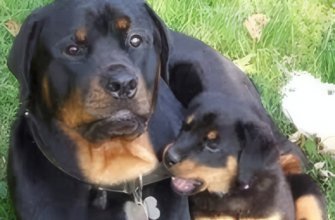

A German Rottweiler puppy weighs 10 to 15 pounds at eight weeks and can reach 90 pounds by its first birthday, which means the training window closes faster than most new owners expect. The first 12 weeks shape most of the adult temperament, and a handler who drifts through that period ends up with a 110-pound adolescent that has already decided how the household ranks. This guide walks through puppy selection, the socialisation calendar, feeding and exercise limits, potty and crate training, health checks specific to the breed, and the early obedience drills that save both dog and owner from rehoming within the first year.
Choosing a German Rottweiler Puppy
German Rottweilers differ from American Rottweilers in breed club registration and conformation. Litters registered with the Allgemeiner Deutscher Rottweiler Klub carry stricter health and temperament testing than the American Kennel Club baseline, including mandatory hip and elbow scoring of both parents through the Orthopedic Foundation for Animals or the equivalent German HD scheme.
Ask for the following before paying a deposit. Hip and elbow scores of sire and dam, ideally OFA Good or Excellent or a-normal to a-fast normal on the German scale. Eye certification through the Canine Eye Registration Foundation or OFA Companion Animal Eye Registry. Cardiac clearance for juvenile dilated cardiomyopathy, a known breed concern. Temperament notes on both parents, including reaction to strangers, handling, and noise.
Meet the dam with her litter and ask to see the sire in person or on video. A reputable breeder welcomes the visit, answers questions about previous litters, and keeps a waiting list rather than selling to whoever arrives first. Prices for a German import litter range from 2,500 to 4,500 US dollars in 2024 market terms, with working-line pups at the upper end.
The 12-Week Critical Socialisation Window
Puppy temperament locks in between weeks three and 12. By the time a new owner brings the dog home at eight weeks, a third of the window has already closed, and the breeder’s handling has set the baseline.
Daily socialisation goals during weeks eight through 12:
- Introduce at least three new people per day, including men with beards, women with hats, and children under 10
- Walk on three different surfaces daily: grass, gravel, tile, carpet, metal grate, wood
- Expose to recorded sounds of thunder, fireworks, traffic, vacuum, and doorbell at low volume
- Handle paws, ears, mouth, and tail for one minute each, paired with food rewards
- Attend a puppy kindergarten class after the second vaccine round, usually around 10 weeks
The Rottweiler’s adult confidence comes from this window, not from later training. A puppy that never meets children before 12 weeks tends to treat every small human as a wildlife encounter for the rest of its life, and a puppy that never hears traffic will startle on every walk at six months.
Feeding and Growth Rate
Rottweilers are giant-breed dogs in growth terms, which means overfeeding during the first year causes skeletal problems that no adult diet can reverse. The goal is slow steady growth on a large-breed puppy formula, not maximum weight gain.
Feed three meals a day through four months, then two meals from four months through adulthood. Use a formula with calcium between 1.2 and 1.5 percent and phosphorus between 1.0 and 1.2 percent, with balanced calcium-to-phosphorus ratio close to 1.2 to one. Avoid adult formulas or high-calorie performance diets under 18 months.
Weight targets give a rough check. At eight weeks most Rottie pups weigh 10 to 18 pounds. At four months the range is 35 to 55 pounds. At one year most dogs sit between 75 and 100 pounds for females and 85 to 110 pounds for males. Pups that exceed these ranges early usually grow too fast and pay for it in joints.
Early Obedience and House Training
Crate training starts the first night. The crate becomes the puppy’s resting space, not a punishment. Place it in a social area of the house, feed meals inside it for the first week, and cover it at night to cut visual stimulation. Most Rottweiler pups sleep through the night by ten weeks with a midnight toilet break.
Potty training runs on a timer. Take the puppy out every 45 minutes during waking hours for the first two weeks, then every 90 minutes through 12 weeks, and every two to three hours from 12 to 16 weeks. Reward outdoor elimination within three seconds of the behaviour. Never punish indoor accidents after the fact because the puppy cannot connect the correction to the act.
Obedience drills should stay under five minutes per session in this age bracket. Introduce name, sit, down, come, and wait during the first month at home. Pay with food that the puppy values, usually small cubes of soft training treats rather than kibble. Short, frequent sessions beat long drills every time.
Managing a Large Puppy That Wants to Lead
Rottweilers carry a genuine leadership drive, bred in from the cattle-droving roots around the town of Rottweil in southern Germany. The breed was used by butchers to guard carts and later by the Roman army crossing the Alps. That working lineage produced a dog that expects structure and provides it when structure is absent.
Rules that prevent early dominance problems:
- The puppy earns food, door access, and play with a sit or down cue
- No free feeding from a full bowl
- Daily handling drills that include rolling the puppy onto its back for 15 seconds with gentle restraint
- No shoulder-height play or wrestling that teaches the dog to use its size against humans
- Consistent cues across every family member, written on the fridge if needed
The cradle exercise, a legacy drill from older breed manuals, still has value. Sit on the floor, lift the puppy onto your lap, and hold it gently on its back for 15 seconds. Repeat until the puppy settles without struggle. This builds handling tolerance and sets a non-confrontational leadership baseline without any pain.
Health Checks Through the First Year
Core vaccinations run at 8, 12, and 16 weeks, with rabies added at 16 weeks in most jurisdictions. The breed has a known sensitivity to parvovirus, so keep the puppy off shared dog park ground until 10 days after the final vaccine round.
Schedule the following through the first year. A veterinary hip and elbow preliminary at six months for any dog that will be bred or will do serious working sport. A cardiac auscultation at each vaccine visit to screen for congenital defects. A panosteitis check if the puppy shows transient lameness between five and 12 months, since this breed-prone condition resolves on its own but gets misdiagnosed frequently.
Spay or neuter timing for Rottweilers has shifted since 2015 based on joint and cancer studies from the University of California Davis. Current veterinary guidance delays the procedure until 18 to 24 months for males and after the first heat for females. Earlier procedures raise the lifetime rate of cruciate ligament disease and certain cancers in the breed.
Frequently Asked Questions
How much exercise does a Rottweiler puppy need?
The five-minutes-per-month-of-age rule works well through 18 months. A four-month-old handles 20 minutes twice a day, a nine-month-old handles 45 minutes. Avoid repetitive jumping, long jogging sessions, or stairs until growth plates close around 18 to 24 months.
Do German and American Rottweiler puppies differ?
German-registered pups carry stricter health and temperament testing in the parents and tend toward stockier conformation with larger heads. American-registered pups trace the same ancestry but with looser breed club oversight. The temperament differences are handler-dependent more than line-dependent.
When does a Rottweiler puppy finish growing?
Bones complete around 18 to 24 months, and the chest fills out through three years. Mental maturity often lags until age three or four, which is why the dog can still act like a teenager at 18 months in a fully grown body.
Are Rottweilers good with small children?
A well-socialised Rottie raised with children integrates into family life without issue. Risk lies in the size mismatch. A 90-pound adolescent that play-bumps a toddler knocks the child over, so supervised interactions and off-switch training matter more than temperament alone.
Can the puppy live outside?
No. The breed bonds tightly to its family and backyard isolation produces anxious, reactive adults. The dog belongs inside the house with the family, crated at night through the first year and free-ranging once house manners are solid.
For the adult breed overview, see our German Rottweiler guide. For breeding-side details on health testing and litter planning, read Rottweiler breeding facts. Families considering a female puppy specifically can see our female Rottweiler comparison for temperament and size notes.
Sources and Further Reading
- Allgemeiner Deutscher Rottweiler Klub, breed standard and health protocols
- Orthopedic Foundation for Animals, hip and elbow grading scheme
- University of California Davis, retrospective study on neuter timing in Rottweilers
- American Kennel Club, Rottweiler breed standard and health statement
- Fédération Cynologique Internationale, breed standard 147 Rottweiler