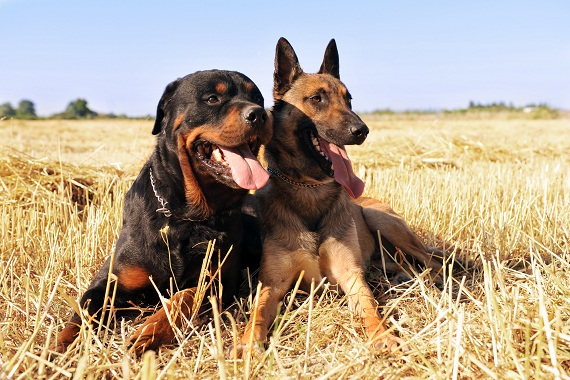
The German Shepherd and the Rottweiler share a country of origin, a working dog heritage, and a place among the most recognised large breeds, yet the two dogs demand different commitments from an owner. Shepherds weigh 10 to 20 pounds less, live a year or two longer, exercise longer, and shed more. Rottweilers settle more readily indoors, carry higher insurance premiums in many US states, and age faster. This comparison covers breed origins, physical and temperament differences, training styles that each breed responds to, health profiles, household fit, and the practical considerations that decide which breed suits a specific family.
Two Breeds, Two Working Traditions
Rottweilers carry a Roman cattle-drover and medieval butcher heritage stretching back roughly two thousand years to the Roman colony at Rottweil. The breed worked livestock, guarded carts, and carried coin purses tied around their necks during a single continuous role shift from droving to guarding as railways displaced cattle driving.
German Shepherds arrived much later. Max von Stephanitz founded the modern breed in 1899, about fifteen centuries after the Rottweiler lineage settled. The shepherd was designed from the start for versatility, with herding, guarding, search, detection, and military roles layered onto a single genetic programme within two generations.
The different histories shaped distinct temperaments. The Rottweiler’s calm steadiness suits slower working tempos, long vigilance, and measured threat assessment. The shepherd’s higher versatility suits task switching, rapid learning, and the mixed demands of modern police or service work.
Physical Differences at a Glance
Adult weight separates the breeds most clearly. A male Rottweiler typically weighs 110 to 130 pounds, while a male shepherd weighs 65 to 90 pounds. Both males stand 24 to 27 inches at the withers, so the Rottweiler is broader and heavier rather than taller.
Coat differences matter for grooming logistics. Rottweilers carry a short to medium double coat that sheds heavily twice a year but needs minimal daily brushing. Shepherds carry a medium to long double coat that demands weekly brushing year-round plus intensive deshedding during spring and autumn blowouts. A shepherd household sees noticeably more floating hair than a Rottweiler household.
Lifespan differences favour the shepherd. Rottweilers average 8 to 10 years due to high cancer rates, particularly osteosarcoma and lymphoma. Shepherds average 9 to 13 years, with the longer end found in smaller working lines rather than large show lines. Families planning a decade of companionship should weigh this gap.
Quick comparison of adult metrics:
- Male weight: Rottweiler 110-130 lbs, GSD 65-90 lbs
- Male height: Both 24-27 inches at withers
- Lifespan: Rottweiler 8-10 years, GSD 9-13 years
- Grooming: Rottweiler weekly, GSD daily during blowout seasons
- Exercise: Rottweiler 60-90 minutes, GSD 90-120 minutes
Temperament and Working Style
Both breeds rank among the most trainable large dogs, but they respond differently to handling. A Rottweiler considers requests before complying. A shepherd anticipates and often starts the task before the handler finishes the cue. That difference produces visibly different working dogs in sport and service contexts.
Rottweilers excel at roles requiring calm vigilance: courthouse security, property guarding, slower-tempo detection work, and carting. The breed’s moderate drive sits at a threshold that activates for real threats rather than for every movement in the environment. Shepherds cover a wider role range, from airport detection to patrol work to therapy and service, with drive that stays engaged across longer sessions.
Strangers meet a measured Rottweiler who assesses the situation before responding. A shepherd in the same scenario often reads visitor body language faster and either dismisses or alerts within seconds. Both breeds protect their family when a genuine threat appears, but the shepherd trips into that mode faster and returns to baseline faster once the threat passes.
Training Methods That Work for Each Breed
Both breeds reward clear, consistent, reward-based training and both shut down under harsh methods. The specifics of successful training differ.
Rottweilers respond best to steady, slightly slower sessions with clear criteria and generous rewards. The breed retains lessons well once learned and does not need frequent refresher drills. A Rottie trained to an IGP title at three years old typically holds the behaviours with monthly maintenance sessions rather than weekly work.
Shepherds thrive on higher-rate repetition, faster transitions between exercises, and mixed activity sessions that combine obedience with scent work and play. A shepherd without varied training loses sharpness faster than a Rottweiler does and benefits from weekly sessions rather than monthly.
Correction tolerance differs. A Rottweiler corrected too harshly often disengages from the handler for days. A shepherd corrected too harshly often accepts the correction in the moment and moves on. Neither breed benefits from physical correction as a primary tool, but the shepherd recovers from handler errors more readily.
Health Profiles Compared
Rottweilers carry higher rates of osteosarcoma, subaortic stenosis, and juvenile laryngeal paralysis. Shepherds carry higher rates of degenerative myelopathy, exocrine pancreatic insufficiency, and pannus. Both breeds share risk of hip and elbow dysplasia at roughly similar rates, around 18 to 22 percent for hip dysplasia in unscreened populations.
Gastric dilatation volvulus, or bloat, affects both breeds due to deep-chested conformation. Prophylactic gastropexy at the time of altering reduces lifetime risk by over 90 percent and is now routine veterinary practice for either breed.
Cancer screening shapes the senior years for both breeds. Rottweilers over seven should receive twice-yearly veterinary examinations with focus on limb palpation for osteosarcoma. Shepherds over eight benefit from annual blood panels and abdominal ultrasound screening for hemangiosarcoma, a vascular cancer common in the breed.
Household Fit and Ownership Reality
Family fit differs by lifestyle more than by breed aesthetics. Rottweilers suit households with steady routines, one primary handler, and space for the dog to settle indoors between exercise sessions. The breed handles apartment living when daily exercise stays consistent. Shepherds suit households with higher activity levels, multiple engaged family members, and tolerance for more visible shedding.
Insurance implications favour the shepherd in most US jurisdictions. Homeowner policies and rental leases more often list Rottweilers on restricted breed lists than shepherds. Families renting or in condo communities should verify policy terms before committing to either breed.
Multi-dog households suit shepherds more easily than Rottweilers. Two shepherds of opposite sex usually coexist without careful management. Two Rottweilers, particularly two females of similar age, often produce conflict by age two to three and may require lifetime separation. A shepherd combined with another breed usually integrates smoothly after a week of structured introductions.
Space requirements differ more modestly than many guides suggest. Both breeds do well with a fenced yard but neither requires acreage. A townhouse with regular walks, a nearby park, and daily mental work satisfies either breed. Rural living gives the dogs more decompression space, but urban life works when the handler commits to daily exercise and training.
The cost of ownership over a decade favours neither breed strongly. Food runs higher for the heavier Rottweiler, while grooming and veterinary cancer screening run higher for the shepherd. Total ten-year costs fall in the 18,000 to 25,000 US dollar range for either breed before any major veterinary episode.
Frequently Asked Questions
Which breed is better for a first-time owner?
A moderate show-line shepherd from a reputable breeder usually works better for first-time owners than a Rottweiler. The shepherd’s forgiveness of handler errors and the lower insurance complications lower the ownership barrier. An experienced owner fits either breed.
Which is more protective?
Rottweilers show slower, more measured protection. Shepherds show faster, more alert protection. Both protect their families when genuine threats arise. The shepherd produces more false alerts, the Rottweiler fewer but with higher commitment when triggered.
Do the two breeds get along in the same house?
Usually yes with proper introductions, particularly if one is male and one is female. Two same-sex adults introduced after maturity require more careful management regardless of which breed is which. Puppies raised together bond readily.
Which breed sheds less?
Rottweilers shed moderately year-round with two heavier seasonal blowouts. Shepherds shed more in both daily volume and during blowouts. Coat length in the shepherd ranges from medium to long, and long-coat variants shed noticeably more than the standard-coat.
How much does a responsibly bred puppy cost?
Both breeds run 2,000 to 4,500 US dollars from health-tested breeders with titled parents in 2024 rates. European imports reach 5,000 or more. Puppies priced under 1,500 usually indicate shortcuts on health testing, parent evaluation, or early socialisation that show up in later veterinary and behaviour costs.
The two parent breeds are detailed separately in our German Shepherd breed overview and German Rottweiler guide. Training considerations carry over from our German Shepherd training guide. For mix breed alternatives that combine shepherd traits, see German Shepherd Labrador mix.
Sources and Further Reading
- Fédération Cynologique Internationale, Standards 166 and 147
- Allgemeiner Deutscher Rottweiler Klub breeding protocols
- Verein fur Deutsche Schaferhunde, German Shepherd breeding and health
- Orthopedic Foundation for Animals, breed-specific hip and elbow statistics
- American Kennel Club, breed standards for both breeds