A newborn German Shepherd weighs around 500 grams and runs a body temperature 8 degrees Fahrenheit below the adult baseline, with a heart rate near 220 beats per minute. Across the next 24 to 36 months that same puppy will gain 60 to 90 pounds, develop a full adult coat, and move through six distinct developmental stages that each demand specific handling from the breeder and new owner. Missing the timing of any stage produces measurable problems in the adult dog: fear reactivity from a botched socialisation window, joint dysplasia from early over-exercise, or confidence deficits from premature weaning. This guide walks through the complete growth timeline from neonatal period through skeletal maturity with weight targets, milestones, and handling priorities for each stage.
Neonatal Period: Birth Through Two Weeks
The newborn shepherd is blind, deaf, and largely immobile. Movement is limited to crawling toward warmth and nipples, and the entire wakeful state centres on feeding and sleep. Body temperature runs 94 to 97 Fahrenheit compared to the adult 101 to 102, which makes the litter vulnerable to chilling if ambient temperature drops below 85 Fahrenheit.
Umbilical cord stumps dry and detach within three to five days. Eyes begin opening around day 10 but vision stays blue-blurred and non-functional through the second week. The mother stimulates elimination by licking the anal and genital regions, since the puppies cannot voluntarily urinate or defecate yet.
The breeder’s role at this stage centres on environmental control rather than handling drills. Keeping the whelping box at 85 to 90 Fahrenheit for the first week, monitoring weight gain with daily weighing, and ensuring adequate milk supply from the dam all matter more than socialisation interventions. Gentle daily handling of each puppy for a minute or two builds early human association without overwhelming the still-developing nervous system.
Transitional Period: Two to Three Weeks
The third week reshapes the puppy. Eyes fully open by day 14 with functional vision by day 21. Ears open around day 12 with hearing coming online across the following week. Incisor teeth emerge around day 14, permitting the beginning of solid food introduction.
Motor development accelerates in week three. The puppy transitions from crawling to walking, with the first wobbly steps appearing around day 16. Tail wagging begins around day 18, and playful interaction with littermates starts around day 21. By the end of the third week the puppy voluntarily eliminates away from the sleeping area, a crucial step toward later housebreaking.
Weight at three weeks typically sits between 1.5 and 2.2 kg (3.3 to 4.8 pounds) for standard-sized lines, with working lines running lighter and show lines heavier. Weight gain averages 150 to 200 grams per day through this period, a pace that continues through the socialisation window before slowing during adolescence.
Primary Socialisation: Three to 12 Weeks
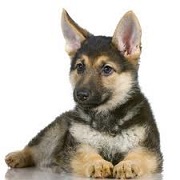
This window shapes adult temperament more than any other period in the dog’s life. Experiences between weeks three and 12 produce lifelong neural patterns for meeting strangers, tolerating handling, responding to novel environments, and interacting with other animals. Missing exposures during this window produces gaps that later training can partly repair but rarely erase.
Milestones across these nine weeks:
- Week 4: startle response appears, puppies react to sudden sounds and movements
- Week 5: bite inhibition training begins through littermate play corrections
- Week 6: weaning progresses with the pup eating more solid food than nursing
- Week 7: the optimal week for meeting adult strangers in the breeder’s home
- Week 8: puppies can go to new homes, with core vaccines beginning
- Week 9: fear period may briefly emerge, requiring careful positive exposures
- Week 10: second vaccine round, puppy kindergarten enrolment
- Week 12: primary socialisation window closes, third vaccine round
Body weight at eight weeks averages 7 to 10 kg for males and 6 to 9 kg for females. A puppy noticeably outside this range in either direction may indicate nutritional problems at the breeder’s facility, worm burden, or line-specific differences that deserve discussion with the breeder and veterinarian.
Juvenile Period: Three to Six Months
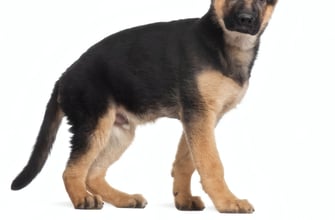
The puppy transitions from round and soft to gangly and awkward across these months. Legs elongate faster than the torso, ears often flop during a tooth-cutting phase before the cartilage fully stiffens, and the coat shifts from puppy fluff to intermediate adult texture.
Teething runs from roughly 14 weeks through six months. Deciduous teeth fall out in sequence, with incisors first, then canines, then premolars. The last premolars and molars are adult-only, emerging between four and seven months. Adult teeth total 42, and a missed premolar counts against conformation scoring in some breed registries.
Growth plate closure considerations shape exercise during this period. The long bones of the legs grow from plates near each joint, and high-impact activity before these plates close can cause permanent orthopedic damage. Avoid repetitive jumping, long-distance running on pavement, steep stair work, and weighted activity. Free play on soft ground, short on-leash walks, and structured obedience drills all suit this age without risk.
Adolescence: Six to 18 Months
The adolescent shepherd tests every rule established in puppyhood. Hormones kick in around six to eight months in females (first heat) and five to seven months in males (leg lifting, marking behaviour). Confidence may swing between pushy and insecure across weeks, and previously reliable cues often wobble.
Weight targets across adolescence. At six months expect 25 to 30 kg for males and 20 to 25 kg for females. At 12 months expect 32 to 38 kg and 25 to 30 kg respectively. By 18 months the dog reaches approximately 90 to 95 percent of adult weight, with filling out continuing into the third year.
The correct handler response to adolescent regression is consistency rather than escalation. Rules remain the same. Expectations remain the same. Reward frequency rises briefly to re-establish engagement. Punishment rarely works and often damages the handler relationship, which the adolescent shepherd tests and watches for signs of instability.
Skeletal Maturity: 18 to 36 Months
Bone growth plates close between 18 and 24 months, marking the end of the growth-plate exercise restrictions. High-impact work can now begin, though full-intensity training should ramp up gradually rather than immediately. Joint strain from abrupt workload increases causes soft-tissue injury that can persist for months.
The chest fills out through the third year, and many shepherds do not reach their final adult appearance until 30 to 36 months. The coat reaches full density around 24 months, and temperament continues developing as well, with many shepherds maturing mentally around two to three years old.
Final adult weight settles between 30 and 40 kg for males and 22 to 32 kg for females, per the FCI standard. Working lines often sit at the lower end of these ranges with proportionally more muscle, while show lines sit at the upper end with heavier bone structure.
Frequently Asked Questions
When is a German Shepherd fully grown?
Skeletal growth completes around 18 to 24 months. Muscle and chest fill-out continues through three years. Mental maturation often extends to three or four years old, particularly in working lines that retain juvenile play behaviour longer.
How much should my puppy weigh at six months?
Males typically reach 25 to 30 kg (55 to 66 pounds), females 20 to 25 kg (44 to 55 pounds). Lower weight often reflects working-line genetics rather than a problem. Much higher weight may indicate overfeeding and raises the risk of joint issues.
When can I start jogging with my shepherd?
After 18 months for controlled jogging on soft surfaces, building distance gradually over several months. Full marathon-level conditioning should wait until 24 months to protect growth plates and soft tissue. Shorter sessions, varied terrain, and attention to any lameness during the build-up keep the dog sound long term.
Why does my puppy’s coat look patchy at four months?
Normal coat transition. The puppy fluff falls out while the intermediate adult coat grows in unevenly. The patchy appearance resolves by six to eight months as the adult coat fills in. Bald patches with skin irritation, by contrast, warrant a veterinary check for mites or fungal infection.
My shepherd’s ears won’t stand up. Is this permanent?
Ears often wobble during teething between four and six months. Most standard-line shepherd ears stand fully by seven months. Ears still soft past nine months may stay that way permanently, though the dog functions normally either way. Some breeders tape ears during teething to encourage standing, with mixed results.
For breed-wide considerations and selection guidance, see our German Shepherd breed overview. Training that accompanies each growth stage is covered in our German Shepherd training guide. For health considerations through the growth years, read German Shepherd health issues.
Sources and Further Reading
- Fédération Cynologique Internationale, Breed Standard 166 German Shepherd Dog
- American Veterinary Society of Animal Behavior, puppy socialisation position statement
- Ian Dunbar, Before and After Getting Your Puppy (developmental timeline)
- Orthopedic Foundation for Animals, growth plate and hip development research
- Dr. Ed Bailey, canine developmental psychology lectures