Ghana’s art traditions run continuously from the 13th-century gold casting of the Akan kingdoms through the 20th-century kente weaving of the Ashanti court, the adinkra symbolic printing of the Akan people, the contemporary coffin-making of the Ga-Adangbe around Accra, and the Afro-futurist gallery scene that has put Ghanaian artists on the international biennial circuit since 2015. The country’s art is unusual among West African traditions because much of it has remained commercially active rather than slipping into museum status: kente weavers still supply the Manhyia Palace in Kumasi, adinkra symbols still print on funeral cloth, and fantasy coffin makers still handle over 90 percent of Ga burials in the Greater Accra region.
This guide covers the main threads of Ghanaian art: gold casting and the Akan royal regalia, kente cloth weaving, adinkra printing and symbolism, Ashanti woodcarving (including the akuaba fertility dolls and Ashanti stools), the fantasy coffin tradition of the Ga-Adangbe, contemporary Ghanaian painting and its global gallery representation, and where travellers can see or buy authentic Ghanaian art today.
Gold Casting and Akan Royal Regalia
Ghana’s western and central regions sit on some of Africa’s richest gold deposits. The Akan kingdoms (Asante, Akyem, Akwamu, Fante, Bono) developed sophisticated gold-casting techniques from the 13th century onwards, alongside the Ghanaian bead traditions that produced the glass and stone jewellery worn at court, producing the regalia, weights, and ornaments that defined kingship across the region. Our companion piece on Ghana gold jewellery covers the modern jewellery market that descends from the same casting traditions. Gold was cast using the lost-wax (cire perdue) method, in which a wax model is covered in clay, heated until the wax runs out, and replaced by molten gold.
The best-known category is the Akan gold weights, small brass or bronze figures used to weigh gold dust in market transactions. Each weight carried a specific weight value and a symbolic figure (a proverb scene, an animal, a tool, a geometric pattern). Thousands of distinct weight designs exist in museum collections, and the weights have become one of the most collected categories of African art in the global market. A fine 18th-century weight can reach $2,000-8,000 at auction at Sotheby’s or Christie’s, while generic market-era weights sell for $50-300 at most African art galleries.
Royal gold regalia of the Asantehene (king of the Ashanti) includes the Sika Dwa Kofi (Golden Stool) that descended from the sky around 1700 through the priest Okomfo Anokye, cast gold pectoral discs, sword ornaments, elaborate gold crowns, and the gold-covered umbrella used in state processions. These pieces belong to the Asantehene and are not for sale; they are displayed during major ceremonies at the Manhyia Palace in Kumasi and during the Akwasidae festival every six weeks of the Akan calendar.
Kente Cloth Weaving
Kente is the most internationally recognised Ghanaian textile. Our dedicated piece on Ghana kente cloth covers weaving techniques, pattern names, and sourcing in more depth. The weaving tradition originated with the Ashanti in Bonwire near Kumasi around the 17th century, using a narrow treadle loom to produce strips 10-15 cm wide and several metres long. The strips are then sewn together edge-to-edge to form the finished cloth, which can be 2-4 metres wide for a man’s wrap or the narrower stola width for a woman’s shoulder cloth.
Each kente pattern has a name and an associated proverb or meaning. Traditional Ashanti court patterns include:
- Oyokoman: “Nothing is greater than the Oyoko nation”, the pattern of the Asantehene’s royal clan.
- Adwinasa: “All designs are exhausted”, a complex pattern combining every weaving technique the weaver knows.
- Sika Futuru: “Gold dust”, a yellow-and-black pattern associated with wealth.
- Nyankontong: “God’s eyebrow” or rainbow, a multicoloured pattern associated with divine favour.
- Emaa da: “Something has never happened like this”, used for unprecedented honours.
Royal-grade kente uses silk thread imported historically from trans-Saharan trade (Italian and Middle Eastern silk) and now from domestic or Asian sources. Cotton kente is worn at less formal occasions and as school-graduation regalia across Ghanaian schools. A full royal-weight silk kente cloth can cost $3,000-10,000 and takes six months to a year to weave. Cotton kente cloths cost $200-800 depending on pattern complexity and quality. The Ewe weaving tradition in southeastern Ghana produces a parallel kente form with less tightly coded pattern meanings but similar visual density. A broader look at Ghanaian fabrics covers the batik and block-print traditions that complement kente.
Adinkra Symbols and Printing
Adinkra is a stamped textile tradition developed by the Akan people in the late 18th century. The cloth is marked with black stamps carved from calabash gourds, dipped in a dye made from the bark of the badie tree. The dye produces a dark brown-black stamp on the cotton cloth. Each stamp carries a specific symbol that represents a proverb, a value, or a historical reference.
The adinkra symbolic vocabulary runs to around 80 recognised symbols in traditional use. Well-known examples include:
- Gye Nyame: “Except God”, a stylised supreme-being symbol. The most common adinkra in modern use, adopted on jewellery, architecture, and brand logos across Ghana.
- Sankofa: A bird turning its head backwards, “return and fetch it” or “learn from the past”. Widely used in African-American heritage contexts outside Ghana.
- Nyame Dua: “Tree of God”, an altar where libations are offered.
- Akoma: “The heart”, patience and tolerance.
- Adinkrahene: “King of adinkra symbols”, a pattern of concentric circles used as the foundation of the system.
- Duafe: “Wooden comb”, beauty, cleanliness, and feminine virtue.
Adinkra cloth was originally worn for funerals and mourning (the word adinkra means “farewell”). Modern use has expanded to general ceremonial and decorative contexts. The stamping workshops of Ntonso near Kumasi remain the main production centre and welcome visitors who want to see the carving and printing process or commission pieces. A standard adinkra-printed cotton cloth of 2 metre length costs $30-100 at Ntonso; commissioned pieces with custom symbol selection can reach $200-500.
Ashanti Woodcarving and Akuaba Dolls
The Ashanti carving tradition produces two iconic forms: the carved stool (dwa), which functions as a family heirloom and at high rank as a political symbol, and the akuaba fertility doll, a stylised wooden figure carried by women hoping to conceive. Both forms use the same Sese wood (Holarrhena floribunda) and the same abstraction toward geometric simplification.
The akuaba doll has a flat disc-shaped head with minimal facial features (eyes, ears, small mouth), a short cylindrical neck, and a compact body with simple arms. The design is often said to represent the Akan ideal of feminine beauty: a smooth flat forehead, small nose, high neck. Women historically carried an akuaba tied to their back during pregnancy and early infancy, believing it would bring a healthy child. The doll entered the Western art market in the early 20th century through Cabinet de Curiosites collectors, and original 19th-century akuabas now sell for $10,000-100,000 at major auction.
The Ashanti stool, or dwa, marks its owner’s family and social position. A man is said to “sit on the stool” of his father; when he dies, the stool is blackened with soot and animal blood and placed in the family ancestral room, where it receives periodic libations. The Golden Stool of the Asantehene is the most important of these, but every Ashanti family has its own ancestral stool. Stools for royal subchiefs are carved with specific patterns (crescent moon, elephant, lion, porcupine) that match the chief’s political title.
Fantasy Coffins: The Ga-Adangbe Tradition
The Ga-Adangbe people of the Accra coastal region produce the world’s most internationally recognised fantasy coffin tradition. A fantasy coffin (abebuu adekai, literally “proverb box”) is a custom-built wooden coffin shaped like a meaningful object from the deceased’s life: a fisherman’s coffin shaped like a boat, a farmer’s coffin shaped like an ear of corn, a pilot’s coffin shaped like an airplane, a taxi driver’s coffin shaped like a Nissan Sunny or a Ford Taunus.
The tradition developed in the 1940s from the decorative palanquin making of Accra’s Ga royal families, which drew on the spiritual framework covered in our overview of traditional Ghanaian religions. Seth Kane Kwei, a carpenter born in 1922, is credited as the founder of the modern fantasy coffin form when he built a cocoa-shaped coffin for his uncle, a cocoa farmer, in the 1940s. Kwei’s workshop in Teshie, a suburb of Accra, became the centre of the tradition and continues under his descendants today.
A fantasy coffin takes 2-6 weeks to build and costs $600-3,000 depending on complexity. The cheaper pieces are simple shapes (canoe, palm tree, hoe) while the more expensive ones reproduce complex vehicles or machines with interior detail. Teshie has become a tourist destination because of the coffins, and several workshops sell smaller display versions for international buyers who want a scale model rather than a burial coffin. The best-known workshops today include Kane Kwei Carpentry, Paa Joe Coffins, and Eric Adjetey Anang’s gallery.
Contemporary Ghanaian Painting
Ghana’s contemporary art scene has produced several internationally visible painters since the 2010s. El Anatsui, though Nigerian-born and long based in Nsukka, has worked with Ghanaian bottle-cap recycled sculptures since the early 2000s and has shown at the Venice Biennale and the Guggenheim. Serge Attukwei Clottey’s plastic Yellow Brick installations use used jerry cans to comment on Ga-Adangbe identity and Atlantic trade routes.
The Accra gallery scene includes Gallery 1957 (in the Kempinski Hotel Accra), Nubuke Foundation, and Artists Alliance Gallery, all of which show both Ghanaian and pan-African work. The annual Chale Wote Street Art Festival held every August in the Jamestown district of Accra has become a major open-air biennial attracting artists and audiences from across the continent.
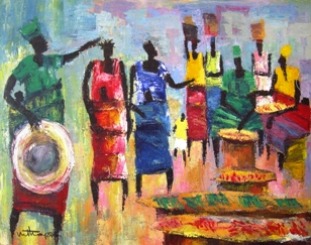
Amoako Boafo, Cornelius Annor, Otis Kwame Kye Quaicoe, and Rufai Zakari are among the most visible Ghanaian painters in the current international market. Amoako Boafo’s solo exhibitions at Mariane Ibrahim Gallery in Chicago and Paris, and Gagosian Gallery collaborations, have pushed his auction prices over $1 million per piece since 2020. This generation’s work often draws on traditional motifs (kente colour codes, adinkra symbolic structure) but reframes them within contemporary figurative painting.
Where to See and Buy Ghanaian Art
For travellers to Ghana, the main destinations for art viewing and purchase:
- Kumasi Cultural Centre: The traditional Ashanti arts complex with a museum, working craft shops, and a central craft market. Good for kente, adinkra, Ashanti stools, and akuaba dolls.
- Bonwire kente village: 30 km from Kumasi, the traditional kente weaving centre. Weavers at work, cloth sales, and commissions.
- Ntonso adinkra workshops: 15 km from Kumasi, the adinkra stamp-carving and printing centre. Hands-on stamping experience available.
- Teshie fantasy coffin workshops: Eastern Accra, the fantasy coffin production centre. Workshops tours and scale-model sales.
- Manhyia Palace Museum: Kumasi, the Asantehene’s state museum with royal regalia, gold weights, and historical photographs.
- Arts Centre Accra: Central Accra tourist market with woodcarvings, kente, adinkra, and generic African art at variable quality.
- Gallery 1957: Kempinski Hotel Accra, contemporary Ghanaian and pan-African fine art.
- Nubuke Foundation: East Legon, Accra, contemporary art space with rotating exhibitions.
- Chale Wote Festival: Jamestown, Accra, annual August street art and cultural festival.
Pricing varies widely by venue. The Arts Centre in Accra targets tourists and inflates prices; experienced buyers typically negotiate down 40-60% from opening asking prices. The craftsman workshops in Kumasi, Bonwire, Ntonso, and Teshie sell at fixed rates much closer to actual production costs. Gallery 1957 and Nubuke Foundation operate at Western gallery prices for contemporary work (typically $500-50,000 per piece).
Frequently Asked Questions
What are the main forms of traditional Ghanaian art?
Gold casting and Akan royal regalia, kente cloth weaving, adinkra symbolic printing, Ashanti woodcarving (including akuaba fertility dolls and ancestral stools), and the fantasy coffin tradition of the Ga-Adangbe people. Contemporary Ghanaian painting has also gained international recognition since the 2010s.
What is kente cloth?
Kente is a handwoven Ghanaian textile produced on narrow treadle looms in strips that are then sewn together. Each pattern carries a name and an associated proverb or meaning. Royal-grade silk kente costs $3,000-10,000 per cloth, while cotton kente runs $200-800. The weaving tradition centres on Bonwire near Kumasi (Ashanti) and separately among the Ewe people of southeastern Ghana.
What are adinkra symbols?
Adinkra are a set of around 80 traditional Akan symbols, each representing a proverb or value. They are stamped onto cotton cloth using calabash-carved stamps dipped in badie-tree bark dye. Common symbols include Gye Nyame (supreme deity), Sankofa (learn from the past), and Adinkrahene (king of adinkra symbols). Ntonso near Kumasi is the main production centre.
What is an akuaba doll?
Akuaba is a carved wooden fertility figure of the Ashanti tradition. Women hoping to conceive carry the doll tied to their back. The design features a flat disc-shaped head, short neck, and simplified body, representing the Akan ideal of beauty. Historical examples sell for $10,000-100,000 at major auction; modern commercial versions cost $30-200 in Kumasi craft markets.
What is a fantasy coffin?
A fantasy coffin (abebuu adekai) is a custom-built coffin shaped like a meaningful object from the deceased’s life. The tradition developed among the Ga-Adangbe of Accra in the 1940s under Seth Kane Kwei. Coffins cost $600-3,000 to build and take 2-6 weeks. The main workshops are in Teshie, a suburb of Accra, and several produce scale-model display versions for tourists and international collectors.
Where can I buy authentic Ghanaian art?
Kumasi Cultural Centre, Bonwire kente village, Ntonso adinkra workshops, and Teshie fantasy coffin makers all sell directly from producers. For contemporary fine art, Gallery 1957 in Accra and Nubuke Foundation handle the main representation. Avoid the Arts Centre Accra for anything beyond basic souvenirs; prices there are inflated and quality varies widely.
Sources and Further Reading
- Adinkra symbols overview – en.wikipedia.org/wiki/Adinkra_symbols
- Kente cloth history – en.wikipedia.org/wiki/Kente_cloth
- Akan goldweights – en.wikipedia.org/wiki/Akan_goldweights
- Fantasy coffins of Ghana – en.wikipedia.org/wiki/Fantasy_coffin
- Gallery 1957 Accra contemporary art – gallery1957.com