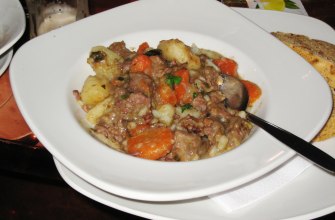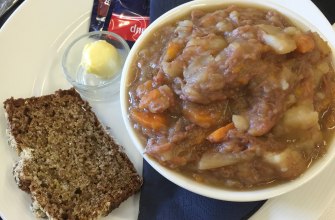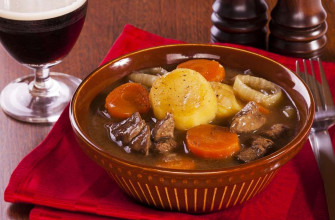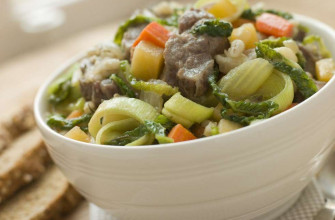
A meat-free Irish stew is closer to the original than most people think. For centuries a cottage pot held meat only on a good week, and the everyday stew was potatoes, onions, whatever roots grew in the ridge and a little fat for richness. A vegetarian version brings that reality back to the table, and done well it stands as a full dinner in its own right rather than a side dish for people who do not eat meat. The trick is replacing the savoury depth the meat used to give, and Irish cooking has more tools for that than a bowl of plain vegetables suggests.
How to build depth without meat
The complaint about vegetable stew is that it tastes thin. The fix is to chase umami, the savoury note meat provides, from several plant sources at once. Vegetarian cooks consistently point to the same two boosters above all others: mushrooms browned hard until deeply coloured, and a spoon of miso, soy or yeast extract, the pair that does the most to replace the missing meat.
- Brown the mushrooms hard. Mushrooms are the meatiest vegetable. Cook them in a hot pan until they are deeply coloured and their water has gone, and they bring a chew and a savoury punch no raw mushroom can.
- Add lentils for body. Brown or green lentils hold their shape, add protein and make the stew filling enough to stand as a main.
- Use pearl barley. Barley needs no pre-cooking and releases starch as it simmers, thickening the broth and giving the chewy texture that makes a stew feel substantial.
- Reach for a savoury booster. A spoon of miso, yeast extract, soy sauce or a vegan Worcestershire sauce deepens the broth and replaces the meatiness most directly.
Layer two or three of these rather than leaning on one, and the stew stops tasting like a side dish.
The Irish vegetables that carry it
The base is the same root cellar that fed Irish kitchens through winter. Floury potatoes do double duty, some sliced thin to dissolve and thicken the broth, the rest in chunks to hold their shape. Around them go carrots, parsnips, turnip or swede, leeks and celeriac, each adding sweetness and body. A native touch worth trying is Irish seaweed: a small piece of dulse or carrageen, harvested off the Atlantic coast for generations, dissolves into the pot and lends a clean, mineral, faintly briny note that stands in for the savour of the sea.
Is Irish stout vegan?
It is now. For almost two hundred years Guinness was clarified with isinglass, a fining agent made from fish bladders, which meant the stout was not suitable for vegetarians or vegans. The brewery changed its filtration and Guinness has been officially vegan since 2018. The older process had paired the isinglass with Irish Moss, the carrageen seaweed, which was always plant-based. So a splash of stout is back on the table for a vegan stew, adding the same roasted, chocolate and caramel depth it gives the beef version, with the alcohol cooking off in the pot.
Choosing your protein: lentils, beans or barley
The bulk of a vegetarian stew comes from a starch or a pulse, and each one changes the character of the pot. Brown and green lentils are the most stew-friendly, holding their shape over a long simmer and turning soft without dissolving into mush. Red lentils do the opposite, breaking down completely, which is useful when you want them to thicken and disappear into the broth rather than stand out. Pearl barley brings a chew closer to grains of rice and a starch that gives the stew its silky body, and it is the most traditionally Irish of the three. Butter beans or cannellini add a creamy, larger bite for anyone who finds lentils too small. Many cooks use two together, barley for texture and lentils for protein, which gives a stew that satisfies the same way a meat one does. Whichever you pick, rinse it well and let it cook fully, since an underdone pulse leaves a chalky note that no amount of seasoning hides.
A vegetarian Irish stew recipe
This serves six and works as a full main course. It is vegan if you use stout, oil and a plant-based savoury booster, and vegetarian if you finish with a knob of butter.
Ingredients
- 400 g mushrooms, halved or quartered
- 150 g brown or green lentils, rinsed
- 100 g pearl barley
- 4 floury potatoes, half sliced thin and half in chunks
- 3 carrots and 2 parsnips, in thick rounds
- 1 small turnip or swede, in chunks
- 2 onions and 2 leeks, sliced
- 1 can of stout, about 440 ml, optional
- 1.2 litres vegetable stock
- 2 tablespoons tomato puree and 1 tablespoon miso or yeast extract
- 2 bay leaves, thyme, oil or butter, chopped parsley
Method
- Brown the mushrooms hard in oil until coloured and dry, then set aside.
- Soften the onions, leeks, carrots and parsnips in the same pot for a few minutes.
- Stir in the tomato puree, then pour in the stout if using and let it reduce by half.
- Add the stock, lentils, barley, turnip, the thin potatoes, bay and thyme. Stir in the miso.
- Simmer covered for about forty five minutes, until the lentils and barley are tender and the broth has thickened.
- Add the chunky potatoes and the browned mushrooms for the last twenty five minutes.
- Season, finish with parsley and a knob of butter if not vegan, and serve with brown bread.
Like the meat stews, it deepens overnight and reheats beautifully, so it is worth making a big pot.
What to serve with it
A vegetable stew this hearty needs little beside it, but a few partners lift the plate. Brown soda bread or a floury boiled potato soaks up the broth, with butter or a vegan spread. A sharp green salad or some quick-pickled red onion cuts through the richness and brightens each spoonful. For a bigger table, a wedge of Irish cheddar on the side suits the vegetarian version, and a glass of the same stout you cooked with ties the meal together. Stirred-in greens such as kale or savoy cabbage at the end turn it into a one-bowl dinner that needs nothing else at all.
The history hiding in a meatless pot
The vegetable stew is not a modern compromise dreamed up for vegetarians. Meat was a luxury in most Irish cottages, eaten on Sundays and feast days rather than daily, and the everyday pot was built from the garden and the potato ridge. During the worst years of the nineteenth century, when even a scrap of mutton was beyond reach, a stew of potatoes and roots was simply dinner. A modern vegetarian Irish stew is a direct descendant of that table, which is why it sits so naturally inside the tradition rather than outside it. The modern proof that meat-free Irish cooking is no fad is Cornucopia, the wholefood restaurant on Dublin’s Wicklow Street that has served vegetarian and vegan dinners since 1986, long enough to count as an institution. Diners come back for it decade after decade, the sort of staying power that says a vegetable-forward Irish kitchen was never a compromise but a cuisine in its own right.
Tips for a richer vegetable stew
- Do not skip the browning. Colour on the mushrooms and a good reduction of the stout are where the depth comes from.
- Salt in stages. Miso, soy and yeast extract all carry salt, so season at the end once their flavour is in.
- Let it sit. Barley and lentils keep drinking liquid as the stew rests, so make it ahead and loosen with a little stock when you reheat.
- Add greens late. A handful of kale or cabbage stirred in at the end keeps colour and bite.
Common questions
How do you make vegetarian stew taste meaty?
Brown mushrooms hard for a savoury chew, add lentils and pearl barley for body, and stir in miso, soy or yeast extract for umami. A reduced splash of stout deepens it further.
What can I use instead of meat in Irish stew?
Mushrooms, lentils and pearl barley together replace both the texture and the protein. Plenty of root vegetables and a savoury booster handle the flavour the meat used to carry.
Is Guinness suitable for vegetarians?
Yes, since 2018. Guinness removed the fish-derived isinglass from its filtration, so the stout is now vegan and fine to cook into a meat-free stew.
Can you freeze vegetarian Irish stew?
Yes, it freezes well for up to three months and is a good batch dish. The barley and lentils thicken it further in the freezer, so loosen it with a little stock or water when you reheat, and warm it gently so the vegetables do not collapse.
Is vegetarian Irish stew authentic?
More than people assume. Meat was a rare luxury in old Irish cottages, eaten on Sundays and feast days rather than every night, so a stew of potatoes and roots was the everyday reality for most households. The meat-free pot sits squarely within the tradition rather than at its edge.
Related recipes
For the full background and every variation, see the Irish stew guide. For the meat versions, read traditional Irish stew and Irish beef stew.
Sources
- Bord Bia, the Irish Food Board
- Teagasc, potato and vegetable varieties
- Guinness Storehouse, on the move to vegan-friendly stout
- Dúchas, the National Folklore Collection of Ireland
- Fáilte Ireland, National Tourism Development Authority
- The Irish Times, food and drink
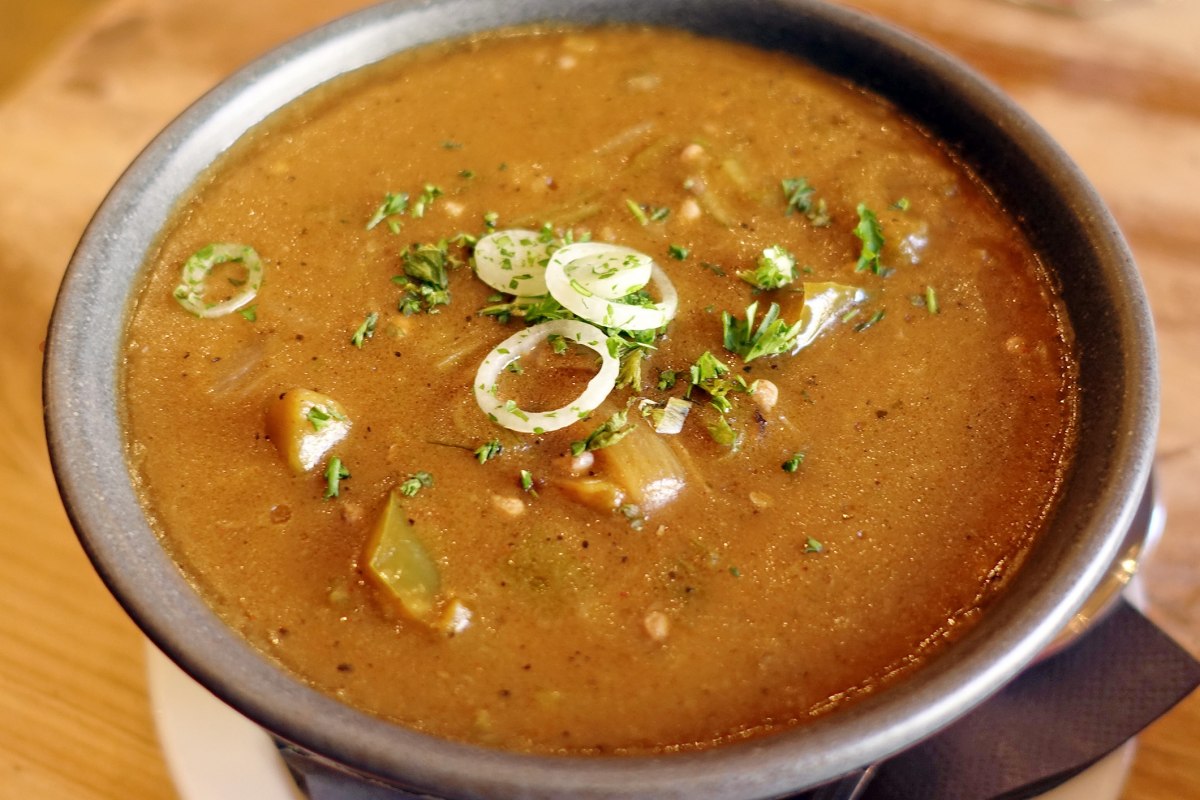
- Tiia Monto, vegetable stew photograph, Wikimedia Commons, licensed CC BY-SA 3.0