Around thirty thousand people belonged to the documented Mexican-American street gangs of southern California by the late 1990s, according to the gang threat assessments compiled by the Federal Bureau of Investigation. Body marking practices that those communities developed across the twentieth century have since become a serious subject in American prison ethnography and Chicano cultural history.
The phrase Mexican gang tattoos picks up search traffic from journalism, academic researchers, and family members trying to make sense of what they have seen. This article handles the subject as sociology rather than as design inspiration, and sets out what the academic and law enforcement record says about the origins of these tattoos and the symbolic vocabulary they use.
Origins in Pachuco Culture and Chicano Identity
The visual tradition associated with Mexican-American body marking goes back to the pachuco subculture of the 1930s and 1940s in El Paso, Los Angeles, and other south-western American cities. Pachucos, second-generation Mexican-American young people who developed a distinctive zoot-suit dress, calo slang, and identity politics, used small hand-poked tattoos as identity markers within their peer groups.
The most documented of these is the small cross or pachuco cross between the thumb and forefinger, a mark that has been documented in academic ethnography by researchers including Mauricio Mazon and Catherine Sue Ramirez on the pachuco riots of 1943. The cross migrated from pachuco use into the broader Chicano identity vocabulary across the second half of the century and now appears in contexts that range from family commemorations through to documented gang membership. The historical roots inside a youth subculture rather than inside criminal organisation are central to understanding why the same imagery carries different meanings in different settings.
The California Prison System and Symbolic Vocabulary
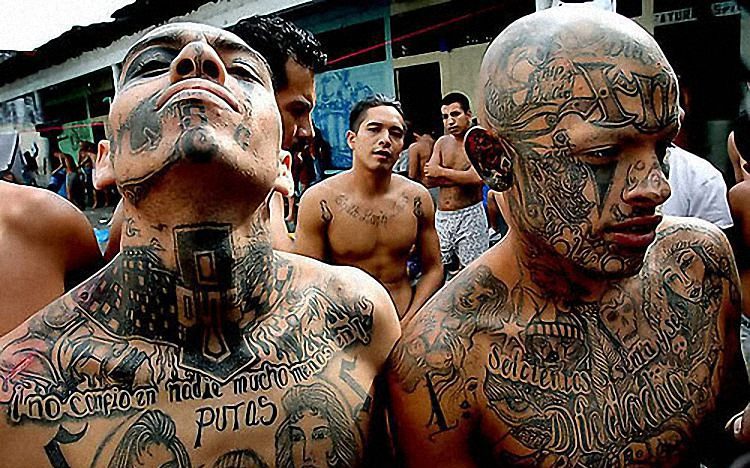
The institutional context that shaped most of the recognised Mexican-American gang tattoo vocabulary is the California state prison system from the 1950s onward. The founding of La Eme, the prison gang known in English as the Mexican Mafia, whose prison tattoo practices developed their own distinct vocabulary, in the Deuel Vocational Institution in 1957, and the later rise of the Nuestra Familia, Sureños, and Norteños associations, gave rise to a set of identity markers used inside the closed community of the prison. Sociologist John Irwin’s work on the California prison system in the 1970s documented how these identity markers operated as a parallel form of communication and ranking within the institution.
Tattoo work inside prison runs through specific tools and practices and produces a distinctive line quality. The numbers 13 and 14 became loaded markers tied to Sureños and Norteños affiliations through their position in the alphabet, with 13 representing the M as the thirteenth letter and the founding initial of La Eme. Three dots arranged in a triangle, called mi vida loca in Chicano slang, became another widely used marker that has since travelled into use far outside its original context.
Religious Imagery in a Catholic Context
Mexican-American culture is shaped by Catholic religious tradition with deep roots in colonial Mexico, and that religious tradition runs through the body marking practices of communities at the margins of legal society as much as through any other part of Chicano culture. The image of the Virgin of Guadalupe, the syncretic Marian apparition that has been central to Mexican Catholic identity since the sixteenth century, appears in tattoo work across Mexican-American communities, including among individuals who have spent time inside the prison system. The image of clasped hands in prayer, the rosary, the crucifix, and the Sacred Heart of Jesus appear in similar contexts.
Academic researchers on Latino prison populations have noted that the religious imagery carries multiple readings, including as a request for forgiveness, as a marker of cultural identity, and as a memorial to family members lost to violence or to prison time. The same religious imagery appears in Mexican Catholic body marking traditions that have nothing to do with the prison system or organised crime. Anyone reading the imagery in isolation will misread it.
Calo Slang and Old English Lettering
Tattoo work in Mexican-American communities often includes phrases written in Spanish, English, or the hybrid calo slang that grew out of the pachuco era. The phrases tend to use a stylised Old English blackletter font that became associated with Chicano lowrider culture in the 1960s and 1970s and that has since spread into wider American tattoo flash. Common phrases documented in academic and law enforcement sources include mi vida loca and short references to family members or to home neighbourhoods.
Place name tattoos, with the abbreviation of a city or a barrio neighbourhood, function as identity markers that locate the wearer within a specific community of origin. The use of three-letter or two-letter abbreviations of organisation names is documented in law enforcement gang identification guides, although researchers warn that the same letters can stand for many things and that attribution requires the rest of the body context and the wearer’s biography rather than the letters alone. The imagery does not work as a stand-alone code that can be decrypted from a photograph.
Symbols that appear most frequently in academic and law enforcement documentation:
- Pachuco cross – small cross between thumb and forefinger, rooted in 1930s-1940s pachuco subculture
- Three dots (mi vida loca) – triangular arrangement meaning “my crazy life,” used across multiple contexts
- Numbers 13 / 14 – positional alphabet codes linked to Surenos (M=13) and Nortenos (N=14) affiliations
- Virgin of Guadalupe – syncretic Marian image central to Mexican Catholic identity, not exclusive to gang use
- Old English lettering – blackletter font associated with Chicano lowrider culture, used for names and barrio references
- Praying hands / rosary / Sacred Heart – Catholic devotional imagery that carries different readings depending on community context
What the Imagery Cannot Tell You
The most consistent finding across the academic literature on prison and gang tattoo practice is that the meaning of any single tattoo depends almost entirely on the community of readers around it and not on the design itself. A pachuco cross on a hand can mean a 1940s zoot-suit identity, a 1970s Chicano cultural commitment, a memorial for a family member, or a documented gang affiliation, depending on who is wearing it and where they have been.
Law enforcement gang identification guides published by the FBI and by state corrections departments include sections on Latino prison gang tattoos and emphasize that documented affiliation requires multiple corroborating elements rather than a single visual marker. Researchers working in Chicano studies, including the work of Catherine Sue Ramirez on pachuca women, have argued that the popular reduction of Mexican-American tattoo culture to a gang catalogue erases the much wider and longer cultural use of the same imagery. The serious researcher needs the historical, biographical, and community context before any reading is reliable.
The movement of Mexican-American tattoo imagery into mainstream culture has added another layer of complexity. Chicano-style tattooing – black and grey realism, religious iconography, script lettering – has become a recognized category in international tattoo conventions and reality television shows.
Artists like Mister Cartoon (Mark Machado) from Los Angeles built careers translating barrio visual language into commercial art for musicians, athletes, and fashion brands. This crossover raises questions about cultural appropriation that mirror debates in other minority art traditions: when imagery developed under conditions of poverty, incarceration, and racial exclusion gets picked up by outsiders who carry none of that history, the original meaning shifts. The academic literature on Chicano art, including work by Marcos Sanchez-Tranquilino and Holly Barnet-Sanchez, addresses this tension directly.
Editorial Note on Treatment
This article does not provide design templates, motif catalogues, or stylistic instructions of any kind. The Latino, Chicano, and Mexican-American religious and cultural imagery discussed above carries meaning within its original communities and is not a stylistic template for outsiders.
Anyone considering a Latin American or Catholic religious tattoo for personal heritage reasons should work with a tattoo artist who understands the imagery and its context rather than picking designs from a search results page. The aim of this article is to give a researcher, journalist, family member, or curious reader a clean entry point into the academic literature on a topic that has been treated badly by sensationalist sources for decades.
Frequently Asked Questions
What is the pachuco cross?
The pachuco cross is a small mark, usually three short lines forming a cross with rays, placed between the thumb and forefinger. It originated in the pachuco subculture of the 1930s and 1940s among second-generation Mexican-American youth in the south-western United States. It later moved into wider Chicano identity use and into specific gang contexts.
What do the numbers 13 and 14 mean?
Within the documented Mexican-American prison gang context, the number 13 is associated with Sureños affiliations linked to the Mexican Mafia, since M is the thirteenth letter of the alphabet. The number 14 is associated with Norteños affiliations linked to the Nuestra Familia, since N is the fourteenth letter. Outside that specific context the same numbers carry no fixed meaning.
Are religious tattoos part of gang membership?
Religious imagery, including the Virgin of Guadalupe, clasped hands in prayer, and the Sacred Heart, appears in many Mexican-American body marking contexts, including among individuals with no connection to the prison system or to organised crime. The same imagery has been documented inside prison populations as well. The reading depends on the community context rather than on the design itself.
Can a Mexican gang tattoo be identified from a photo?
Reliable identification of gang affiliation from tattoo imagery requires multiple corroborating elements and the wearer’s biography, according to FBI and state corrections gang identification material. A single tattoo in isolation rarely supports a confident reading.
Sources and Further Reading
- Mauricio Mazon, The Zoot-Suit Riots: The Psychology of Symbolic Annihilation, University of Texas Press, 1984
- Catherine Sue Ramirez, The Woman in the Zoot Suit: Gender, Nationalism, and the Cultural Politics of Memory, Duke University Press, 2009
- John Irwin, Prisons in Turmoil, Little, Brown, 1980, with later editions on the California prison system
- FBI National Gang Intelligence Center, National Gang Threat Assessment, public reports series, fbi.gov
- California Department of Corrections and Rehabilitation, Security Threat Group identification material, cdcr.ca.gov