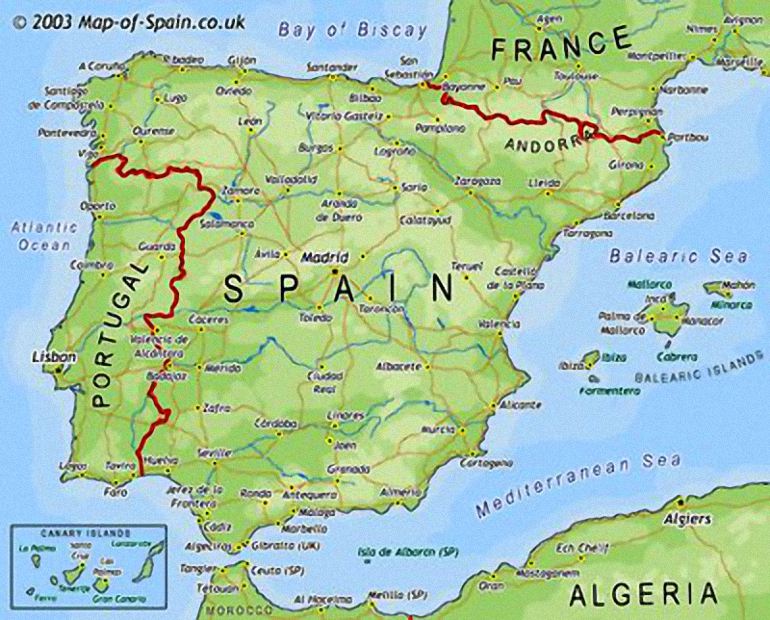
Spain’s history stretches back roughly 40,000 years through Paleolithic cave art at Altamira, Roman provinces known collectively as Hispania, eight centuries of Muslim al-Andalus rule, the 1492 unification under the Catholic Monarchs, a global empire that spanned four continents for three centuries, a civil war that killed 350,000 people in the 1930s, and forty years of dictatorship under Francisco Franco that ended with the transition to democracy in 1975. The modern parliamentary monarchy dates from the 1978 constitution.
This timeline walks through the major events in Spanish history: the prehistoric and Celtiberian foundations, the Roman province of Hispania, the Visigothic kingdoms, the Muslim conquest and the al-Andalus emirate and caliphate, the Christian Reconquista, the dynastic unification under Ferdinand and Isabella, the Habsburg and Bourbon empires, the Napoleonic occupation, the loss of the American colonies, the Second Republic and Civil War, the Franco dictatorship, and the democratic transition and monarchy today.
Prehistoric Iberia (40000 BCE-1000 BCE)
The Altamira cave paintings in Cantabria, dated to around 36,000 BCE, rank among the oldest figurative art in Europe and were the first Paleolithic rock art recognised by archaeologists, in 1880. Similar painted caves run through the Cantabrian coast and the Mediterranean rim, and UNESCO now protects 17 cave sites as the Cave of Altamira and Paleolithic Cave Art of Northern Spain World Heritage listing.
Neolithic farming cultures spread across the Iberian peninsula from around 5500 BCE, followed by the Bronze Age Los Millares and El Argar civilisations of southeastern Spain. Celtic tribes entered the peninsula from central Europe from around 1000 BCE, mixing with the indigenous Iberian population to produce the Celtiberian cultures of the central peninsula. The Phoenicians founded Cadiz as a trading colony around 1100 BCE, making it the oldest continuously inhabited city in western Europe.
Roman Hispania (218 BCE-476 CE)
The Second Punic War brought Roman armies to the Iberian peninsula in 218 BCE, and Roman campaigns against Carthaginian and Celtiberian opposition continued until the final pacification of the Cantabrian Wars in 19 BCE. Rome organised the peninsula as Hispania, divided into provinces that changed boundaries several times across the imperial period.
Roman Hispania produced three Roman emperors (Trajan, Hadrian, and Theodosius I), the philosophers Seneca and Lucan, the agricultural writer Columella, and the poet Martial. The Roman legacy includes the Segovia aqueduct, the Tarragona amphitheatre, the Merida theatre, the Las Medulas gold mines, and the Via de la Plata that still traces the Roman road from Merida to Astorga (covered alongside other major sites in our guide to famous Spanish monuments). Christianity reached Hispania by the second century CE and became the dominant religion after the 313 Edict of Milan legalised the faith across the empire. The Romans also introduced Vulgar Latin, which evolved into Castilian, Catalan, Galician, and Portuguese.
Visigothic Kingdom (415-711)
Germanic tribes (Vandals, Suebi, Alans) crossed into the peninsula in 409 as the Western Roman Empire collapsed. The Visigoths followed in 415 and established a kingdom centred on Toledo that unified most of Spain and southern France by the late sixth century. King Reccared’s conversion from Arian Christianity to Catholicism at the Third Council of Toledo in 589 aligned the Visigothic monarchy with the Roman Church and shaped Spanish religious identity for the next thousand years.
The Visigothic Code of Law (Liber Iudiciorum, 654) was the first legal system in medieval Europe to apply equally to the Hispano-Roman and Germanic populations. The kingdom fell in 711 when a disputed royal succession produced a civil war, one faction of which invited Muslim support from North Africa.
Muslim Al-Andalus (711-1492)
Tariq ibn Ziyad led a Berber army across the Strait of Gibraltar in 711 and defeated the last Visigothic king, Roderic, at the Battle of Guadalete. Muslim forces conquered nearly the entire peninsula within seven years. Al-Andalus was governed first as a province of the Umayyad Caliphate of Damascus, then as the independent Emirate of Cordoba (756-929), the Caliphate of Cordoba (929-1031), and finally the fragmented Taifa kingdoms.
Cordoba became one of the largest cities in medieval Europe, with an estimated population approaching 500,000 at its peak in the tenth century. The Great Mosque of Cordoba (now the Mezquita-Cathedral), begun in 785, survives as the most visible monument of the al-Andalus era. Arab and Berber scholars in Cordoba, Toledo, and Seville preserved and translated Greek philosophical and scientific texts that reached western Europe through the Latin translation movement of twelfth-century Toledo. The jewish population of al-Andalus flourished during the Golden Age of Jewish culture in Spain, producing the philosopher Maimonides (born in Cordoba in 1138) and the poet Yehuda Halevi among many other figures.
Reconquista and Christian Kingdoms (718-1492)
Christian resistance began in the Asturian mountains with the semi-legendary victory of Pelayo at Covadonga around 722. The Kingdom of Asturias grew through the eighth and ninth centuries and gave rise to the Kingdom of Leon in 910. The County of Castile became an independent kingdom in 1065 and gradually expanded southward. The Crown of Aragon developed separately in the northeast, merging with the County of Barcelona in 1137 to form a Mediterranean trading empire that would reach Sicily, Sardinia, Naples, and Athens at its height.
The walled medieval town of Avila, with its eleventh-century fortifications still intact, dates from this Reconquista period. Major Reconquista milestones include the fall of Toledo in 1085 (which gave Christian Spain the ancient Visigothic capital and access to al-Andalus libraries), the decisive Battle of Las Navas de Tolosa in 1212 (which broke Almohad military power), the fall of Cordoba in 1236, and the fall of Seville in 1248 (which brought most of present-day Andalusia under Christian rule). Only the Emirate of Granada remained Muslim after 1248, surviving for another 244 years until its final fall in January 1492. The southern Andalusian town of Ronda joined the Christian kingdoms in 1485, seven years before Granada itself.
Unification and the Year 1492
The marriage of Isabella of Castile and Ferdinand of Aragon in 1469 united the two major Christian kingdoms in a personal union, the foundation of modern Spain. The year 1492 brought three events that reshaped Spanish and world history: the fall of Granada and the completion of the Reconquista on 2 January; the Alhambra Decree expelling the Jewish population on 31 March; and Christopher Columbus’s landing in the Caribbean on 12 October, which opened the Spanish American empire.
The expulsion of the Jews was followed in 1502 by a similar decree against Muslims and later Moriscos, producing a forced homogenisation of the Spanish religious landscape that the Spanish Inquisition (founded in 1478) enforced for three centuries. The discovery of silver deposits at Potosi in modern Bolivia from 1545 and at Zacatecas in Mexico made Spain the richest European power of the sixteenth century.
Habsburg Empire (1516-1700)
The Habsburg dynasty inherited the Spanish crown through Charles I (Emperor Charles V) in 1516. Charles united the Spanish kingdoms with the Holy Roman Empire, the Low Countries, parts of Italy, and the expanding American empire under a single ruler. His son Philip II made Madrid the permanent capital in 1561 and built the Escorial monastery-palace northwest of the city from 1563 to 1584. The defeat of the Spanish Armada in 1588 against England did not end Spanish naval dominance but marked the peak of Habsburg Spanish power.
The seventeenth-century Spanish Golden Age produced the literature of Cervantes (Don Quixote, 1605-1615), the paintings of Velazquez and Murillo, and the theatre of Lope de Vega and Calderon de la Barca. The same century also brought repeated wars, economic collapse under the pressure of colonial silver inflation, the Revolt of the Netherlands (1568-1648) that ended Dutch independence, and the collapse of Habsburg rule at the death of the heirless Charles II in 1700.
Bourbon Dynasty and Napoleonic Wars (1700-1814)
The War of the Spanish Succession (1701-1714) ended with the Bourbon Philip V on the Spanish throne, beginning the dynasty that continues to this day (with interruptions). The eighteenth century saw enlightened reforms under Charles III (1759-1788), the construction of the current Royal Palace in Madrid, the building of Spanish naval and colonial infrastructure, and the gradual loss of European possessions. The French Revolution’s ideas penetrated Spanish intellectual life despite official censorship.
Napoleon invaded Spain in 1808 and installed his brother Joseph Bonaparte as king. The Spanish population rose in revolt, producing the Peninsular War (1808-1814) that Wellington’s British-Portuguese army combined with Spanish guerrilla forces to fight. The war killed an estimated 215,000 to 375,000 Spaniards and left the country economically devastated. Goya’s series The Disasters of War documented the conflict’s brutality in prints that are still widely reproduced. The 1812 Constitution of Cadiz was the first democratic constitution in Spanish history, though it was suspended on the Bourbon restoration in 1814.
Loss of the American Empire (1808-1898)
The Napoleonic occupation broke the political link between Spain and its American colonies. Independence movements in Venezuela, Argentina, Mexico, Peru, and Chile succeeded between 1810 and 1825, reducing the Spanish American empire to Cuba and Puerto Rico in the Caribbean and the Philippines in the Pacific. The Spanish-American War of 1898 ended Spain’s remaining overseas possessions when American forces defeated the Spanish fleets at Manila Bay and Santiago de Cuba. The loss of Cuba and the Philippines became known in Spanish historiography as the Disaster of 1898, and the so-called Generation of 98 produced writers (Unamuno, Azorin, Baroja, Machado) who turned national introspection into a major literary project.
Second Republic and Civil War (1931-1939)
The abdication of King Alfonso XIII in April 1931 brought the Second Spanish Republic, a liberal democracy that attempted agrarian reform, separation of church and state, and regional autonomy for Catalonia and the Basque Country. Polarisation between left-wing republicans, conservatives, monarchists, and the growing fascist Falange Party produced political violence through the mid-1930s.
The military uprising of 17-18 July 1936 triggered the Spanish Civil War. Nationalist forces under General Francisco Franco, supported by Nazi Germany and Fascist Italy, fought Republican forces supported by the Soviet Union and the International Brigades (volunteers from forty countries, including George Orwell whose memoir Homage to Catalonia documents his service). Germany’s Condor Legion bombed Guernica on 26 April 1937, the event that produced Picasso’s painting of the same name. The war ended with Nationalist victory on 1 April 1939 and the beginning of Franco’s dictatorship. Estimates of the war dead range from 350,000 to 550,000 across combat, executions, and disease.
Franco Dictatorship and Democratic Transition (1939-1982)
Francisco Franco ruled Spain as head of state from 1939 until his death on 20 November 1975, establishing a nationalist Catholic authoritarian regime that executed political opponents, suppressed Catalan and Basque language and identity, and isolated Spain economically until the 1960s. Spain joined the United Nations in 1955 after a cold-war rapprochement with the United States, and the tourism boom of the 1960s began the country’s modernisation.
Franco’s death in 1975 opened the Transition to democracy under King Juan Carlos I. The 1977 Pactos de la Moncloa brought the major political parties into consensus on economic reform, and the 1978 Constitution established Spain as a parliamentary monarchy with seventeen autonomous communities. An attempted military coup by Colonel Tejero on 23 February 1981 briefly seized the Congress of Deputies but was defeated by King Juan Carlos’s televised intervention. Spain joined the European Economic Community (now European Union) in 1986 and NATO in 1982.
Modern Spain (1986-Present)
Spain’s post-1986 trajectory has included European integration, the 1992 Barcelona Olympics and Seville Expo, the adoption of the euro in 1999-2002, major infrastructure modernisation, the 2004 Madrid train bombings (Europe’s worst Islamist attack), the 2008 financial crisis that ended the housing bubble, the Catalan independence referendum of 2017, the abdication of King Juan Carlos in 2014 in favour of his son Felipe VI, and continued political fragmentation with the rise of new parties since 2014. The country today has a population of around 48 million and is the fourth-largest economy in the euro area.
Frequently Asked Questions
When did Spain become a unified country?
Spain was unified as a personal union through the 1469 marriage of Isabella of Castile and Ferdinand of Aragon. Full political unification followed in 1492 with the fall of Granada. The modern centralised state developed under the Habsburg and Bourbon dynasties, and the current constitutional monarchy was established by the 1978 Constitution.
How long was Spain under Muslim rule?
Muslim rule over parts of the Iberian peninsula lasted from 711 to 1492, a total of 781 years. The territory under Muslim control shrank steadily through the Reconquista, with Cordoba falling in 1236, Seville in 1248, and the final Muslim kingdom of Granada falling on 2 January 1492.
What was the Spanish Golden Age?
The Spanish Golden Age (Siglo de Oro) is the cultural flourishing of the sixteenth and seventeenth centuries, when Spanish literature, painting, and theatre produced figures including Miguel de Cervantes, Lope de Vega, Calderon de la Barca, Diego Velazquez, El Greco, and Murillo. The period coincides with the height of the Spanish Habsburg empire before the economic decline of the later seventeenth century.
When did Franco rule Spain?
Francisco Franco ruled Spain from 1939 to 20 November 1975, a period of 36 years following his Nationalist victory in the Spanish Civil War. He served as head of state with the title Caudillo and restored the monarchy as a successor form of government, naming Juan Carlos I as his successor in 1969.
When did Spain become a democracy?
Spain became a constitutional parliamentary monarchy with the 1978 Constitution, which was approved by referendum on 6 December 1978. Democratic elections had resumed in 1977 during the transition period following Franco’s death in 1975. The current democratic system has functioned continuously since 1978, through peaceful changes of government between the major political parties. Our broader guide on traditions in Spain covers the cultural continuity that runs through these political changes.
Sources and Further Reading
- History of Spain overview – en.wikipedia.org/wiki/History_of_Spain
- Spanish National Library historical archives – bne.es
- Archivo Historico Nacional – cultura.gob.es/archivos-estatales
- Museo del Prado Spanish history resources – museodelprado.es
- UNESCO World Heritage sites in Spain – whc.unesco.org/en/statesparties/es