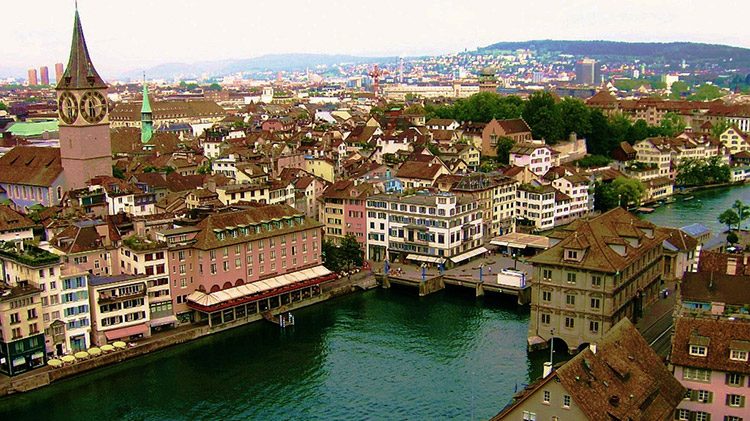
Every spring Zurich straps a snowman full of fireworks to a tall pyre and times how fast its head explodes, then reads the result as a weather forecast for the summer. That is the kind of city Zurich turns out to be once you look past the banks and the luxury shopping: a place where people swim home through the river after work, refill their bottles at street fountains fed by spring water, and run a centuries-old festival on a burning effigy. This guide covers the sights everyone comes for, the Old Town, the lake and the museums, alongside the local habits that make a visit worth more than a stopover.
Getting Your Bearings: the Limmat, the Lake and the Districts
Zurich sits at the northern tip of Lake Zurich, where the lake drains into the River Limmat, in the German-speaking part of Switzerland. The city proper holds only about 440,000 people, small enough to cross on foot, with the Alps an hour or two south by train. The Limmat splits the compact Old Town in two, and the city numbers its neighbourhoods as districts, the Kreise.
- Niederdorf (east bank): the medieval tangle of lanes, churches and bars.
- Bahnhofstrasse and the Lindenhof (west bank): shopping, banks and the old Roman hill.
- Kreis 1: the Old Town, where most of the sights sit.
- Kreis 5 (Zuri-West): the former industrial quarter, now the nightlife and design district.
The Old Town: Churches, Lanes and the Birth of Dada
The medieval core spreads over both banks of the Limmat, compact enough to cross on foot in an afternoon. The east bank, Niederdorf, keeps the oldest lanes, the taverns and the room where Dada began, while the west bank climbs from the river to the Lindenhof terrace and the main churches.
The landmarks below sit within a few hundred metres of each other, tied together by the low bridges over the Limmat, so the whole quarter works as a single walk rather than a list of separate stops.
Grossmunster
The Romanesque minster with its twin towers is where Ulrich Zwingli launched the Swiss-German Reformation from 1519. Climb the Karlsturm tower for the standard postcard view across the rooftops to the lake.
Fraumunster and the Chagall Windows
Facing the Grossmunster from the west bank, the Fraumunster began in 853 as a convent for the daughters of Frankish nobility. Its draw today is the set of five stained-glass windows that Marc Chagall designed for the choir in 1970, best seen in morning light.
St. Peter and the Lindenhof
St. Peter, the oldest parish church in the city, carries the largest church clock face in Europe, 8.7 metres across. A few steps away the Lindenhof, a quiet tree-shaded terrace above the river, marks where the Romans ran a customs post called Turicum, the root of the city’s name.
By local legend the same terrace once saved the city. In 1292, with Zurich’s fighting men depleted after a defeat at Winterthur, Duke Albrecht of Habsburg moved to take the town. The women of Zurich are said to have lined the Lindenhof in armour, weapons raised, and the duke, mistaking them for a full garrison, called off the siege and withdrew.
Niederdorf and the Birth of Dada
The Niederdorf lanes reward slow wandering past guildhalls and fountains. On the Spiegelgasse, in 1916, Hugo Ball and Emmy Hennings opened the Cabaret Voltaire and launched Dada, the anti-art movement that scattered across Europe from this one small room. The building still works as a bar and museum. For the wider context, see our timeline of Switzerland.
Bahnhofstrasse and Paradeplatz
The west bank runs along Bahnhofstrasse, the 1.4-kilometre boulevard that links the main station to the lake and ranks among the most expensive shopping streets anywhere, lined with watches, jewellery and the flagship department stores.
Halfway down sits Paradeplatz, the small square that is the address of the two big Swiss banks and, by reputation, the gold vaults beneath them. Walking it costs nothing, and the tram stop there is the busiest interchange in the city.
Swimming the City: the Badis on River and Lake
The habit that surprises most visitors is how Zurich swims. From late spring the river and lake fill with locals after work and at lunch, using a network of public baths the city calls Badis, many of them free.
- Flussbad Oberer Letten: the one to try first. A 1950s concrete river bath with a 400-metre lane in the green Limmat, where you climb in upstream and let the current carry you down past sunbathers and bars. Free.
- Frauenbad Stadthausquai: a wooden Jugendstil bath on the Limmat from 1837, listed as national heritage, reserved for women by day. After eight in the evening it opens to everyone as the Barfussbar, a barefoot bar with DJs over the water.
- Seebad Enge and Utoquai: lake platforms to dive from, with the Alps on the horizon and a cafe on the deck.
The Oberer Letten carries a heavier past than its summer crowds suggest. This stretch of riverbank held Zurich’s open drug scene through the early 1990s, the successor to the infamous Platzspitz that the foreign press nicknamed Needle Park, until the city cleared it in 1995 and won the water back. Its turn from that low point into a free public swimming spot is a piece of recent history most visitors never hear, and it sits behind the easy summer scene on the banks.
The river even has its own festival. On a Saturday in mid-August the city stages the Limmatschwimmen, the one day of the year when swimming the Limmat is allowed, and thousands float the two-kilometre course through the centre, kit stowed in a buoyant orange bag towed behind them.
Drinking from the Fountains
Zurich runs more than 1,200 public fountains, the highest density of any city in the world, and almost all of them pour fresh drinking water around the clock, fed mostly by springs and the lake.
For a traveller this means you never need to buy bottled water. Carry an empty bottle and refill it at any of the carved stone fountains you pass, from the Old Town squares to the lakeside parks. Locals do exactly that.
Sechselauten and the Exploding Snowman
Zurich’s strangest tradition runs every third Monday in April. Around 3,500 members of the city’s historic guilds, the Zunfte, parade in costume on horseback and on foot along Bahnhofstrasse and the Limmatquai, with some thirty marching bands, to Sechseläutenplatz beside the opera house. The Zunfte are the city’s 26 surviving guilds, descendants of the craft corporations that governed Zurich from 1336 until 1798, and their guildhalls still line the Limmat, most now working as restaurants you can eat in.
At six in the evening they light a tall pyre topped by the Boogg, a cotton-wool snowman packed with fireworks that stands in for winter. The sequence is the whole point of the day:
- The guilds ride in and the bonfire is lit at 6pm sharp.
- The crowd times how long the head takes to explode.
- Folk tradition reads the time as a forecast: the quicker the bang, the hotter the summer.
- Once the fire dies down, people scoop out embers with shovels and grill sausages over them on the square.
Summer brings the city’s other mass event, the Street Parade in August, a techno procession along the lakefront that draws close to a million dancers and ranks among the largest of its kind anywhere.
Museums and the Art City
Zurich packs serious collections into a small footprint, nearly all of them a short walk or tram ride from the centre. The city counts more than a hundred galleries alongside the big institutions, but four stand out for a first visit, running from old masters to a World Cup trophy.
- Kunsthaus: the leading art museum in Switzerland, enlarged by a David Chipperfield wing in 2021 into the country’s largest, strong on the Giacomettis and a deep Munch holding.
- Swiss National Museum: the country’s biggest museum of cultural history, in a turreted building beside the main station.
- Rietberg: Switzerland’s main collection of non-European art, set in lakeside parkland.
- FIFA Museum: in the Enge district, home to the original Jules Rimet World Cup trophy.
Our guide to Zurich’s museums covers the full list and opening details.
Zuri-West: Industry Turned Nightlife
The old factory and rail district west of the centre, Kreis 5, is where Zurich goes out. The regeneration kept the industrial bones and filled them with bars, clubs, design shops and street food.
Frau Gerolds Garten, opened in 2012 at the foot of the Prime Tower and behind the flagship store that Freitag built from stacked shipping containers, is the emblem of the change: a summer garden of container bars, a kitchen plot and art. Nearby, Im Viadukt threads shops and a food market through the arches of a railway viaduct, and the clubs around Langstrasse run late.
Lake, Mountain and Day Trips
Lake Zurich begins in the centre and curves more than 40 kilometres southeast. Boats leave the Burkliplatz pier for short circuits or longer runs to the lakeside towns, an easy way to see the city from the water. Beyond the lake, the rail network puts a lot within an easy ride:
- Uetliberg: the 870-metre hill locals call the top of Zurich, half an hour out on the S-Bahn, with a view over the city, lake and Alps.
- Zurich Zoo: on the Zurichberg in the city’s east, known for the Masoala Rainforest, a giant glass dome that recreates a slice of Madagascar.
- Lindt Home of Chocolate: across the lake in Kilchberg, opened in 2020 around a nine-metre chocolate fountain.
- Lucerne: the lakeside town with its covered Chapel Bridge, under an hour by train.
- Rhine Falls: the largest waterfall in Europe by volume, about 40 minutes north.
- Rigi: the rack-railway peak above Lake Lucerne for a half-day in the mountains.
The same rail base suits a wider Swiss trip, including our guide to camping in Switzerland.
Food and Drink
Zurich eats well, if not cheaply. The dishes to seek out run from a local veal classic to the cheese staples of the Alps.
- Zurcher Geschnetzeltes: the city’s signature dish, strips of veal in a cream and white-wine sauce with mushrooms, served with crisp rosti.
- Rosti: the grated, pan-fried potato cake that accompanies most traditional plates.
- Fondue and raclette: melted-cheese winter staples, covered in our Swiss fondue guide.
- Lake fish: perch and whitefish from the Zurichsee, at their best in summer.
- Kronenhalle: the historic art-filled brasserie that has fed everyone from James Joyce to visiting heads of state.
Prices run high across the board, so our note on money in Switzerland is worth a read before you order.
Getting There and Around
Zurich Airport is the largest in Switzerland and sits about ten minutes from the main station, Zurich HB, by frequent train. The city is also a major rail hub, with fast and overnight trains to Paris, Milan, Munich and Vienna, so many visitors arrive without flying.
- ZVV network: one ticket covers trams, buses, S-Bahn trains and even lake boats.
- Zurich Card: sold for 24 or 72 hours, it bundles unlimited transport with free or reduced museum entry and usually pays for itself.
- On foot: the Old Town and both riverbanks are best walked; trams fill the longer gaps.
When to Go
The season shapes a Zurich visit more than it does in most cities, because so much of local life runs outdoors and on the water. Beyond the weather, the calendar pins a few set-piece events worth building a trip around, from the spring guild festival to the autumn funfair.
- May to September: the heart of the year, when the Badis open, the lake fills with swimmers and cafes spill onto the pavements. Midsummer highs reach the high twenties.
- April: Sechselauten and the burning of the Boogg.
- August: the Street Parade and the Limmatschwimmen river swim.
- September: the Knabenschiessen, the city’s largest folk festival, a centuries-old youth shooting contest paired with Switzerland’s biggest funfair on the Albisguetli.
- December: Christmas markets and the lights along Bahnhofstrasse.
- Winter: cold and often grey, but quieter and cheaper, and a clear day on the Uetliberg above the fog rewards the trip.
Frequently Asked Questions
How many days do you need in Zurich?
Two full days cover the Old Town, the lake, a museum and a walk through Zuri-West. A third day lets you add a Badi swim in summer, the Uetliberg, or a train day trip to Lucerne or the Rhine Falls without rushing.
Can you swim in the lake and river in Zurich?
Yes, and locals do all summer. The lake has public bathing areas such as the Seebad Enge, and the Flussbad Oberer Letten lets you swim a marked channel in the Limmat itself, drifting downstream with the current. Most river and lake baths are free or cheap and the water is clean.
What is Sechselauten and the Boogg?
Sechselauten is Zurich’s spring festival on the third Monday of April, when the city guilds parade and burn the Boogg, a snowman stuffed with fireworks. The time its head takes to explode is read as a forecast for the summer, and people grill sausages over the embers afterwards.
Is Zurich expensive?
Yes, it is among the most expensive cities in the world, with meals, hotels and drinks well above European norms. The free fountains, public Badis, lake walks and the Zurich Card help keep a visit affordable.
How do you get from the airport to the city centre?
A train runs from Zurich Airport to the main station, Zurich HB, in about ten minutes and several times an hour. From there trams and S-Bahn trains reach the rest of the city, and the transfer is covered by the Zurich Card.
Is the tap water safe to drink?
Completely. Zurich has more than 1,200 fountains pouring drinking water across the city, the highest density anywhere, so carry a bottle and refill it rather than buying water.
Sources and Further Reading
- Zurich Tourism – the official city visitor board on sights, baths and events
- City of Zurich, fountains and drinking water – the municipal page on the 1,200 public fountains
- Sechselauten – the official site of the guild festival and the Boogg burning
- Cabaret Voltaire – the birthplace of Dada, now a museum and bar on Spiegelgasse
- ZVV Zurich Transport Network – trams, S-Bahn, boats and the Zurich Card
- Kunsthaus Zurich – the national art museum and its Chipperfield wing