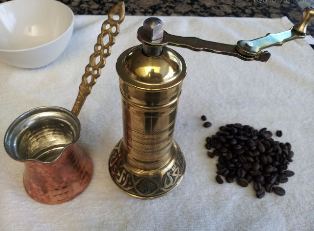
Turkish coffee needs a grind finer than any other brewing method, a powder closer to flour than to the gritty grounds an espresso machine takes. The tool built for that job is the Turkish coffee grinder, the tall brass hand mill called a kahve değirmeni. This guide explains how it works, why the grind has to be so fine, how the hand mill compares with electric grinders, and what to look for when you buy one.
The classic Turkish mill
The traditional grinder is a slim brass cylinder that sits in the palm, with a folding crank on top and a small drawer at the base.
- The body. A cylindrical brass case, often engraved, holds the works and doubles as a handsome object on a shelf.
- The burr. Inside sits a conical steel burr that crushes the beans rather than chopping them, which is what produces an even powder.
- The adjustment. A nut under the crank sets how tightly the burr sits, and tightening it all the way gives the flour-fine grind Turkish coffee demands.
- The drawer. Ground coffee collects in a pull-out compartment at the bottom, ready to spoon into the cezve.
Why the grind has to be powder-fine
Turkish coffee is brewed unfiltered, so the grounds stay in the pot and the cup. For the coffee to release its flavour in a few short minutes and then settle cleanly, the particles have to be extremely small. A coarse grind brews weak and leaves a gritty mouthful. The conical burr of a Turkish mill can be closed far tighter than a kitchen grinder, which is why it reaches a fineness that blade grinders and most burr machines never manage. A blade grinder, which chops unevenly, cannot do it at all.
Hand mill or electric grinder
- The hand mill. A brass değirmeni gives total control over fineness, needs no power, lasts for generations and looks the part on the counter. The trade-off is effort, since grinding enough for several cups takes a few minutes of cranking.
- Electric Turkish grinders. Purpose-built electric grinders now reach the same fineness with a motor, which suits anyone making coffee daily or in quantity. Look for one rated specifically for Turkish or ibrik grind, as a general espresso grinder will not go fine enough.
- The verdict. For ritual, display and small batches the hand mill wins. For speed and volume an electric Turkish grinder makes sense, as long as it reaches a true powder.
Using and maintaining a hand grinder
- Set the fineness. Tighten the adjustment nut close to the limit, grind a little, and check it feels like flour before committing a full batch.
- Grind fresh. Grind just what you need for the pot, since powder-fine coffee stales fast.
- Keep it dry. High humidity builds static and clogs the works. Tap the drawer and brush the burr clean rather than washing it.
- Store empty. Leaving oily grounds inside over time can taint the next batch.
Antique and decorative grinders
Old Ottoman brass mills are sought-after pieces, often hand-engraved and passed down as heirlooms. Many sold today are decorative reproductions, so a genuine antique is worth checking for a working burr and honest wear rather than buying for looks alone. The coppersmith and metalwork bazaars of Gaziantep, Mardin and Istanbul still turn out both useful and ornamental mills.
Choosing a Turkish coffee grinder
- Burr quality. A solid steel conical burr that closes down to a flour-fine grind is the part that matters most.
- Build. Heavier brass with a firm crank grinds more smoothly than thin, light cases.
- Size. A standard hand mill holds enough for a couple of cups per fill, which is fine for home use.
- Honesty of purpose. If you want one to use, buy for the mechanism. If you want one to display, accept that many decorative mills grind poorly.
Before the mill: how coffee was ground
The hand mill is not the oldest way Turks made the grind. For generations coffee was pounded by hand in a heavy stone or wooden mortar called a dibek, often a large communal one in the village or neighbourhood, where roasted beans were crushed to powder with a long pestle. Dibek coffee is still sold as a style today, prized for the slightly oilier, denser cup that pounding gives. The dibek was carved by hand from wood, marble or stone, while the smaller mortar kept for spices, the havan, was cast in bronze. The brass cylinder mill arrived as the household version of that work, putting a fine, repeatable grind within reach of a single kitchen. Turkish mills came in two forms, the handheld el değirmeni and a larger standing yer değirmeni, most of them turned from brass.
Where the Turkish grind sits
It helps to place the grind next to other brewing methods.
- Coarse suits a French press, where big particles steep in water.
- Medium suits drip and filter brewing.
- Fine suits espresso, where pressure pushes water through quickly.
- Powder, finer still, is Turkish coffee, where the grounds all but dissolve and stay in the cup. It is the finest grind in everyday coffee, which is why ordinary machines stop short of it.
Setting and testing the grind
On a hand mill the fineness is set by a nut beneath the crank. Turn it to tighten the burr, grind a teaspoon, and rub it between your fingers. If you feel separate grains it is still too coarse, so tighten further and test again. Aim for the feel of flour. Once it is right the setting stays put, so you only check it when the cup starts tasting thin or gritty.
Caring for a brass mill
- Brush, do not wash. Water rusts the steel burr and clogs the works, so empty the drawer and brush out the grounds instead.
- Beat static. In dry or humid air the powder clings and cakes. Tap the body and drawer to shake it loose.
- Grind to order. Leaving oily powder inside between uses stales the next batch, so grind only what the pot needs.
- Oil the crank. A drop of food-safe oil on the spindle keeps an old mill turning smoothly for decades.
Common grinding problems
- Grind feels gritty. The burr is set too loose. Tighten the adjustment nut and test a pinch between your fingers until it feels like flour.
- Crank turns hard. You are taking too many beans at once, or the spindle wants a drop of food-safe oil. Grind in smaller loads.
- Powder cakes and clings. Static from dry or humid air. Tap the body and the drawer to shake it free.
- Uneven grind. A worn or cheap burr. A solid conical steel burr is the part worth paying for.
The grinder is one of three tools that make the cup. Pair it with the right beans and roast, brew in a proper copper cezve, and follow the full guide to how to make Turkish coffee.
Frequently asked questions
What is a Turkish coffee grinder called?
A kahve değirmeni. The classic form is a tall brass hand mill with a conical burr, a crank on top and a drawer at the base.
Why does Turkish coffee need a special grinder?
Because the grind must be finer than espresso, almost a powder. A Turkish mill closes its burr far tighter than ordinary grinders, which cannot reach that fineness.
Can I use a regular coffee grinder?
Only if it is a burr grinder that can be set to a powder fineness, which is rare. Blade grinders chop unevenly and cannot produce a proper Turkish grind.
Is a hand grinder better than electric?
A hand mill offers control, longevity and looks for small batches. A purpose-built electric Turkish grinder is better for speed and volume, provided it grinds to true powder.
How fine should the grind be?
Like flour or cocoa powder. If you can feel distinct grains between your fingers, it is still too coarse for Turkish coffee.
How long does hand-grinding take?
Enough coffee for two cups takes a couple of minutes of steady cranking. Many enjoy it as part of the ritual, but anyone grinding daily or in volume may prefer a purpose-built electric Turkish grinder.
Can an antique mill still be used every day?
Yes, if the burr is sound and the crank turns freely. A genuine old brass mill with an intact burr often grinds better than a thin decorative reproduction, so check the mechanism before buying one to use.
Should I clean the mill between uses?
Brush it out rather than wash it. A quick brush of the burr and a tap of the drawer is enough day to day, and you only strip it down for a deeper clean if the grind starts tasting stale.
Are electric Turkish grinders worth buying?
For daily or high-volume brewing, yes, as long as the model is rated for Turkish or ibrik fineness rather than espresso. For a cup or two with a sense of ritual, a brass hand mill is the classic and longer-lasting choice.
Sources
- Turkish coffee – grind and preparation
- Kurukahveci Mehmet Efendi – on the fine grind
- UNESCO – Turkish coffee culture and tradition